

Streaming And Gaming Are In The Same Fight Now... And Free, Ad-Supported Content Is The Answer To Both

Follow me here… or on LinkedIn
Welcome back to Patch Notes. It is May, somehow, which means we are weeks out from the noisiest stretch of the gaming calendar. Summer Game Fest kicks off in early June, and with it comes the avalanche... new trailers, release dates, surprise reveals, and the inevitable wave of “news” around the games we already knew about. GTA VI sits at the center of all of it. Most of the fall slate is going to get fresh oxygen between SGF and the Xbox showcase and whatever Sony decides to do this year. The data is about to get loud.

Before that happens... a quick housekeeping note. We are wrapping up our latest quarterly report at mindGAME, and it is shaping up to be one of the more useful ones we have produced. If you want a look, or want to chat about how the data could plug into your team’s planning before SGF chaos hits, DM me. Happy to walk through it.
I will also be at GamesBeat Summit 2026 in LA on May 18th and 19th. LA based, so I will be on the ground both days. If you are flying in, if you are local, if you just want coffee... reach out. Same goes for SGF and the events orbiting it in early June. I know it feels insanely early to plan SGF, but the calendar is the calendar and the good meetings get booked first. Let me know either way. The best part of doing this newsletter is the people, and the next six weeks are when most of the industry is in the same zip code at the same time. Worth the effort.
Alright. Let’s get into it.
Ubisoft Showed The Game... And The Numbers Moved
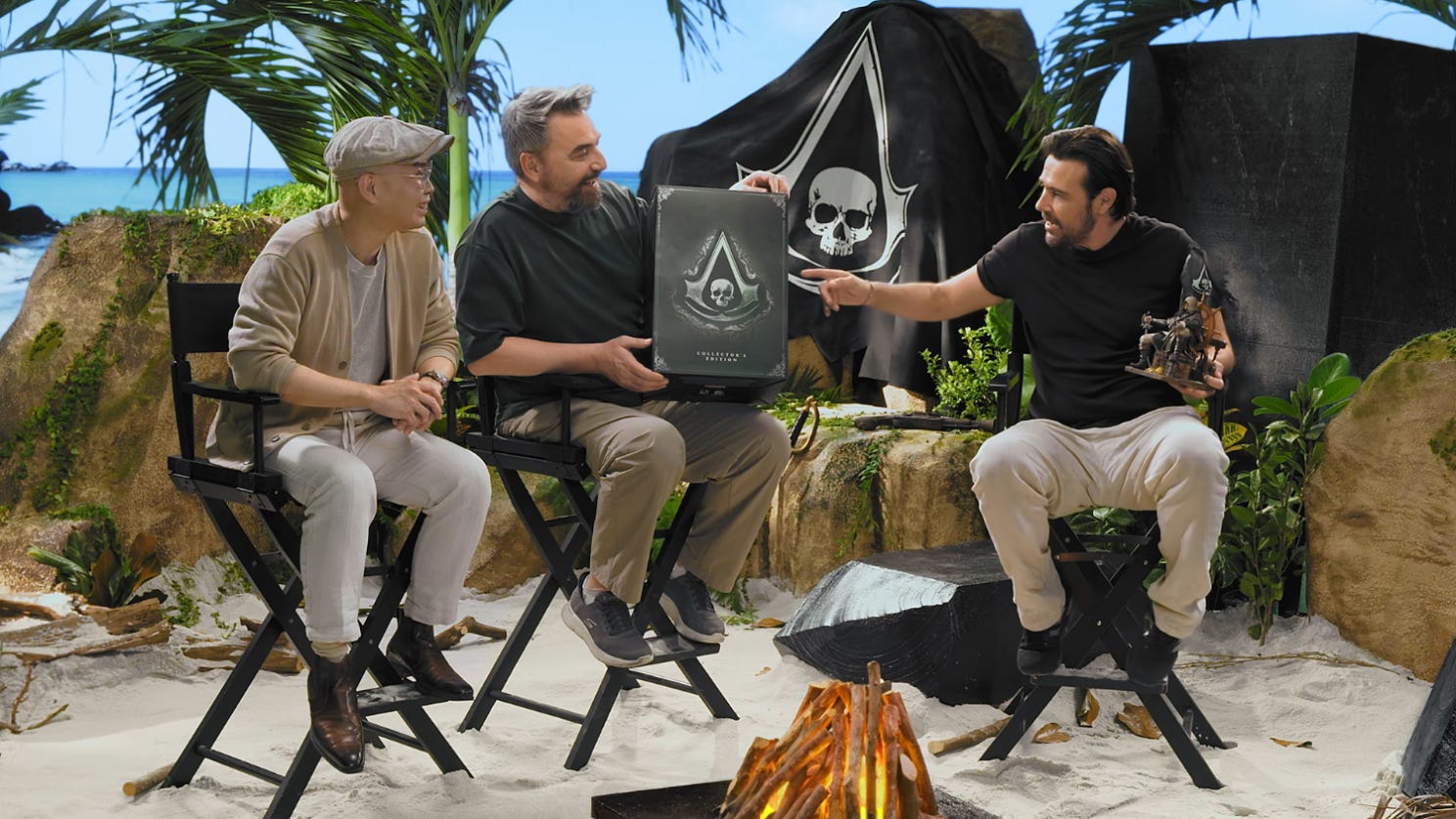
I led last week’s piece with my fears about Assassin’s Creed Black Flag Resynced. The data was telling a story I did not want to hear. At twelve weeks out the game was sitting at 0.124% cumulative mindSHARE, and I called the gap to Valhalla a canyon. I was not being dramatic. The numbers said what they said.
Then Ubisoft held the worldwide reveal showcase on April 23rd, and the canyon got a little smaller.
What Singapore Actually Built

Let’s set the table. Black Flag Resynced is being developed primarily by Ubisoft Singapore, and the lineage on this matters more than the press release suggests. Singapore was a key co-developer on the original 2013 Black Flag, specifically the studio that built the naval and ocean tech people fell in love with. That same tech became the foundation for Skull & Bones, which started life as a Black Flag multiplayer expansion in 2013 before getting spun out into a standalone game that took over a decade to ship. Now Singapore is back making a faithful remake of the original game they helped build, with many of the original developers returning... the loop closes. From IGN’s coverage of the showcase, the framing from Ubisoft was deliberate:
“With Resynced, we made a clear choice. It is a pure, story-driven adventure, and we are fully focused on Edward’s adventures in the Caribbean. As a result of this focus, we have elected to not have the multiplayer, or the DLC.” — Paul Fu, Resynced Creative Director, via IGN, April 23, 2026
No DLC. No multiplayer. No live-service hooks. Edward Kenway’s story, full stop. The game director put a finer point on it:
“This remains a solo adventure and character-driven experience. It is not an RPG. The focus stays on how you play, and how you explore the world.” — Richard Knight, Game Director, via IGN, April 23, 2026
Read that quote twice. “It is not an RPG.” That single sentence is the most important thing Ubisoft said all day. After Valhalla, Mirage, and Shadows, the franchise had been bloated into a 200-hour open-world skill-tree machine that lost what made the early entries actually fun. Resynced is publicly walking that back. Matt Ryan is back as Edward with new dialogue. Grammy-nominated artist Woodkid is doing the soundtrack, including 10 new sea shanties. Original Black Flag scribe Darby McDevitt wrote new scenes between Edward and his wife Caroline. Three new recruitable officers join the Jackdaw with their own questlines. Blackbeard and Stede Bonnet get expanded arcs. Cat or monkey pet on the ship.

The quality-of-life improvements are where the real work shows up. Combat has been rebuilt around parries and takedowns. The notorious tailing missions, the most universally hated part of the original, no longer instantly fail when you get spotted... you transition to combat instead. Manual crouch is in. Free jumps, side ejects, back ejects. Loading screens are gone. As Kotaku put it in their side-by-side comparison piece... this is what Black Flag looked like in your brain before you saw the remake. The visuals are not the headline. The headline is that all the things players complained about for thirteen years are gone, and the things people loved are still there.
The most important framing came from outside Ubisoft though. Reuters covered the reveal under a headline that tells you exactly how much is riding on this:
“Assassin’s Creed maker Ubisoft bets on ‘Black Flag’ remake to turn its ship around.” — Leo Marchandon, Reuters, April 23, 2026
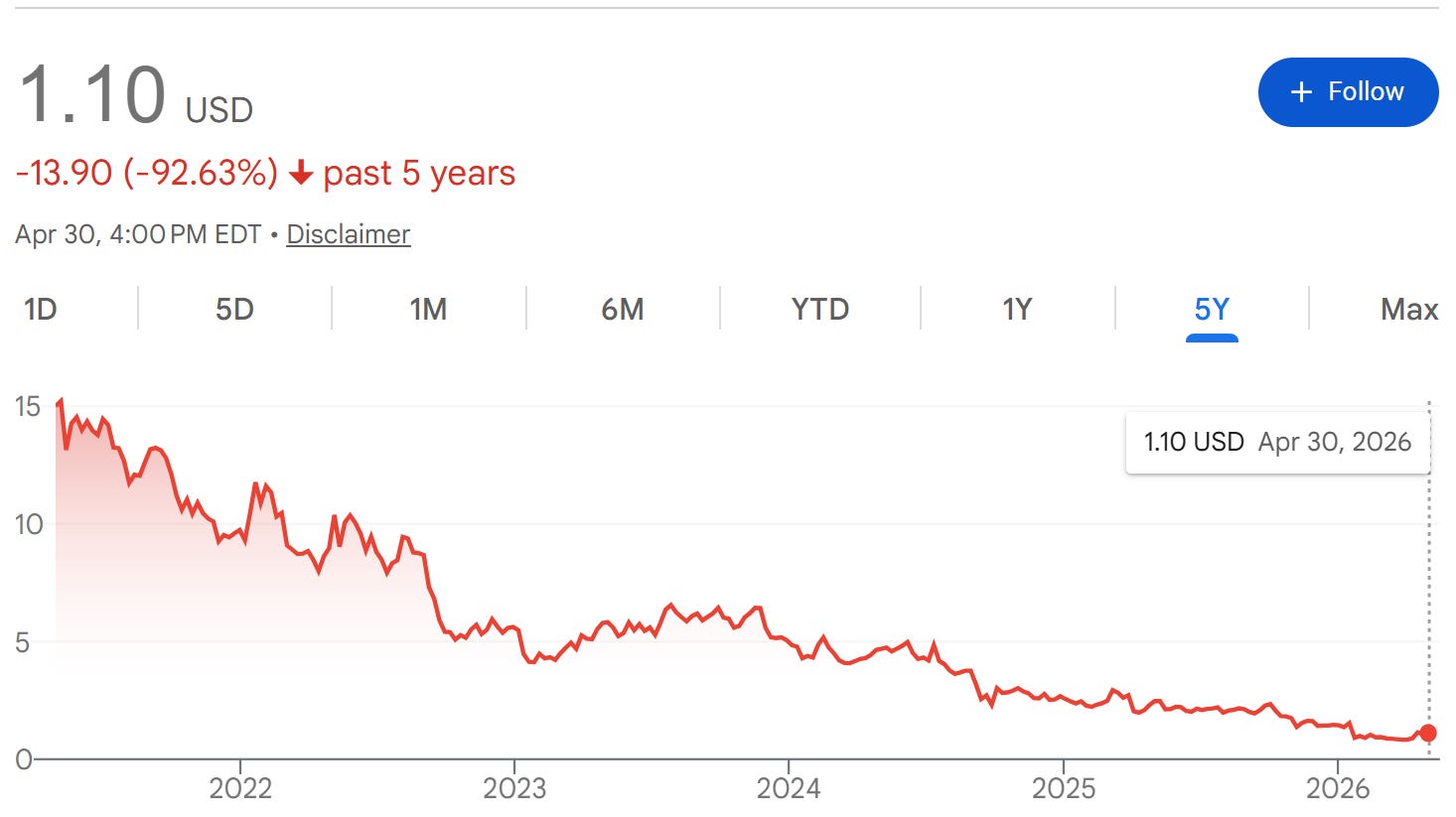
That is not subtle. Reuters laid the financial picture out plainly. Ubisoft’s market cap has collapsed 93% from its 2018 peak of more than €12 billion. The company is expecting a €1 billion operating loss in 2026, driven by the cancellation of six games and a €650 million write-down. Black Flag Resynced is the first major release since Ubisoft’s profit warning in January, when CEO Yves Guillemot put the picture in writing:
“Today’s market environment requires that the Group step-changes how it is organized and operates. The portfolio refocus will have a significant impact on the Group’s short-term financial trajectory, particularly in fiscal years 2026 and 2027, but this reset will strengthen the Group and enable it to renew with sustainable growth and robust cash generation.” — Yves Guillemot, Ubisoft Founder and CEO, January 21, 2026
Translation... 2026 and 2027 are going to hurt. Black Flag Resynced is the first thing Ubisoft is shipping into that hurt. Analyst Corentin Marty at TP ICAP Midcap put the stakes in plainer terms:
“If the showcase succeeds, I think a positive market reaction is likely. But they can’t afford to disappoint.” — Corentin Marty, TP ICAP Midcap, via Reuters, April 23, 2026
Reuters did one more thing in that piece worth flagging. They drew the comparison directly to Capcom‘s Resident Evil revival as the playbook Ubisoft is reaching for. I made the same comparison earlier this year in my Capcom Q1 piece, where I wrote about how Capcom turned the calendar window into a repeatable advantage by showing up early, showing up loud, and doing it when the rest of the industry is still warming up. Capcom has now booked 12 consecutive years of operating profit growth and grown its market cap nearly 1,200% over a decade. That is the model Ubisoft is openly trying to reverse-engineer. I believe in the model. I am less certain Ubisoft has the discipline to execute it... but Black Flag Resynced is the first real test.
The Reveal Moved The Needle. A Lot.
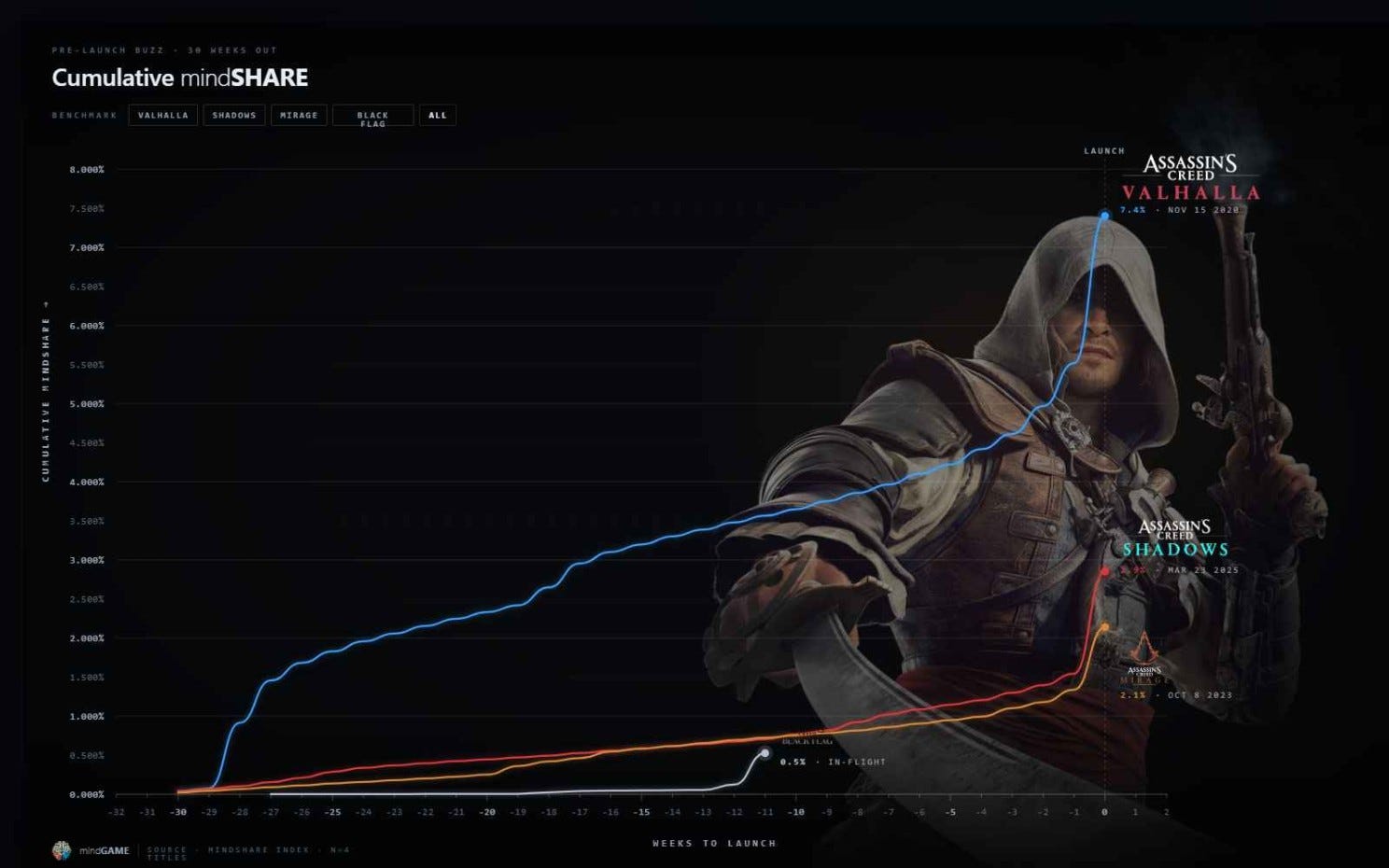
In a single week post-event, Black Flag Resynced’s cumulative mindSHARE jumped from 0.124% to 0.526%, more than 4x the prior week. Weekly Google search volume went from 24,000 to 1.9 million, roughly an 80x lift. The mindSHARE rank vaulted from outside the top 200 to #38. Week-over-week growth on the cume came in over 325%. This is what an event reveal is supposed to do, and Ubisoft delivered.
So where does that put it in the broader Assassin’s Creed story?
At a clean apples-to-apples comparison... eleven weeks out from launch... here is how the franchise stacks up in our system:
Assassin’s Creed Valhalla: 3.56% cumulative mindSHARE
Assassin’s Creed Mirage: 0.72%
Assassin’s Creed Shadows: 0.70%
Assassin’s Creed Black Flag Resynced: 0.53%
A few things worth saying about that table.
Mirage was, fundamentally, a glorified Valhalla DLC. The project started its development life as exactly that... an expansion to Valhalla... before Ubisoft repositioned it as a standalone title. Mirage’s protagonist Basim was a supporting character in Valhalla, and however interesting his backstory, he was never going to draw the audience that Eivor drew. Sitting at 0.72% reflects that ceiling. Mirage was a smaller-scope project for a smaller-scope audience, and it performed accordingly.
Shadows is a different story. From the moment of the reveal in May 2024, the game became one of the most controversial launches in the franchise’s history. Petitions calling for its cancellation. Repeated delays totaling more than $20 million. Marketing reworks. Public apologies for cultural insensitivity. Months of debate over Yasuke as a dual protagonist alongside Naoe. Sitting at 0.70% at week -11 reflects a campaign that never quite got the air it needed... and the post-launch performance fell short of Ubisoft’s expectations for what a mainline AC release in a marquee setting should deliver.
Black Flag Resynced is now within striking distance of both, with a slope coming out of the reveal that suggests it can clear them by launch. That is the meaningful win. Beating Mirage and Shadows is a real signal that the back-to-basics, faithful-remake, “no Animus tower bloat” approach to Assassin’s Creed has an audience. Players want pirates. People want Edward. We want sword fights and naval combat and sea shanties... not a 200-hour RPG sandbox.
Now for the harder part.
Will It Catch Valhalla? Probably Not.
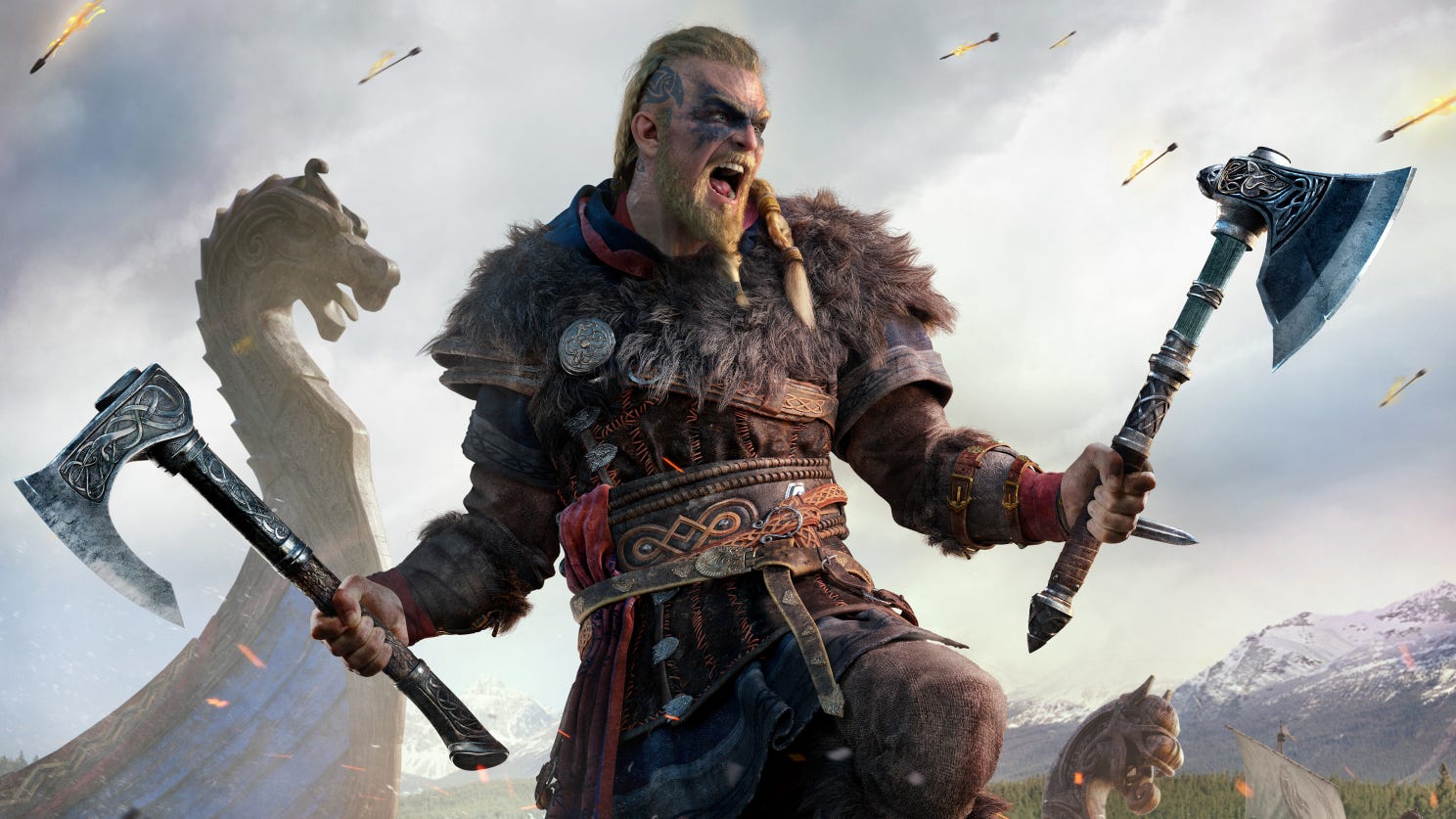
Valhalla at week -11 was at 3.56% cumulative mindSHARE. Black Flag Resynced is at 0.53%. That is roughly a 7x gap, which is not a gap that closes inside eleven weeks no matter how strong the SGF beat is. Valhalla is the best-selling Assassin’s Creed of all time, an estimated 25 million units sold and the first AC title to clear $1 billion in revenue. Catching that number from where Black Flag sits today would require something close to a cultural moment, not just a competent campaign. The path is hard to see on a remake of a 13-year-old game.
But here’s the question that actually matters... is catching Valhalla even the goal?
If Black Flag Resynced clears Mirage and Shadows... if it stabilizes Ubisoft’s first major release post-profit-warning... if it proves the audience for back-to-basics, story-driven, no-RPG-bloat Assassin’s Creed is real... then Black Flag does something more important than beating a unit-sales record. It draws the framework for what comes next. The Ezio Trilogy remake conversation gets louder. Assassin’s Creed II as a rebuild stops being a fan rumor and starts being a fundable project. Ubisoft, the way Capcom did with Resident Evil, gets a repeatable Q3 calendar play built around remakes of titles fans have been asking to revisit for a decade.
So could Black Flag catch Valhalla? Probably not. Could it set the framework for what Assassin’s Creed should do for the next five years? One thousand percent.
And Then There’s The Calendar
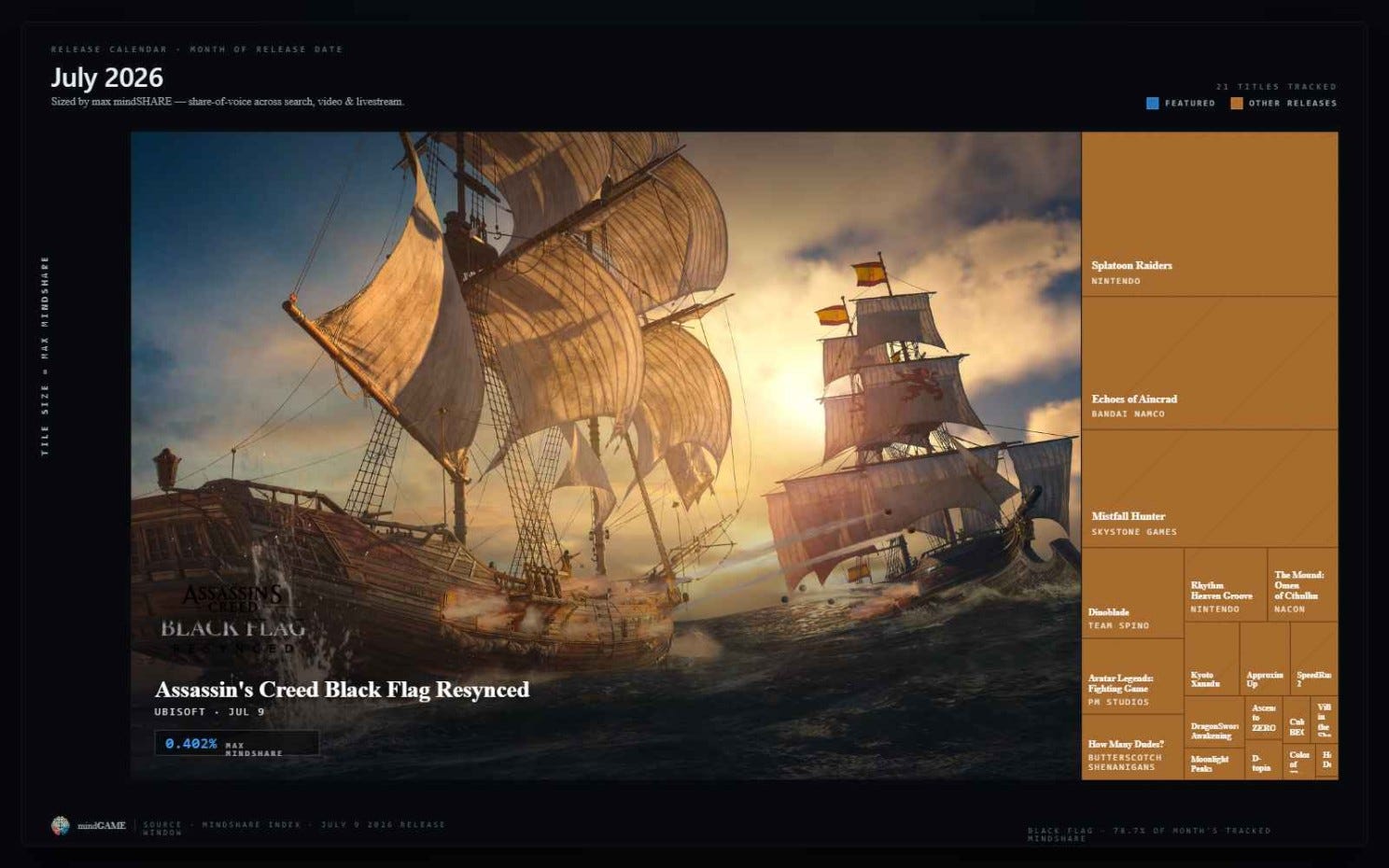
The other piece of this story is that Ubisoft cleared the runway. Black Flag Resynced is going to own July, and it isn’t close.
Across every game tracked in our system launching in July 2026, Black Flag Resynced sits at 0.526% cumulative mindSHARE. Next closest on the list is Echoes of Aincrad from Bandai Namco Entertainment America Inc. at 0.072%, a niche anime-IP action RPG launching the same day. Nintendo‘s Splatoon Raiders, the only other meaningful tentpole on the slate, sits at 0.050%, in a completely different audience lane on Switch 2. Black Flag is roughly 10x ahead of Splatoon and 7x ahead of Echoes of Aincrad in cume mindSHARE at this stage. Everything else launching in July is mid-tier or indie.
This is the smart calendar play. Going before SGF, sticking the landing in a month where no one else is fighting for AAA mindshare, gives the campaign room to compound. The parallel to Capcom is what’s worth watching here. Capcom remade Resident Evil 2, then 3, then 4, then 4 again with VR... and used those projects to rebuild a franchise that had drifted from its core audience. Maybe Ubisoft looks to “own” July going forward. If that’s the strategy, it isn’t necessarily the worst one. Assassin’s Creed II, Brotherhood, Revelations are all sitting right there. The Ezio trilogy is the obvious next move.
One Concern. Ubisoft Needs To Show Up At SGF.
Here’s the soft spot in the strategy. Ubisoft Forward did not happen in 2025, and there’s been no announcement of a 2026 Forward either. The risk of doing the direct now versus later in the summer is that Ubisoft could get drowned out by the noise of SGF... GTA VI, Forza Horizon 6, Halo: Campaign Evolved, whatever Sony and Microsoft bring to their showcases.
That said, I’m hopeful Ubisoft shows more of the game at one of the events around SGF week... the main show, the Xbox showcase, a PlayStation State of Play, IGN Live, PC Gaming Show. They probably aren’t doing their own Forward this year. Maybe they will. Either way, Black Flag needs a second wave of beats during the loudest gaming week of the year, or the reveal momentum is going to dissipate before launch.
Am I More Or Less Excited A Week Later?
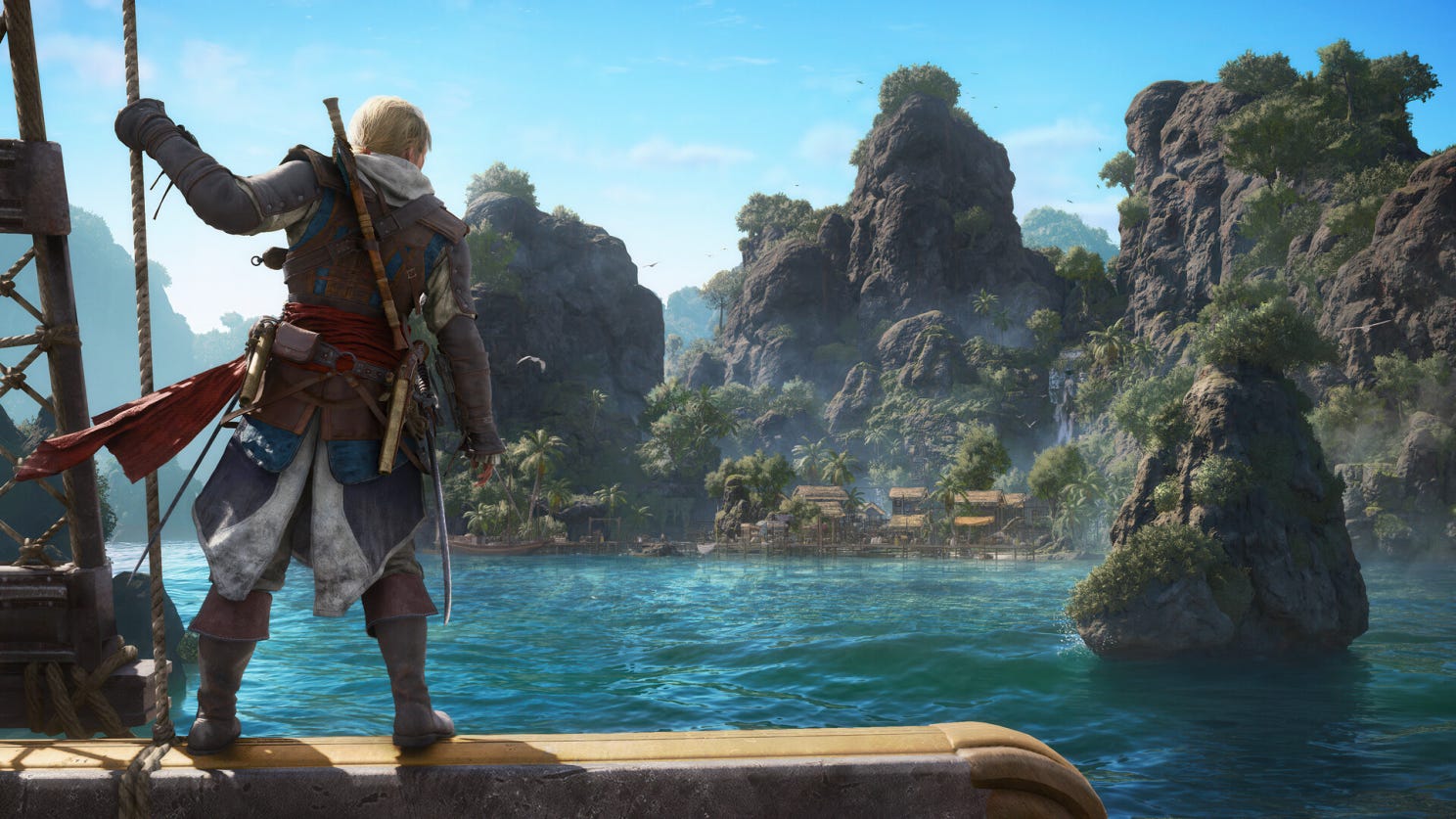
Genuinely warmer to it.
The reveal was strong. Combat showcase looked confident, not bloated. Edward Kenway is back. Matt Ryan is back. Naval combat looked like the naval combat I remember. Stede Bonnet getting a real arc. Blackbeard expanded. Ubisoft Singapore appears to actually understand what the audience wants, not what an internal pitch deck says the audience should want.
My fear from last week was that Ubisoft would over-engineer this thing into something it was never meant to be... a bloated open-world RPG with skill trees and crafting systems and live-service hooks. The reveal did not fully eliminate that fear, but it put a meaningful downpayment on it. Resynced’s “no DLC, no multiplayer, story-driven adventure” framing is the right framing. Ship it that way.
Ubisoft has a chance here. They cleared the calendar. The reveal worked. Data moved. The financial pressure is real, the analyst commentary is real, the Capcom-comparison framing in Reuters is real, and the “we cannot afford to disappoint” line is going to follow this game until July 9th.
I am interested. Let’s say that.
Meanwhile, On The Couch... Disney+ Is Cooking

Pivoting from gaming for a second. Going to spend some time on streaming because there’s a thread here that I want to walk through, and the easiest way to get there is by talking about what I’m actually watching at home right now.
Real talk upfront. Disney+ is the platform getting the most run in my house these days, and a lot of that is because I have kids. My son is deep into Clone Wars right now, working through the back catalog one episode at a time. My daughter is obsessed with Mira, Royal Detective, which if you don’t have small kids in your house, is a Disney Junior animated mystery series set in a fictional India-inspired kingdom that I now know an embarrassing amount about. So Disney+ has a structural advantage in my house that the other platforms simply don’t have.
For my own viewing, I bounce around. Max, Apple TV+, Netflix, and Paramount+ all rotate through depending on the show. But Disney+ has been running rent-free in our must-watch TV slot Monday and Tuesday nights for the past month, and that’s the part worth digging into. Two shows are responsible.
Bear with me here. I’m going to talk about Star Wars and Daredevil for a few minutes before this loops back to where I’m trying to take this piece. There is a real throughline. Promise. Stay with me.
Maul: Shadow Lord
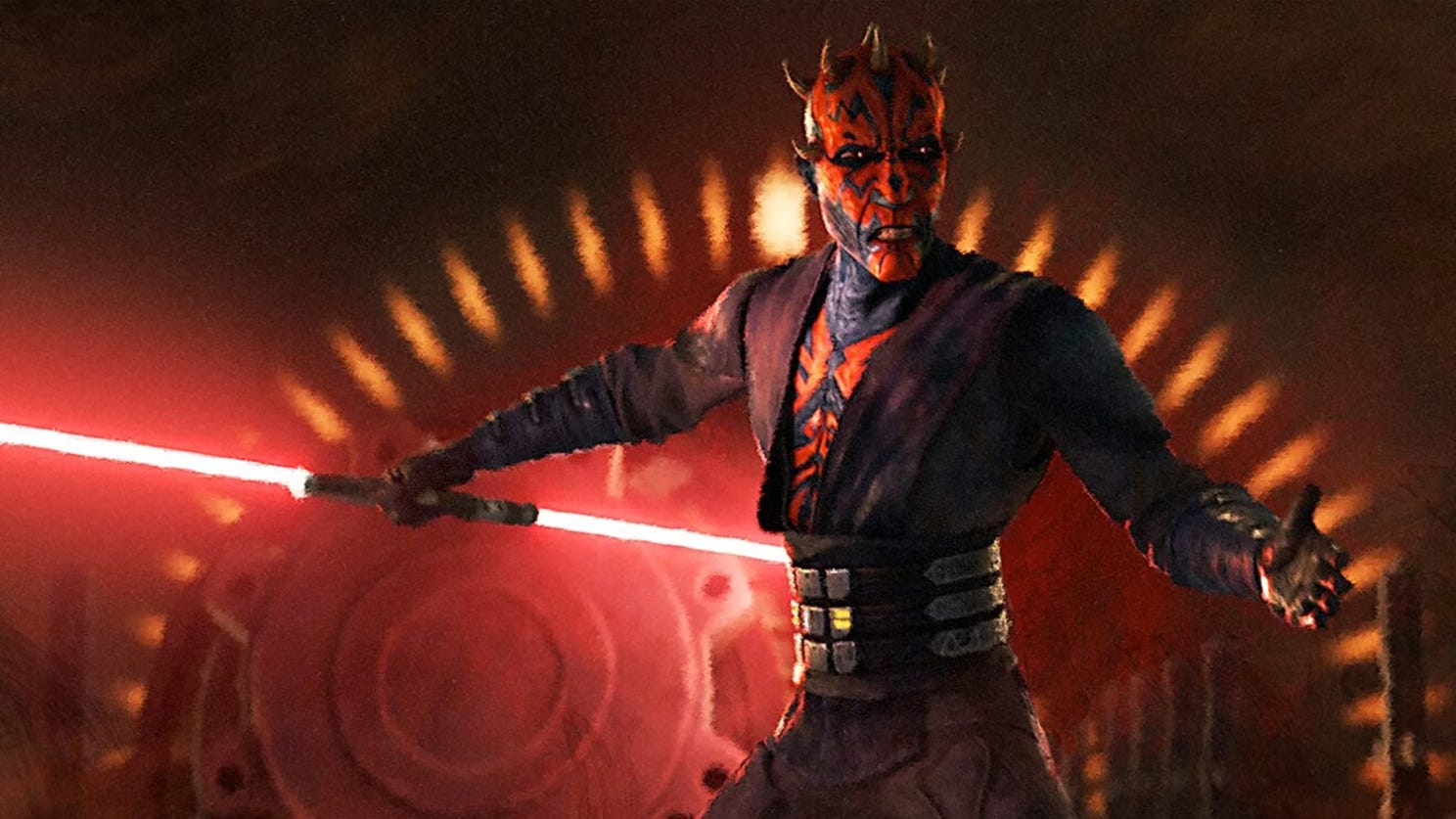
Quick personal disclosure first, because anyone who reads this newsletter knows it... I am a Star Wars junkie. Have been my whole life. The originals are sacred. The prequels I’ve grown warmer to over time, almost entirely because of Dave Filoni and what he built across Clone Wars, Rebels, Bad Batch, Ahsoka, and now this one. The sequels I genuinely hate. I have not made peace with them and honestly do not know if I ever will. Maybe one day. Not today. Moving on.
Maul: Shadow Lord is the most fully formed Filoni show on arrival. My usual take on his animated work is that it takes a season or two to find its gear. Clone Wars season one is rough. Rebels season one is rough. They are introductory by design, because the broader Star Wars animated universe is built to bring kids in first and reward adults later. Once those shows hit, they really hit. Mortis. The Siege of Mandalore. Twilight of the Apprentice. Some of the best storytelling in the franchise lives there. But you have to get through the table-setting to get to it.
Shadow Lord is different. Shot out of a cannon. Episode one is already operating at the level Filoni’s other shows do not reach until season three. Animation is more aggressive, more painterly, more stylized. The story is denser. Character work is sharper. Sam Witwer has been voicing Maul since 2012 and this might be his best performance in the role. The show fills in everything the movies never had room for, beyond the cinematic version of I hate everyone, I look incredible, I do cartwheels, and I get sliced in half.
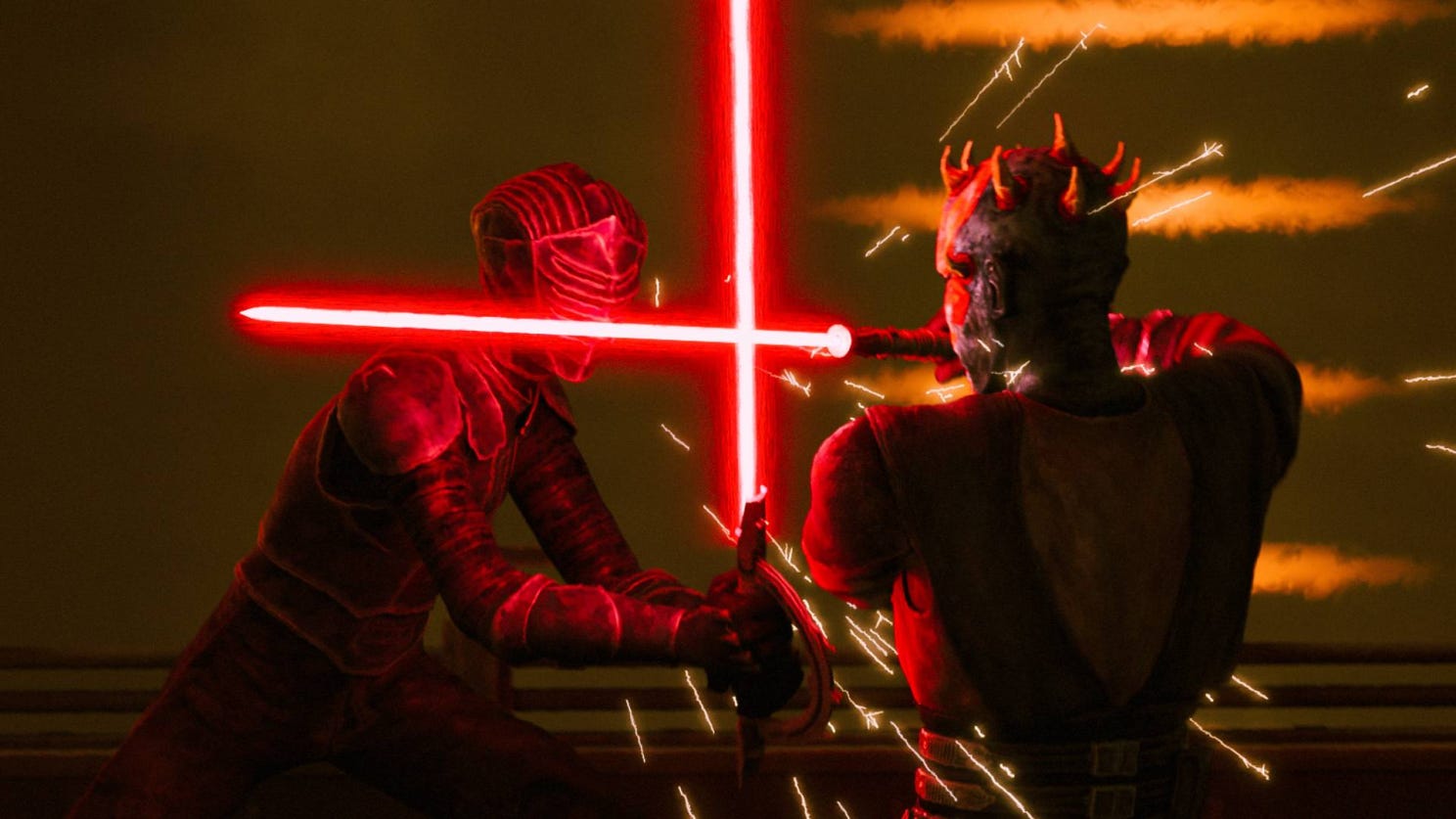
The reason any of this exists is that George Lucas refused to let Maul stay dead. Filoni told the story at Star Wars Celebration:
“We would be in a story meeting, and [Lucas] would often say stuff like, ‘I’ve got an idea and you’re gonna love it.’ And I thought, ‘Ohhhhh, that so seldom lines up.’ Then he said, ‘We’re bringing Darth Maul back,’ and I said, ‘Really?’” — Dave Filoni, Star Wars Celebration 2017
Lucas himself had been clearer about it in an Empire interview years prior... “I had to cut him in half to say that this guy’s gone, he’s history, he ain’t coming back.” And then a decade after that, he turned to Filoni and said figure it out. And Filoni did. The season one finale drops on May the 4th, which is an absurd bit of programming, and a second season has already been ordered.
Watch it. Whatever your relationship to Star Wars is, watch it.
Daredevil: Born Again Season 2
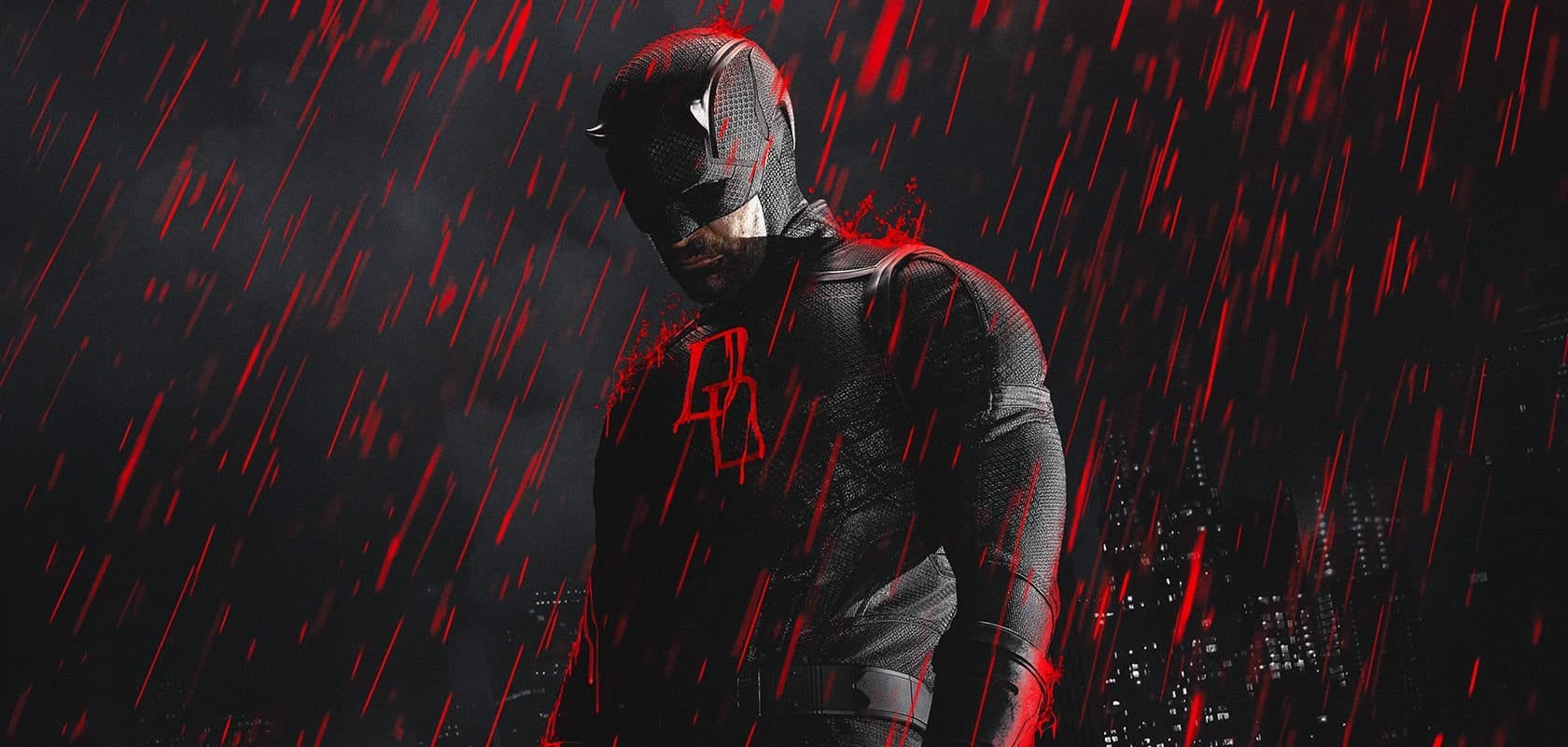
The other show keeping Disney+ in heavy rotation is Daredevil: Born Again Season 2. I would not call it the best MCU show on Disney+, but it is the latest signal that Marvel’s TV strategy has finally found its footing. The lesson the studio seems to be internalizing is the right one... TV content does not have to please everyone. You are not making a $1 billion theatrical product that needs to land with global four-quadrant audiences. You are making something smaller, weirder, more adult, more niche. Agatha All Along can be an oddball detour. Daredevil can be a pulpy, grounded crime drama. Loki can be a metaphysical sci-fi auteur project. The TV side has the freedom to have a voice that does not need to flatten itself to a mass audience, and Marvel is finally letting that freedom show up on screen. More of this. Not less.
Now here’s the conversation that has been impossible to avoid this week. Per Luminate data published by ComicBook, Season 2’s first five episodes pulled 4.5 million views, down 46% from Season 1’s 8.3 million at the same point. Hours watched dropped 54%, from 24 million to 10.8 million. Critics and fans agree Season 2 is significantly better. The numbers don’t reflect that, and the pundit class across social, especially the people who cover the media industry for a living, has spent the better part of the week panicking about it.
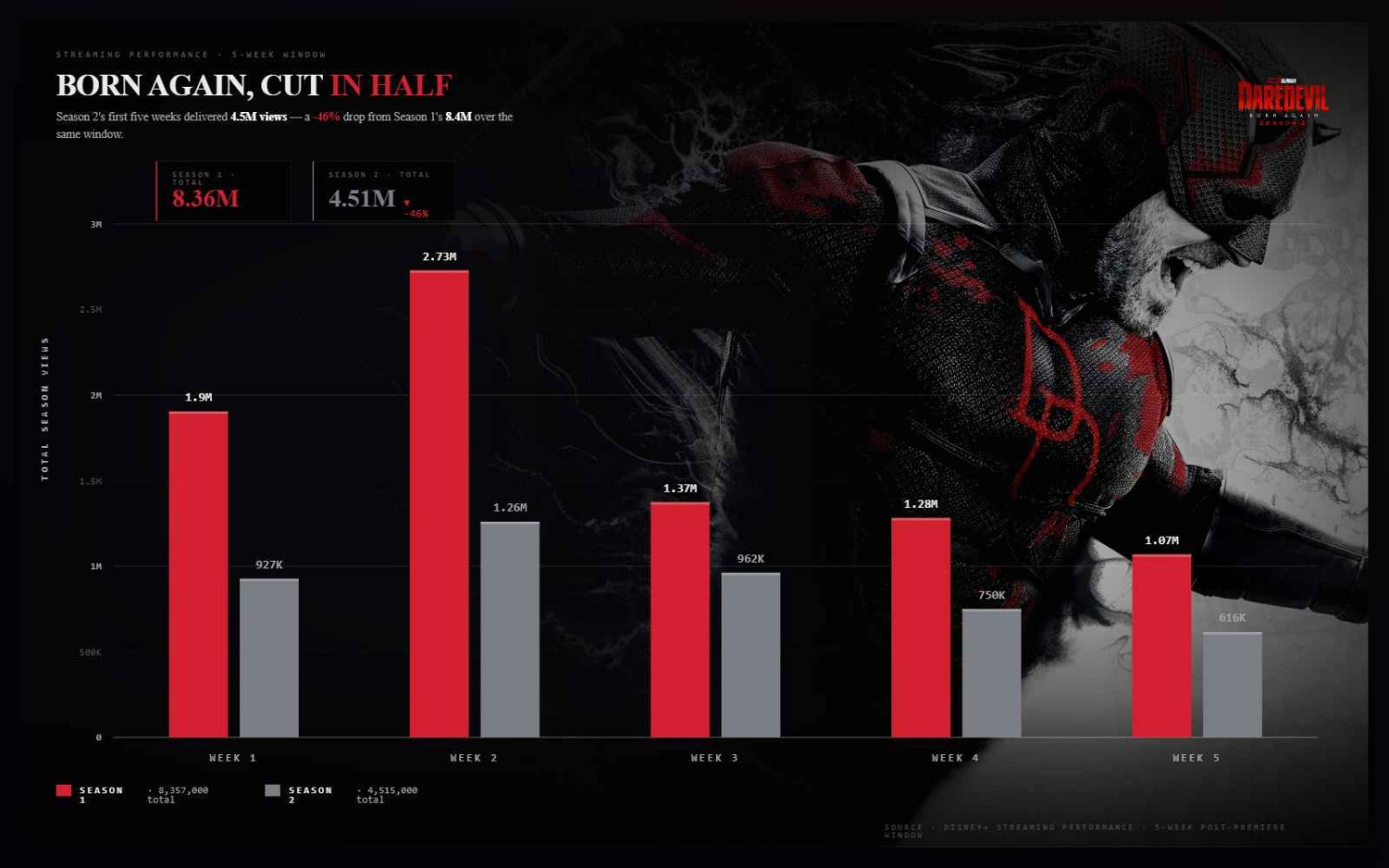
I posted about this on LinkedIn earlier in the week and the thread has run hot since. The short version of my argument is this. Season 1 had a massive novelty tailwind. Daredevil was properly back after years of cameos, Marvel made the Netflix series canon, and that one-time gravitational pull was never repeating in Season 2. Marketing was nearly invisible. I live in LA, I pay for ad-free experiences across the board, so I’ll own that caveat... but I genuinely cannot remember seeing any marketing for Season 2. Marketing drives viewership. Full stop. If you do not put the show in front of people, they will not find it on their own.
Those two factors together explain part of the drop. They do not explain all of it. And here’s where I want to land the plane on this section, because the biggest point I have been making all week is also the simplest one... the best form of marketing for Daredevil right now would be to put the show out there for free, ad-supported, with no paywall and no signup friction.
Free is the marketing... free is the distribution... free is the audience growth. Disney+ does not have a free tier. Netflix does not have a free tier. Max does not have a free tier. The companies that own the IP people actually want to watch are the only major players in the streaming space without a free entry point, and they are losing the audience-acquisition war to a set of platforms whose entire value proposition is that they cost zero dollars to enter. Daredevil’s viewership story is a symptom. The disease is structural.
So let’s talk about the disease.
The Symptom Is Daredevil... The Disease Is The Whole Streaming Stack
Here’s the part of this conversation that almost nobody in either streaming or gaming wants to admit out loud. The thing every executive at The Walt Disney Company, Netflix, Max, Microsoft, and Sony will tell you on their earnings calls is that their real competition is YouTube and TikTok and Roblox and Fortnite. Reed Hastings has been saying this version of it for half a decade. The most-quoted line came from Netflix’s Q4 2018 letter to shareholders:
“We compete with (and lose to) Fortnite more than HBO. When YouTube went down globally for a few minutes in October, our viewing and signups spiked for that time. There are thousands of competitors in this highly-fragmented market vying to entertain consumers and low barriers to entry for those with great experiences.” — Netflix Q4 2018 Shareholder Letter, January 17, 2019
That letter is more than seven years old. Most CEOs in the streaming and gaming space have echoed some version of the framing since. The argument is settled. Everyone in the industry agrees the real competition is the open free attention surfaces of the internet... and yet, almost nobody is competing on those surfaces’ actual terms.
Yes, I Know Premium Content Costs Money

I don’t want to seem naive about how the content economics work. Premium content costs real money to produce. Disney shelling out $250M+ per Marvel film and Sony spending half a billion on a tentpole game are operating on a fundamentally different cost basis than what powers most of YouTube and TikTok and Twitch, which is user-generated content created at near-zero marginal cost. That comparison is not perfectly clean.
It’s also not as clean as the streaming and gaming industry would like to pretend, because the top of the YouTube ecosystem is not some kid with a camcorder in their bedroom anymore. Mr. Beast is running full-blown production studios. Kai Cenat‘s broadcasts have crew, logistics, and budgets that look more like cable TV than the YouTube of 2008. The line between premium and free on the content side has been blurring for a decade, and the platforms doing the blurring are eating market share from the platforms that haven’t.
Worth saying the same thing on the gaming side. Free has been around in gaming forever. Mobile is a $100B+ business mostly built on free-to-play with ad and IAP monetization, and a small number of companies have made absurd amounts of money there. The catch is that free has not really worked on console and PC the way it has on mobile, for reasons worth coming back to later in this piece. Hold that thought.
The Laws Of Attention
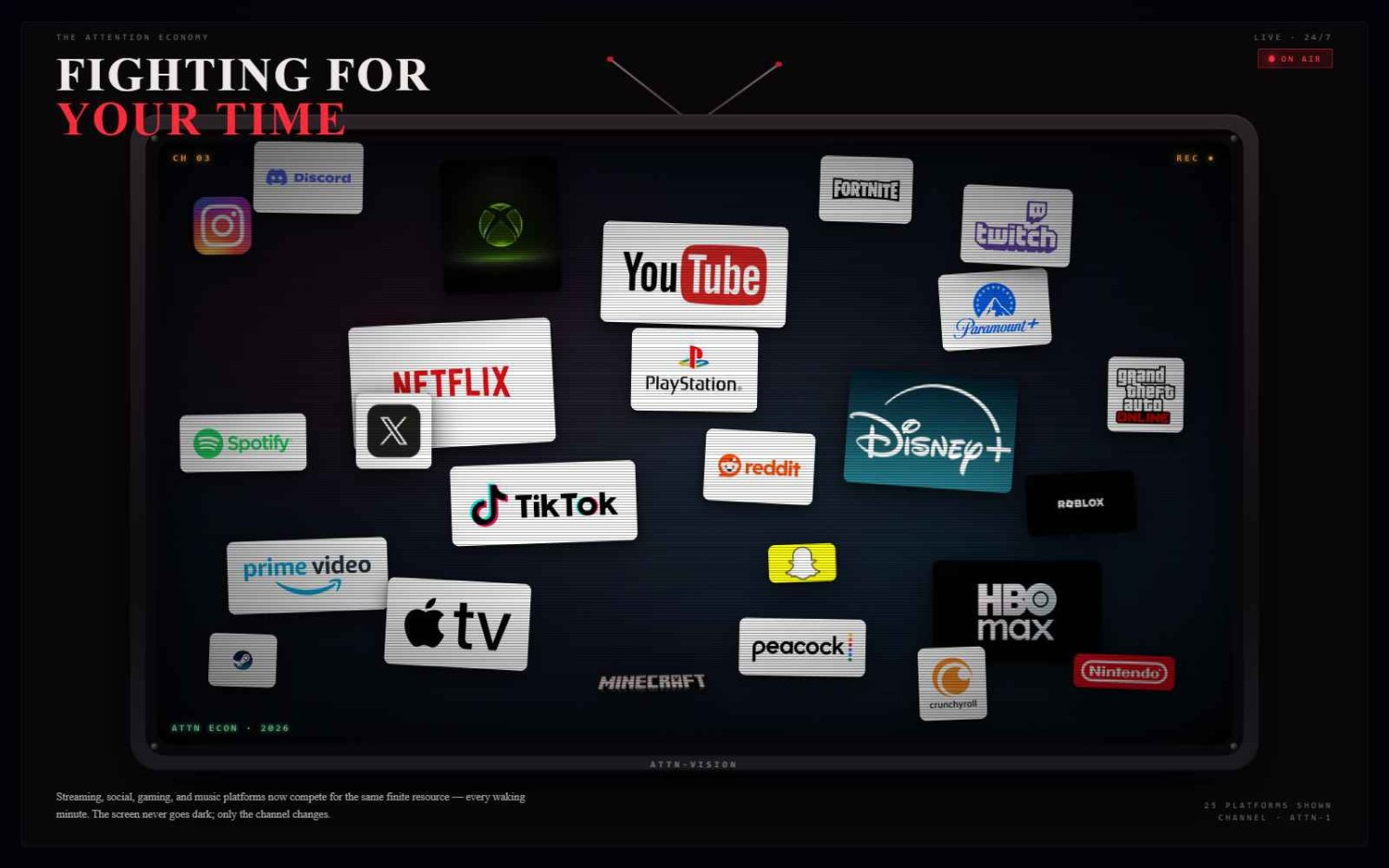
Here’s the framing I keep coming back to, and the one I think gets ignored every time the streaming and gaming industries try to design their pricing tiers.
Attention is the only scarce resource left in media. That is not my insight. Ben Thompson at Stratechery has been hammering this point for the better part of a decade, but he put it most clearly in his April 2022 piece arguing Netflix should sell ads:
“It follows, then, that the most effective business model in the attention economy is advertising: if customers rely on Google or Facebook to navigate the abundance of content that is the result of zero marginal costs, then it is Google and Facebook that are the best-placed to sell effective ads. Notice, though, the trouble this Internet reality presents to Netflix: if content is abundant and attention is scarce, it’s easier to sell attention than content.” — Ben Thompson, Stratechery, April 4, 2022
Read that quote carefully. It’s easier to sell attention than content. The whole streaming and gaming industry is built on the opposite assumption... that the right way to monetize is to package content into a subscription and charge for access. The internet inverted that. Attention is the scarce resource. Content is the abundant one. Sell the scarce thing.
When you internalize that framing, the consumer pricing tier looks completely different than how the industry has been drawing it up. There are not two consumers in this market. There are three.
Going Back To The Disneyland Frame
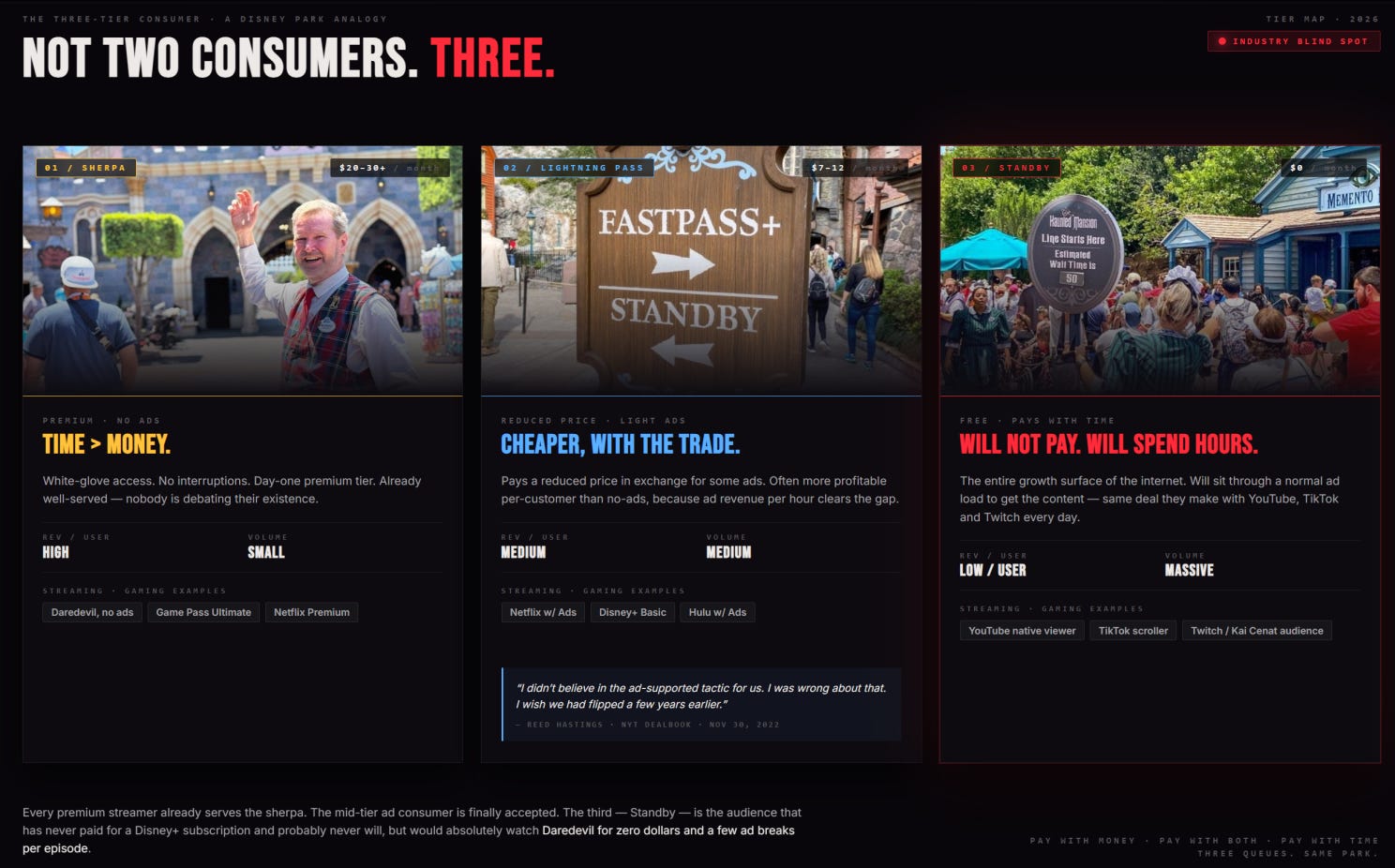
Stay with me, because this is the part that I think the industry refuses to actually sit with. Long-time readers will recognize this framing from last week’s piece, where I used the Disneyland park experience as the analogy for how Xbox should think about its consumer tiers. The frame holds up just as cleanly when you apply it to streaming. There are not two consumers in this market. There are three.
The first consumer is the sherpa. This is the person who pays for the no-ads, premium experience. They want to watch Daredevil with no interruptions. They want Game Pass Ultimate with cloud streaming and day-one releases. They are willing to pay $20 a month, $25 a month, sometimes $30+ a month, because their time is more valuable than their money. They want the white-glove version of the product. This consumer is small in number and high in revenue per user. Every premium streamer and platform already has this consumer. They are well served. Nobody is debating their existence.
The second consumer is the lightning pass. This is the person who pays a reduced price in exchange for some ads. The Netflix ad tier consumer. The Disney+ Basic with Ads consumer. The Hulu with ads consumer. They want the content but they want it cheaper, and they will tolerate ad breaks as the trade. This consumer is medium in number and medium in revenue per user, and the irony is that on a per-customer basis they are often more profitable than the no-ads consumer because the ad revenue per hour can clear the gap. Reed Hastings finally admitted in 2022 that he had been wrong about this consumer, and that the cost of being wrong was years of compounding lost revenue:
“I didn’t believe in the ad-supported tactic for us. I was wrong about that. Hulu proved you could do that at scale and offer customers lower prices. We did switch on that. I wish we had flipped a few years earlier on that.” — Reed Hastings, Netflix Co-Founder and Co-CEO, New York Times Dealbook Conference, November 30, 2022
That admission is, in my opinion, the most important thing any streaming CEO has said about advertising in the last five years. The CEO of the most successful streaming service in the world said on camera that he was wrong about ads. Read it twice. Now think about who in the streaming and gaming industry is currently in the same posture Hastings was in circa 2018-2021. Our brand is incompatible with advertising. We are a premium service. We will never run ads. Every one of those positions ages exactly the same way.
But here is where Thompson’s argument keeps going, and where the industry keeps refusing to follow.
The third consumer is standby. This is the person who will not pay anything. They are not unwilling to consume premium content. They are unwilling to convert with a credit card. They will sit in the standby line all day if the standby line is genuinely free. They will absolutely pay with their time. They will sit through a normal ad load to get the content, because that is the deal they make with YouTube and TikTok and Twitch every single day already. This consumer is large in number and represents the entire growth surface of the internet. It is the Mr. Beast audience. It is the Kai Cenat audience. It is the audience that has never paid for a Disney+ subscription and probably never will, but would absolutely watch Daredevil if it cost them zero dollars and a few ad breaks per episode.
Thompson made this exact argument in May 2023, in the piece he titled The Unified Content Business Model, and he used YouTube as the model:
“Work backwards from the proposition that the only difference between the ad-supported plan and the Standard plan is the absence of ads, and layer on the fact that Netflix is a scale service that seeks to have content for everyone, and it follows that Netflix should probably end up in the same place that YouTube is: have one free ad-supported plan and one paid plan, with the only difference being the presence or lack thereof of ads.” — Ben Thompson, Stratechery, May 2, 2023
That is the punchline. YouTube is the model. The most successful video platform on the internet runs exactly this structure. Free as the front door. Premium as the upgrade. The free tier is what creates the gravity. The free tier is what lets a creator or a piece of content get discovered, get hooked, get loved. The paid tier is what consumers convert into when they decide the ads are getting in the way of how much they’re enjoying the content.
Thompson nailed the funnel logic in the same piece:
“This is also the argument as to why the ad-supported plan should eventually be free: the best way to get customers interested in your premium subscription is to get them watching your content and getting annoyed that ads are in the way of consuming more of it!” — Ben Thompson, Stratechery, May 2, 2023
Read that one carefully too. The free tier is not a leak in the funnel. The free tier is the funnel. The premium tier is the conversion event. Disney+ Premium does not pull people into the Disney+ ecosystem. A free, ad-supported version of Disney+ would. Daredevil at $0 with ads would be doing the work of audience acquisition that Disney is currently spending hundreds of millions of dollars on traditional marketing campaigns to fail at.
What This Looks Like Built Right
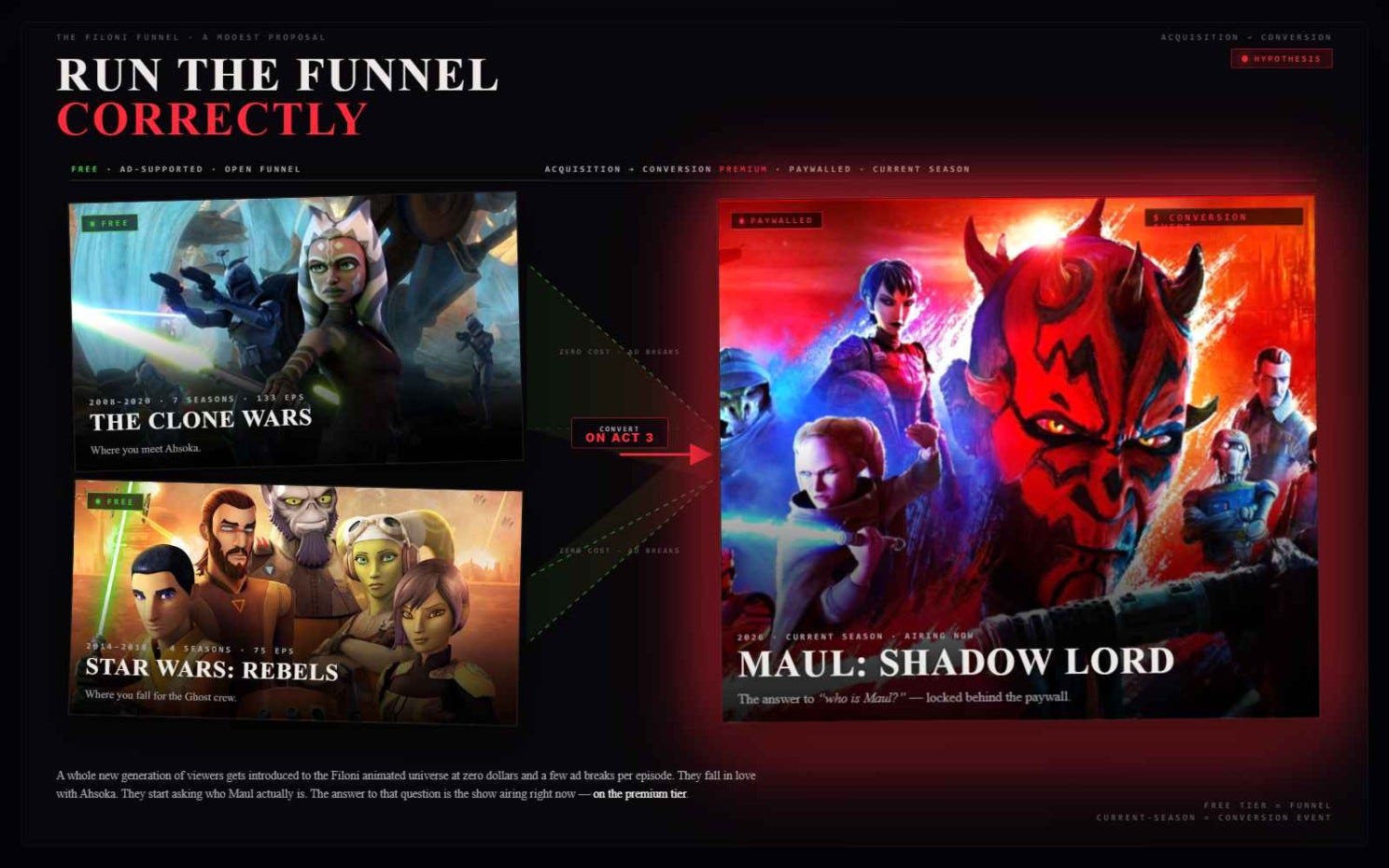
Three tiers. Three consumers. One platform.
The sherpa pays $20+ for the no-ads premium experience and gets day-one releases, the deepest library, the best stream quality, all the bells and whistles. The lightning pass consumer pays $7.99 to $9.99 for the same content with a manageable ad load. The standby consumer pays nothing... opens the app... and gets a meaningful subset of the content with a heavier ad load.
Apply this to what’s actually airing on Disney+ right now. Born Again Season 2 is on the platform. Maul: Shadow Lord is on the platform. Both shows are extensions of universes with massive existing libraries that are already sitting on the same service, generating zero incremental marketing value, because Disney is treating them as locked-down catalog instead of as audience acquisition tools.
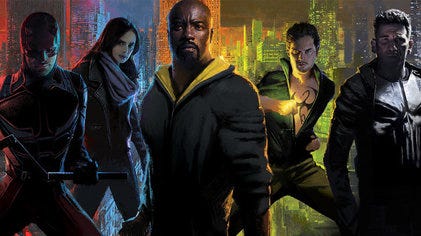
Imagine the version of this that runs the funnel correctly. Free, ad-supported Clone Wars. Free, ad-supported Rebels. A whole new generation of viewers gets introduced to the Filoni animated universe at zero dollars and a few ad breaks per episode. They fall in love with Ahsoka. They start asking about who Maul actually is. And the answer to that question is the show airing right now on the premium tier... Maul: Shadow Lord... which they cannot watch unless they convert to a paying subscription. The free tier is the funnel. The current-season show is the conversion event. Disney+ would be doing the work of audience acquisition that they are currently failing to do with traditional marketing campaigns. Same for Daredevil. Free, ad-supported Netflix-era Daredevil seasons one through three, and the Defenders run, would absolutely pull lapsed fans back into the Marvel TV ecosystem... and the show they convert into the paid tier to watch is Born Again Season 2.
If you’re an entertainment exec reading this and your reflex is but it cheapens the content to have it out there day one for free, fine. I disagree, but fine. Window it. That’s not a new idea. The entire television and film industry has been built on windowing for sixty years. Day one in theaters. Six months later on premium streaming. Eighteen months later on cable. Thirty months later in syndication. Each window monetizes a different consumer at a different price point with a different ad load. Streaming has spent a decade collapsing those windows into a single gated subscription, and the result has been... predictably... a smaller funnel and a harder time growing the audience.
So fine. Don’t put Born Again Season 2 on the free tier on day one. Put it there on day 365. Put Maul: Shadow Lord on the free tier when Season 2 launches behind the paywall. At what point are you just cold-storing content for no reason when there’s real value in pushing it out there ad-supported? And here’s the harder strategic question worth asking. The IP that’s already getting licensed to Pluto, Tubi, and Roku is generating ad revenue on platforms Disney and Netflix and Max do not own, for an audience they cannot remarket to. There is a version of this where the studios run that ad layer themselves, inside their own apps, with their own data and their own conversion path back into the paid tier. That’s not a moral argument. It’s a funnel argument.
Own the funnel. Own the inventory. Own the audience.
This is not a radical idea. It is how every other attention business on the internet works. YouTube does it. Spotify does it. Even the ones that started as paid-only have moved this way. The streaming industry has been refusing to do it for a decade. The gaming industry has barely engaged with the question at all on console and PC.
Which brings me to where I actually want to take this piece.
The Same Argument, On The Gaming Side
Hold that thought I asked you to hold earlier in this piece. Here it is.
Before I get into the structural argument, a personal disclosure that matters for the credibility of what comes next.
I worked in ads for over a decade before getting to where I am now... and I worked across all three layers of the ad stack. Nielsen on the analytics side. Evolve Media on the ad network side. Twitch on the platform side. I have seen advertising from every angle of the discipline... measurement, inventory aggregation, and platform monetization. I love ads. Not in a corporate-pitch-deck way, in a genuine, professional, this-is-how-the-internet-actually-works way. Some of my favorite internet experiences are ads. Instagram has functionally become a shopping app for me, with the actual photos from people I know mostly hidden under the algorithmic feed. I do not bristle at ads as a category. I bristle at bad ads, which is a different thing entirely. Good advertising is a service... it connects me to products I want, brands I respect, and creators I support. The frustration most consumers express about ads is really frustration about ads done poorly. Good ads, served at the right moment in the right context, are some of the highest-leverage content on the internet.
I say all of this up front because the rest of this section is going to argue that the gaming industry has been thinking about ads at the wrong layer of the stack, for the wrong reasons, with the wrong infrastructure. That argument lands harder when it comes from someone who has spent a decade building ad businesses, not someone parachuting in to lecture an industry about a discipline they have never practiced.
Gaming Has Been Pointing Ads At The Wrong Layer
Gaming is in the same place streaming is. Same gravitational forces, same closed-tier platforms, same audience drift toward free experiences, just on a slower timeline. The industry has been even slower than streaming to engage with it... streaming at least has ad tiers, however gated. Gaming on console and PC has none.
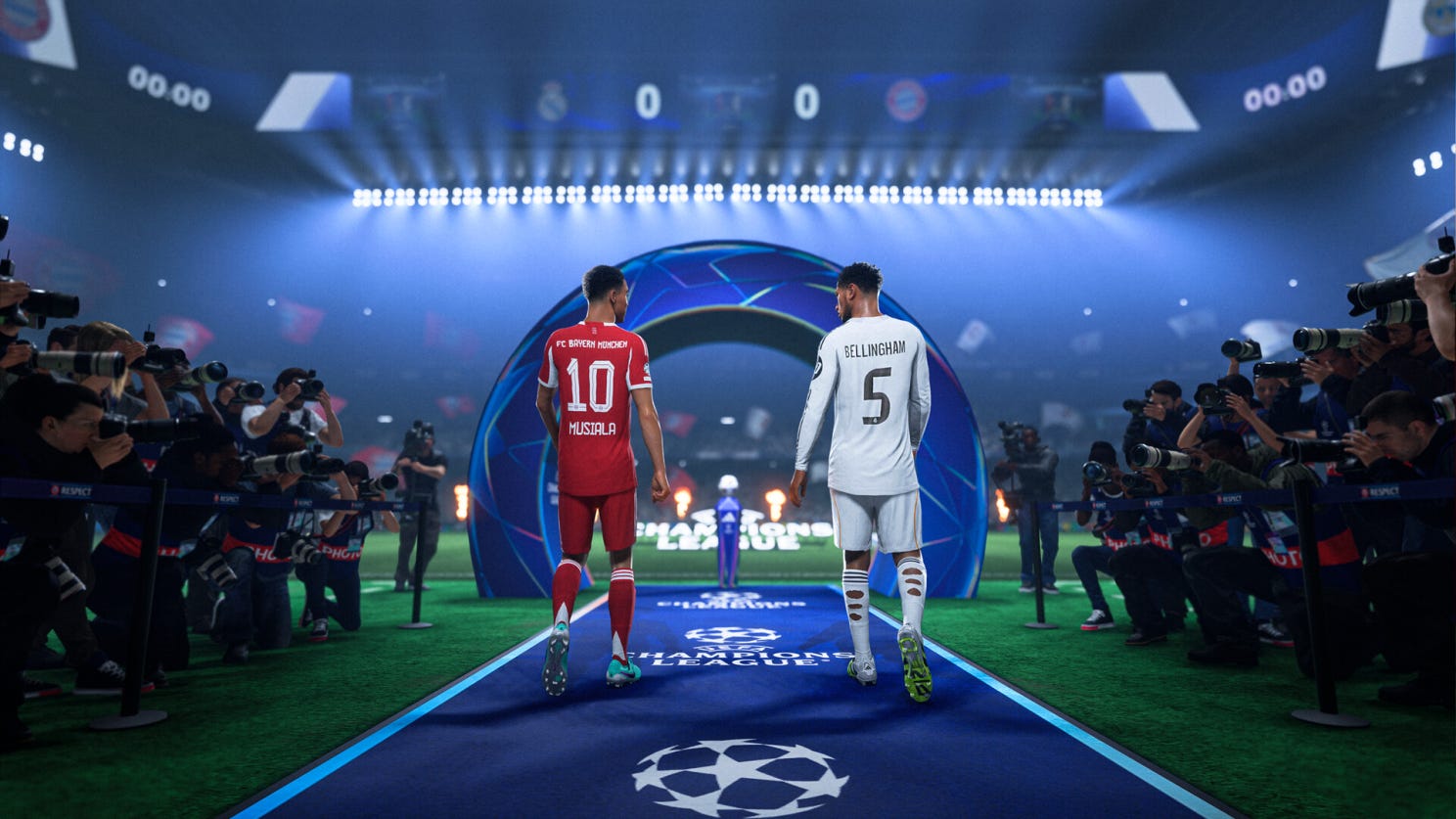
The bigger problem, though, is that the gaming industry’s approach to ads has been fundamentally at the wrong layer of the stack. The instinct, when ad conversations come up at the publisher level, has been to figure out how to shove ads into the game itself. EA Sports FC is the cleanest example. Electronic Arts (EA)‘s CEO confirmed the company is actively working on this, on their Q4 FY24 earnings call back in May 2024:
“Our expectation is that advertising has an opportunity to be a meaningful driver of growth for us. We’ll be very thoughtful as we move into that, but we have teams internally in the company right now looking at how we do thoughtful implementations inside of our game experiences.” — Andrew Wilson, CEO, Electronic Arts, Q4 FY24 Earnings Call, May 8, 2024
EA’s existing ad inventory lives primarily inside its sports titles, where stadium banners, jersey sponsorships, and pitch-side LED placements actually add to the realism of the player experience because that is what real-world soccer looks like. That part works. The expansion past that... ads inside premium console titles whose virtual worlds are not designed to host them... is the part I am skeptical about. And I genuinely agree with the people inside gaming who push back on those efforts at the game level.
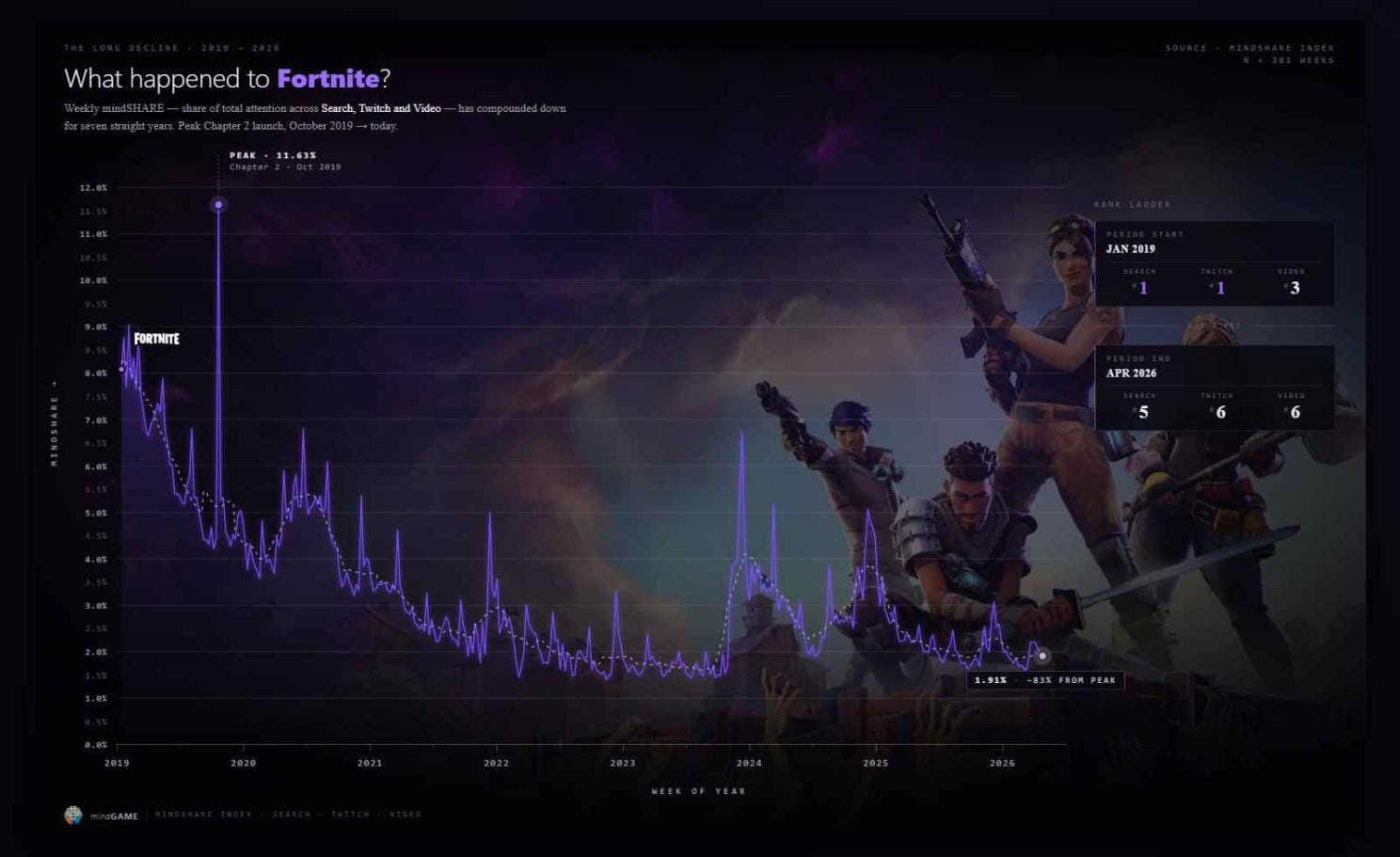
The reason I agree is structural. Games, broadly, see their popularity come and go. Specific titles spike, plateau, decline. Even the biggest live-service games are not immune. Fortnite in our system has fallen from 11% peak global mindSHARE in 2019 to 2.2% today. The hours-played decline is now in the data:
“The average PlayStation user played Fortnite for 16 hours last month, down from 21 hours in February 2025. Xbox users averaged 15 hours of Fortnite in February, down from 19 hours in February 2025.” — Mat Piscatella, Video Game Industry Analyst, Circana, via The New York Times, March 24, 2026
Still number one in MAU on both platforms. Hours moving the wrong direction. That decline is also why Tim Sweeney announced over 1,000 layoffs at Epic in March, citing “a downturn in Fortnite engagement that started in 2025.” I have been writing about this kind of structural strain for months, and the data keeps pointing the same direction.
Here is the takeaway for the ad business. If you are an advertiser and you build your gaming media plan around inventory inside specific titles, you are buying ad supply on top of an asset whose demand curve is volatile by nature. You scaled inside the wrong layer. You are stuck with the volatility of the underlying asset.
The streaming version of the same mistake would be: every dollar of TV ad inventory only sold inside live sports broadcasts. Sports content commands premium CPMs, sure. But you are concentrating your entire ad business in one volatile category and ignoring everything else. Oh wait... that is kind of exactly where the streaming space is right now. (That is partially a joke. Mostly a joke. Also kind of true.)
Overwolf Is The Closest Existing Analog

There is one company that has built a real ad business in gaming by working around the in-game inventory problem entirely, and they are worth understanding before we get to the Microsoft argument.
Overwolf. Per Variety:
“Based in Tel Aviv, Overwolf describes itself as ‘the guild for in-game creators,’ reaching more than 100 million monthly active users across more than 1,500 games (including ‘Fortnite,’ the ‘Call of Duty’ franchise, ‘Minecraft’ and ‘League of Legends’) and working with 178,000 in-game creators to build, distribute and monetize in-game apps, mods, and private game servers... Overwolf, which has raised more than $150 million from investors including Ubisoft and Samsung...” — Jennifer Maas, Variety, July 29, 2025
The company started over a decade ago as a single in-game app letting World of Warcraft players chat over Skype without leaving the game. It has since become the world’s leading companion-app platform for PC gaming, with coverage spanning Fortnite, Minecraft, Call of Duty, League of Legends, Valorant, GTA, Elden Ring, and hundreds of others. Their ad business doubled from $50M in 2023 to $100M in 2024. Their client list reads like a Cannes Lions roster... P&G, Pringles, KFC, Intel, Nissan, Monster Energy, dentsu, WPP, Havas. Comscore ranks them the #5 US gaming property by reach.
The reason Overwolf works is that they are not trying to sell inventory inside the games themselves. They are selling inventory around the games. Ads on companion apps. Ads in the loading windows. Ads in the mod and creator tooling. Ads on the 500+ gaming websites in their network that gamers visit between sessions. They built a true cross-game audience-targeting layer because they recognized that the publisher-level approach was a dead end. Publishers cannot scale ads to a stable, predictable, advertiser-ready inventory level when individual games are volatile assets. Networks can.
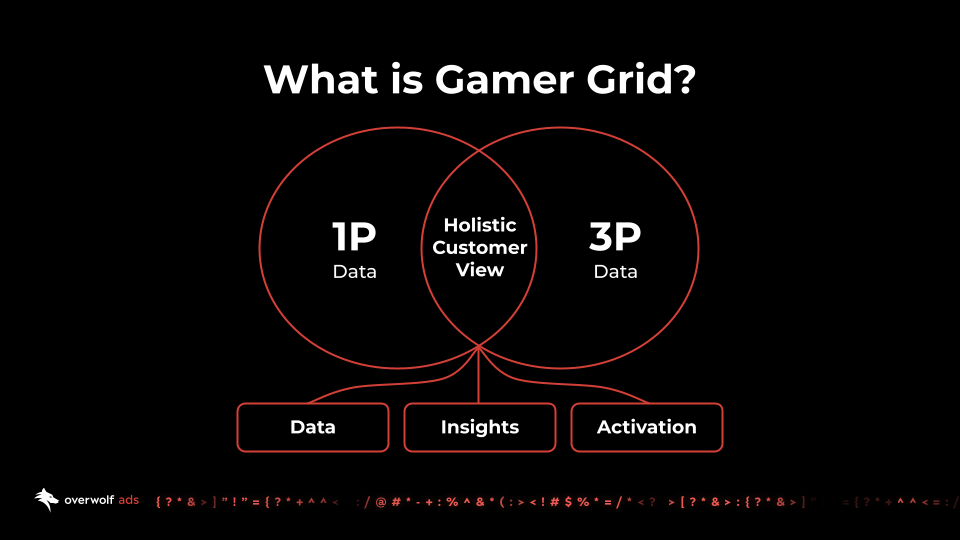
Overwolf’s most recent product announcement makes the strategy even clearer. Last week they unveiled Gamer Grid, an audience data product that targets PC gamers based on actual gameplay behavior and hardware signals, not on the game they happen to be playing in any given week. From the Forbes coverage:
“For years, gaming enthusiasts have been lumped together regardless of what they actually play or how deeply they’re engaged. Gamer Grid changes that by building from what happens inside the gaming PC, including what game they play, how long they stay, and what hardware they’re running. That’s a fundamentally different signal, and it’s one that only Gamer Grid can provide at this scale. For advertisers, it means the difference between reaching someone who once clicked on a gaming website and reaching someone who played 40 hours last week.” — Uri Marchand, CEO and Co-Founder, Overwolf, via Forbes, April 27, 2026
Read that carefully. Targeting based on what someone played, not based on whatever game happens to have an ad slot for sale. That is the move past the in-game ad problem. That is the network insight at scale.
Why Networks Aren’t Enough... Aggregation Theory
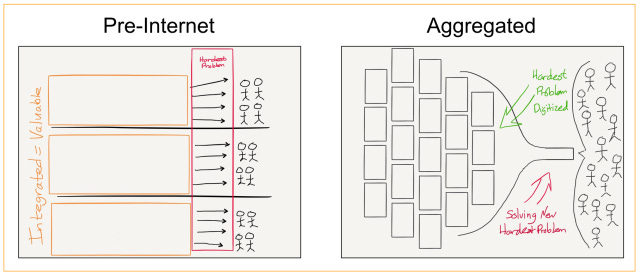
Here is the catch though, and it is the point Ben Thompson has been making about the structure of the internet for the better part of a decade. Networks are useful infrastructure, but the value pools at the aggregator layer.
Thompson defined Aggregation Theory in a foundational 2015 piece that I have read more times than I can count. The core argument:
“The most important factor determining success is the user experience: the best distributors/aggregators/market-makers win by providing the best experience, which earns them the most consumers/users, which attracts the most suppliers, which enhances the user experience in a virtuous cycle... aggregators who aggregate modularized suppliers — which they often don’t pay for — to consumers/users with whom they have an exclusive relationship at scale.” — Ben Thompson, Stratechery, “Aggregation Theory,” July 21, 2015
This framework is, for me personally, one of the most formative things I have ever read about the internet. Every time I look at a media business... gaming, streaming, social, music... I run it through Aggregation Theory first to figure out what I am actually looking at.
Apply it to the gaming ad stack and the picture gets very clear. Google is an aggregator on the open web. Meta Facebook is an aggregator on social. Amazon is an aggregator on retail. They own the consumer relationship, they own the inventory, they own the targeting infrastructure, and they capture the majority of value because of that ownership. Networks / platforms like The Trade Desk are essential infrastructure for the broader ad ecosystem, but the value capture is dramatically smaller than the value capture at the aggregator layer.
Overwolf is the closest gaming has to a real cross-platform ad network. They are doing important work and getting paid for it, but they are not the aggregator of gaming attention. They are the network. Gaming does not have its aggregator yet. That is the structural gap. And the company best positioned to build it... or to acquire what already exists and stitch the rest together... is sitting on a quarterly earnings call talking about $190 billion of AI capex while their gaming segment shrinks and takes impairments.
Which brings me to today’s earnings call.
Microsoft Reported Wednesday... And Xbox Was Barely In The Story
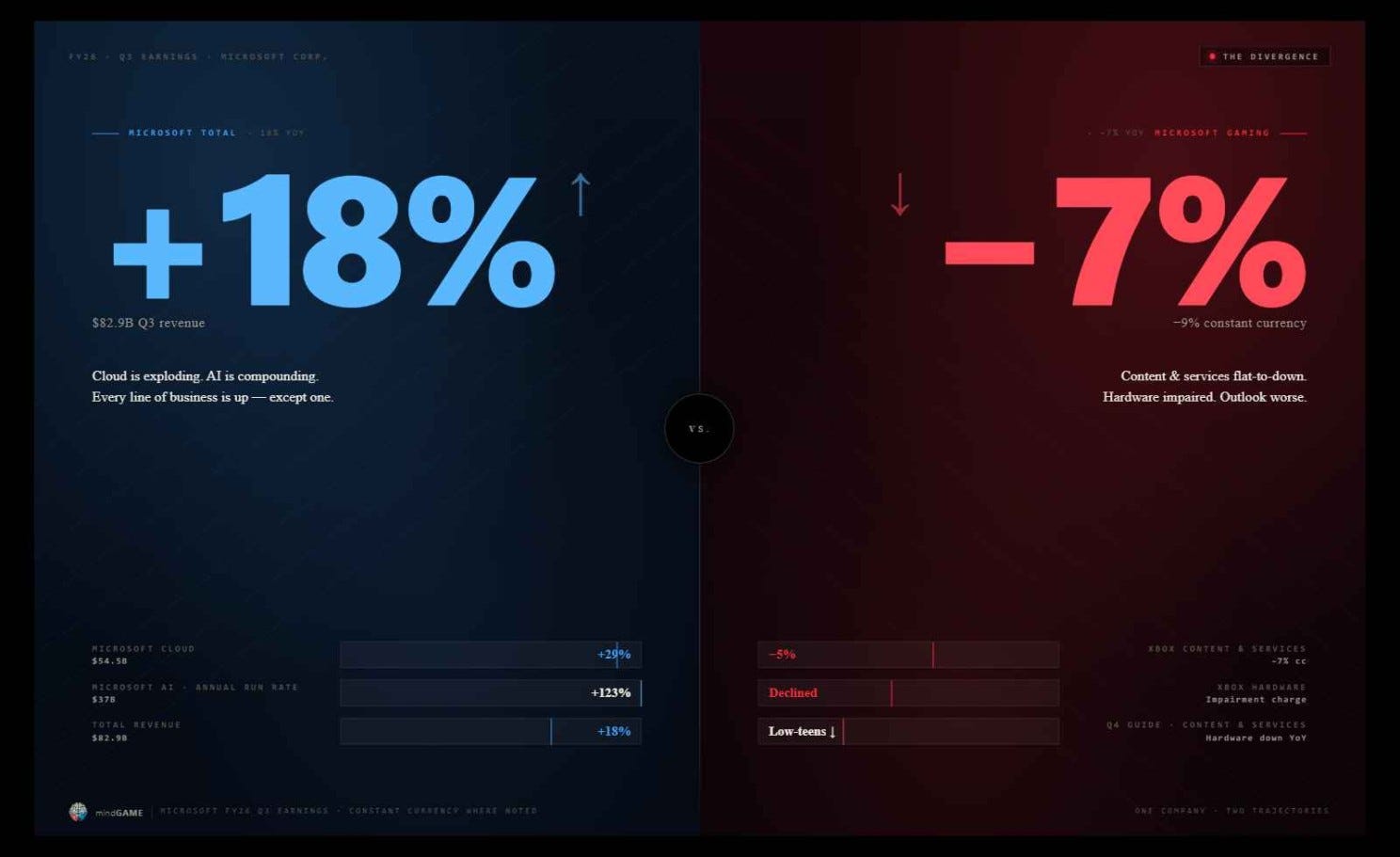
The headline numbers from this week’s call:
Total Microsoft revenue: $82.9 billion, up 18%
Microsoft Cloud: $54.5 billion, up 29%
Microsoft AI annual run rate: $37 billion, up 123% year-over-year
Microsoft Gaming revenue: down 7% (down 9% in constant currency)
Xbox content and services: down 5% (down 7% constant currency)
Xbox hardware: declined year-over-year, with explicit “impairment and other related expenses in our gaming business” callout
Q4 outlook for Xbox content and services: decline in the low-teens, hardware down year-over-year
Read the contrast. Microsoft’s AI business grew 123% year-over-year and crossed $37 billion in annual run rate. Microsoft’s gaming business shrunk 7% and took an impairment charge. Both businesses live under the same roof... both are run by the same CEO... both compete for the same finite pool of capital allocation. And that is before getting to the capex story, because Amy Hood guided calendar 2026 capex to $190 billion, including $25 billion of impact from higher component pricing alone. That is up materially from the framing on the prior call.
Here is the part that matters more than the numbers. Xbox has had an insane amount of drama this quarter. Game Pass price hikes that produced enough customer blowback to require a public response. The Outer Worlds 2 / Ninja Gaiden 4 / Call of Duty Black Ops 7 miss compounding into a soft holiday quarter. The impairment charge itself. Hardware down year-over-year again. Structural questions about portfolio direction that have been the subject of three months of industry coverage. And here is what Satya said about Xbox in his prepared remarks Wednesday, in its entirety:
“And you also see this in Xbox where the team is recommitting to our core fans and players, and shaping the future of play. Last week’s Game Pass changes are one example of how we are staying responsive to customer feedback... We set new records for monthly Xbox active users in the quarter, as well as game streaming hours.” — Satya Nadella, Microsoft FY26 Q3 Earnings Call, April 29, 2026
Two paragraphs in a 30-minute call. The Game Pass price hike, which would have been a major news beat in any other quarter, gets one defensive sentence. Part of that is fair... Asha Sharma is six months into a major reset and the public posture is “we are responding to a previous regime’s bad calls, give us time.” But the bigger part is structural. Gaming is an enormous business sitting inside a parent that has redefined itself as an AI company, and even genuine drama does not earn paragraph time when AI is the only narrative that moves the stock.
This is exactly what I argued in my February piece when I called Microsoft Gaming the Berkshire Hathaway of gaming. The thesis was that Xbox can be a $23 billion business and still feel like a rounding error inside a parent company optimized for AI and cloud. This week’s numbers reinforced that read.
What’s Different Now

Two things have changed since I wrote that piece in February.
First, the AI capex story has gotten more aggressive, not less. The $190 billion calendar 2026 number is, frankly, hard to put in perspective. That is more than the entire annual revenue of Sony, Nintendo, EA, Take-Two Interactive, and Ubisoft combined. Microsoft is going to spend that on AI infrastructure in a single calendar year, while Microsoft Gaming continues to shrink and take impairments. The opportunity cost framing inside the company is going to keep tightening, not loosening.
Second, the muscle Microsoft has built around ads is real but unspectacular, and the gap between what they have and what they could have is the entire point.
“LinkedIn revenue increased 12%... with growth across all lines of business.” — Amy Hood, Microsoft FY26 Q3 Earnings Call, April 29, 2026
“Search advertising revenue ex-TAC increased 12%... with growth driven by higher volume and revenue per search across Edge and Bing.” — Amy Hood, Microsoft FY26 Q3 Earnings Call, April 29, 2026
LinkedIn revenue this quarter was $5.4 billion. Search ad revenue ex-TAC is on a multi-billion-dollar growth trajectory. To be fair to my own writing, I argued last week that Microsoft is not great at ads in the consumer space and should look at acquiring Discord to fix that gap and supercharge a Game Pass push to a much wider gamer audience. I stand by that. Microsoft is a tier-two ad company at best, growing steadily, nothing exceptional. Not Meta. Not Google. Not Amazon. But “tier-two and steady” is still meaningful. They have the audience targeting infrastructure, the inventory management systems, the brand-safety tooling, and a real LinkedIn business that throws off enterprise ad signal nobody else can match.
Here is the part worth sitting with though. Look at the other hyperscalers running comparable AI capex programs. Google has YouTube and Search. Meta has Facebook, Instagram, WhatsApp, and Threads. Amazon has retail media at hyperscale. Every one of them has a consumer ad business at hyperscale that monetizes the AI investment on the front end. Microsoft does not have that. LinkedIn is great. Bing is fine. Neither is the kind of consumer surface that turns hundreds of billions of capex into a flywheel. Xbox Game Studios Publishing could be that surface. Microsoft is choosing not to flex it. That is the gap, and it is the gap that defines this entire argument. Every piece of infrastructure Microsoft would need to run platform-level ads on Xbox already exists somewhere inside the company. The capability gap with the other hyperscalers is real, but it is also fixable, and a Discord-style acquisition would close it fast. The thing actually missing is the will to deploy it inside gaming.
What Platform-Level Ads Actually Mean
Last week I made the platform-level argument and got pushback that conflated platform with in-game. Worth being specific again, because the distinction is everything.
Nobody is arguing for ads inside the games themselves. Nobody is asking Microsoft to run a 30-second pre-roll before you respawn in Halo. Nobody wants ads in the middle of a Doom boss fight. That is not the proposal. The proposal is platform-level ads, which means:
Ads on the Xbox dashboard
Ads at the game load screen, the moment between launching a title and the title actually starting
Ads inside the Xbox Store and the Game Pass UI
Ads served through the Xbox app on mobile
Ads at sign-in, app open, content discovery
These are surfaces where attention is already idle. The user is sitting there waiting for something to load, browsing the store, navigating the dashboard. Ads in those moments are tolerable in exactly the way ads on YouTube before a video are tolerable... they monetize attention that would otherwise be uncaptured... and they do not interfere with gameplay. The model is the same as Spotify ads between songs and YouTube ads between videos. The infrastructure is well understood. The gating factor is internal will at the gaming org.
Worth saying something about how consumers actually experience this. People do not hate ads. People hate paying for a service and watching ads. That is the friction point. Free content with ads is a value exchange consumers willingly make every day on YouTube, TikTok, Twitch, and Spotify Free. Paid content with ads feels like double-charging. The reason a free Xbox tier with platform-level ads works is that the consumer is not paying anything. They are getting a real experience for zero dollars in exchange for some attention. And if the ad load ever gets to the point of being annoying, the consumer can buy their way out of it by upgrading to a paid tier. That is exactly the YouTube model. That is exactly the Spotify model. Friction that exists, but exists by design as an upsell mechanism.

There is one objection worth addressing up front. The ads on day one would not be great. New ad inventory always starts thin. The early Meta ads were not Meta ads, the early YouTube ads were not YouTube ads, and a free Xbox tier on day one would feel similar. The reason that does not matter is that ad businesses get exponentially better with signal. More users means more behavior data, more behavior data means better targeting, better targeting means more relevant ads, and more relevant ads means higher CPMs and a better consumer experience simultaneously. The end state is the experience I have on Instagram now, where the ads are so well-tuned to my actual interests that they are functionally a shopping app. Every ad business in history has started weak and gotten better. The Xbox version would be no different.
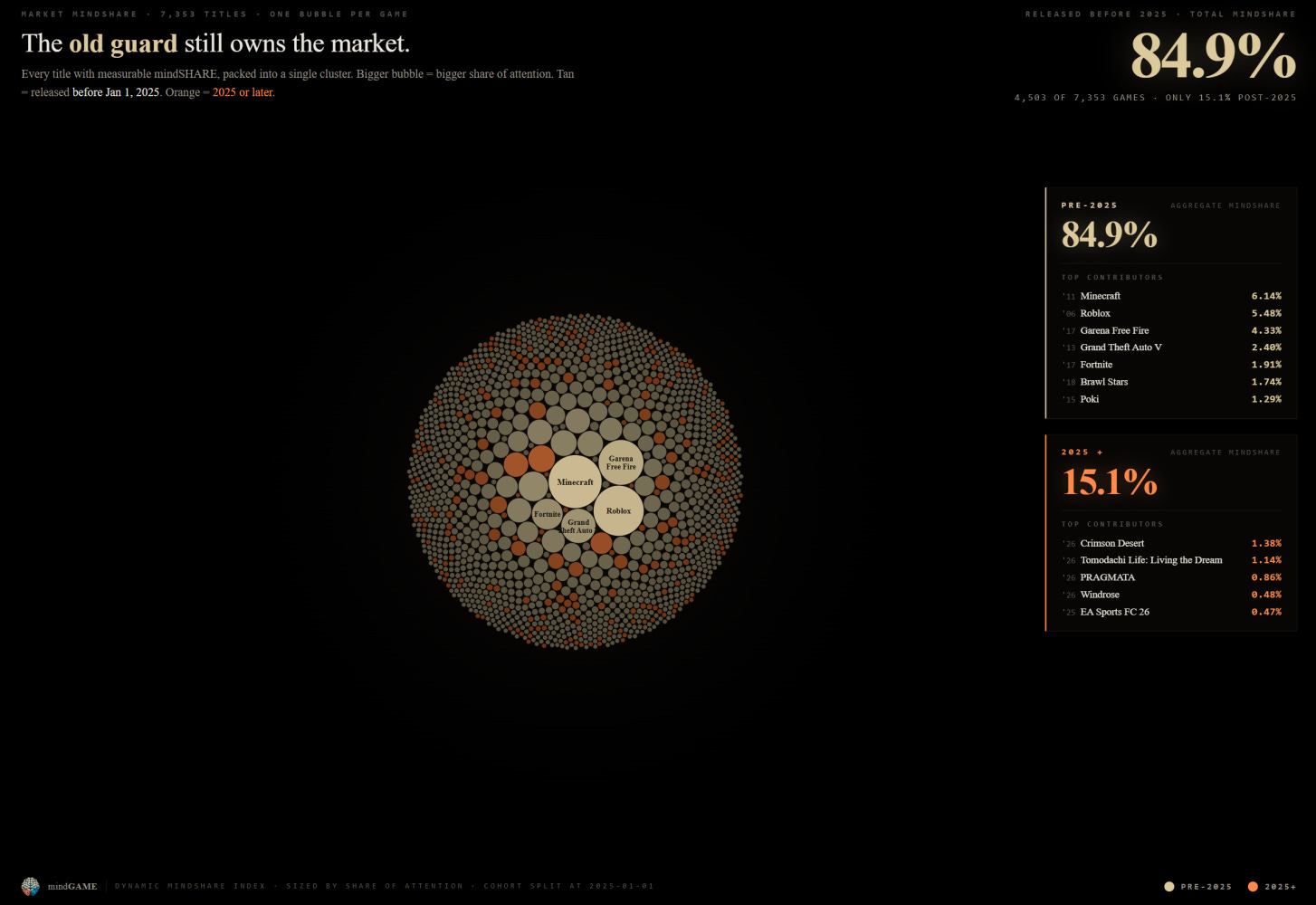
And here is the Aggregation Theory point worth landing now, because this is the punchline. Xbox is one of the largest gaming demand-side relationships in the world. Consumers go to Xbox to play games. The dashboard is the home base. The store is the marketplace. Game Pass is the catalog. Microsoft owns that demand-side relationship. They already have the consumer side of an aggregator built. What they have not built is the supply side... a free entry point that pulls in the audience sitting outside the paywall, monetized by ads at scale. Combine that with mindGAME data showing roughly 85% of gaming attention in any given week is captured by games that have already been released, not games launching that week, and the picture becomes very clear. There is an enormous supply of windowed back catalog generating zero incremental revenue. There is a paywall keeping a huge audience out of it. There is an existing demand-side relationship sitting on top of all of it. The aggregator is half-built. Closing the loop is a strategic decision, not a technical one.
The Free Game Pass Tier
Now bring the structural argument from earlier in this piece down onto Xbox specifically.
Three tiers. Three consumers. One platform.
The sherpa pays for Game Pass Ultimate. Day-one releases. Cloud streaming. EA Play and Ubisoft+ Classics bundled in. The full library, the full experience, no ads. This consumer already exists. They are paying $19.99 a month and they are not the audience that needs to grow.
The lightning pass consumer pays for a tier of Game Pass with reduced price and some platform-level ad load. Ads on the dashboard. A pre-roll on game load. A modest ad presence on the store. They get most of the library at a real discount.
The standby consumer pays nothing. They sign in with a Microsoft account, they get a curated rotating library of older first-party titles, and they accept a meaningful platform-level ad load as the trade. That is the funnel. Xbox Game Studios has fifteen years of catalog sitting in cold storage, generating zero incremental revenue. ABK, Bethesda, and the back catalog of Halo, Gears, Forza Horizon, Forza Motorsport, Fallout, Dishonored, Wolfenstein, and Doom... all of it could be powering audience acquisition right now... and it is not.
Here is the proof point that should be impossible for Microsoft to ignore. Gears of War: E-Day, the prequel and the first mainline Gears game in six years, is launching late 2026. Pre-launch interest is muted. The franchise has been off the air since Gears 5 in 2019. The Coalition has shown one trailer in two years and is finally doing a deep-dive Direct on June 7th. Gears of War: Reloaded, the remaster of the original game, dropped in August 2025 as the first Gears title to ever launch on PlayStation. Microsoft already has the Reloaded → E-Day flywheel set up structurally. They are just not running it as hard as they could.
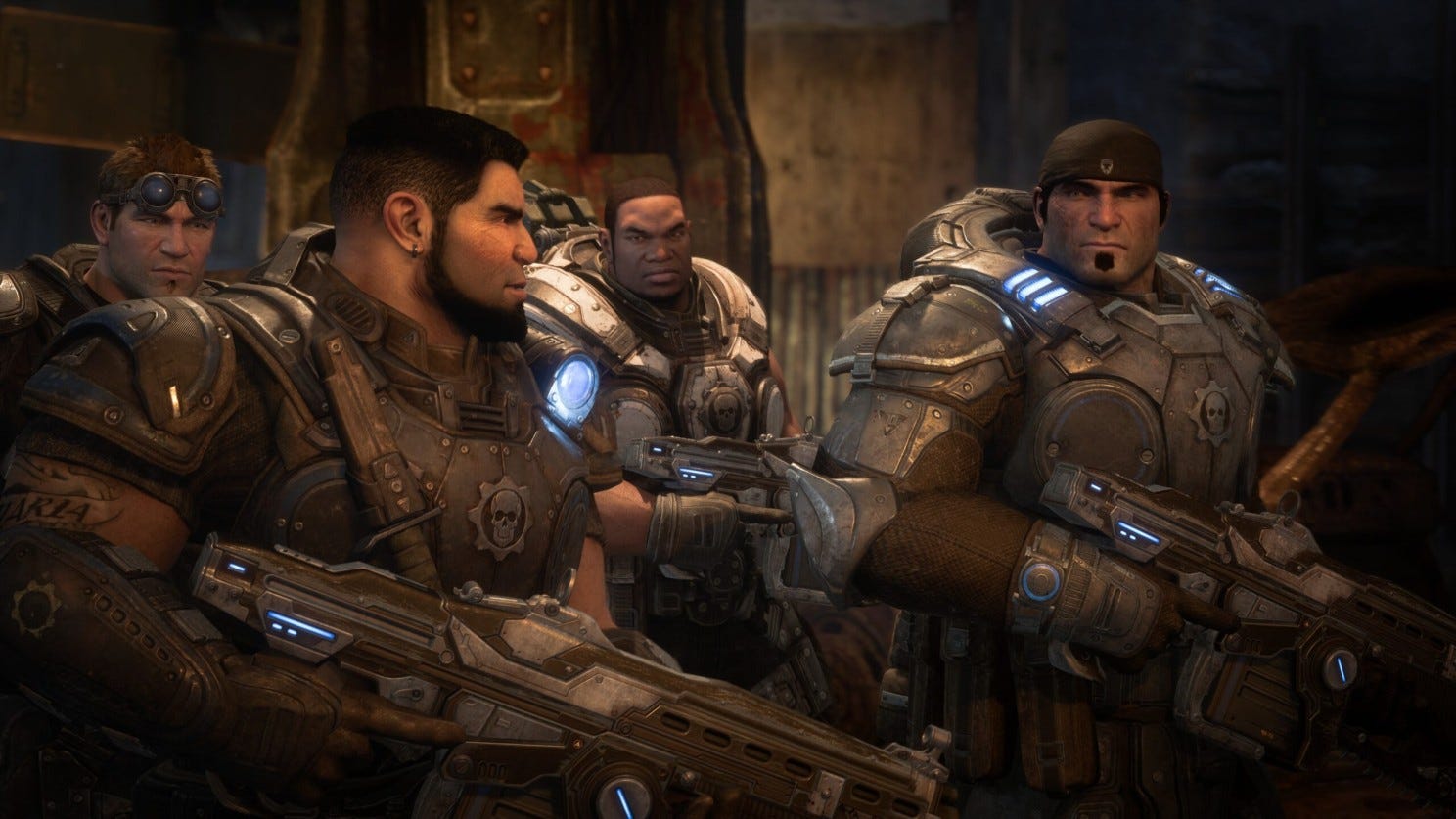
Now imagine the right version of this play. Free, ad-supported Gears of War: Reloaded on the standby tier through the rest of 2026, leading up to E-Day. Anybody with a Microsoft account on Xbox or PC can install it, free, with platform-level ads. That is the marketing campaign for E-Day. New players experience the franchise for the first time at zero cost. Lapsed Gears fans get pulled back in. Reloaded becomes the audience-acquisition vehicle for E-Day at full price, or for Game Pass Ultimate to play E-Day on day one. Microsoft monetizes Reloaded through ads in real time, and uses Reloaded to drive demand for the marquee 2026 release. The IP becomes both a marketing asset and an ad-supported revenue source simultaneously. Same logic as putting Star Wars Jedi: Fallen Order, Star Wars: Squadrons, the LEGO Star Wars catalog, and the older Lucasfilm Games catalog on the free tier on May the 4th. Free, with ads, available to anybody with a Microsoft account. The IP is the funnel. The premium tier is the conversion. Same logic as a free Disney+ ad tier surfacing Clone Wars and Rebels to pull people into the Maul: Shadow Lord paywall.
Gaming and streaming are dealing with the exact same gravitational forces, because they are both attention businesses, and the attention economy does not care which industry your trade association is in.
The Right Person Is Already In The Building
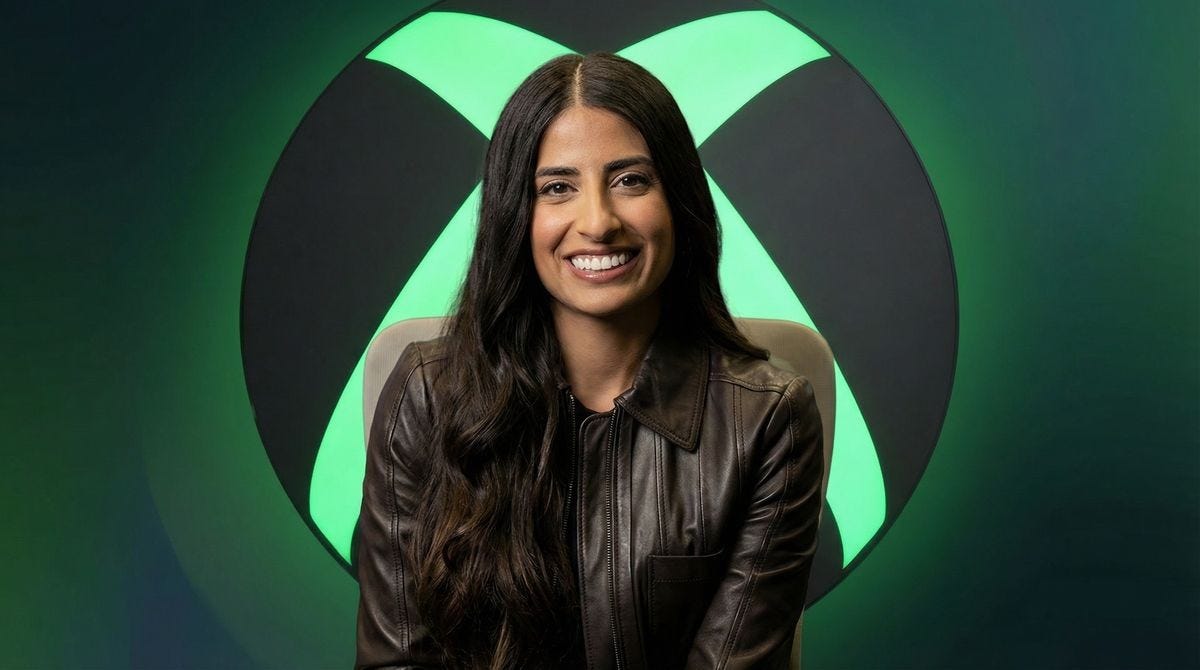
Worth being honest about my own posture on this. I am dubious on Microsoft’s execution. Game Pass changes have been reactive. The communication has been clumsy. The internal narrative is fixated on AI to the detriment of pretty much everything else. If this strategy works, it is going to work despite the broader Microsoft posture toward gaming, not because of it. But if any executive has the actual toolkit to pull this off, it is Asha Sharma.
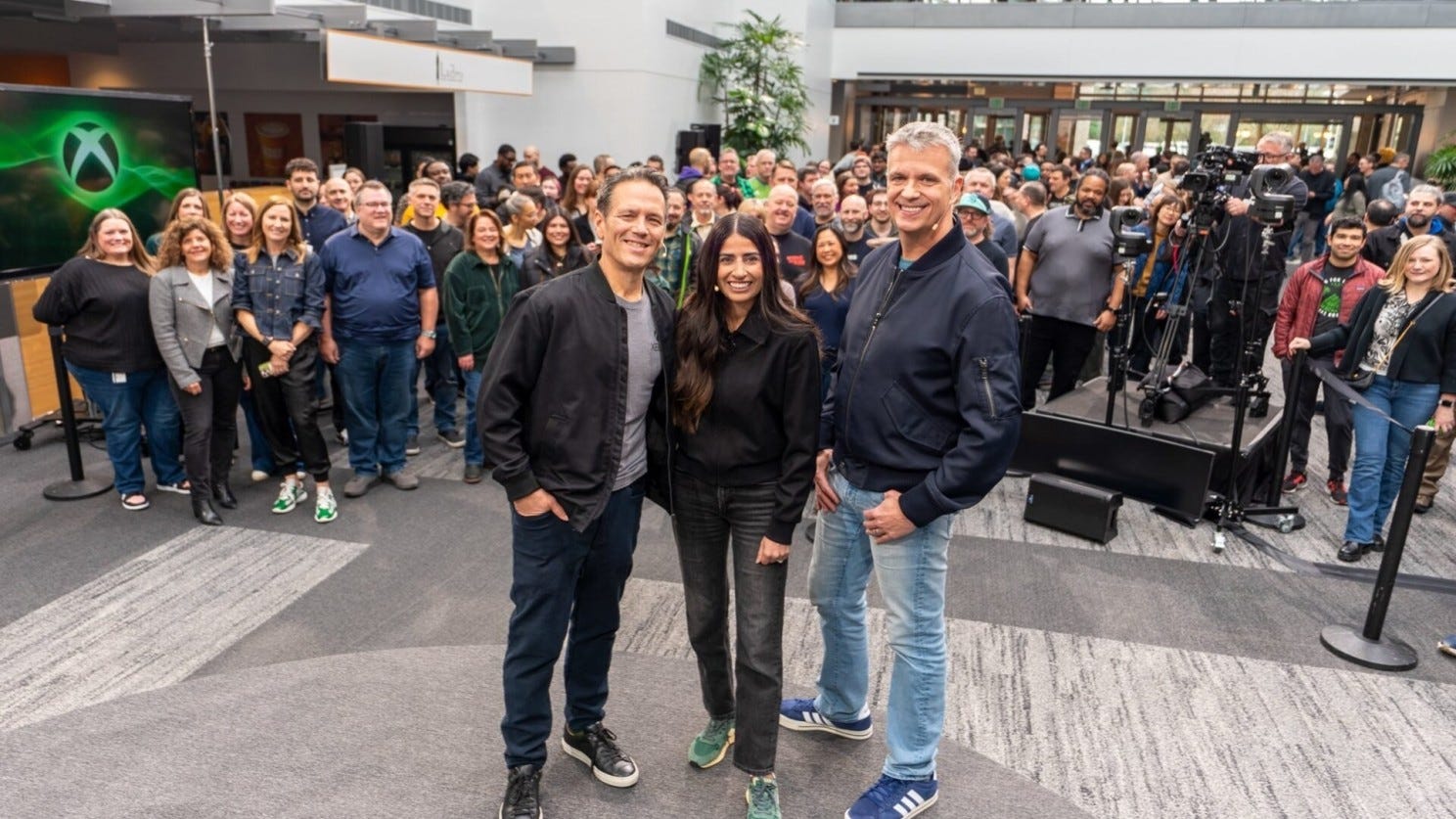
Start with the fact that her appointment in February was a deliberate choice by Satya, not a continuity hire. Sarah Bond was the assumed successor inside the building. Phil Spencer’s second-in-command. Microsoft passed her over to bring in an executive whose entire background sits at the intersection of consumer product, ads, and AI. From Satya’s blog post announcing the move:
“Over the last two years at Microsoft, and previously as Chief Operating Officer at Instacart and a Vice President at Meta, Asha has helped build and scale services that reach billions of people and support thriving consumer and developer ecosystems. She brings deep experience building and growing platforms, aligning business models to long-term value, and operating at global scale, which will be critical in leading our gaming business into its next era of growth.” — Satya Nadella, CEO, Microsoft, Official Microsoft Blog, February 20, 2026
Read that carefully. Aligning business models to long-term value. That is not the language of a continuity appointment. That is the language of somebody being brought in to restructure how Microsoft Gaming makes money.
Bloomberg framed the move even more bluntly:
“Sharma, who previously held roles at Instacart and Meta Platforms Inc., was chosen for her consumer expertise and will serve as the chief executive officer of gaming, Microsoft CEO Satya Nadella said Friday in a blog post.” — Bloomberg, via Yahoo Finance, February 20, 2026
The supporting context on her resume matters here. Her last role before Microsoft was COO of Instacart, where she ran product, marketing, and operations across the Instacart App, Instacart Logistics, and Instacart Enterprise. The Wall Street Journal profiled her schedule in late 2023, and the relevant detail is buried in the routine. Her Mondays start at 5am scanning Instacart’s dashboard. The metric she opens with is engagement and frequency:
“On Mondays, she wakes up around 5 a.m. to 5:30 a.m. and scans Instacart’s dashboard for an overview of key figures like number of orders, frequency, new users and others.” — Jaewon Kang, The Wall Street Journal, December 15, 2023
That is the daily habit of an operator who measures the business by usage and acquisition, not by GAAP revenue line. Translate that habit to Xbox. If Sharma is reading the dashboard the same way every morning, she is going to see what every Xbox observer has been seeing for two years... that the platform is undermonetizing relative to its actual reach, and that the audience growth lever has been pulled almost entirely through paid Game Pass tiers rather than free entry points.
Before Instacart, she was VP of Product at Meta across Messenger, Facebook, and Instagram private communications. Before Meta, marketing and operations roles at Microsoft itself. And in between, she sat on the AppLovin board of directors. That last detail is the one most worth dwelling on, because AppLovin is the most aggressive AI-driven mobile ad targeting business in the public market, and her appointment to that board came with a public statement from AppLovin’s CEO that reads, in retrospect, like a perfect endorsement for the role she now holds:
“Asha has built an incredible career revolutionizing mobile platforms... her proven track record for creating beloved product experiences used by millions of people, as well as her deep expertise scaling teams in high growth environments, will be critical in helping us realize the enormous opportunity ahead.” — Adam Foroughi, Co-Founder and CEO, AppLovin, Press Release, August 16, 2021
Look at that resume holistically. Meta. Instacart. AppLovin. Microsoft CoreAI. Four of the most important companies in the world for understanding the modern intersection of consumer product, subscription, ads, and AI-driven targeting. And now Xbox. If anybody inside the Microsoft building knows how the AI-supercharged platform-level ads model actually works in practice, it is the person who has lived inside the companies that built it.
GeekWire’s profile after her appointment landed on the same takeaway:
“She has experience running large tech platforms, the clear trust of Microsoft CEO Satya Nadella, and a belief in the potential of AI to reshape every business.” — Todd Bishop, GeekWire, February 23, 2026
Her own first statement as Microsoft Gaming CEO was, frankly, the right one for the moment:
“We will recommit to our core Xbox fans and players... we will not chase short-term efficiency or flood our ecosystem with soulless AI slop.” — Asha Sharma, CEO, Microsoft Gaming, February 23, 2026
That second clause matters more than the gaming press has given it credit for. Sharma is publicly distancing the Xbox business from the kind of low-effort, AI-generated content that everybody in gaming has been worried Microsoft would lean into to cut costs. The framing is “AI as infrastructure, not AI as content,” which is exactly the right framing if the actual play is using AI to power better ads, better targeting, and better consumer experiences on the platform layer rather than slapping AI-generated assets into the games themselves.
This is where I want to call out the part of the AI conversation I think is being misconstrued. Most of the public AI discussion is enterprise productivity. Copilot. Agents. Knowledge work. Coding. Those are real businesses... Microsoft’s AI run rate is $37 billion and accelerating... but they are also the most familiar version of the AI revenue story because they fit cleanly inside Microsoft’s existing enterprise muscle. The under-discussed piece of the AI monetization story is the consumer side, and the consumer side runs on better ads.
This is the part Meta has been saying out loud for the better part of a year. AI-driven ad targeting. AI-generated creative. AI-managed campaigns. More inventory, better signal, higher conversion, more revenue. That is the consumer AI business model that actually scales. And it is the version of AI monetization Microsoft has been quiet about... despite the fact that the executive they just put in charge of Xbox spent the last decade inside the companies that built the playbook.
Microsoft has the surface. Sharma has the toolkit. The capex pressure is the problem, the internal narrative is the problem, the leadership cycle is the problem. But the play itself is the right play, and the person to run it is the person already running it. Whether the rest of Microsoft lets her actually run it is the open question.
The Meta Of It All... Or, What Microsoft Should Be Learning From Mark Zuckerberg
Meta also reported earnings this week, on the same day as Microsoft.
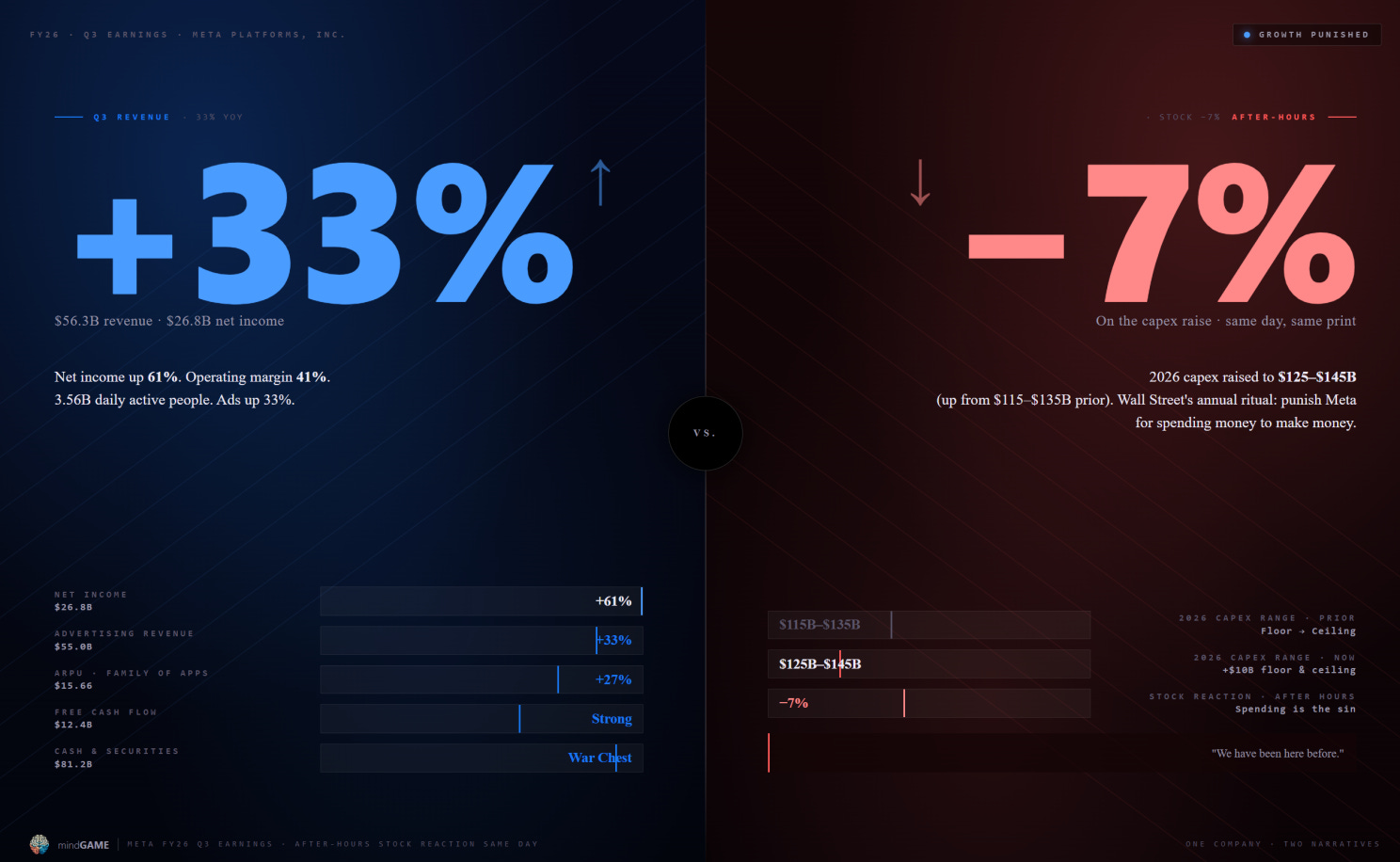
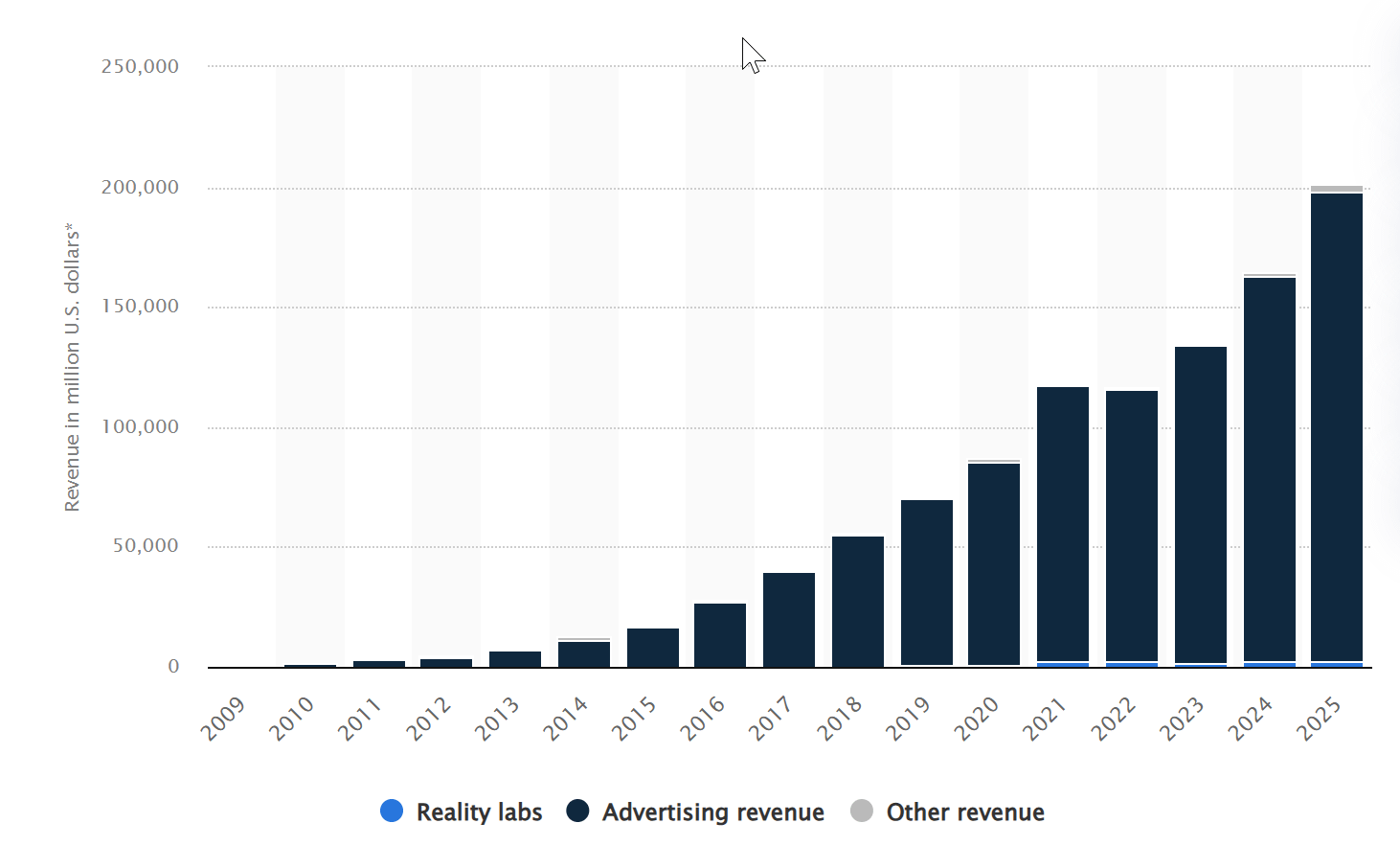
The numbers are absurd. Total revenue of $56.3 billion, up 33%. Net income of $26.8 billion, up 61%. Operating margin of 41%. Advertising revenue of $55 billion, also up 33%. Daily active people across the family of apps at 3.56 billion. Free cash flow of $12.4 billion. Cash and marketable securities at $81.2 billion. Average revenue per person up 27% year over year to $15.66. The company also raised its 2026 capex guidance to $125 to $145 billion, up from the prior $115 to $135 billion range, and the stock dropped roughly 7% after-hours on the spending raise. Wall Street is in its annual ritual of punishing Meta for spending money to make money. We have been here before.
What I want to focus on is not the headline number. It is why Meta is spending $145 billion on AI infrastructure and what that money is being asked to do, because this is the part that connects directly back to everything I just argued about Microsoft.
The Meta Thesis Is The Cleanest AI Business Model In Tech
Mark Zuckerberg has been very direct about what Meta is building and why. From his prepared remarks Wednesday:
“We had a milestone quarter with strong momentum across our apps and the release of our first model from Meta Superintelligence Labs. We’re on track to deliver personal superintelligence to billions of people.” — Mark Zuckerberg, CEO, Meta, Q1 2026 Earnings Call, April 29, 2026
That phrase, “personal superintelligence to billions of people,” sounds like a mission statement. It is also a very specific business model. Personal superintelligence is the AI layer that sits on top of Meta’s family of apps and makes the ads better. Not “agents that do your work.” Not “Copilot for the enterprise.” Not “AI that replaces software engineers.” The Meta AI thesis, stripped to its core, is that more compute applied to ad targeting and ad creative produces better ads, which produce more revenue per impression, which produces more cash flow, which funds more compute.
I have written about this dynamic before. Ben Thompson has been making this argument for the better part of a year, and he laid it out clearly in his analysis of Meta’s Q4 2025 print back in January:
“This right here, to the extent it is true, is by far the most compelling case for Meta’s investments, because Li is making the argument that more compute means better ad targeting, which directly translates into more revenue.” — Ben Thompson, Stratechery, January 29, 2026
Read that closely. Thompson is describing the first publicly disclosed AI business model where the math actually closes loop in the public market. Compute in, ad targeting out, revenue out, cash flow out, more compute. Meta is the only hyperscaler with a fully closed loop on the AI investment thesis where each link in the chain is already proven. Google is closing it. Amazon is closing it through retail media. Microsoft is not closing it on the consumer side because Microsoft does not have a consumer surface at hyperscale that monetizes through ads. Read the same paragraph again with that framing and the entire Microsoft argument from earlier in this piece becomes very clear.
The Q1 numbers prove the thesis is working. Susan Li broke out the receipts on the call:
“In Q1, the total number of ad impressions served across our services increased 19%. The global average price per ad increased 12% year over year in Q1 with broad-based growth as we benefited from ad performance improvements, better macro conditions versus Q1 of last year, and currency tailwinds in international regions.” — Susan Li, CFO, Meta, Q1 2026 Earnings Call, April 29, 2026
Both impressions and price per ad are up simultaneously. That basically never happens in a normal advertising cycle. Either inventory grows and prices compress, or prices climb on a fixed inventory base. Meta is doing both at once. That is what AI is doing for them.
The SMB Engine Is The Real Story
Here is the part of the Meta story that does not get enough attention in the gaming and consumer tech press, and the part most relevant to the argument I have been building. Meta’s growth is not coming from giant brand advertisers. It is coming from small and medium businesses being able to run sophisticated, well-targeted, AI-generated ad campaigns that they could never have run before. From Variety’s coverage of the Q1 print:
“More than 8 million advertisers now use at least one of its generative AI creative tools, with particularly strong adoption among small and midsize advertisers.” — Variety, April 29, 2026
Eight million advertisers. That is the entire long tail of the global SMB economy plugging into Meta’s AI-powered ad creation tools. A boutique furniture maker in Vietnam can now run a creative-rich Instagram ad campaign that targets the exact micro-audience for their product, with creative generated by Meta’s tools, optimized in real time by Meta’s models, and served at exactly the right moment. That is the actual story of how AI changes consumer monetization, and it is happening right now, this quarter, on the Meta platform. Not in some five-year horizon. In Q1 2026.
Susan Li also flagged the GEM ad ranking model and the architecture work on the call, talking about the work to scale larger models into the ad inference path:
“Historically, we have not used larger model architectures like GEM for inference because their size and complexity would make them too cost prohibitive. The way we drive performance from those models is by using them to transfer knowledge to smaller, more lightweight models that are used at runtime.” — Susan Li, CFO, Meta, Q1 2026 Earnings Call, April 29, 2026
Translate that. Meta has built the largest AI ad-targeting model in production. It is too expensive to run live in the ad auction, so they distill it down into smaller models that can run in milliseconds. The bigger model trains the smaller model. The smaller model serves the ads. This is how Meta’s $145 billion of capex turns into ad revenue, mechanically, step by step, all the way down to the actual impression you see in your Instagram feed.
What Microsoft Should Be Learning From This
Now read the Microsoft argument from earlier in this piece against the Meta playbook. Same week. Same earnings cycle. Same AI capex story at the macro level. Two completely different versions of how to monetize the AI investment.
Microsoft has $190 billion of calendar 2026 capex going into AI infrastructure. The monetization story is enterprise productivity. Copilot. Azure AI. Agents for knowledge workers. That is real money and a real business, but it is one lane of the AI revenue story. The other lane, the consumer lane, is what Meta is running. Better ads. Better targeting. Better creative. More inventory. SMB at scale. AI compute compounding into ad revenue. Microsoft is not running that lane on the consumer side because Microsoft’s consumer surfaces are LinkedIn (great, but enterprise) and Bing (fine, but small). Xbox is the consumer surface Microsoft has and is not flexing.
Imagine for a second that the same playbook Meta is running on Instagram and Facebook ran on Xbox. AI-powered ad targeting at the dashboard, store, and Game Pass UI level. AI-generated creative for SMB game and entertainment advertisers who could never afford to buy gaming media before. A free Game Pass tier that pulls in the audience that has not paid Microsoft anything yet, monetized through platform-level ads that get smarter every quarter as the targeting models accumulate signal. That is the consumer-side AI flywheel that Microsoft has all the components for and is choosing not to assemble.
The capability gap between Microsoft and Meta on consumer ads is real. But the gap between Microsoft Gaming and what it could be is bigger than the gap between Microsoft and Meta. Meta is doing this today. The blueprint is public. Asha Sharma has worked inside Meta and Instacart and AppLovin, three of the companies that built variations of the playbook. The structural opportunity is sitting right there.
The Moonshot Worth Raising

I want to be careful about how I frame what I am about to say, because its easy to gravitate towards “this giant is going to buy that giant” and that is not the argument I am making.
I am more bullish than I was last week that Microsoft figures this out. Asha Sharma is the right person to run the play. The Game Pass restructure last week was clumsy in execution but the underlying direction was correct. The internal narrative around AI-as-enterprise will eventually have to make room for AI-as-consumer-monetization, because the math is too compelling to ignore forever. My base case is that Microsoft, slowly and somewhat reluctantly, ends up building the consumer ad flywheel on Xbox themselves over the next two to three years. Maybe with a Discord acquisition along the way. Maybe with internal tooling. But they get there.
The moonshot version of this story, though... the version worth raising even though I am not predicting it... is what happens if Microsoft does not figure this out. Because if Microsoft cannot or will not build the consumer-side AI ad flywheel themselves, the company best positioned to do it for them is the one that just reported 33% revenue growth and $145 billion of AI capex on the back of an ad business that scales with compute.
Meta has been trying to get into gaming for a decade. Reality Labs has burned tens of billions of dollars trying to build a gaming and entertainment platform on emerging VR hardware. Quest has been a real success in its niche, but it has not become the next computing platform Zuckerberg has been chasing since the Oculus acquisition in 2014. The Metaverse pivot was, in retrospect, partially a bet that Meta could build a gaming and entertainment ecosystem from scratch using new hardware as the entry point. That bet has not paid off the way the company hoped, and I think Mark Zuckerberg knows it.
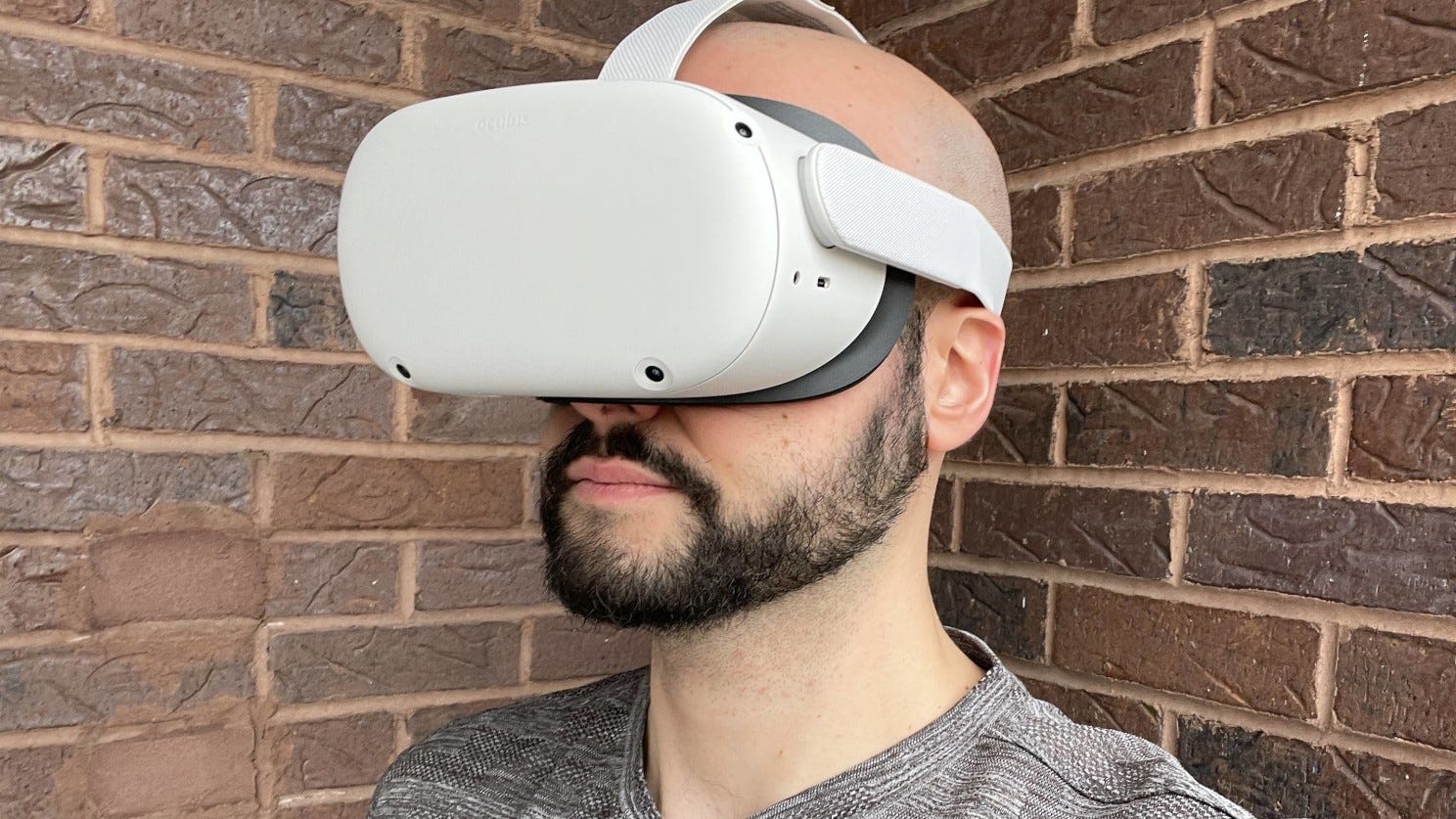
Now look at the strategic gap between what Meta has tried to build internally and what Microsoft has assembled through acquisition. Microsoft has the largest first-party gaming portfolio in the industry. Activision Blizzard. Bethesda. Xbox Game Studios. The Game Pass platform. Cloud streaming infrastructure. A direct relationship with hundreds of millions of console and PC gamers. Meta has been trying to build pieces of this from scratch for ten years. Microsoft has it sitting on the shelf, undermonetized, inside a parent company that increasingly treats gaming as a side business.
I am not saying Meta buys all of Xbox. A full acquisition of the Microsoft gaming portfolio would face antitrust review on three continents and the political optics during an active youth-online-safety moment would be brutal. I do not see that happening, and I would not even put it in the realm of “likely if Microsoft fails to execute.”
But the more interesting and more plausible version is a partial transaction. Imagine Microsoft, two or three years from now, having decided that gaming really does not fit inside the AI-and-cloud-focused company they want to be. Imagine they decide to split the studios the way I have mapped out before... Blizzard goes to Disney, etc... and spin off the Xbox platform and Game Pass infrastructure along with everything else. Included in that hardware spin off some of the marquee franchises... Call of Duty, maybe, or the broader Activision portfolio... go to a buyer that has the consumer ad muscle and the strategic reason to want them. That buyer is Meta. It is not really anybody else. Sony doesn’t need it. Tencent has Chinese regulatory and US political constraints that make it impossible. Amazon has shown it does not really know what to do in gaming. Google has YouTube and that is the gaming attention surface they actually care about. Apple does not buy things at this scale.
Meta has the cash. Meta has the ad infrastructure. Meta has the AI flywheel. Meta has the strategic reason to want every gaming attention hour they can get... because every hour spent in gaming is an hour where Meta could be serving AI-targeted ads against the world’s most engaged audiences. And Meta has spent ten years trying and largely failing to build that surface internally. The Microsoft platform and franchise assets would be the missing piece of a strategy Meta has been chasing since 2014.
Again, I want to be clear. I am not predicting this happens. The base case is Microsoft figures it out themselves. The moonshot is that Microsoft does not, and the most strategically logical buyer for parts of the ecosystem is the one company that has been trying to build a platform for a decade and has not been able to do it organically.
The Future Of Content Has A Free Tier. The Question Is Who Builds It.
Lets land this plane..
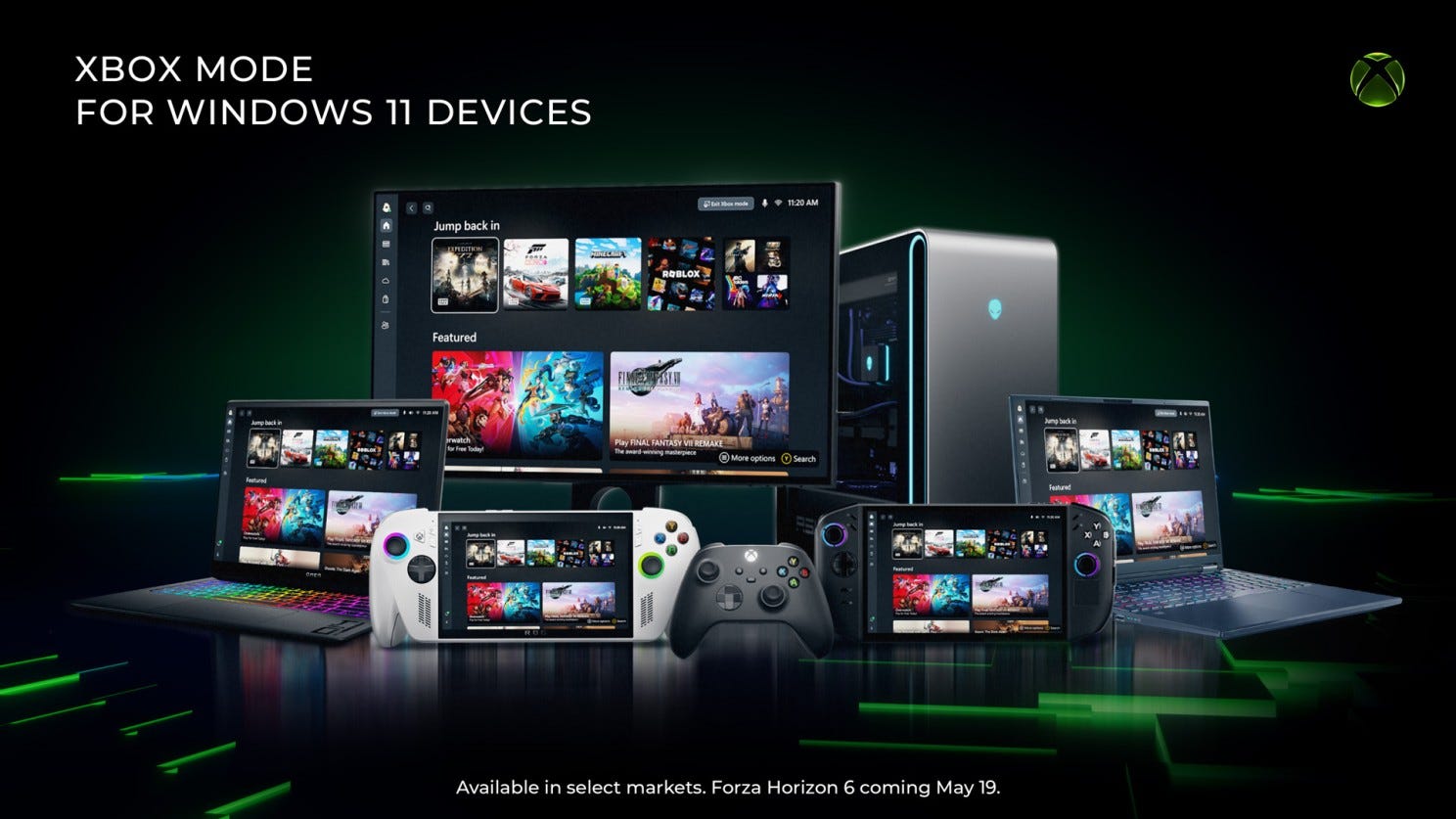
Disney+ is wrestling with the same gravitational forces every closed-tier streamer is wrestling with. Maul: Shadow Lord and Daredevil: Born Again only matter if a much wider audience has been exposed to the IP they extend. Reed Hastings admitted in November 2022 he was wrong to resist ads, and Netflix launched its ad-supported tier shortly after. That was the right move on the wrong timeline. The next move, in my view, is the one nobody on the streaming side has actually taken yet... a genuinely free tier on the lower end of the funnel, paid for entirely by consumer attention.
Gaming is the same story on a slower timeline. Game Pass and PlayStation Plus are real businesses, but they are not competing for the audience playing free games on Roblox and Fortnite. The audience that has not paid you anything yet is the only growth surface left.
Streaming and gaming are the same fight. Same forces. Same ceiling. Same answer. The future of content has a free tier, paid for by consumer attention, supercharged by AI on the ad targeting layer. That is true for Maul: Shadow Lord and that is true for Gears of War: Reloaded. The companies that get there first are going to look like they had the most obvious play in the world. We will find out over the next few earnings cycles which group Microsoft is in.