

Xbox Is Xbox Again... And The Opportunity Ahead Is More Interesting Than The Mess Behind

Follow me here… or on LinkedIn
Almost May. I genuinely cannot believe it. January felt like three weeks ago and somehow Q2 is already underway. From a mindGAME Data perspective this year has been a sprint from the jump, and I mean that in the best possible way. We are busy. We are grateful. And honestly, the work keeps getting more interesting, which is not something I take for granted.
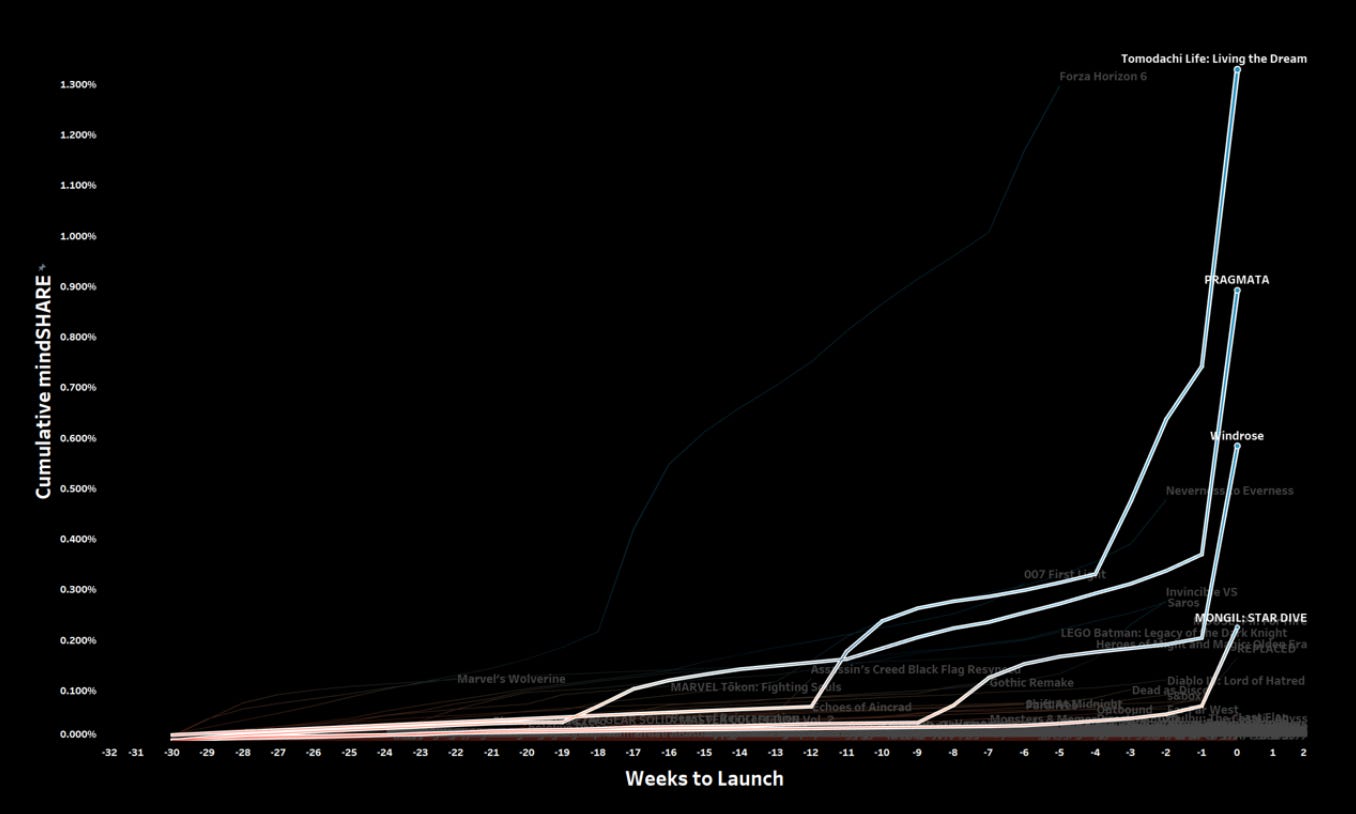
Before I get into the main piece this week, I need to give a shout to Brian Rogers and the mindGAME newsletter. If you’re not subscribed, fix that. Brian put out a breakdown this week of the biggest launches in gaming right now, and the number that stuck with me is Tomodachi Life: Living the Dream, which dropped April 16th and is tracking toward two million copies already. In the UK, physical launch sales came in 36% ahead of Pokopia. The caveat Brian rightly notes: Tomodachi launched on both Switch and Switch 2, which means it had access to roughly 150 million devices. Pokopia launched Switch 2 exclusive, so about 17 million. That is not a fair fight. But it does not diminish what Nintendo pulled off here. Another title, another moment. They just keep going.
Meanwhile Pragmata from Capcom crossed a million units in 48 hours. I wrote back in January about Capcom’s calendar advantage, the way they’ve quietly built one of the cleanest, most repeatable launch strategies in the business: show up early, show up loud, and do it when the calendar is still relatively calm. Their Q1 tentpole has become almost clockwork at this point, and the rest of the year tends to be gravy. What makes Pragmata different is that it’s brand new IP. Not a sequel. Not a remake. Not a franchise with a decade of goodwill behind it. A completely original sci-fi action-adventure that spent years in development hell before finding its footing... and it delivered. That matters. New IP is hard. Capcom made it look easy.
Also in the mix this week: Windrose, an open-world pirate game that hit a million copies in its first week. I love a pirate game. I cannot help it. Which actually brings me somewhere.
The Worst Terrible Secret In Gaming
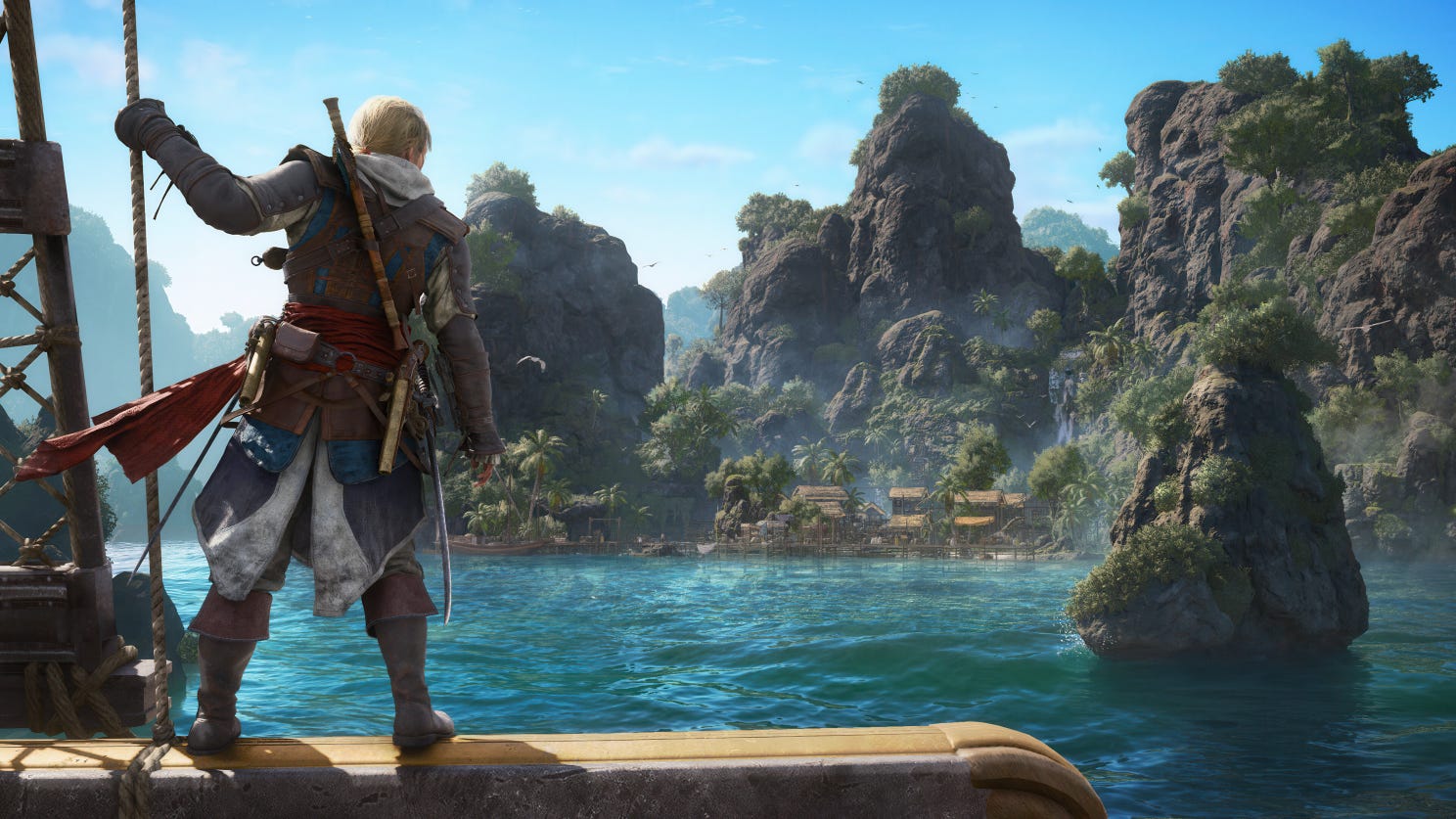
Because the other pirate game news this week hit differently. Assassin’s Creed Black Flag Resynced is officially not a terrible secret anymore. Ubisoft held the worldwide reveal showcase yesterday, April 23rd, confirming a July 9th release date. I wrote the section below before the event, intentionally... because I wanted a clean record of where my head was at before I saw a single frame of official footage. It may also be time to have a longer conversation about Ubisoft and what the hell they are doing... and next week feels like the right moment for that.
What’s interesting is how much we already know. Leaks have been everywhere. The combat system has reportedly been reworked into something faster and more action-oriented... dual swords, pistols, fluid combos, perfect parry mechanics. Matt Ryan, the original voice of Edward Kenway, is confirmed to be reprising his role. Restored cut content and additional missions are rumored. This sounds like more than a remaster. All of that is circulating before Ubisoft said a word officially. The internet is interested. People have strong, deeply personal feelings about the original... and that is a real asset, if Ubisoft can hold it.
Here is my complicated truth about this one. Black Flag is my favorite Assassin’s Creed game of all time. It is not close. Edward Kenway, the open seas, the naval combat, the whole feeling of that world. I love it. So as a fan, I desperately want this to be great. But I have also watched Ubisoft closely since Valhalla... and that history makes me nervous in a very specific way. My fear is not that they fail to make a good game. My fear is that they over-engineer it. That they take something that was clean and singular and stuff it full of the same bloated RPG mechanics and live-service scaffolding that has defined the post-Valhalla era. That they ruin an all-time classic by trying to modernize it into something it was never meant to be.

And honestly... that fear says something about where Ubisoft stands right now. Why Black Flag? Why not start with Assassin’s Creed 1, which genuinely needs a remake, or the Ezio trilogy, which defined the franchise for a generation? Capcom showed us this year what a real remake strategy looks like: intentional, sequenced, built around a creative vision. This feels more like reaching for the most beloved IP on the shelf and hoping the nostalgia does the work. Maybe it will. Maybe that is enough.
And here is the thing... maybe Windrose is the argument that it could be. People want pirate games. People want open sea combat and the feeling of freedom that comes with it. Windrose hit a million copies in a week scratching exactly that itch. If Black Flag Resynced can capture even a fraction of that energy and deliver on what made the original special, Ubisoft might have stumbled into exactly the right move at exactly the right time... even if the strategy behind it leaves something to be desired.
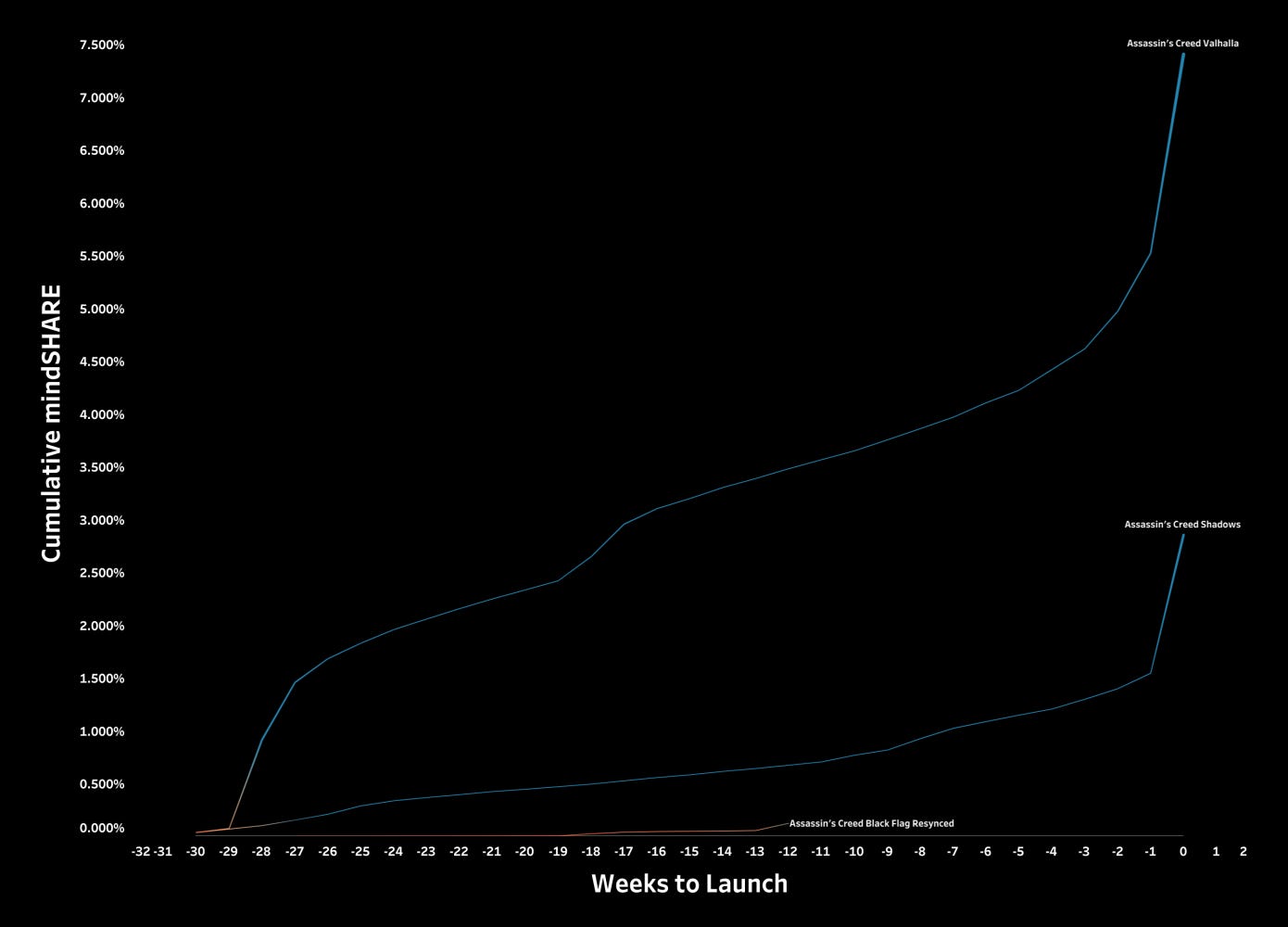
At roughly 12 weeks out from launch, AC Black Flag Resynced is sitting at a cumulative mindSHARE score of 0.124%. AC Shadows was at 0.673% at the same point in its pre-launch cycle, and that was already considered a soft build. Valhalla, the commercial watermark for the series, was at 3.479% at this stage. That is not a rounding error. That is a canyon. The reveal yesterday should move the needle, and I’ll have the post-event data next week. But the runway is short, the franchise goodwill has been tested, and the margin for error feels thin.
Please don’t screw this up.
A Few Worth Reading... Among Many
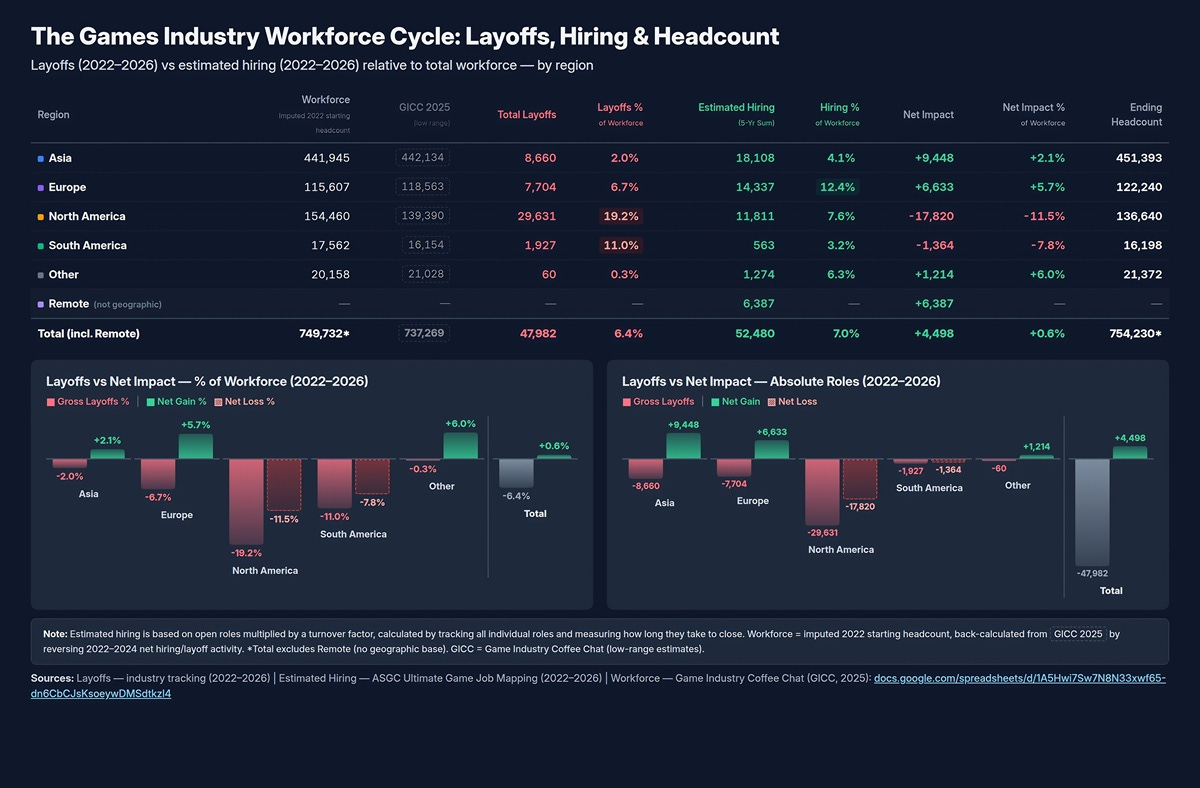
Ubisoft has been dealing with its own share of layoffs and restructuring, which is a topic I’ve been circling for a while now... but today is not that day. What I will say is that nobody is doing a better job of documenting the broader employment picture across this industry than Amir Satvat. His latest workforce analysis dropped this week and look... if you’re reading this newsletter, you’re almost certainly already following him. But on the off chance you’re not, fix that immediately.
The headline number: global gaming’s workforce grew 0.6% over four years. North America shrank 11.5%. From 2022 to 2026, roughly 48,000 roles were eliminated globally... but North America absorbed the most damage, losing nearly 20% of its regional workforce. The 2026 layoff projection now sits at 11,580 and is still climbing, up 8.4% from just a month ago. The five largest layoff events this year account for more than half of all cuts. And the number of people trying to break in has never been higher... 288,000 seekers competing for roughly 4,500 net new positions globally over four years. As Amir Satvat puts it:
“The industry did not collapse. It redistributed.” — Amir Satvat, GamesBeat, April 20, 2026
And then, because he cannot help himself, he adds the line that actually stings:
“Flat is the new shrinking, at least for anyone trying to break in or find their next role.” — Amir Satvat, GamesBeat, April 20, 2026
Go read the whole thing. Seriously.
One of the things I have genuinely loved about the past year or so is the business-to-business content creator community in gaming. The level of generosity, the willingness to share data and signal-boost each other’s work... it has been one of the more quietly great things about doing this newsletter. Amir is a perfect example of that. So is the next person I want to mention.

Joost van Dreunen has been on a heater. I’ve known Joost van Dreunen since the SuperData days, going back to my time at Twitch, and I have always respected what he builds. But the last several issues of SuperJoost Playlist have been on a different level. Rising in the East. Epic Decline. Prelude to Divestiture. Not Crashier. The Sharma Memo. Five in a row that I have read start to finish. His documentation of the Xbox story this year has been pure popcorn... and we agree on most of it, which I won’t pretend doesn’t make it more enjoyable to read. He framed where Xbox is headed better than almost anyone this year:
“Sharma is steering toward something different: a full-stack platform model where distribution, monetization, and audience aggregation take precedence over content ownership. This is not a games-industry idea. It is a technology-industry idea applied to games.” — Joost van Dreunen, SuperJoost Playlist, April 14, 2026
That sentence is basically the thesis for everything I want to say today. And I’ve been waiting to say it for a while.
Now look. I am approximately the 99th person giving an Xbox take this week. I get it. But to be fair to myself... I have been giving Xbox takes almost as long as I have been doing this newsletter. I called a lot of this. And now that Xbox has made their first major move under new leadership, a move that a lot of us figured was coming, I don’t want to just recap the news. I want to talk about what comes next. Because the more interesting story is not what just happened... it’s what happens after.
So. Let’s get into it.
The Retreat That Was Always Coming
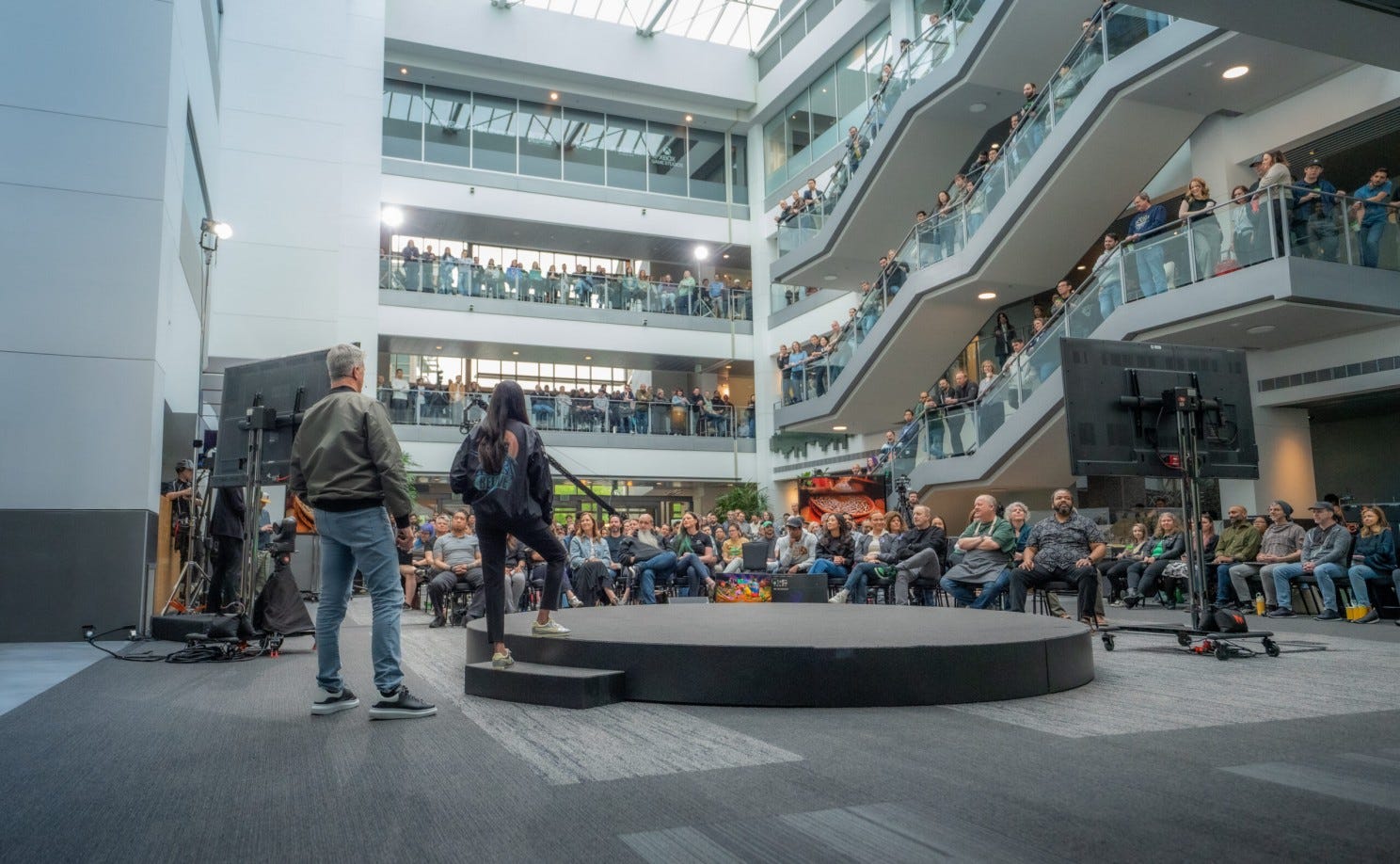
Tuesday morning. April 21st. Xbox Game Studios Publishing dropped a blog post that was short, clean, and remarkably unbothered about the fact that it was essentially an admission that the last two years of Game Pass strategy needed to be walked back.
The headlines wrote themselves. Game Pass Ultimate dropping from $29.99 to $22.99, effective immediately. Call of Duty out of Game Pass at launch going forward... new titles will arrive on the service roughly a year after release. Existing titles, including Black Ops 7, stay in the library. PC Game Pass dropping from $16.49 to $13.99. Xbox’s official statement on the whole thing:
“Our players cover a wide breadth of geographies, preferences, and tastes, so while there isn’t a single model that’s best for everyone, this change responds to a lot of feedback we’ve gotten so far. We’ll continue to listen and learn.” — Xbox Wire, April 21, 2026
We’ll continue to listen and learn. Corporate for: yeah, we heard you, that didn’t work.
Bloomberg was more direct about what actually happened here:
“The 23% reduction in subscription costs for Game Pass Ultimate... is a sign that Xbox isn’t happy either with the growth trajectory of Game Pass or its effects on the revenue from Call of Duty, one of the most lucrative video-game franchises in the world.” — Jason Schreier, Bloomberg, April 21, 2026
Christopher Dring at The Game Business added the context that tends to get lost in the celebration:
“Subscription services don’t typically fall in price. Although it’s worth noting that Xbox Game Pass Ultimate is still 35% more than it was two years ago.” — Christopher Dring, The Game Business, April 21, 2026
Still 35% more than two years ago. This is a retreat, not a revolution. But it is the right retreat.
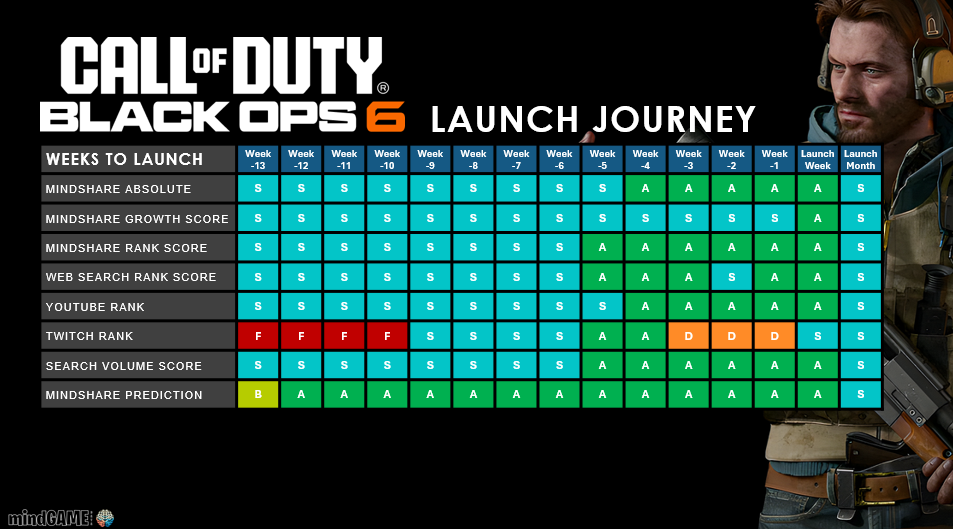
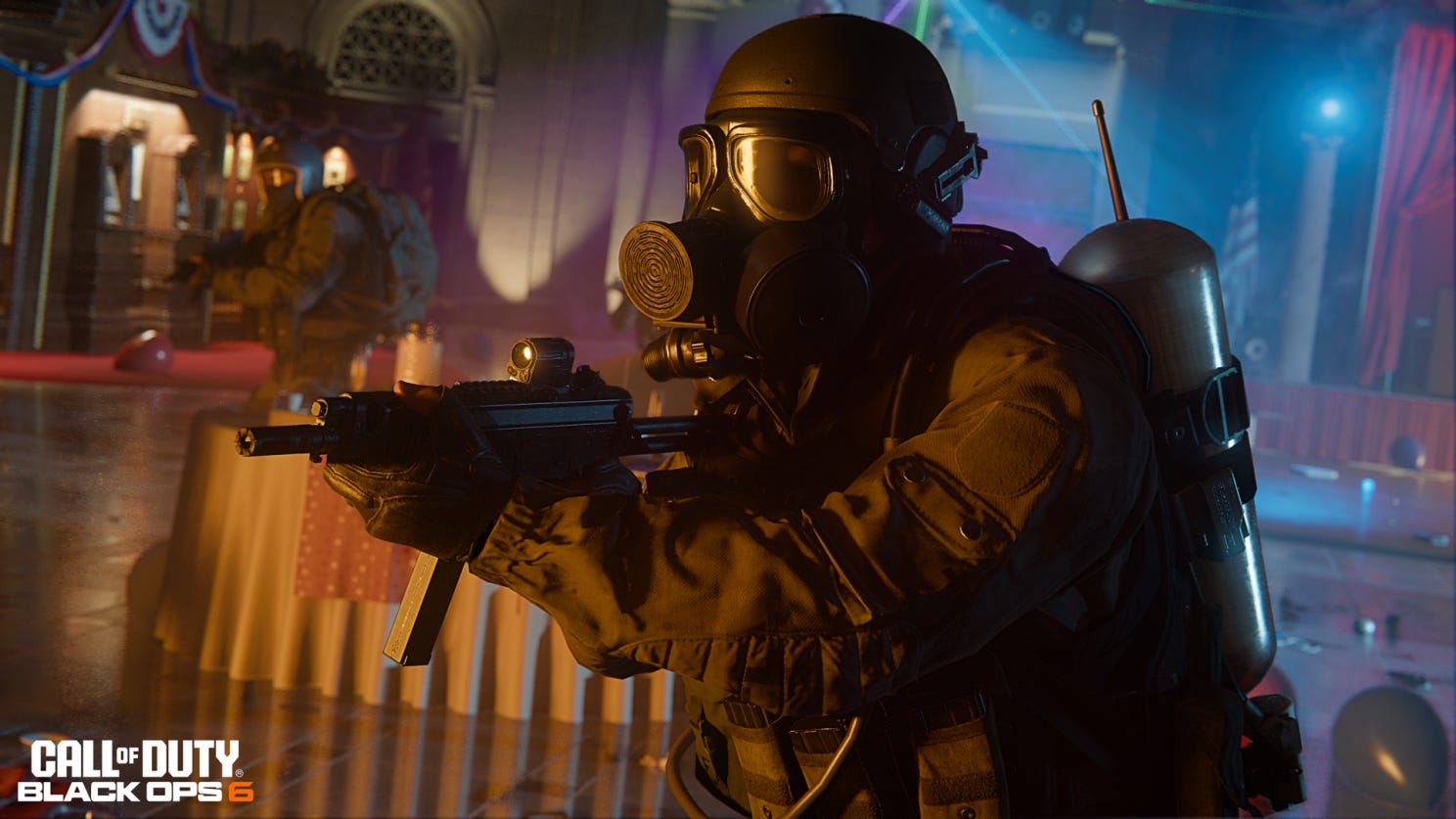
And then there’s the number that makes the whole thing click. Black Ops 6... which by every behavioral metric was an S-tier launch. The mindSHARE, the streaming numbers, the search volume, the social engagement. That game had everything going for it. It reportedly cost Microsoft $300 million in cannibalized revenue by going into Game Pass on day one:
“Xbox gave up more than $300 million in sales of Call of Duty on console and PCs last year.” — Bloomberg, Cecilia D’Anastasio, October 2025
A game that should have been a retail juggernaut instead ate itself. And here is the detail that really stings: 82% of all full-price Black Ops 6 sales came from PlayStation... a platform where Game Pass doesn’t even exist. Xbox and PC players, the ones who had Game Pass, largely just... didn’t buy it. PlayStation players kept paying $70 like nothing changed. The franchise’s retail engine was fine. It was Microsoft’s own subscribers who stopped buying.
Not a streaming problem. Not a content problem. A business model problem.
And then came Black Ops 7. We don’t have the full numbers yet... but we have enough. Microsoft’s Q2 FY26 earnings told the story without saying it directly. Gaming revenue down 9%. Xbox hardware down 32%. Xbox content and services down 5%. CFO Amy Hood blamed it squarely on first-party content:
“[Gaming revenue was] below expectations, driven by first-party content with impact across the platform.” — Amy Hood, Microsoft CFO, January 28, 2026
First-party content. In a quarter where the flagship first-party title was Call of Duty: Black Ops 7. A game that trailed behind Monster Hunter Wilds, Borderlands 4, NBA 2K26, and Battlefield 6 in sales. The worst performance for the franchise this decade. A series that used to print money... stumbling badly, in part because Microsoft spent two years training its own audience not to pay for it.
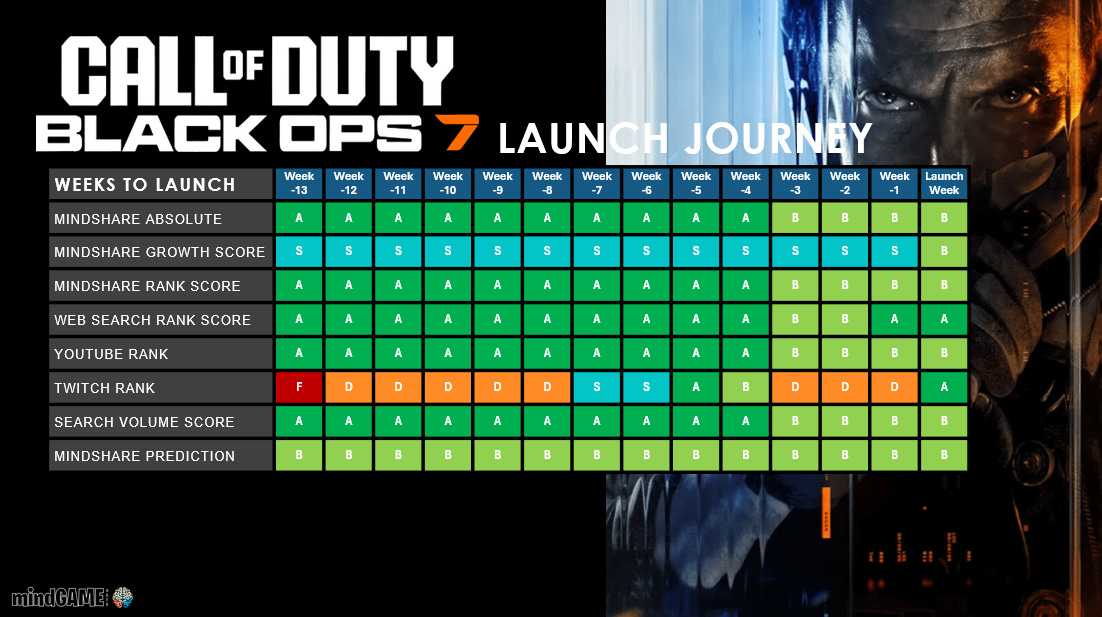
I wrote about this in February. The Xbox earnings miss was not a surprise. It was a confirmation of what the data had been showing for months. They blew up a business model that worked, replaced it with one built on lifetime value math instead of cash, tried to buy their way out of it with a $69 billion acquisition... and pulled one of gaming’s greatest franchises down with them in the process. Cash is cash. LTV math is not cash. A company that needs margin found that out the hard way.
The good news, if you can call it that, is we are getting another earnings call next week. Fresh numbers. A new CEO who has already made her first major move. And a lot of explaining to do about where the business actually stands heading into the back half of 2026. That call is going to be... interesting.
But before we get there. Let me take a moment. Because I have been right about a lot of this. And I would like my points now, please.
Collecting My Being Right Points
Let me take you back to February.
When Phil Spencer retired and Asha Sharma stepped in as Xbox CEO, I wrote about what it actually meant. Not the discourse. Not the “is she a gamer” takes. Not the LinkedIn hot takes, of which there were... many. The actual structural shift underneath all of it. My read at the time was that this was not a new CEO finding her footing. It was a controlled demolition with a blueprint already in hand. Sharma’s first message to the organization said it in three words:
“the return of Xbox” — Asha Sharma, via The Verge, February 23, 2026
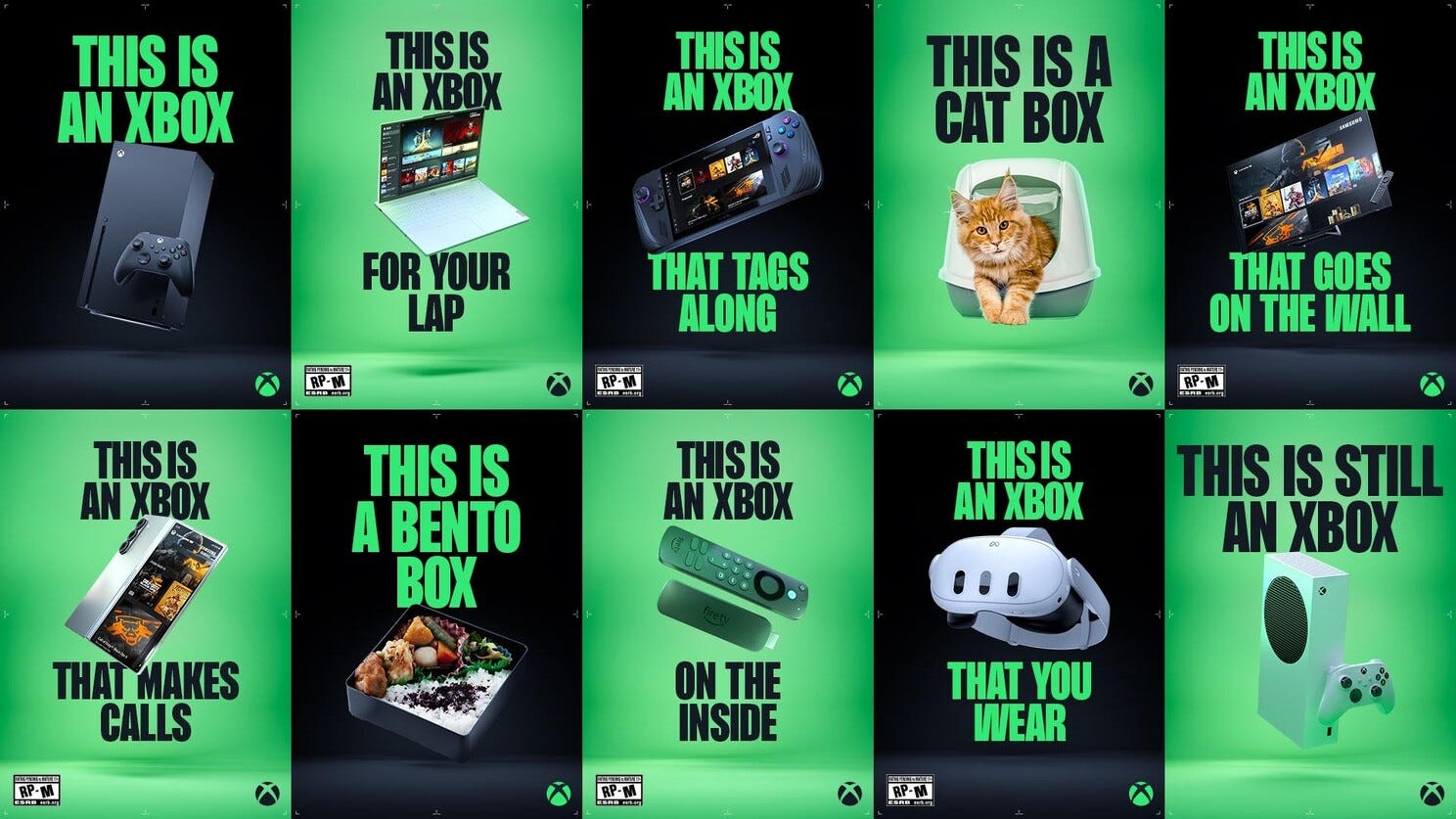
Three words. An unambiguous signal to 10,000 people inside Microsoft Gaming about how the last few years had landed. I said at the time that the “This is an Xbox” campaign was going to be the first thing to go. It was. I said Game Pass pricing was unsustainable and that the subscription model as constructed was going to have to be restructured. It was. I said putting tentpole franchise IP into a subscription at launch was the wrong move for Microsoft’s business, not just once, but repeatedly over the course of this newsletter’s existence.
And before the Sharma news even broke, back in February when Microsoft’s Q2 earnings missed and the industry acted shocked... I was not shocked. My reaction at the time was simple:
“this was unsurprising. We’ve been writing about this for months.” — Patch Notes, February 6, 2026
We had been watching the Call of Duty signals diverge in the mindGAME data for months before that earnings call. The behavioral data was telling the story. Black Ops 7’s mindSHARE trajectory was softer than Black Ops 6 at comparable points. The engagement signals going into launch were not what you want to see from a franchise that is supposed to carry your entire gaming division’s quarterly numbers. When the miss landed, it landed exactly where we expected it to.
Now look at where we are. The $30 experiment is dead. Call of Duty is off Game Pass at launch. The price has been walked back. Sharma’s internal memo, leaked earlier this month, said plainly what the data had been showing for two years:
“Game Pass has become too expensive for players.” — Asha Sharma, via The Verge, April 2026
That is a CEO confirming publicly what anyone paying attention already knew. Game Pass was never the right home for a $500M+ annualized franchise with a built-in retail audience. It was always the right home for indie games, AA titles, back catalog, discovery-layer content. The games people want to try... not the games they were already going to buy. I have been saying some version of this since the first piece I wrote about Game Pass last June. The data supported it then. The business results confirmed it over the last two years. And now Microsoft is finally acting on it.
And then, as I was literally finishing my first draft of this piece... Sharma held an all-hands with Xbox employees and dropped the memo that made everything official. Because that is life with Xbox. Just when you think you have the story, they give you more story. Microsoft Gaming is dead. Xbox is back. The division is returning to its original name, and Sharma and Matt Booty put it plainly in the memo sent to the team today:
“’Microsoft Gaming’ describes our structure but it does not describe our ambition. So, we are going back to where we started and changing our team’s name. We are Xbox.” — Asha Sharma and Matt Booty, Xbox Employee Memo, April 23, 2026
And this line, which I think is the most important thing Microsoft has said about its gaming business in years:
“The model that got us here won’t be the one that takes us forward.” — Xbox Employee Memo, April 23, 2026
That is an admission. A real one. Not dressed up in investor language or quarterly guidance hedging. Said out loud. To the entire organization.
Look... Sharma hasn’t fixed anything yet. She’s named the problems, admitted the failures of the last regime, and promised a strategy. That’s not nothing. But it’s also the oldest playbook in leadership: come in, blame what came before you, and buy yourself runway with a reset narrative. Presidents do it. CEOs do it. It works... for a while. The shelf life on that move is limited. At some point the scoreboard is yours.
Microsoft went to church. Congrats. Now let’s see if they can actually live by the religion.
Now let’s talk about what comes next.
What Comes Off Game Pass Next... And What Should Stay
So Call of Duty is out of Game Pass at launch. Good. Now let’s talk about what comes next, because this is not a one-time correction. This is a framework shift. And if you understand why CoD had to go, you already know which games follow.
The logic is simple. If a game has decades of brand equity behind it, a $70+ price point, a marketing budget in the hundreds of millions, and a built-in retail audience that was already going to buy it... it does not belong in a subscription at launch. Full stop. I wrote about this last summer in The Game Pass Sugar High and the argument has only gotten stronger since. Game Pass cannibalizes what it cannot afford to cannibalize.
The data backs this up in a way that should make every Xbox studio head uncomfortable. In our mindGAME tracking, non-Game Pass AAA titles average a 65% mindSHARE drop after peak. Game Pass titles average 93.5%. The sugar high is real. So is the crash. Cash is cash. Subscription accounting is not cash. Microsoft learned that the hard way with Black Ops 6. They are learning it again with Black Ops 7. At some point you stop learning and start changing.
That point was Tuesday.
The Games We Know Are Coming
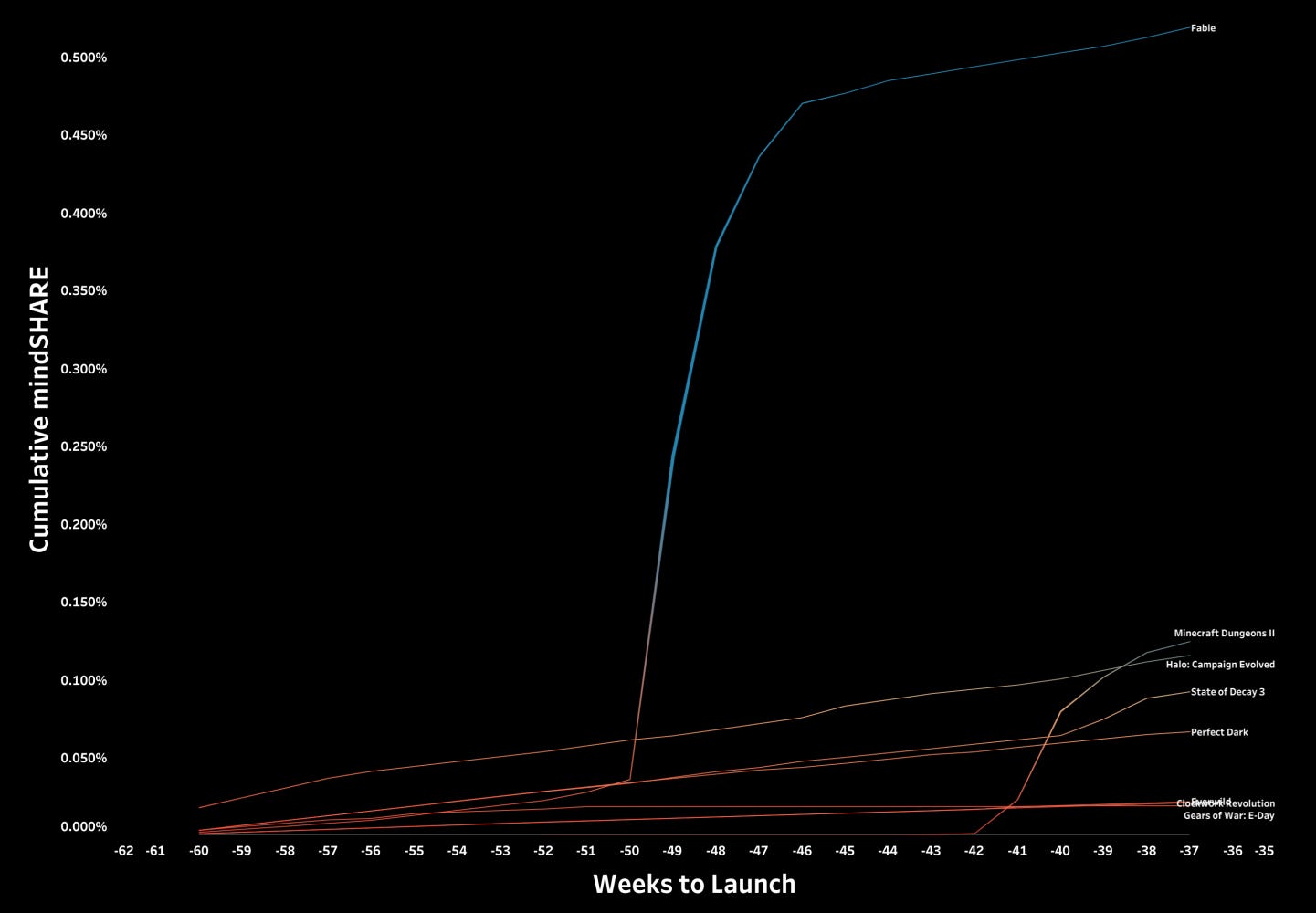
Xbox has three tentpole franchise revivals in the pipeline right now, all tracking toward release. Same studio ownership structure. Same distribution plan on paper. Three very different stories in the data.
Fable. Years in development. Beloved franchise reboot from Playground Games, the same studio that turned Forza Horizon into one of the most acclaimed open world series in gaming. And the market is already telling us what it thinks. Fable is sitting at 0.519% cumulative mindSHARE right now... ranked #2 out of 813 undated unreleased games we track. Weekly Google search around 49,000. Twitch top 400. YouTube top 1,500. The curve broke out in late January and it’s still accelerating. This is not a franchise that needs Game Pass to find its audience. This is a franchise whose audience is already lined up at the door with $70 in hand. Let them pay it.
Halo: Campaign Evolved. Halo Infinite’s day-one Game Pass launch is the cautionary tale nobody inside Microsoft seems to want to say out loud. Strong IP, soft commercial return, a franchise that spent two years trying to rebuild the player base it effectively gave away. Now Halo has Campaign Evolved coming... a full remake of the 2001 original... and the data says the rebuild is actually working. Cumulative mindSHARE of 0.115%, ranked #30 of 813 undated unreleased games, up 6.5x since we started tracking it 23 weeks ago. The studio rebranded from 343 to Halo Studios. Engine shift from Slipspace to Unreal 5. A project name that signals direct lineage to the game that started it all. They are doing the work. Is it too late to pull it off Game Pass day one? Probably. But they should. The attention is earned. Honor it with a retail window.
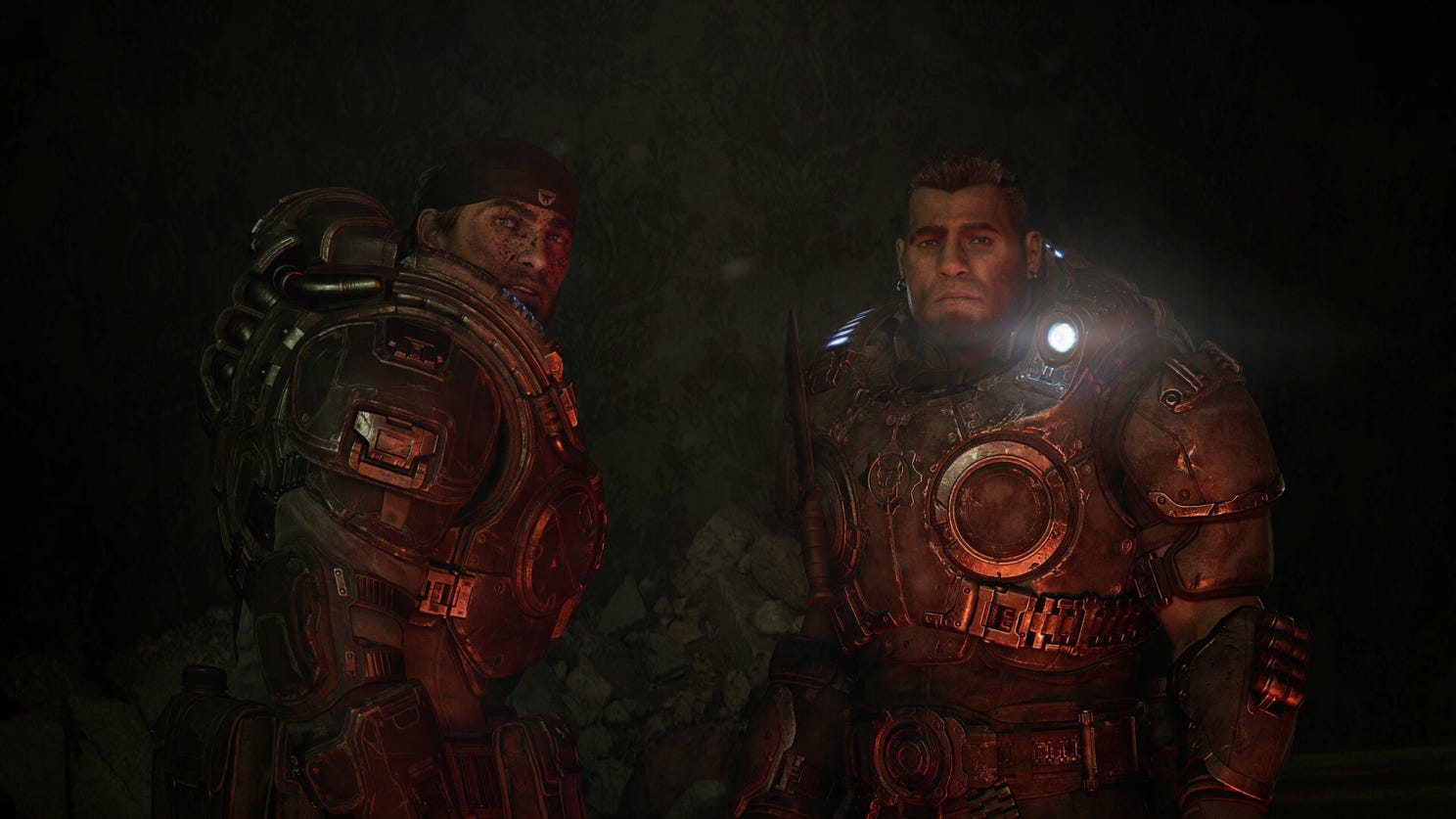
Gears of War: E-Day. Same calculus in theory. Decades of brand equity, a passionate fanbase, a prequel that should write itself. Except the data is not confirming any of that. Gears of War: E-Day is sitting at 0.019% cumulative mindSHARE. Ranked #447 of 813 undated unreleased games. Weekly Google search, most weeks, is literally zero. The cume has been frozen for 27 consecutive weeks. For context... Halo: Campaign Evolved was already at 0.018% cume at the very start of our tracking window. Gears is barely above that number 23 weeks later. Halo’s floor is Gears’ ceiling.
That is not a Game Pass problem. That is a franchise that isn’t winning attention right now, and no distribution model fixes that. Halo gave the market a reason to re-enter. Fable did too. Gears has given us a prequel framing and a teaser. The distribution question here is downstream of a creative and marketing question that hasn’t been answered yet.
Three tentpoles. Same studio ownership. Same release economics. One is a top-2 hit. One is climbing. One is flatlined. If Game Pass were the only variable, all three would look the same. They don’t. Game Pass does not create dormant-franchise demand. It monetizes whatever demand is already there. When the creative engine is working, day-one Game Pass leaves premium retail dollars on the table. When the creative engine isn’t working, day-one Game Pass is a cost sink... the game doesn’t drive subs because nobody is asking for it, and it doesn’t recoup retail value either because it is being given away. Worst of both models.
The Games Yet To Come
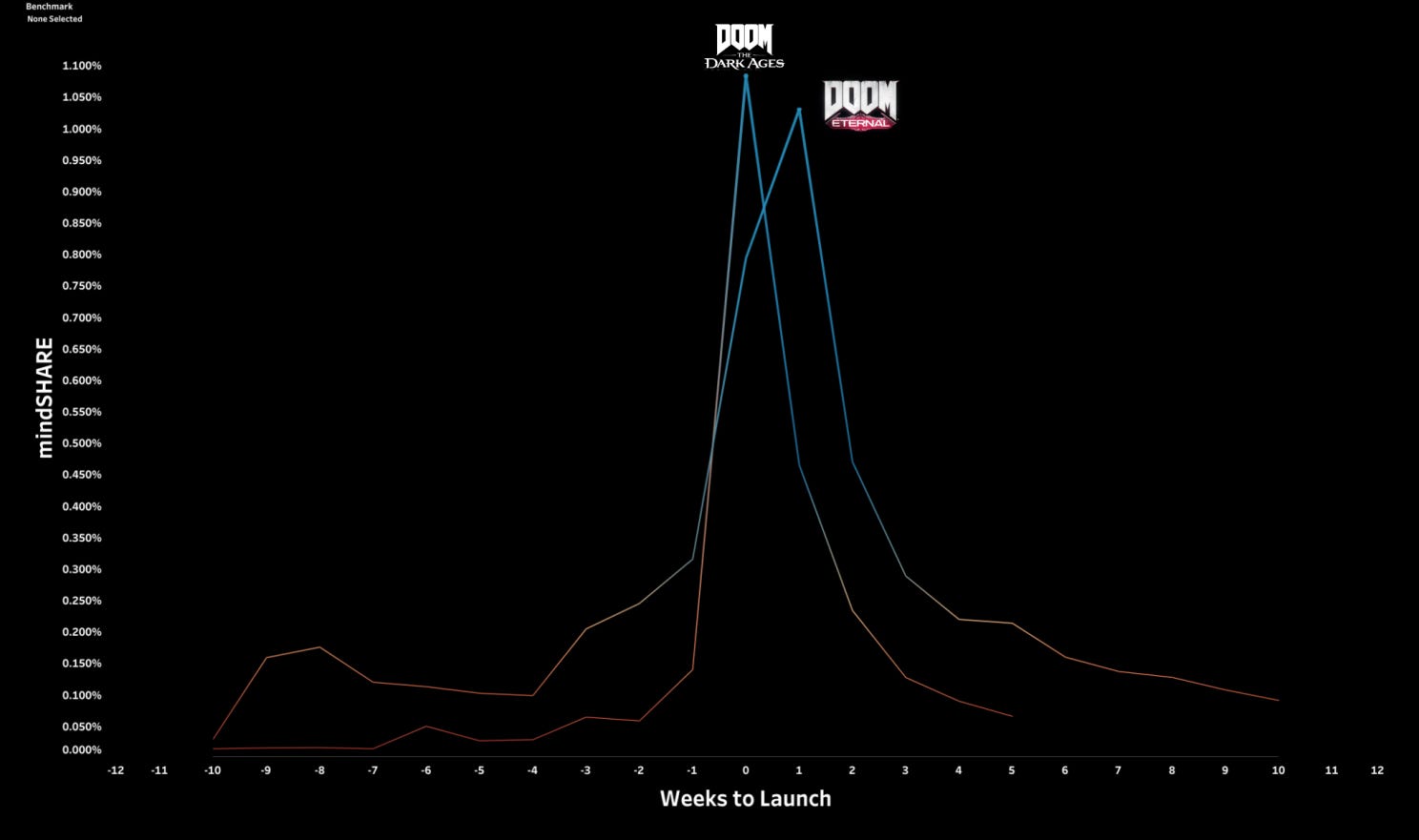
Beyond the current pipeline, the windowing argument gets even more important when you look at what Xbox is eventually going to have to make decisions about.
The next Doom. This one hurts a little, because DOOM: The Dark Ages was a genuinely great game. Critically acclaimed, a strong launch... and then it evaporated. I wrote about this dynamic in The Game Pass Sugar High... the member-weighted value credits Xbox uses to offset lost sales are not a substitute for what a premium retail launch of a beloved franchise actually generates. DOOM: The Dark Ages is one of the poster children for that 93.5% average drop. A marquee title that should have had legs, gone in weeks because the Game Pass audience samples and moves on. The franchise deserves better. The next Doom should be sold, not given away.
Elder Scrolls VI. This one is further out, but worth saying clearly now, and worth saying with context. Skyrim has sold over 60 million copies. It is the seventh best-selling video game of all time. Released in 2011, it is still generating cultural relevance, still showing up in our data, still being played by millions of people who weren’t alive when it launched. The Elder Scrolls franchise consistently captures nearly 1% of the total gaming market’s attention... despite not having a new numbered entry in almost 15 years. That is an almost incomprehensible level of sustained IP equity.
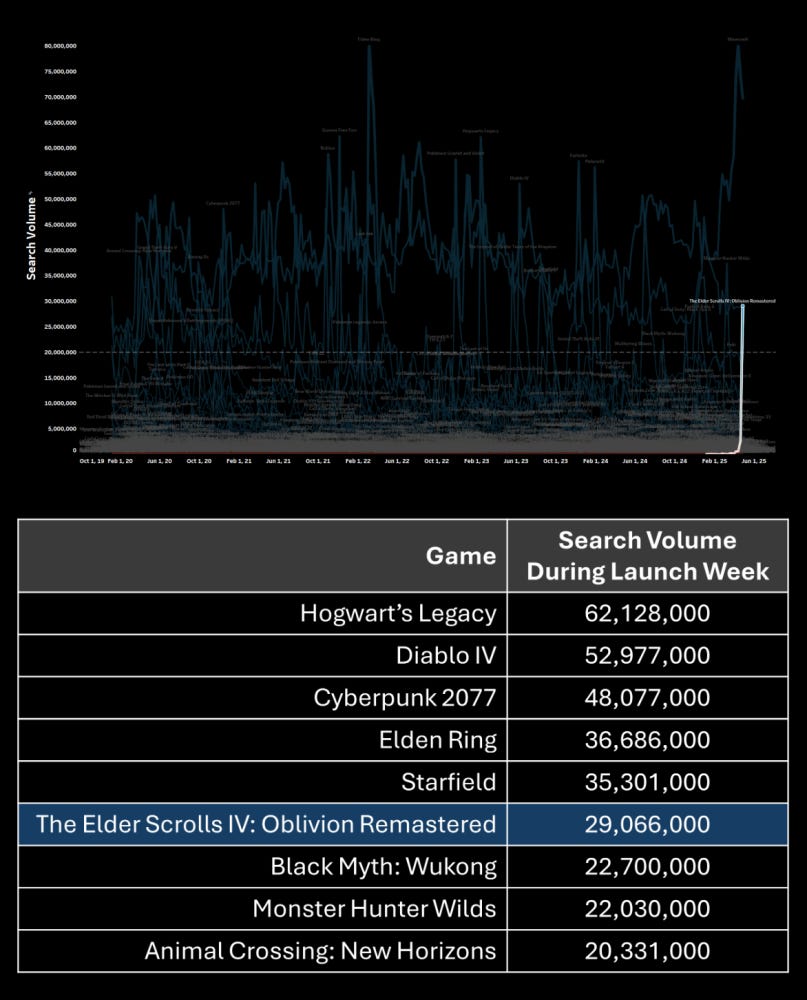
We got a preview of what the next chapter of this franchise looks like when Oblivion Remastered shadow dropped in April 2025. In launch week, it hit 29 million global searches. At mindGAME, any game that crosses that threshold is what we call the 20M Club... titles that have historically gone on to capture 20 million or more lifetime players. Elden Ring was in that club. Cyberpunk 2077 was in that club. Hogwarts Legacy, Diablo IV, Monster Hunter Wilds. That is the company Oblivion Remastered was keeping.
And Microsoft shadow dropped it into Game Pass.
Our view at mindGAME is that Oblivion Remastered was on the journey to sell a lot of copies. The signals were there. We called it out in the mindGAME newsletter at the time. But we will never know what it could have been at retail... because it was free. Microsoft handed away the answer before anyone could ask the question.
The consequences of that decision are not abstract. Games that do not generate the revenue they should generate become justification for layoffs, studio closures, and canceled projects. Nobody wants that. The math has real human consequences on the other end of it, and Microsoft has been living those consequences ever since.
Elder Scrolls VI, whenever it gets announced and whenever it ships, will be the most anticipated RPG in the history of this medium. Putting it in Game Pass on day one would be, by a wide margin, the most expensive mistake Microsoft could make. Sell it. Please.
The Signal From The Top
Today’s “We Are Xbox” memo made the reevaluation explicit:
“Along the way, we will reevaluate our approach to exclusivity, windowing, and AI, and share more as we learn and decide.” — Asha Sharma and Matt Booty, Xbox Employee Memo, April 23, 2026
Forza Horizon 6 is already the first test case, launching on Xbox and PC first with PlayStation coming later. The new north star is daily active players, not subscribers. That shift changes everything about how Microsoft thinks about launch strategy. And it is, finally, the right shift.
What Game Pass Is Actually Great For
Here is the thing though. None of this means Game Pass is broken. It means Game Pass was being used wrong. There is a version of Game Pass that is genuinely one of the best value propositions in gaming... it just requires putting the right games in it.
Game Pass thrives as a discovery layer. It is a tool that genuinely solves for one of the industry’s most persistent structural problems: players cannot try everything, and a lot of great games go undiscovered. For new IP, for AA titles, for the kind of games that would otherwise get buried under a AAA tentpole release two weeks later... Game Pass is a genuine gift.
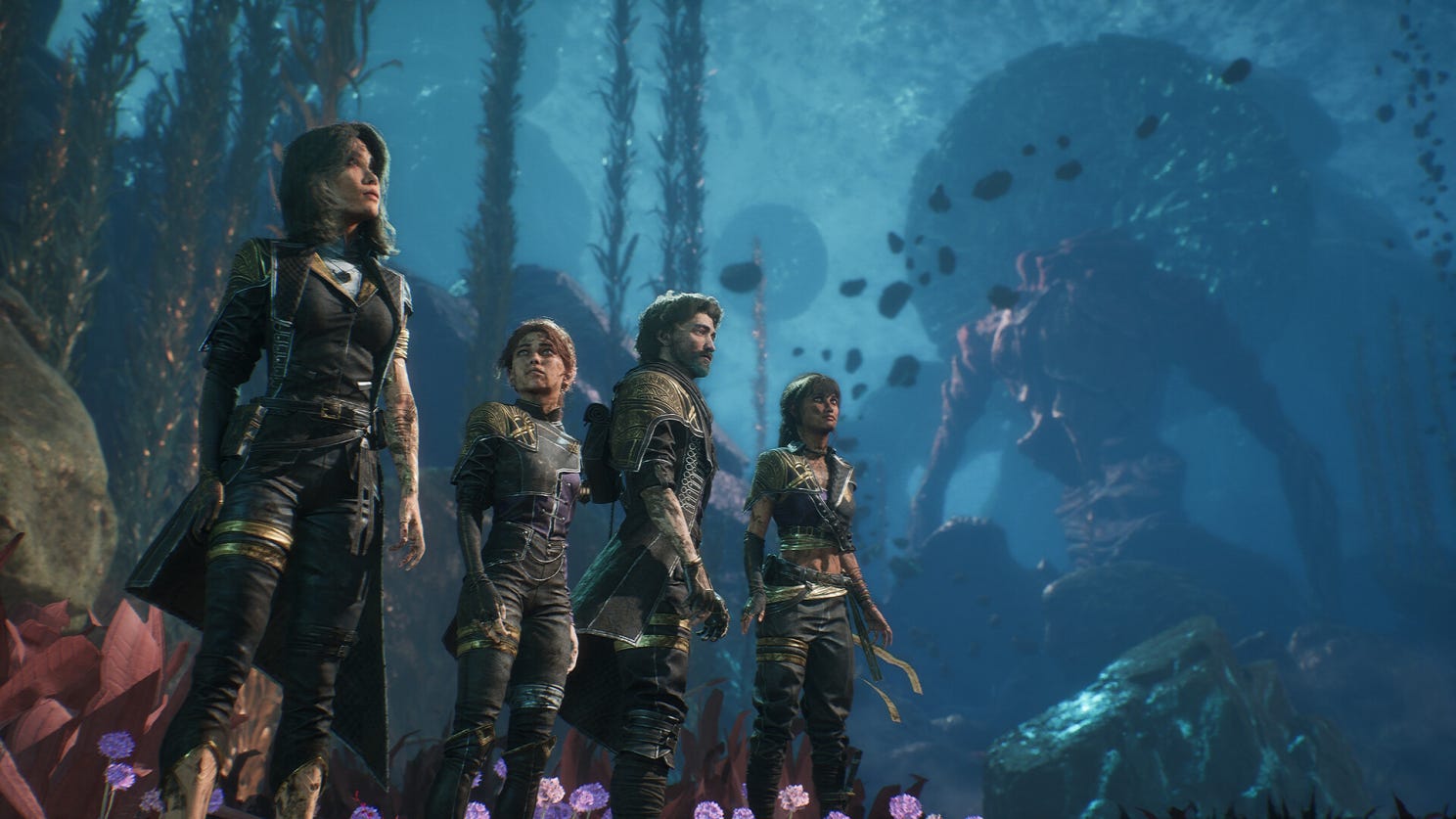
Clair Obscur: Expedition 33 is the clearest recent example. New IP. Unexpected. Critically beloved. Launched day one on Game Pass, and in part because of that, found an audience it might never have reached otherwise. The discovery friction was lower. Players who would have waited for a sale, or never taken the risk on an unfamiliar IP, jumped in immediately because the subscription removed the barrier. The attention curve on that game was remarkable precisely because it kept building after launch rather than spiking and collapsing. That is what Game Pass does when it works.
Rematch is another one. New IP, AA budget, a game that could easily have gotten lost in a crowded calendar. Game Pass put it in front of millions of players who had never heard of it. That is the value exchange. Lower discovery friction for games that need discovery... not lower commercial friction for games that already have all the commercial momentum they need.
And Microsoft is already moving in the right direction on the back catalog side. More classic Call of Duty titles are coming to Game Pass this year, with 17 entries currently absent from the service, including fan favorites like Modern Warfare 2007, Black Ops, Black Ops 2, and World at War. Adding those is exactly right. Old IP, proven games, nostalgic audience... zero cannibalization risk because the premium retail window is long gone. These are titles that have already captured their upside. Adding them to Game Pass is how you reach the price-sensitive gamer who wants to play classic Call of Duty but isn’t paying premium dollars for a game that came out a decade ago. That is the Game Pass back catalog play done correctly. Titles that have already earned their retail money, now earning discovery value inside a subscription. That is a healthy ecosystem.
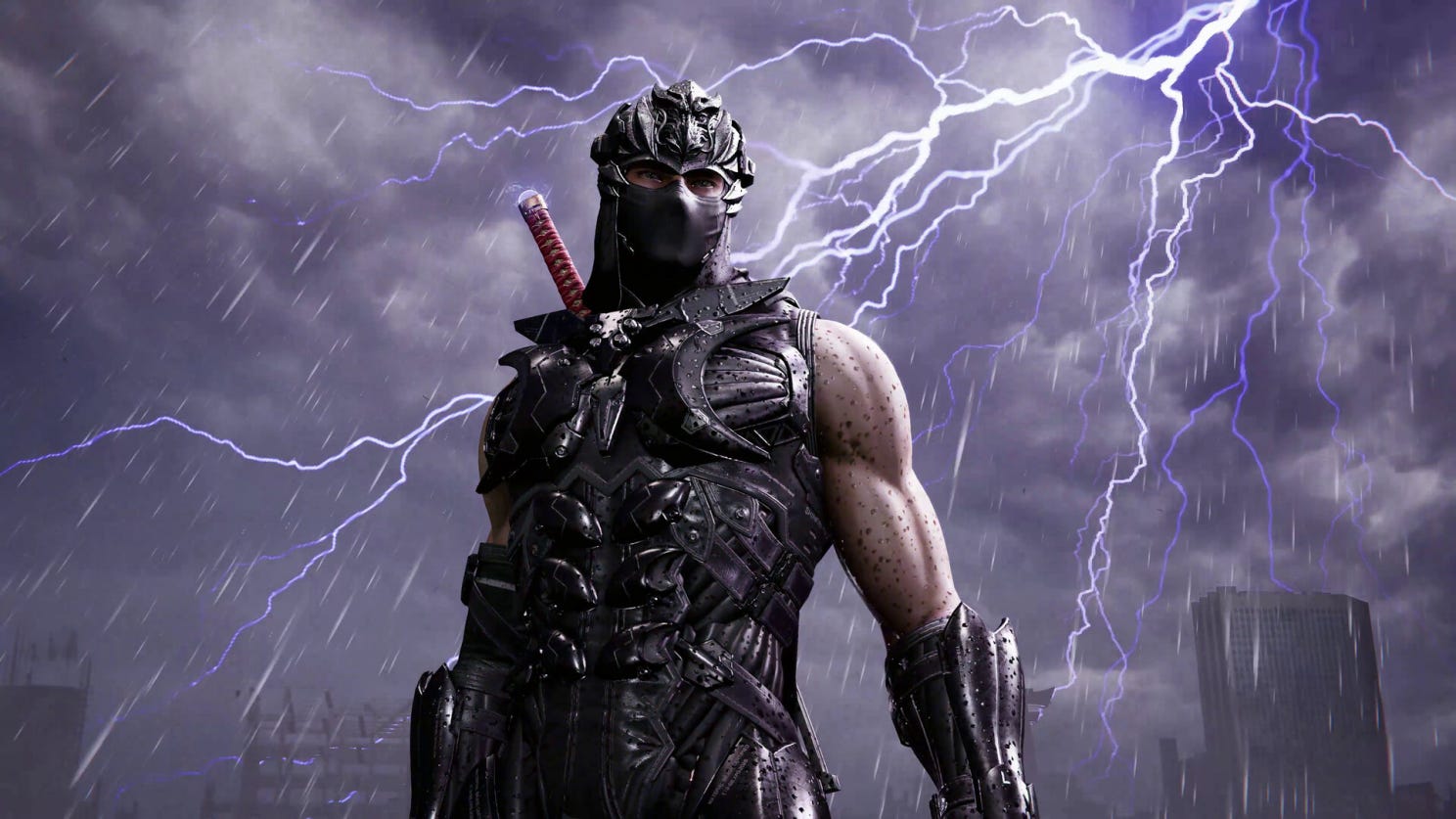
The framework is actually pretty clean once you strip away all the corporate noise. Ask two questions.
First: is this a game people would pay $70 for right now? If yes... let them pay $70 first. If no, or if the retail window has passed... put it in Game Pass and let it find its audience.
Second: is this new IP from a studio that doesn’t have the marketing dollars to compete in the attention economy? Can they hedge their bets with Game Pass and use it as a discovery tool to build a fanbase they wouldn’t have otherwise? If so... Game Pass might be exactly the right move. Low risk, high discovery, build your fans on someone else’s platform. That is the Clair Obscur playbook. First game, day one on Game Pass, find your audience. Now they have fans. The next one is full price.
Simple. Sustainable. What the service should have been from the beginning.
“The model that got us here won’t be the one that takes us forward.” — Xbox Employee Memo, April 23, 2026
No. It won’t. But the model that takes them forward might have been sitting right in front of them this whole time.
And honestly... it might not even be about subscriptions at all.
The Inevitable Conclusion
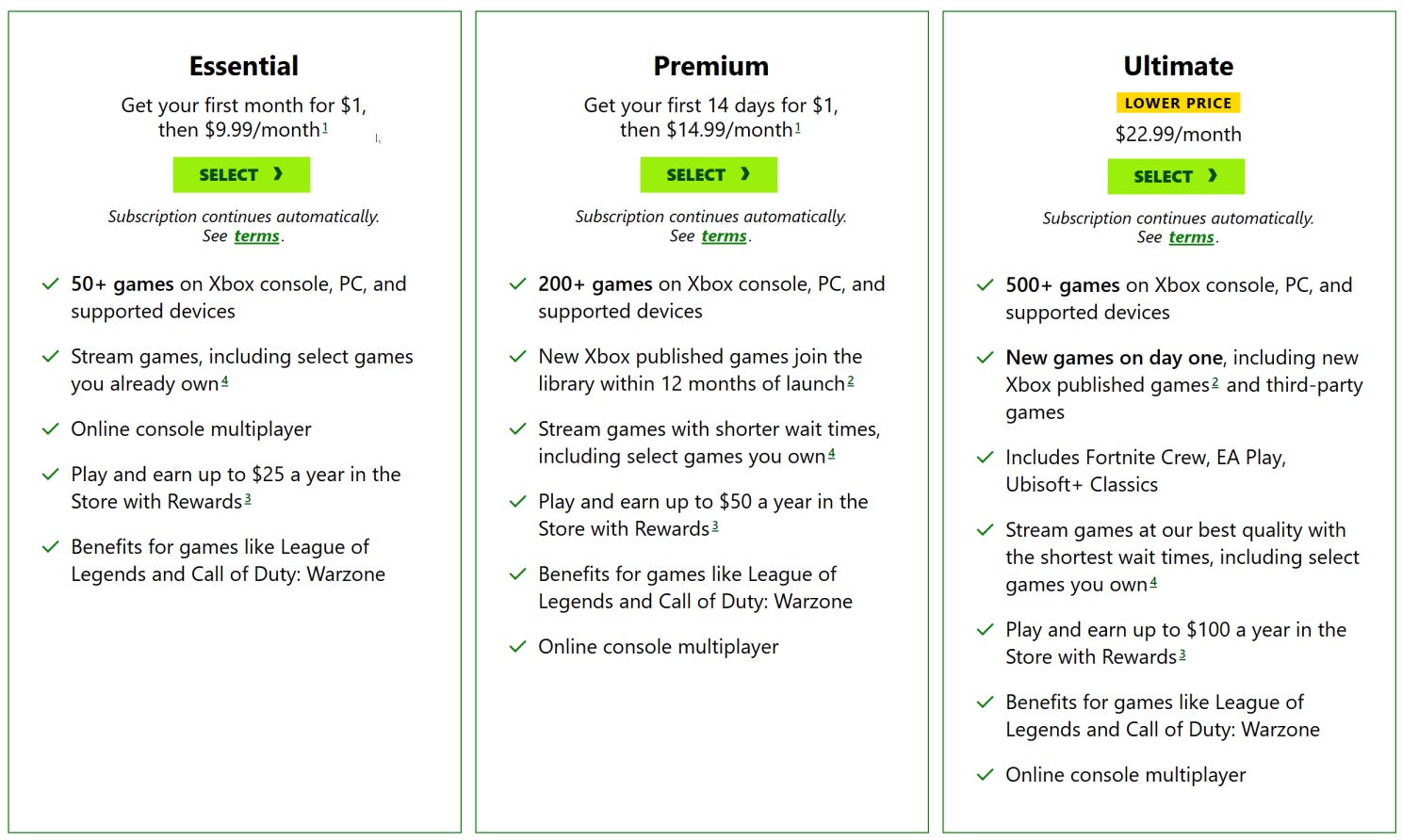
Subscription tiers are one way to capture value from an audience. Paid subscribers, whether at $22.99 or $29.99 or whatever the number settles at, represent the people who have already decided to open their wallets. That is a real business. But it is a floor, not a ceiling.
The ceiling is everyone else. The hundreds of millions of players who will never pay $70 for a game. Who will never subscribe to anything. Who play free-to-play, who watch streams, who consume content adjacent to games without ever making a purchase. They are the majority of the gaming audience, and right now, they generate exactly zero revenue for Xbox.
Every platform that has ever reached sustained attention at scale eventually figures out how to monetize the people who won’t pay. Television did it. Radio did it. Streaming did it. YouTube did it. Spotify did it. The answer is always the same.
Ads.
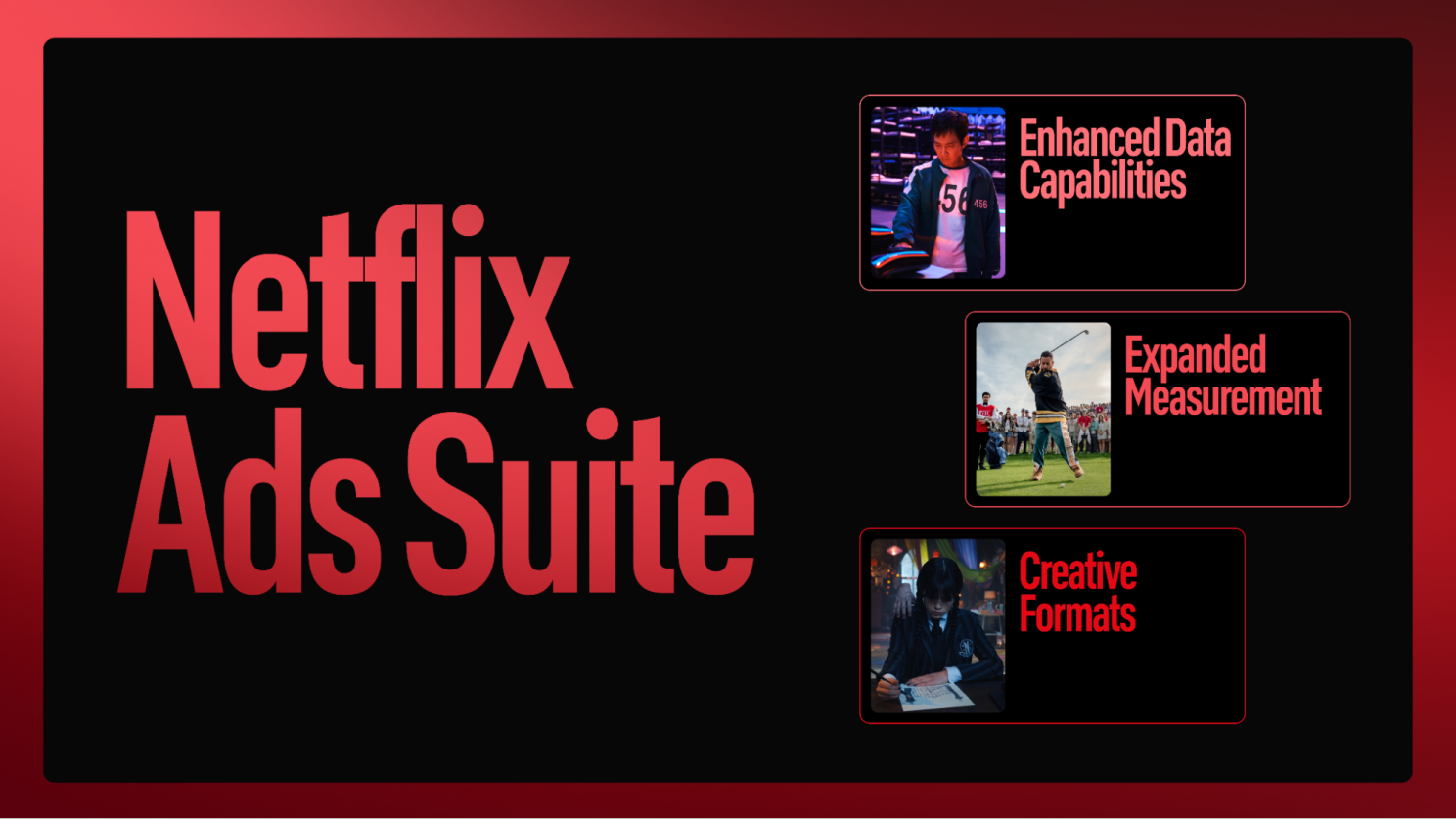
The comps are instructive. Spotify has 751 million monthly active users. Only 290 million of them pay. The other 460 million are free users who generate revenue through advertising. Spotify’s ad business did €1.68 billion in 2025... roughly 13% of total revenue... and it exists entirely because Spotify decided that monetizing attention from non-payers was better than ignoring them. Netflix is even more telling. They spent years publicly vowing they would never run ads. Then in late 2022, they launched an ad-supported tier. Three years later, ad revenue hit $1.5 billion, up 2.5x year-over-year, and they are projecting it to double again to $3 billion in 2026. Over 55% of all new Netflix signups are now choosing the ad-supported plan. 190 million monthly active viewers are on the ad tier. Their fastest-growing revenue stream is the one they swore they would never build.
Gaming is the last major attention platform that hasn’t made this move.
Matthew Ball’s State of Video Gaming 2026 report lists advertising as one of the five biggest revenue growth areas in gaming this year. And in his interview with Christopher Dring at The Game Business, he put it plainly:
“Eventually advertising does reach all addressable surface areas. It does. We see it in an Uber app. We see it in Tinder. It’s now in ChatGPT. It’s going to be in Gemini. We see it at gas station kiosks. Every place that can have an ad does ultimately have an ad.” — Matthew Ball, The Game Business, February 26, 2026
That is not speculation. That is pattern recognition across every medium that has ever existed.
The numbers make the case on their own. Outside of China, mobile game in-app advertising hit roughly $67 billion in gross revenue in 2025. Since 2021, mobile ads have accounted for 37 to 145% of annual industry growth. Without ads, the global gaming market outside China is up only $6.8 billion over four years. With ads, it is up $35 billion. Advertising is not a side business in gaming. It is already one of the primary engines of growth... just not on console. Yet.
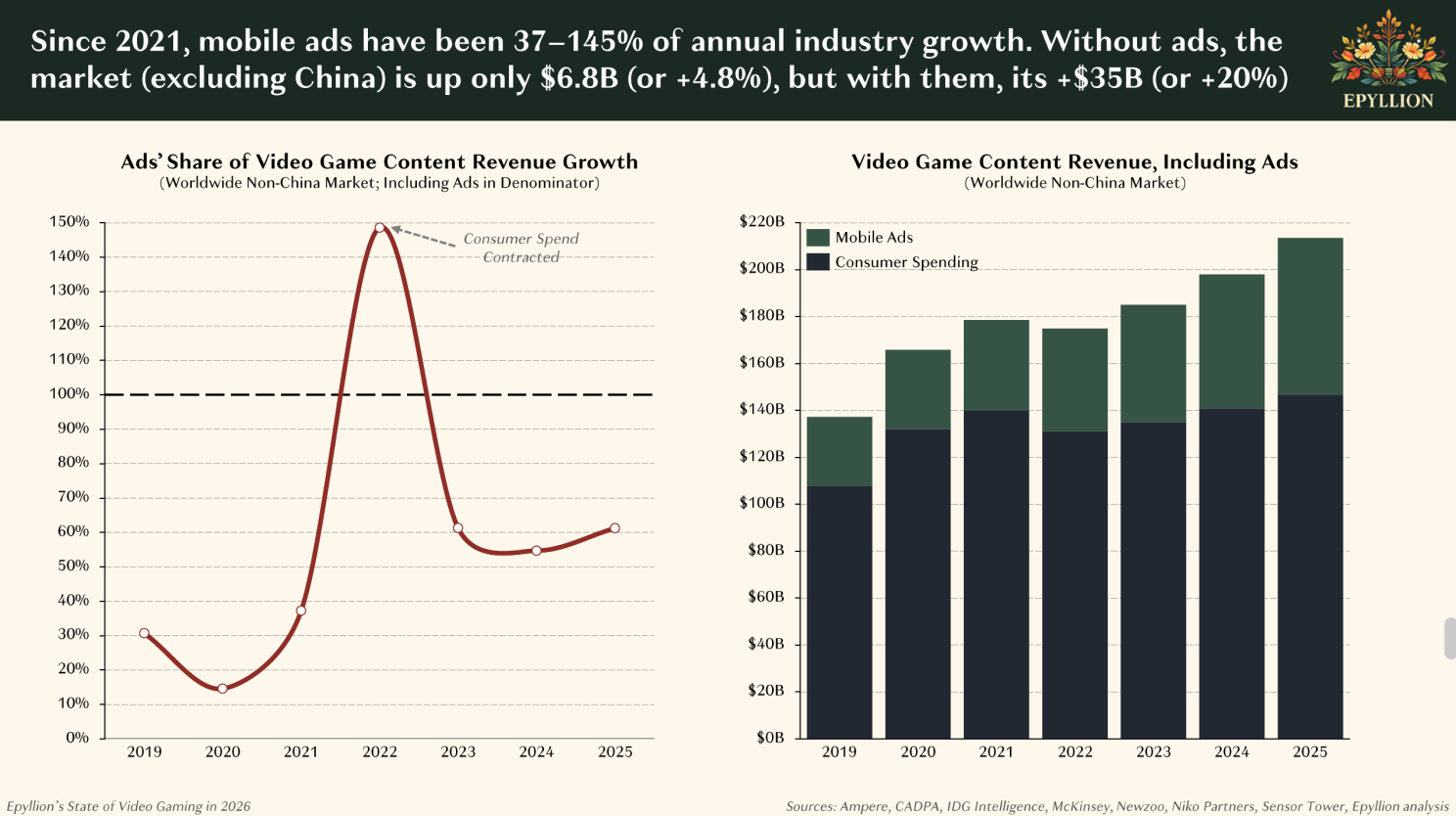
Joost has been documenting this gap for over a year now. In his October 2025 piece on Game Pass, he laid out the numbers:
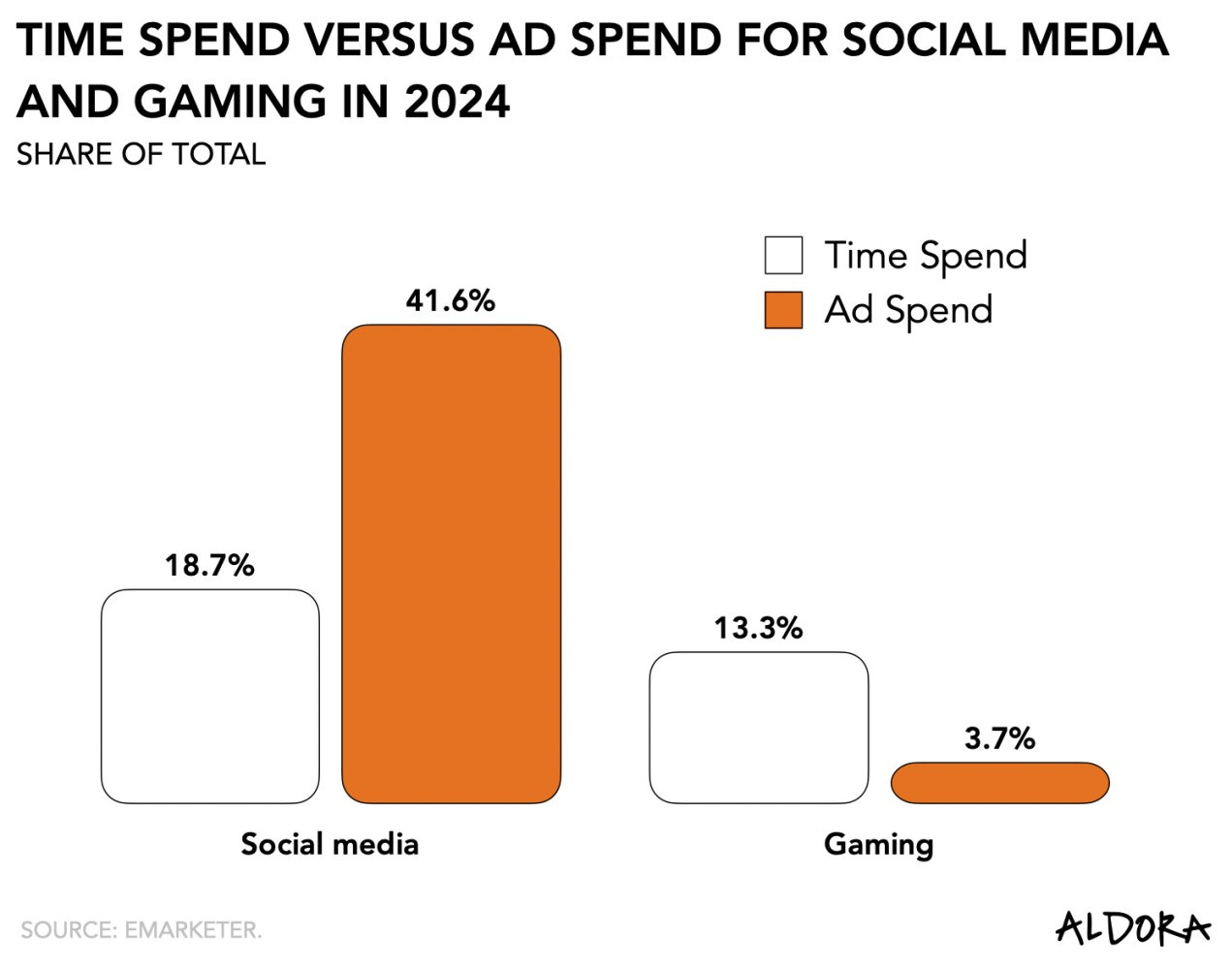
“Gaming commands a comparable time share of 13 percent, but receives only 4 percent of total ad spending.” — Joost van Dreunen, SuperJoost Playlist, October 29, 2025
Joost and Julian Runge made this case explicitly in Harvard Business Review last November:
“Brands that dismiss games as a niche interest are missing out on one of the most powerful media channels available today. Contemporary play offers a dynamic interactive environment for brands to engage with consumers.” — Julian Runge and Joost van Dreunen, Harvard Business Review, November 20, 2024
The data backs it up. In 2024, social media accounted for 19% of total consumer time and 42% of total ad spend. Gaming commands a comparable 13% of time... and gets 4%. That gap is not sustainable. It has closed in every other medium. It will close here.
And in mature markets where player counts are flat, content spend has been declining since 2021, and free-to-play dominates more than half of all PC gaming time... publishers will need to find a way to monetize the people who aren’t paying for anything. Ball made the economic argument directly:
“If we say that audiences in the eight major markets are not spending more, the costs are going up, we don’t want layoffs, we don’t want fewer games... the money needs to come in one way or another.” — Matthew Ball, The Game Business, February 26, 2026
Advertising is the only mechanism that does that at scale.
I wrote about this dynamic in Can Big Tech Be Good at Gaming back in October. Microsoft’s internal 30% accountability margin target for gaming is not achievable through content sales alone. The industry average margin runs between 17 and 22%. Court documents from 2023 revealed that Xbox’s gaming business was running at 12% profit margin. As S&P Global analyst Neil Barbour put it:
“A 30% or better margin is usually reserved for a publisher that is really nailing it.” — Neil Barbour, S&P Global, via Bloomberg
You do not close that gap by selling more copies of Fable. You close it by building a revenue stream that doesn’t exist yet.
So the thesis is clear. The opportunity is real. The question is whether Microsoft can actually execute it.
Microsoft Is Historically Terrible At Ads
I need to be direct about this because it matters. If it could be any company other than Microsoft building the ad-supported future of gaming, I would feel a lot better about it.
The numbers first.
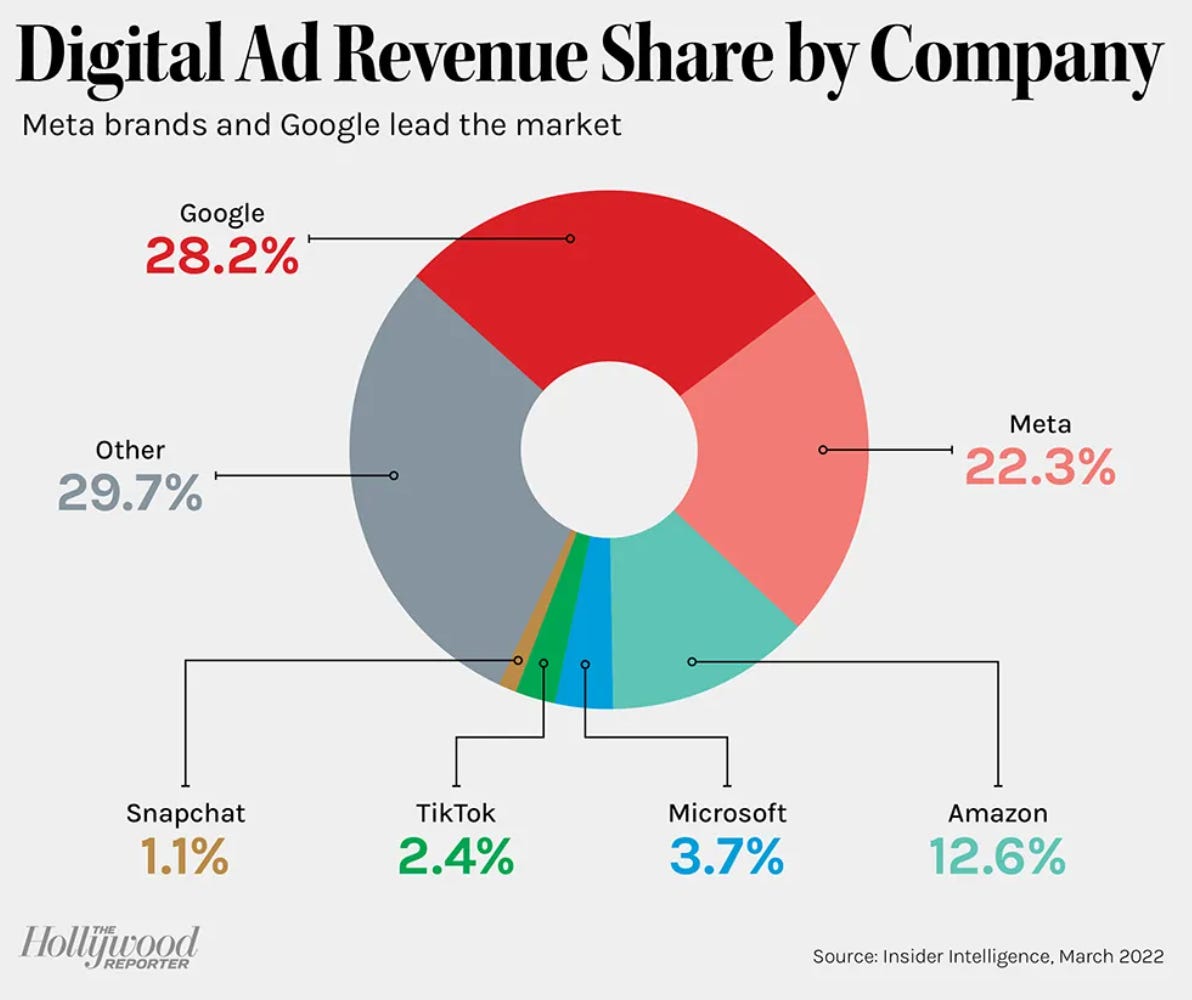
Google: roughly $265 billion in ad revenue in 2025. Meta: roughly $185 billion. Amazon: roughly $69 billion. Microsoft search and news advertising: roughly $14 billion. According to eMarketer, that makes Microsoft the seventh largest advertising company globally... behind not just its US big tech cohort but Chinese companies like Alibaba and ByteDance. For a $3 trillion company, that is embarrassing. Amazon barely had a serious ad business a decade ago and is now 5x Microsoft’s size. Google outpaces them roughly 15-to-1.
And the history is worse than the current numbers suggest. This is not Microsoft’s first attempt at building an ad business. It is closer to their fifth. And every single one has ended the same way.
2006 - Microsoft bought Massive Inc. for somewhere between $200 and $400 million. Massive was the leading in-game ad network at the time, and Microsoft predicted the in-game advertising market would hit $2 billion by 2010. They shut Massive down in 2010. As Digiday reported, it failed partly because cultural and technological roadblocks stood in the way, and partly because Xbox Live’s own ad business was more attractive since Microsoft didn’t have to share revenue with publishers.
2007 - Microsoft paid $6.3 billion for aQuantive, one of the largest ad tech acquisitions in history at the time. AdExchanger documented the whole saga in a fantastic oral history piece from 2022 that is worth reading in full. The short version: five years after the acquisition, Microsoft wrote down $6.2 billion of it. Nearly the entire purchase price. Gone.
They lost the DoubleClick bid to Google, which became the backbone of Google’s display advertising empire. They built AdECN, an ad exchange that showed real promise, and then never let it scale outside Microsoft’s own walls.
2021 - Microsoft bought Xandr back from AT&T. This was supposed to be the one that finally worked. A demand-side platform with real infrastructure, real clients, real scale. They brought Netflix in to power their video advertising infrastructure in 2022... and by 2024, Netflix was already building its own in-house ad tech to replace them. The partnership lasted roughly two years before Netflix walked away entirely, launching its own Netflix Ads Suite in early 2026. And then in May 2025, Microsoft shut the Xandr DSP down. Digiday reported the closure and the reasoning:
“Our commitment to more private and personalized advertising experiences for a conversational and agentic world is not achievable with the industry’s current DSP model and, therefore, it no longer aligns with our investment in this future.” — Microsoft internal document, via Digiday, May 14, 2025
They also shuttered PromoteIQ, their retail media platform purchased in 2019, around the same time. Two ad tech acquisitions, both closed within a year of each other.
Every single time. The idea is right. The execution crumbles. I said it on Player Driven this week and I will say it again here... you cannot find a company of Microsoft’s size doing advertising more poorly, more consistently, over a 25 year span.
Why This Time Might Be Different
Here is the nuance though. It was not always the wrong idea. It was the wrong timing and the wrong audience.
Joost has been writing about this directly. The ad crowd and the gaming crowd have historically been demographic opposites who are only now learning to speak the same language. The gamer of 2006 was actively hostile to brand messaging. The gamer of 2026 is 40 years old on a phone. They have watched ads their entire digital life. Culture finally caught up to the thesis.
And this is where the structural argument gets interesting. This is Ben Thompson’s Aggregation Theory playing out in real time. The winners in every internet-era industry are the platforms that own the consumer relationship and aggregate demand... Google in search, Amazon in retail, Meta in social. Suppliers come to the platform on the platform’s terms because that is where the consumers are. The platform commoditizes supply and monetizes demand. That is how advertising empires get built.
Gaming has not had its aggregation moment on the advertising side yet. The aggregators already exist... Steam, PlayStation, Xbox, Nintendo. They control consumer demand. But they monetize almost exclusively through selling games and in-game transactions. The attention itself, the hours people spend on these platforms, is largely unmonetized. Roblox is the closest thing to an ad-driven platform play in gaming... but it skews heavily toward kids, has struggled to monetize beyond that demographic, and sits as a platform within a platform rather than owning the device layer. The structural ingredients for a true ad-supported aggregation play on console are there. Nobody has pulled the trigger.
The reason in-game advertising companies like Anzu and Bidstack have struggled is exactly this. They don’t own the inventory and they don’t own the platform. They are middlemen without a foundation. If their model works, the platform squeezes them. If it doesn’t, they die. The aggregator always wins.
The ad business in gaming will be built at the platform level. Not inside games. As you load them. Pre-roll, not in-game. Ball made this point directly using the NBA 2K example:
“2K said last year that two and a half billion games of NBA 2K are played a year. That’s two and a half billion games that were match made and have some loading screen. That’s such an extraordinary amount of inventory. Would Ford Mustang or The Avengers or Old Spice pay some pretty material sum for that inventory with a targeted, valuable audience? Of course.” — Matthew Ball, The Game Business, February 26, 2026
Two and a half billion loading screens a year. One game. One franchise. Now imagine that inventory across every game on Xbox. Every boot-up. Every session start. Every cloud gaming stream. That is the surface area.
Now... is Xbox subscale in the console universe? Yes. Roughly 3-to-1 behind PlayStation in the current generation, and that is before you even get to Nintendo. And with Project Helix rumored at $1,000 to $1,200... more than double the Series X launch price... the hardware is not getting more accessible anytime soon. Something has to give. If the device is going to cost more, the service needs to cost less. An ad-supported Game Pass tier drops the subscription floor to zero and monetizes attention instead of fees. You are not competing for the person who is going to spend $1,200 on a console and $23 a month on Game Pass. That person is already yours. You are competing for the person who maybe bought the device, maybe accesses Xbox through their PC, who is price sensitive to buying new games at $70 and will never pay $23 a month for a subscription... but is more than happy to sit through a 30-second ad to play Starfield, Halo, Elder Scrolls, DOOM, or Forza for free. That is a fundamentally different audience. And it is a much, much bigger one.
As Justin Ruiss from BWG Global put it on Player Driven this week:
“If somebody wants to play Starfield... they’ll sit through it. And that’s to an advertiser... those are really strong metrics, especially coming from mobile.” — Justin Ruiss, BWG Global, Player Driven, April 23, 2026
Near-100% video completion rates. A closed-loop ecosystem. Consumer data deeper than anything on YouTube or connected TV. The first advertisers would obviously be other gaming companies... that is the most natural fit and the easiest attribution story to tell. But over time, you would see the traditional male-skewing TV brands migrate over too. Energy drinks. Trucks. Fast food. Sports betting. The same brands that follow the 18-to-49 male demo everywhere it goes. They followed that demo to ESPN. They followed it to YouTube. They followed it to Twitch. They will follow it to Xbox.
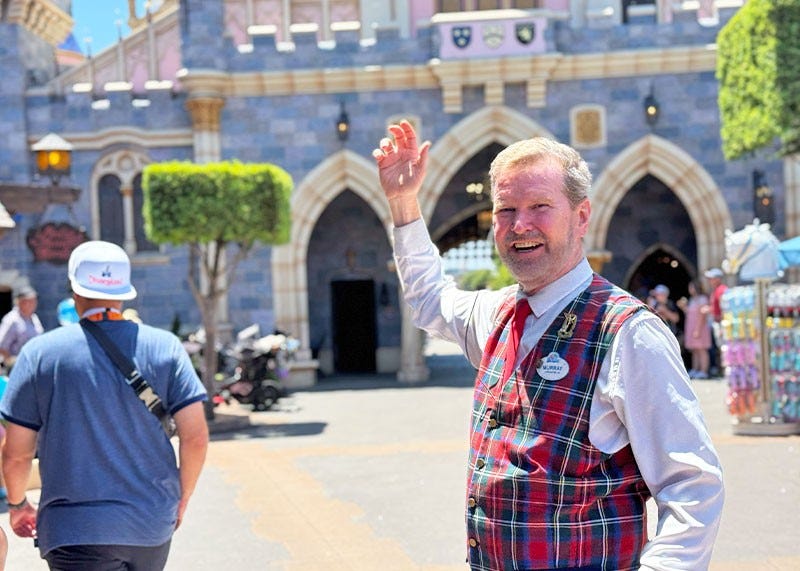
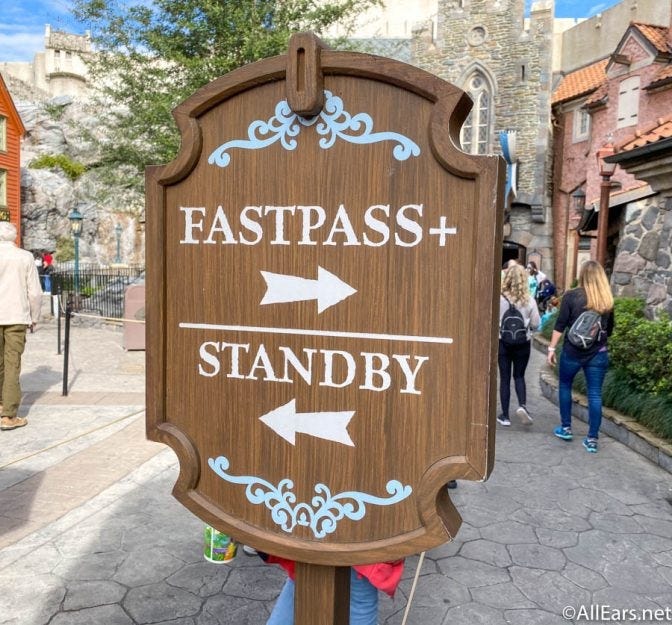
Think about it like Disneyland. You have your Sherpas... the one percenters paying $10,000 for three hours of VIP treatment. You have your Lightning Lane buyers... the middle class paying extra on top of their ticket to skip lines. And then you have standby. Free to enter. You get the experience eventually. But you wait, and while you wait, you consume whatever the park puts in front of you. That is the ad-supported tier of Game Pass. You want to play games for free? Great. But you are going to take your medicine on the way in. For those who can afford to save their time by paying for it... pay up and skip the ads entirely. For those who can’t afford the money but have the time to give... welcome to standby. The experience is the same. The price is different.
No other platform in gaming would do this. Valve does not need to... they are private, profitable, and happy. Sony will not... ads at this scale are not in their DNA, and they have a premium brand to protect. Nintendo will not under any circumstance. And Netflix’s gaming business... I remain deeply skeptical. You cannot explain to me what they are trying to do on the TV set for games.
So who does it? The platform that is desperate enough to try, big enough to absorb the risk, and now run by someone who has actually built this exact model before.
The Sharma Bet
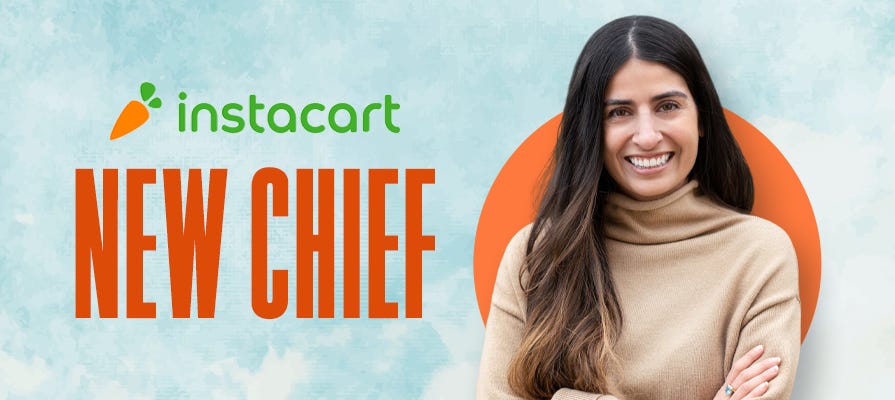
Asha Sharma built Instacart’s ad business into its highest-margin revenue stream, growing faster than core delivery every year since 2022. She knows what it looks like when an audience platform stops pretending to be something else. Joost framed it in his Prelude to Divestiture piece back in February:
“Sharma’s appointment is the strongest signal yet that Xbox’s future is as a platform, not a content business. Her background is in commerce infrastructure and advertising monetization... the opposite of what a gaming executive typically looks like.” — Joost van Dreunen, SuperJoost Playlist, February 26, 2026
She did not come to Xbox to sell consoles. She came to build a platform.
And in today’s “We Are Xbox” memo, Sharma and Booty laid out priorities that read like a platform playbook, not a games company memo:
“Return the business to durable growth with strong cost discipline.” — Xbox Employee Memo, April 23, 2026
“Fortify Game Pass with clear differentiation and sustainable economics.” — Xbox Employee Memo, April 23, 2026
Durable growth. Sustainable economics. Cost discipline. That is not the language of a company about to double down on $500 million game development budgets. That is the language of a company building a platform with multiple revenue streams, where advertising is the one that scales fastest and costs least.
Ball calls advertising one of the five biggest growth opportunities in gaming in 2026. Xbox has the surface area. The question isn’t whether ads are coming to Game Pass. The question is whether Microsoft’s organizational DNA can actually execute it after 25 years of failure.
The track record says no. Sharma’s CV says maybe. She is the first person in that chair who has actually built this model before.
Whether she makes this move remains to be seen. But it is the most obvious play on the board... and given where she came from, it is exactly what I would expect her to do.
Discord, The Missing Piece... And The Disneyland Of It All
One more thing before I let you go this week.
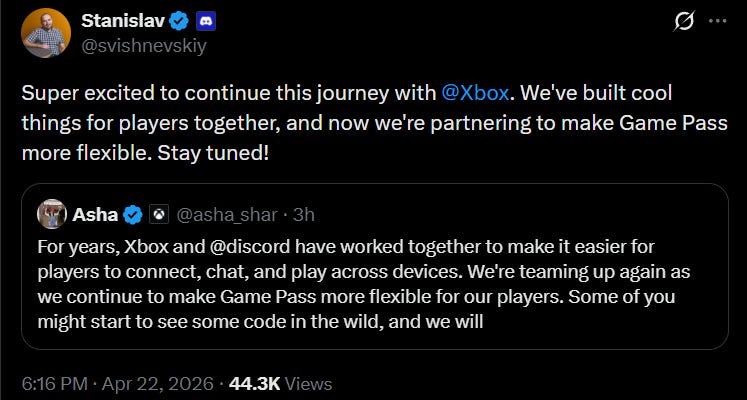
The day after the Game Pass price cut, Sharma tweeted about a new Discord and Xbox Game Pass partnership. Her words: “as we continue to make Game Pass more flexible for our players.” Discord responded with a single word: “Soon.” Sharma followed up by saying some people might start to see code in the wild.
The code showed up faster than expected.
As I’m writing this, The Verge is reporting that a new Xbox Game Pass “Starter Edition” has leaked... bundled with Discord Nitro. Access to over 50 games from the Game Pass library. 10 hours a month of Xbox Cloud Gaming streaming. Xbox Rewards points while playing. Leaked images suggest titles like Stardew Valley, Grounded, and Fallout 4 are included... and it is not limited to Microsoft first-party games. Third-party titles are in the mix too. The leaked codenames “Triton” and “Duet” that had been floating around for months? This is what they were.
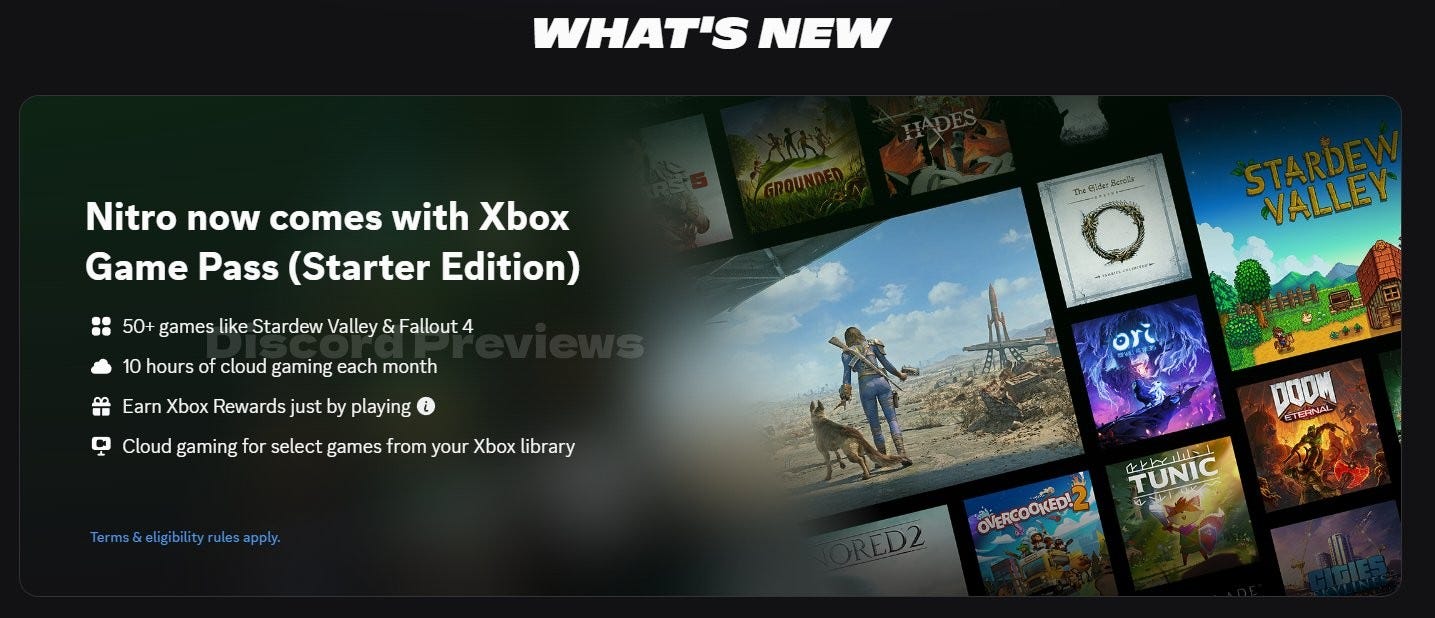
A version of Game Pass, at effectively the cost of a Discord Nitro subscription, bundled inside a service people are already paying for. Accessible through cloud streaming. No console required.
That is not a perk. That is a distribution play. Microsoft is taking Game Pass and embedding it inside other platforms’ subscription ecosystems. Discord Nitro today. Netflix tomorrow... Greg Peters already said publicly that he and Sharma have “kicked around ideas” for a subscription bundle. Game Pass is no longer just a subscription you buy from Xbox. It is becoming infrastructure that other services plug into.
A $12 Billion Rejection That Looks Different Now
Here is where I want to zoom out. Because this partnership is interesting on its own. But the history underneath it is a lot more interesting.
In 2021, at the peak of COVID froth, Microsoft tried to buy Discord. Bloomberg reported the offer and the rejection:
“Microsoft Corp. and video-game chat company Discord Inc. have ended takeover talks after Discord rejected a $12 billion bid.” — Katie Roof and Dina Bass, Bloomberg, April 20, 2021
At the time, Bloomberg’s Jason Schreier framed why Microsoft wanted it in the first place:
“For Microsoft, these varied communities may be Discord’s biggest selling point. The software giant has been shopping for assets that would provide access to thriving communities of users.” — Jason Schreier, Bloomberg, March 26, 2021
That was the logic in 2021. Access to communities. Discord walked away from $12 billion. They had just raised $500 million at a $15 billion valuation. The IPO was the obvious path. Growth was exploding. Why sell?
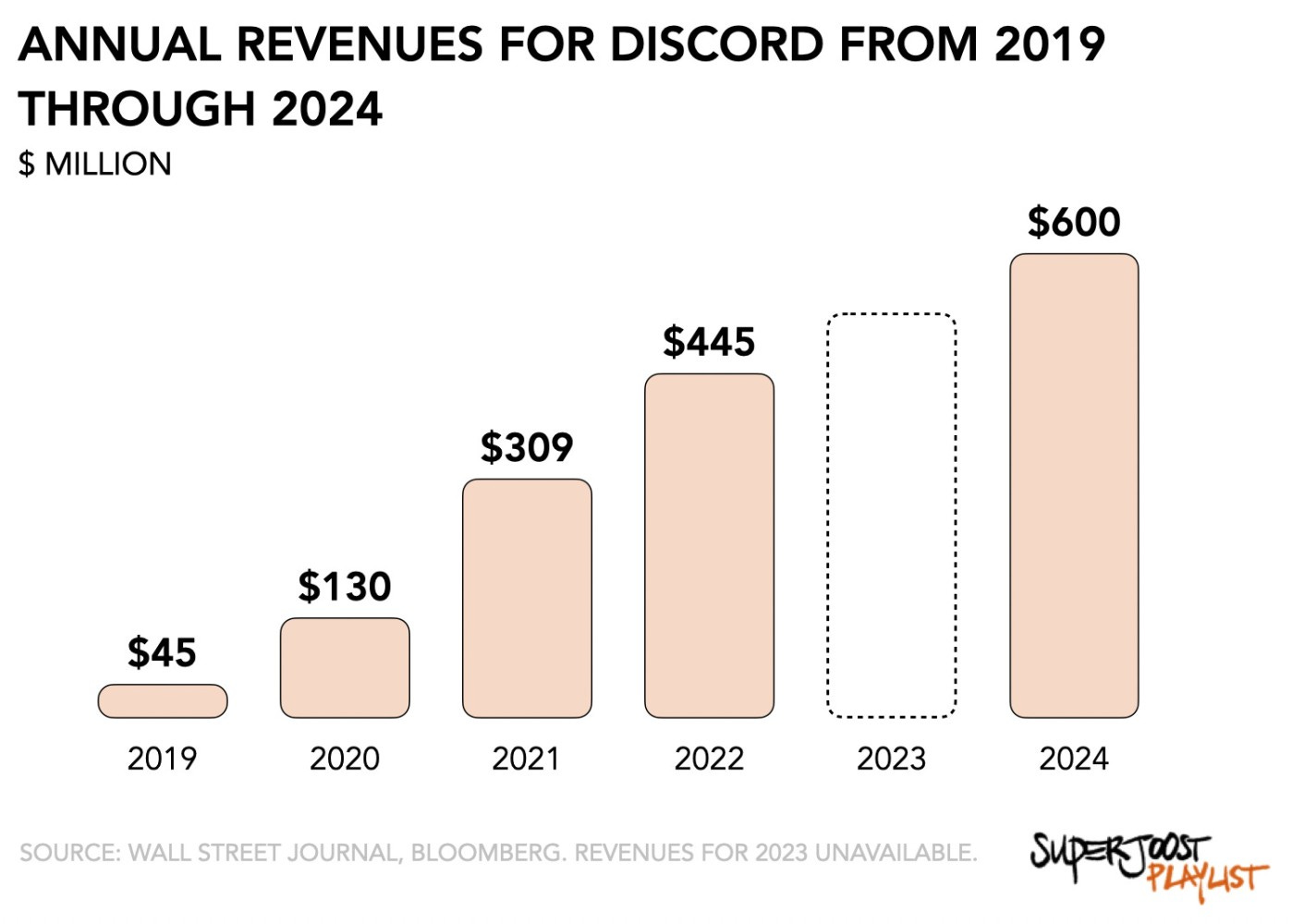
Fast forward five years. Discord’s revenue has roughly tripled... from $309 million in 2021 to an estimated $879 million in 2025. That sounds great. Except the valuation went the other direction. Secondary market pricing in late 2025 had Discord at roughly $7 billion... less than half the $15 billion peak. The revenue tripled. The valuation halved. That math does not lie about what the market thinks of the business.
Joost wrote about this in January when Discord confidentially filed for its IPO:
“Its 200 million monthly active users are proving difficult to monetize directly.” — Joost van Dreunen, SuperJoost Playlist, January 15, 2026
For context... Reddit, considered Discord’s closest public market peer, relies on advertising for 94% of its revenue. Discord is still overwhelmingly dependent on Nitro subscriptions. The ad infrastructure is early. The monetization story is thin. And the IPO that was supposed to happen in March 2026? It is April. It hasn’t happened.
The Ad Inventory Problem
Here is where this ties back to the advertising thesis I just spent several thousand words building.
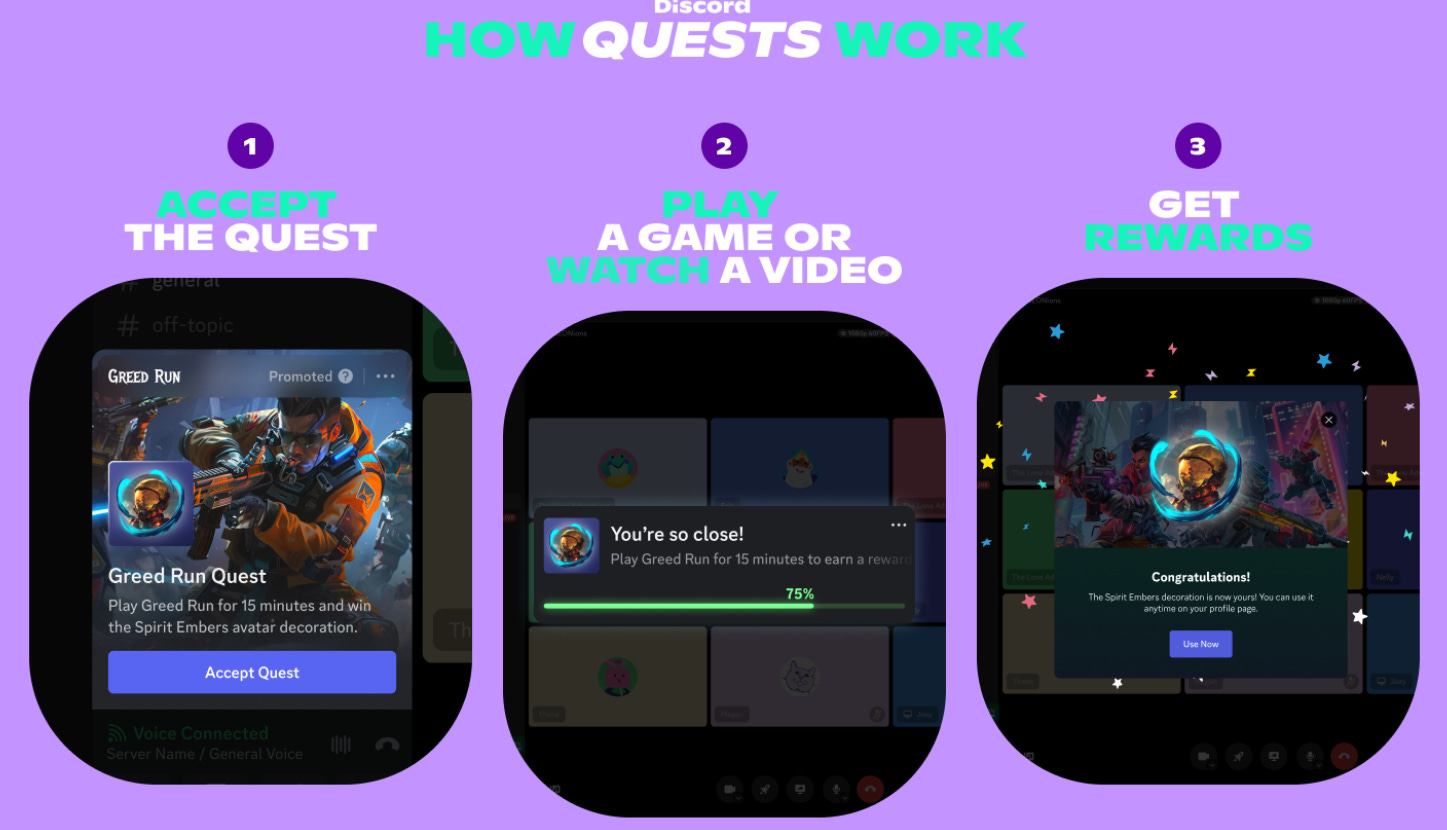
Discord has Quests... their rewarded ad product where players watch a trailer or play a game and earn avatar decorations or in-game items. The early results are solid. Brands like Blizzard, Capcom, Supercell, and even Wendy’s have run campaigns. But Quests are a fraction of what a platform with 90 million daily active users... 90% of whom play video games... could be generating in ad revenue. Discord is a product in search of real ad inventory. The audience is there... the engagement is there... the attention is there. What is not there is the scale of ad infrastructure, the depth of advertiser relationships, or the platform-level monetization engine to turn all of that into revenue that moves the needle on a $7 billion valuation.
Now think about what happens if Microsoft owns Discord.
Microsoft gets a feeder ground for gamers who may play Xbox... or may never play Xbox. It does not matter. What matters is that those 200 million monthly active users, across every gaming platform... PlayStation, Steam, Nintendo, mobile, PC... are now inside a Microsoft-owned product. And Microsoft can push the ad-supported tier of Game Pass directly to them. Not as a marketing campaign. Not as a partnership negotiation. As a product feature. You are on Discord. You are already here. Here is Game Pass for free. Play 50 games. Watch a 30-second ad before you load in. No console required. Cloud streaming. Done.
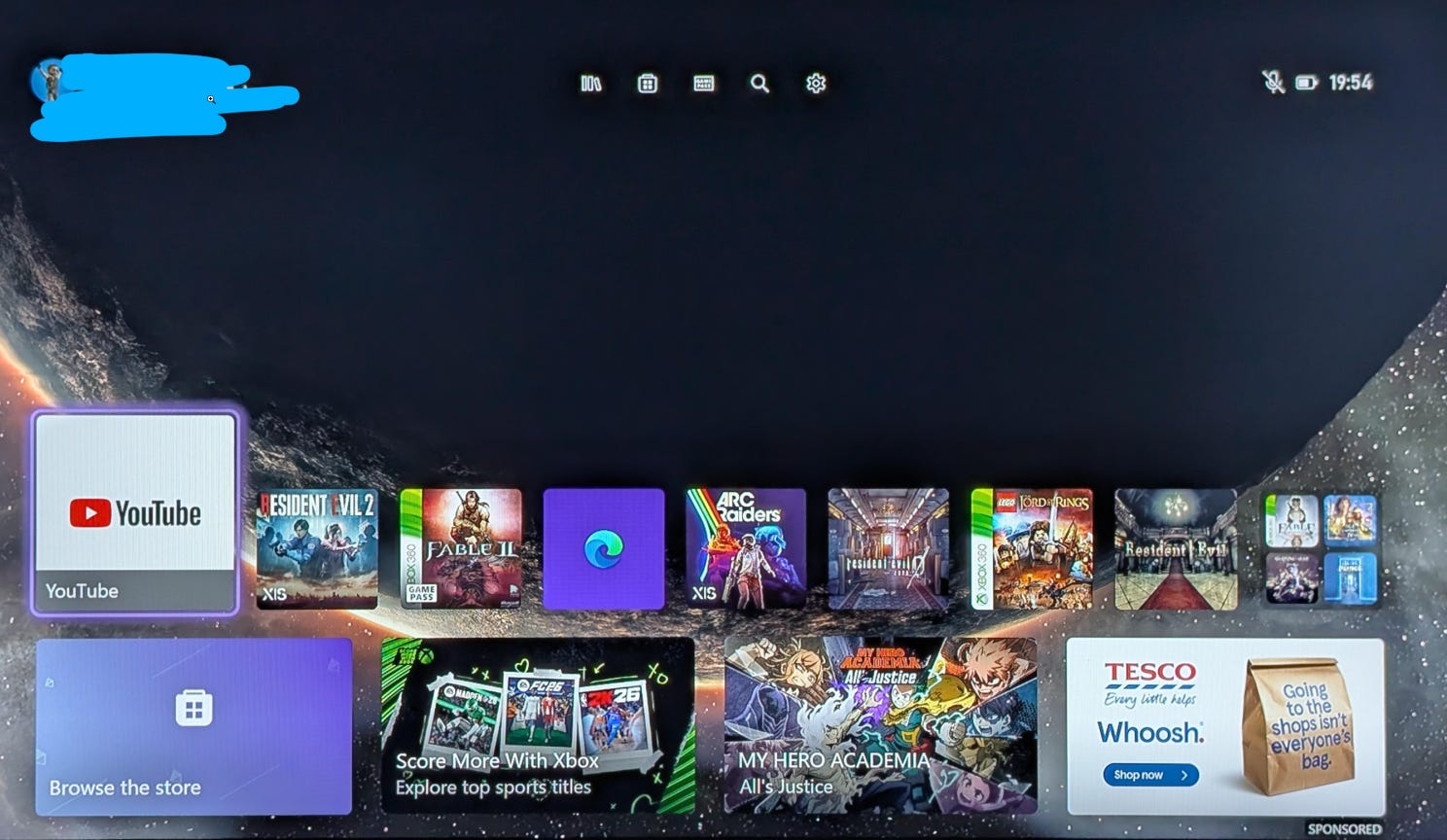
Discord gets the ad inventory it desperately needs... actual games being played, actual loading screens, actual engagement minutes that advertisers will pay premium rates for. Microsoft gets the distribution channel for the free tier of Game Pass without spending a dollar on user acquisition. The player gets free games. The advertiser gets a captive, high-intent audience with near-perfect completion rates.
That is the win-win-win. And it is why I think this partnership is not the end of the story.
Think about what Discord actually is. It is the platform-agnostic social infrastructure of gaming. PlayStation integrated Discord voice chat into the PS5 in 2023 because their own party chat wasn’t enough. Xbox did the same thing in 2022. Steam has its own chat features that nobody uses because everyone is already on Discord. Every major gaming platform has effectively conceded that Discord is where their players actually talk to each other. That is an extraordinary position of leverage.
Xbox gets access to gamers they have lost or never had. And Microsoft gets to play to its actual strength in infrastructure and enterprise services... while being forced to finally get good at the one thing they have historically been terrible at. Ads. That is my concern and it has been the through line of this entire piece. Microsoft has to get good at advertising. Not because they want to. Because the math demands it. The 30% margin target is not achievable through content sales. The subscription ceiling is real. The only path to the kind of high-margin, scalable revenue that justifies a $69 billion acquisition and a gaming division this size... is advertising. They have failed at it five times. Maybe the sixth time, with the right executive, the right platform, and the right structural moment... they finally figure it out. They kind of have to.
And here is the thing that would make Wall Street lose its mind. Microsoft would not pitch a Discord acquisition as a gaming deal. They would pitch it as an AI play. 200 million monthly active users generating billions of messages, voice hours, and behavioral data points every month. That is a training dataset. That is a conversational AI infrastructure play. That is Copilot integrated into the largest real-time communication platform in gaming. You frame it that way and the stock goes up on the announcement, not down.
Back To Disneyland
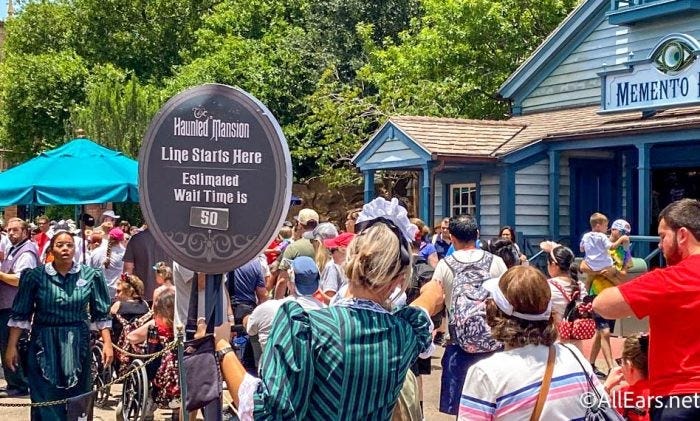
Remember the Disneyland analogy? The Sherpas paying $10,000 for VIP. The Lightning Lane buyers paying extra to skip lines. And standby... free to enter, but you consume whatever the park puts in front of you while you wait.
Discord is how you build the standby line for gaming. It is how you reach the hundreds of millions of players who will never buy a console, never pay $70 for a game, never subscribe to Game Pass at any price... but who are already inside the park. They are already on Discord. They are already in the communities. They are already paying attention. They are just not paying money. Yet.
An ad-supported Game Pass tier, distributed through Discord, accessible through cloud streaming, monetized through pre-roll ads at the platform level... that is standby. That is the free tier. The experience is the same. The price is different. For those who can afford to save their time by paying for it... pay up and skip the ads entirely. For those who can’t afford the money but have the time to give... welcome to the park. Microsoft will figure out how to monetize the wait.
Whether any of this happens or not... I don’t know. But the pieces are on the board. And if the last week has shown us anything, it is that Sharma is not the kind of executive who waits around. Game Pass price cut. Call of Duty pulled from day one. “This is an Xbox” killed. “Microsoft Gaming” scrapped. Xbox identity restored. Exclusivity reevaluated. Discord partnership teased. Netflix conversations in the open. A north star metric shift to daily active players. An employee memo that told 10,000 people the old model is dead.
All of that. In two months.
That is not someone finding her footing. That is someone who showed up with a plan and is executing it faster than anyone expected.