

Star Wars Gaming Has Me Hopeful Again... & Will Xbox Sandbag GTA VI?

Follow me here… or on LinkedIn
Welcome back to Patch Notes. Quick housekeeping before I get into anything else.
I will be at GamesBeat Summit 2026 at the Marina del Rey Marriott on May 18th and 19th. The Marriott has become an annual tradition for me at this point, so I know the building well. Mornings I’ll be camped at the Starbucks in the lobby. Afternoons in sessions. Monday night I’ll be around for whatever shakes loose. If you want to talk all things mindGAME before the Summer Game Fest chaos kicks in, find me, grab me in a corner, let’s talk shop... patch notes, attention economy, my terrible (or great) takes, you decide. Same goes for SGF and the events orbiting it in early June. The next six weeks are when most of the industry is in the same zip code at the same time. Worth the effort.
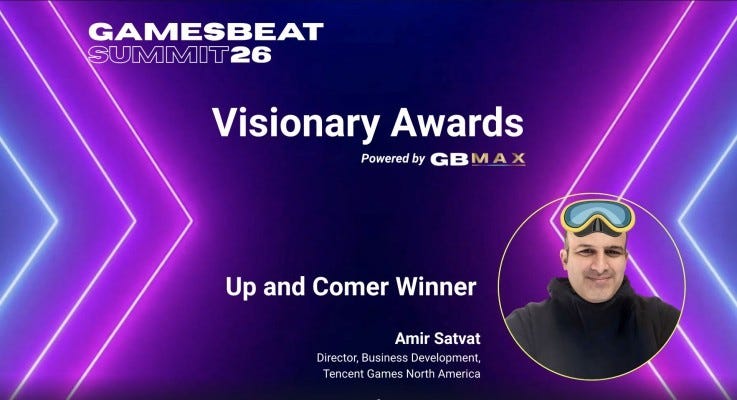
The other GamesBeat moment worth calling out is my friend Amir Satvat being honored with the 2026 Visionary Award. Could not be more deserved. Amir delivers perspective on the hirings, the firings, the restructurings, and the realities of the gaming industry... and he does it in a manner that is earnest, because he gives a shit and wants to make this a better industry to work in. There is not a more deserving person for that kind of recognition. If you are at the show, congratulate him.
Alright. Let’s get into it.
This week is a bit all over the place, and I am owning that up front. I’ve said all that there is to be said on Xbox for the time being. The Asha Sharma rollout has been a marvel to watch. Very online. In a leadership-as-personality-driven culture (see Musk, Altman, etc.), it feels like the right direction. Whether the pattern holds is a fair question for another week. She is making a splash, which is exactly why I am tapping out for this issue. Putting Asha in the corner. Moving on.
What I do want to do is use the week of May 4 to dive into something near and dear to me, which is Star Wars. And before I get to the gaming side of this conversation, which is where the bulk of this piece is going, I have to talk about Star Wars: Maul - Shadow Lord.
I wrote nearly 500 words on this show last week, so I am not going to relitigate the whole thing. The simple version... this show rules.
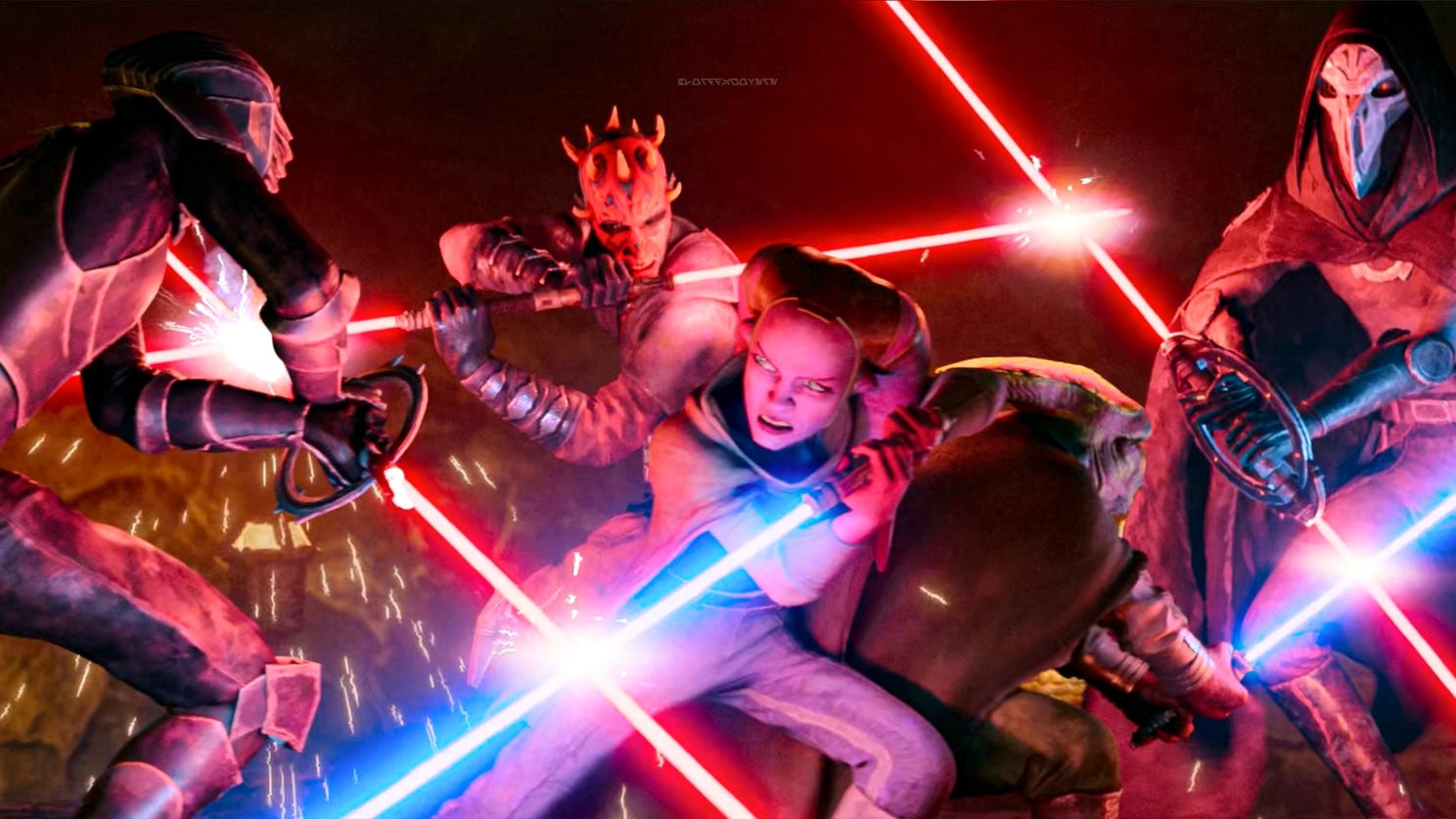
The finale aired Monday, and minor spoilers ahead... watching Maul fight Vader alongside the rest of the cast and watching Vader just methodically work them was incredible television. Granted, Maul had a bum leg the entire time, so I will give him a Mulligan, the way you give an NBA player a Mulligan for playing injured. He tried, he could not do it, and Vader was Vader. The craft on display in this show is something I cannot praise enough.
Last week I also made a bigger argument about Star Wars on the TV and film side, which is that the IP is wildly underleveraged on Disney+ and that a free, ad-supported tier built around the older catalog would do the audience-acquisition work that traditional marketing campaigns are failing to do. I will quote myself from last week, since the framing matters for where I am going this week:
“Imagine the version of this that runs the funnel correctly. Free, ad-supported Clone Wars. Free, ad-supported Rebels. A whole new generation of viewers gets introduced to the Filoni animated universe at zero dollars and a few ad breaks per episode. They fall in love with Ahsoka. They start asking about who Maul actually is. And the answer to that question is the show airing right now on the premium tier... Maul: Shadow Lord... which they cannot watch unless they convert to a paying subscription.” — Patch Notes, May 1, 2026
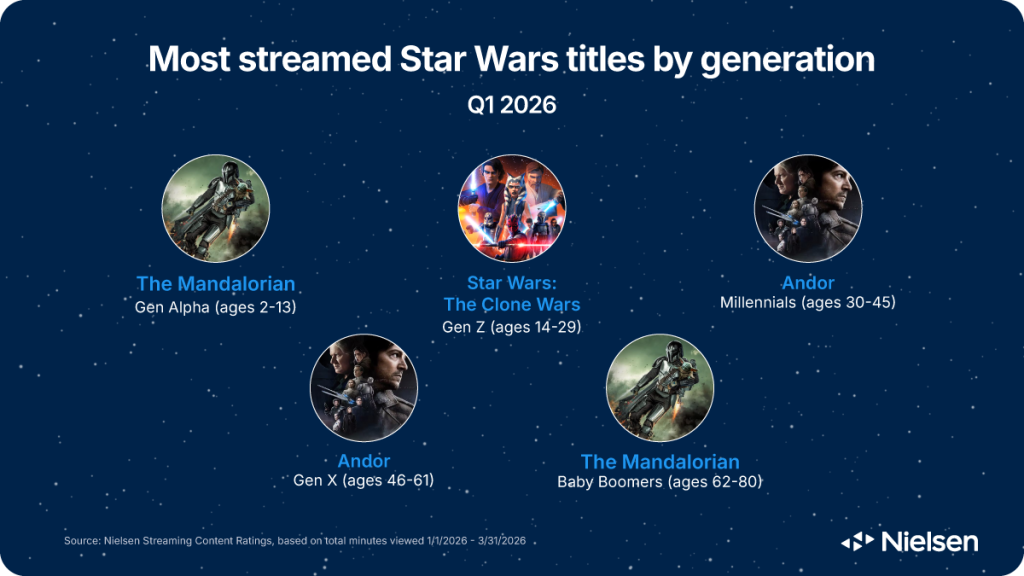
The data backs up why this matters. Per Nielsen, U.S. viewers spent over 33 billion minutes watching Star Wars content across linear TV and streaming in 2025, with streaming taking the bulk of that total. Andor alone pulled 7.4 billion minutes. The IP is enormous. The funnel design around it is not. That was last week’s argument. That is still my argument.
What I did not really get into last week was the gaming side of this conversation. I gave it a paragraph. I owe it more, especially this week, with Maul: Shadow Lord landing the way it did, May the 4th doing what May the 4th does, and Dave Filoni now sitting as President and Chief Creative Officer of Lucasfilm alongside Co-President Lynwen Brennan after Kathleen Kennedy stepped down in January. The torch has officially been passed to the guy Lucas hand-picked as his creative successor twenty years ago. That feels like the right week to ask the question I have been chewing on...
Where is Star Wars in gaming right now, and where is it going?
For the first time in a long time, I am genuinely hopeful about the answer.
Star Wars Gaming, A Love Letter, A Reckoning, And A Slate That Finally Has Me Excited Again
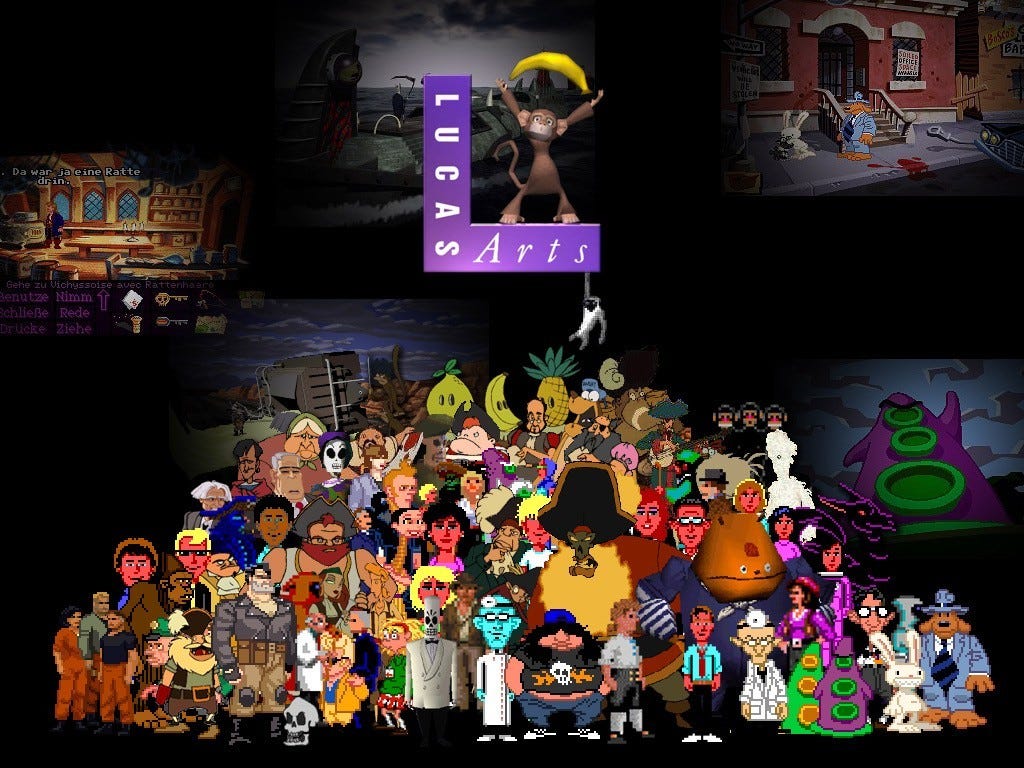
LucasArts Was One Of The Most Important Companies In Gaming History
Before I get to the present, I want to spend some real time on the past, because the past matters here.
LucasArts, which started life in 1982 as Lucasfilm Games, is one of the most important companies in the history of this industry. I am not exaggerating to make a point. The modern video game industry, as we know it, looks meaningfully different and probably worse without the contributions of the company George Lucas built as a side project off the back of Star Wars and Indiana Jones money.
The technology they pioneered, the genres they invented or reinvented, the IP they leveraged to bring an entire generation of older Gen X and younger millennials into video games for the first time... all of it traces back to a small group of people working in a wing of Skywalker Ranch with a mandate to figure out what video games could be.
GamesBeat captured the legacy plainly back in 2012, in a piece written when LucasArts still had a heartbeat:
“LucasArts revolutionized, created, or nurtured several whole genres, so its absence would’ve irreparably hindered the burgeoning video game medium.” — Rus McLaughlin, GamesBeat, November 2012
That sentence undersells the legacy if anything. The whole story really does come back to a few people in a barn at Skywalker Ranch building things that did not exist yet, in formats that did not exist yet, on hardware that mostly was not ready for them.
Before Star Wars Was Even On The Table
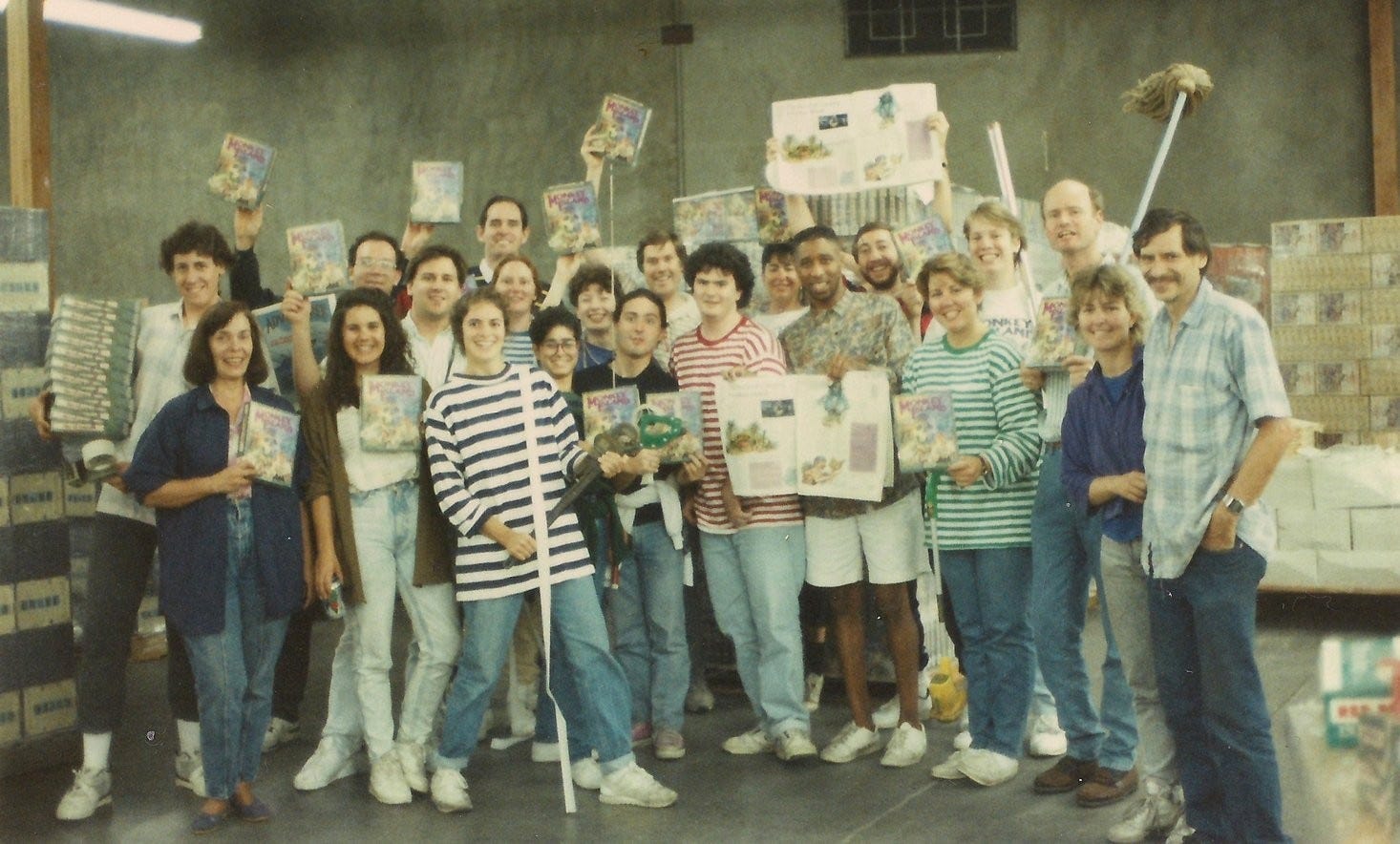
Here is the part most people forget. For the first decade of LucasArts’ existence, they were not allowed to make Star Wars games. Lucas himself put the wall up. The Star Wars license was sold off to outside companies through most of the 1980s. The team was supposed to learn the medium without leaning on the IP, and the constraint forced them to invent.
Steve Arnold, the GM during the golden era, described the founding ethos at GDC 2014:
“We were creating a culture that was designed around innovation. One of the important constraints we had was that we weren’t working with Star Wars. We didn’t have to play in that universe... we got to do our own creation.” — Steve Arnold, former GM, Lucasfilm Games, GDC 2014
What came out of that constraint is still hard to fully appreciate.
Ballblazer and Rescue on Fractalus! in 1984 introduced fractal-rendered 3D landscapes years ahead of when the industry could pull that off, alongside an algorithmic music engine that dynamically reacted to onscreen action. Habitat, in 1986, was the literal progenitor of the MMO genre... a graphical, persistent online world running on the Quantum Link service that would eventually become AOL. Years before EverQuest, years before World of Warcraft.
Lawrence Holland’s WWII flight sim trilogy (Battlehawks 1942, Their Finest Hour, Secret Weapons of the Luftwaffe) built the technical and design foundation that would later directly enable the X-Wing series.
The point-and-click adventure empire that ran from Maniac Mansion (1987) through The Secret of Monkey Island (1990), Indiana Jones and the Fate of Atlantis (1992), Day of the Tentacle (1993), Sam & Max Hit the Road (1993), Full Throttle (1995), The Dig (1995), and Grim Fandango (1998) is the most creatively dense decade of single-genre output any studio has ever produced. The SCUMM engine, born from Maniac Mansion, ran underneath nearly all of it.
Tim Schafer, Ron Gilbert, Dave Grossman, Steve Purcell, Hal Barwood... every one of them came out of that building. Nearly every one of them went on to start studios (Double Fine, Telltale, Electric Eggplant) that are still shaping creative work in games today.
LucasArts was an industry, packaged inside a building, before they ever made a single Star Wars game. Worth holding onto that as the actual baseline.
And Then... Lucas Let Them Off The Leash
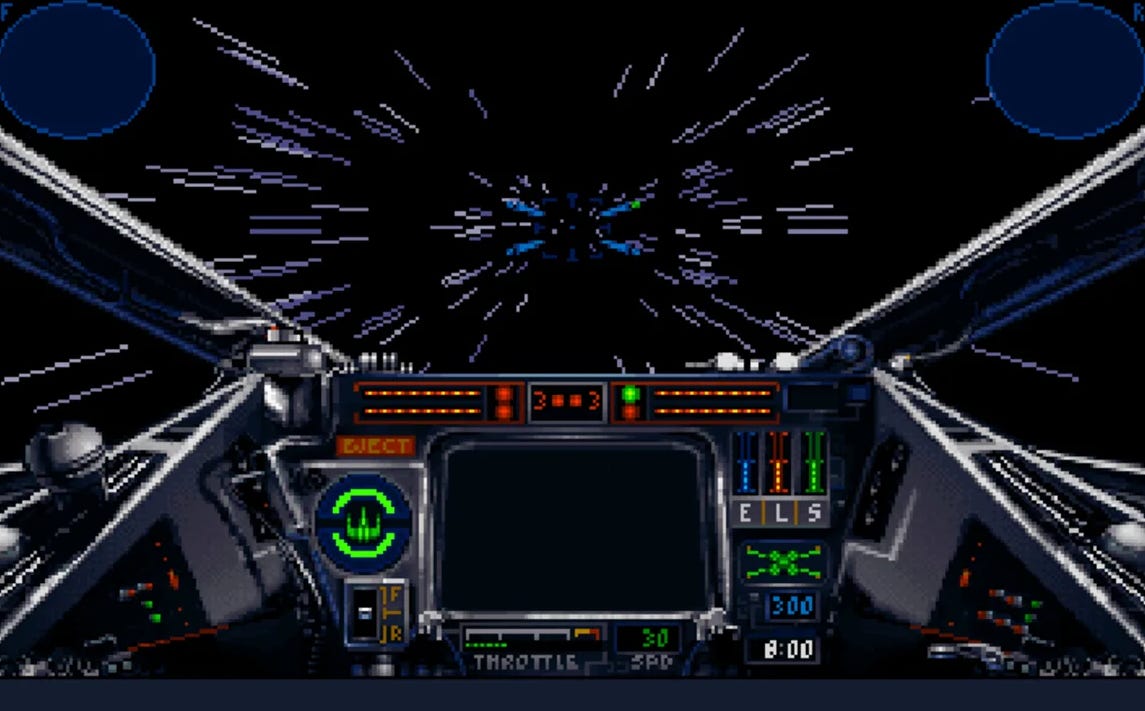
When the IP finally came home in 1991 and the team got to start building Star Wars games of their own, the results were extraordinary. The decade between 1993 and 2005 is, full stop, the most creatively diverse run any single IP has ever had in gaming.
They did not just make great Star Wars games. They invented or evolved entire genres on the back of the IP. Worth grouping the era into tranches.
The space combat lineage. X-Wing (1993) is where it started. Lawrence Holland took everything he had learned from his WWII flight sim work and built the genre-defining 3D space combat sim. Won the Origins Award for Best Fantasy or Science Fiction Computer Game of 1993.
TIE Fighter (1994) is the one most people will tell you is the high-water mark, and they are not wrong. First major Star Wars game where you played the Empire. Political intrigue, secret missions from Sith agents, real moral ambiguity decades before that became a standard-issue narrative move.
X-Wing vs TIE Fighter (1997) introduced online multiplayer space combat to the genre. X-Wing Alliance (1999) closed the series with the Falcon attack run on the second Death Star, which I still maintain is one of the most thrilling sequences ever built into a flight sim.
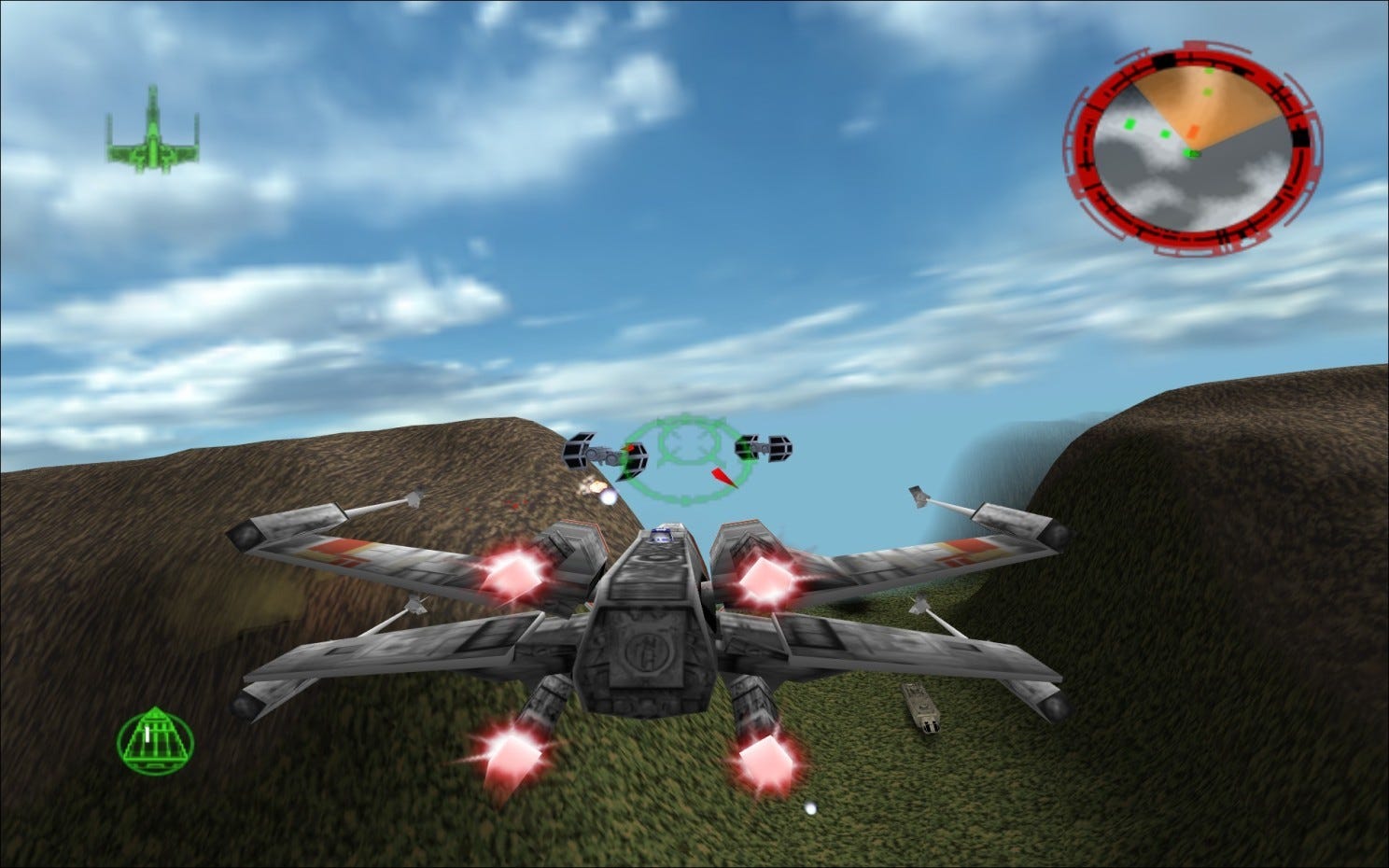
The whole lineage flowed forward into Factor 5’s Rogue Squadron on N64 in 1998, and then into the GameCube exclusive Rogue Squadron II: Rogue Leader in 2001. Rogue Squadron on N64 is my personal favorite Star Wars game in the entire space-combat tradition. I put hundreds of hours into that game as a kid.
Hoth, the Battle of Endor, the Death Star trench run... that was the realization of every Star Wars set piece I had ever wanted to play. Factor 5’s producer summed up the magnitude of what they built:
“It sold about 100 times better than anybody expected.” — Julian Eggebrecht, Factor 5, via USgamer / VG247, 2015
The Jedi Knight series. Dark Forces (1995) took the Doom engine and put a stormtrooper helmet on it, and gave us Kyle Katarn, the first canonically meaningful original character to come out of a Star Wars game.
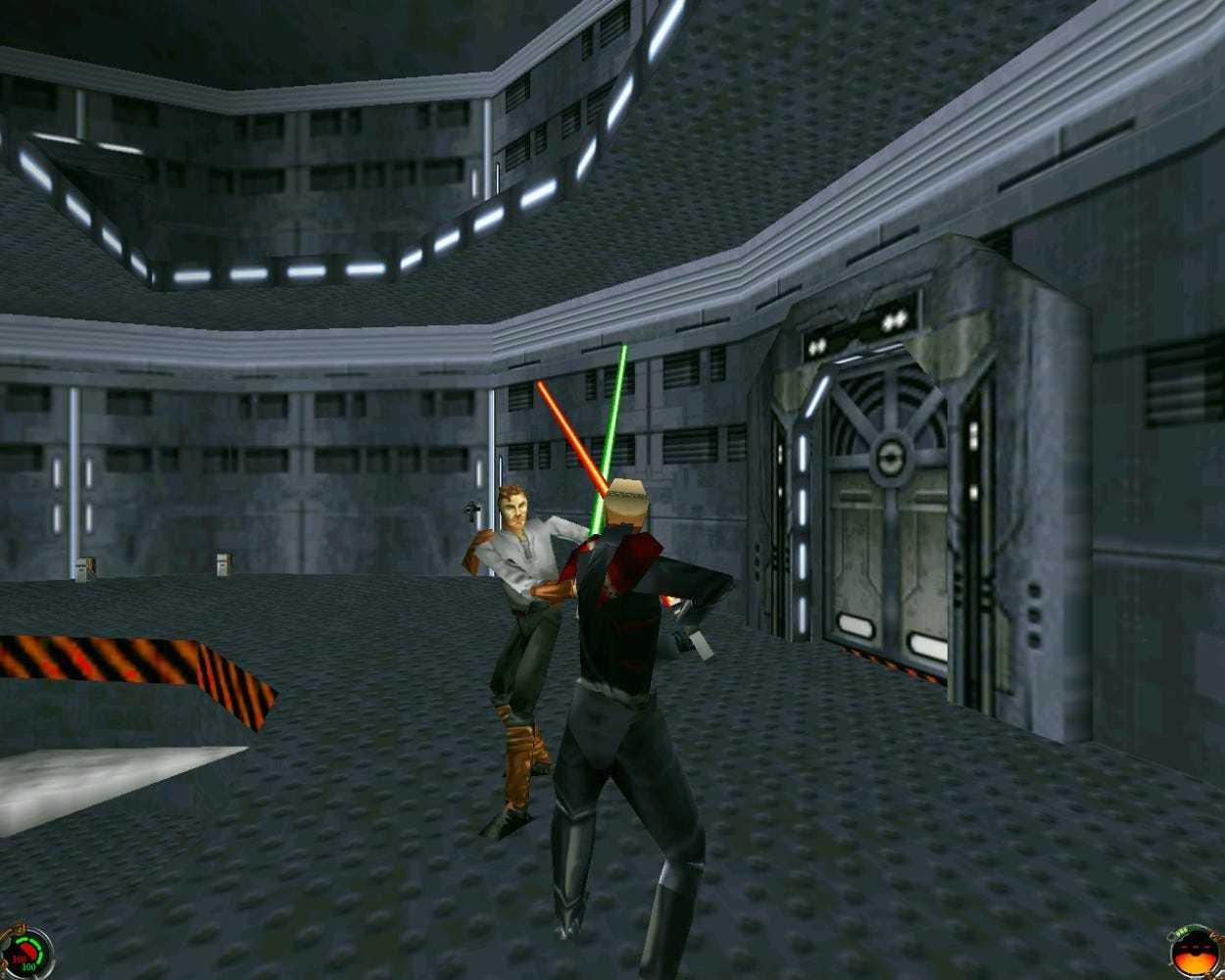
Jedi Knight: Dark Forces II (1997) is my personal favorite of the lineage. It put a lightsaber in your hands in first-person for the first time, broke a fourteen-year on-screen lightsaber-duel moratorium with its opening cutscene, and built the light-side / dark-side branching narrative that every subsequent Star Wars action game has been chasing ever since. Jedi Outcast (2002) and Jedi Academy (2003) carried the torch with Raven Software at the helm.
Episode I Racer (1999) deserves its own callout, because I loved this game. While I thought the prequels were lame as a younger viewer, Racer was next-level for its time. Pod racing, alongside the Maul vs. Obi-Wan duel, was my favorite scene from Episode I, and I am pretty sure I am not alone there.
The game took the only sequence in Phantom Menace that legitimately worked and turned it into one of the most replayable arcade racers on the market. It is also the most direct ancestor to Star Wars: Galactic Racer, the upcoming Fuse Games title I will get to in a minute.
LEGO Star Wars: The Video Game (2005). LucasArts published, Traveler’s Tales developed. This game holds a special place in my heart for reasons I covered at length in How Adult Money Is Reshaping Play. I will quote myself, because the framing matters here:
“LEGO leaned harder into the licensed themes that actually reinforced the brick system instead of distracting from it. Star Wars was the early proof point... when LEGO borrows a world that people already love, the brick becomes the way you live in it.” — Patch Notes, January 16, 2026
LEGO Star Wars: The Video Game is foundational not just to LucasArts gaming history. It is also foundational to the modern LEGO video game era. Batman, Harry Potter, Marvel, Lord of the Rings, Indiana Jones... every one of those LEGO games traces back to that 2005 release.
As I wrote earlier this year, LEGO videogame franchises have been reported at over 200 million units sold worldwide, and that whole engine starts with what TT Games and LucasArts built together in 2005. And to put a bow on it, LEGO Batman: Legacy of the Dark Knight, the next TT Games title in the lineage, is one of the most anticipated games of the spring. None of that exists without the original 2005 LEGO Star Wars.
Star Wars: Battlefront II (2005, the original... not the EA reboot). Pandemic Studios’ capstone on the LucasArts era. Massive multiplayer galactic war, hero characters, a campaign built around the lore of the Imperial 501st Legion.
I played the hell out of this game in college. 2005, dorm-room nights, LAN parties, the whole thing. I loved Halo. I also loved this. The two were not in conflict for an entire cohort of console-shooter fans. Battlefront II was the formative multiplayer Star Wars experience for me and a lot of people my age.
That is the era in tranches. Multiple genre-defining titles. Multiple genre evolutions. Every one of these games shipped with LucasArts-level production polish and Lucas-approved IP fidelity. Compare that to any single decade of Star Wars gaming since, and the gap is uncomfortable.
Knights Of The Old Republic, And The One I Will Die On The Hill For
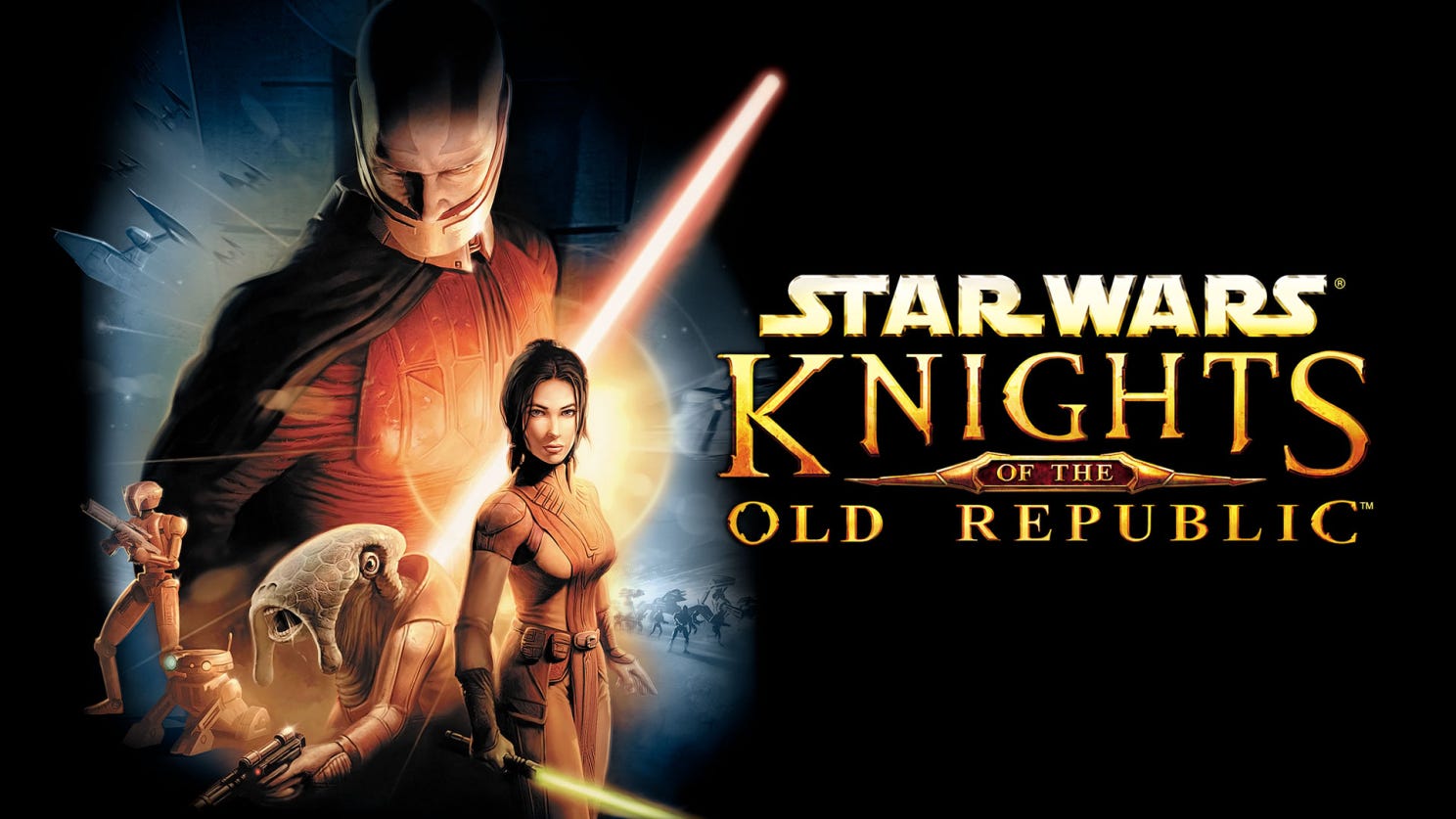
Knights of the Old Republic (KOTOR), 2003. Developed by BioWare, published by LucasArts. It is the best Star Wars game ever made, by a mile, and I will die on this hill.
The making of KOTOR is its own great story. Then-LucasArts president Simon Jeffery approached BioWare in 2002 looking for a franchise-launching Star Wars RPG, a genre LucasArts had never touched before.
Project lead Casey Hudson... yes, that Casey Hudson, the one now running Arcanaut Studios on Fate of the Old Republic, which is going to come up later in this piece... made the call to set the game 4,000 years before the films. Far enough from canon to do anything they wanted. Recognizably Star Wars.
Author Alex Kane, who wrote the Boss Fight book on KOTOR’s making, pulled out the line that captures the whole project:
“There wouldn’t have been a KOTOR if LucasArts hadn’t been run by Star Wars nerds who loved things like D&D and Baldur’s Gate.” — Alex Kane, 365 Star Wars interview, March 2019
The story of Revan, the redeemable fallen Sith Lord whose true identity is concealed even from himself, is one of the most ambitious narrative twists ever attempted in a video game. Darth Malak as the apprentice-turned-betrayer is the perfect inverse of every Star Wars master-apprentice dynamic the films had built to that point.
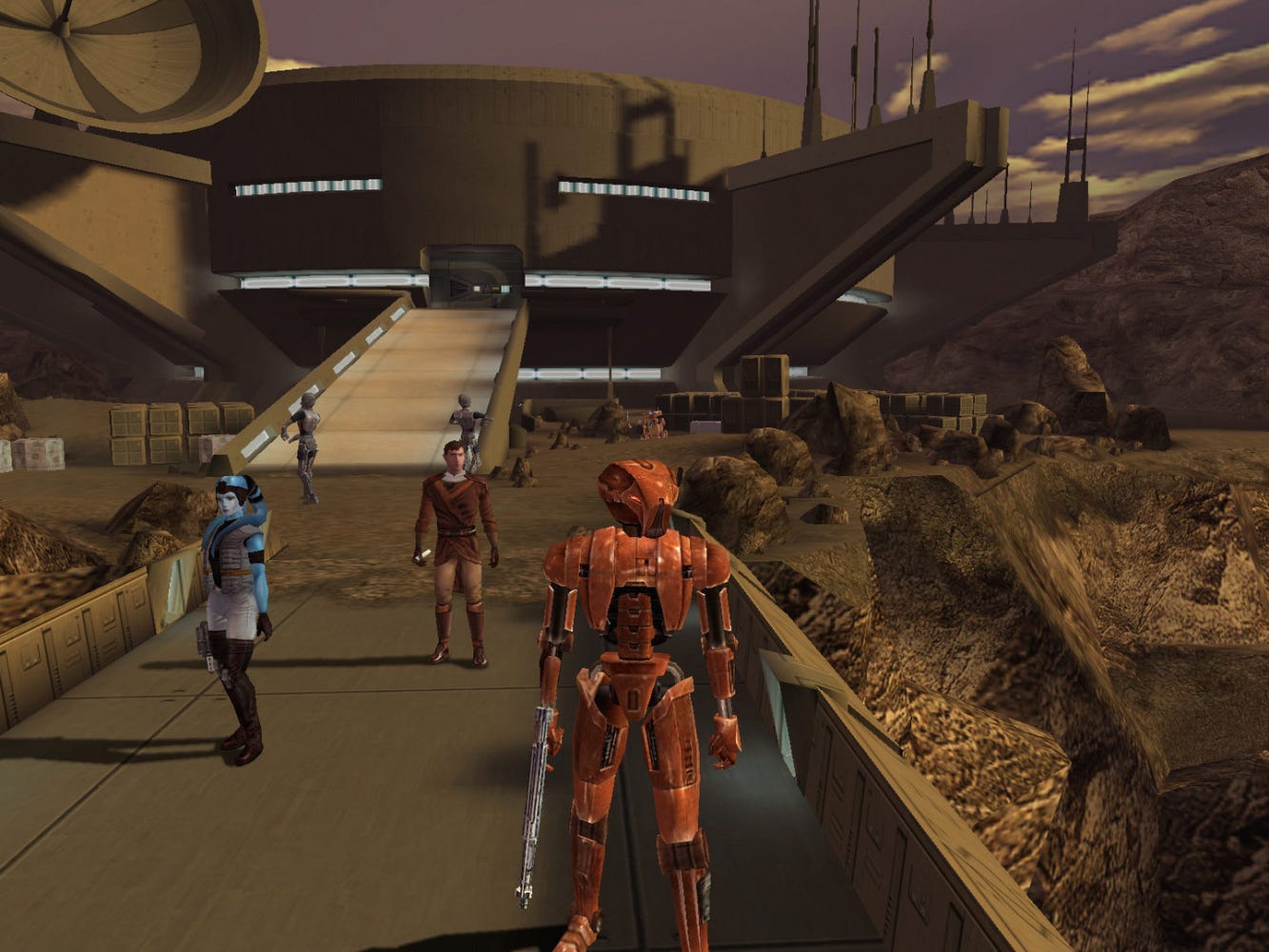
HK-47, the assassin droid Revan built to hunt Jedi, is one of the funniest, most memorable companion characters in the history of the medium. “Statement: I am quite eager to participate in some unadulterated violence.” The whole game runs on dialogue like that. Twenty-three years later, HK-47 is still funnier than 95% of what gaming has produced since.
Bastila Shan as a complicated, dynamic Jedi was a leveling-up moment for women characters in RPGs. Mission Vao, Jolee Bindo, Carth Onasi, Juhani... the whole party still holds up.
The Guardian, looking back on the LucasArts era at the moment of its closure, captured why KOTOR worked when so many other Star Wars games of the same period did not:
“Knights of the Old Republic worked because it retained the core good/evil framing so strongly, but yet took the brand far out of the LucasArts comfort zone, into BioWare’s backyard of compelling RPG mechanics and well constructed narrative arcs.” — Keith Stuart, The Guardian, April 2013
Game Developers Choice Awards. BAFTAs. Interactive Achievement Awards. Game of the Year basically across the board.
KOTOR II... The Misunderstood One
A year later, in 2004, the sequel arrived. Knights of the Old Republic II: The Sith Lords was developed by Obsidian Entertainment, founded by Baldur’s Gate and Planescape: Torment veterans, and built under one of the most punishing development constraints in the history of major game releases... LucasArts gave Obsidian fourteen months and a skeleton crew to ship a sequel to the Game of the Year.
The result is one of the most fascinating, frustrating, ambitious, and genuinely misunderstood Star Wars games ever made. KOTOR II’s writing, led by Chris Avellone, abandoned the clean light-side / dark-side framing of the original in favor of moral ambiguity.
The Jedi Exile, the player character, has severed her connection to the Force. Kreia, the mentor figure, is one of the greatest written characters in the history of gaming and quite possibly the most subversive Force user ever put in front of a player.
And it is hard to argue against how cool Darth Nihilus is. Basically a Force ghost of sorts, sucking the life out of everything and everyone he engages with. Iconic mask, terrifying conceit, one of the most visually striking Sith ever designed for any Star Wars medium.
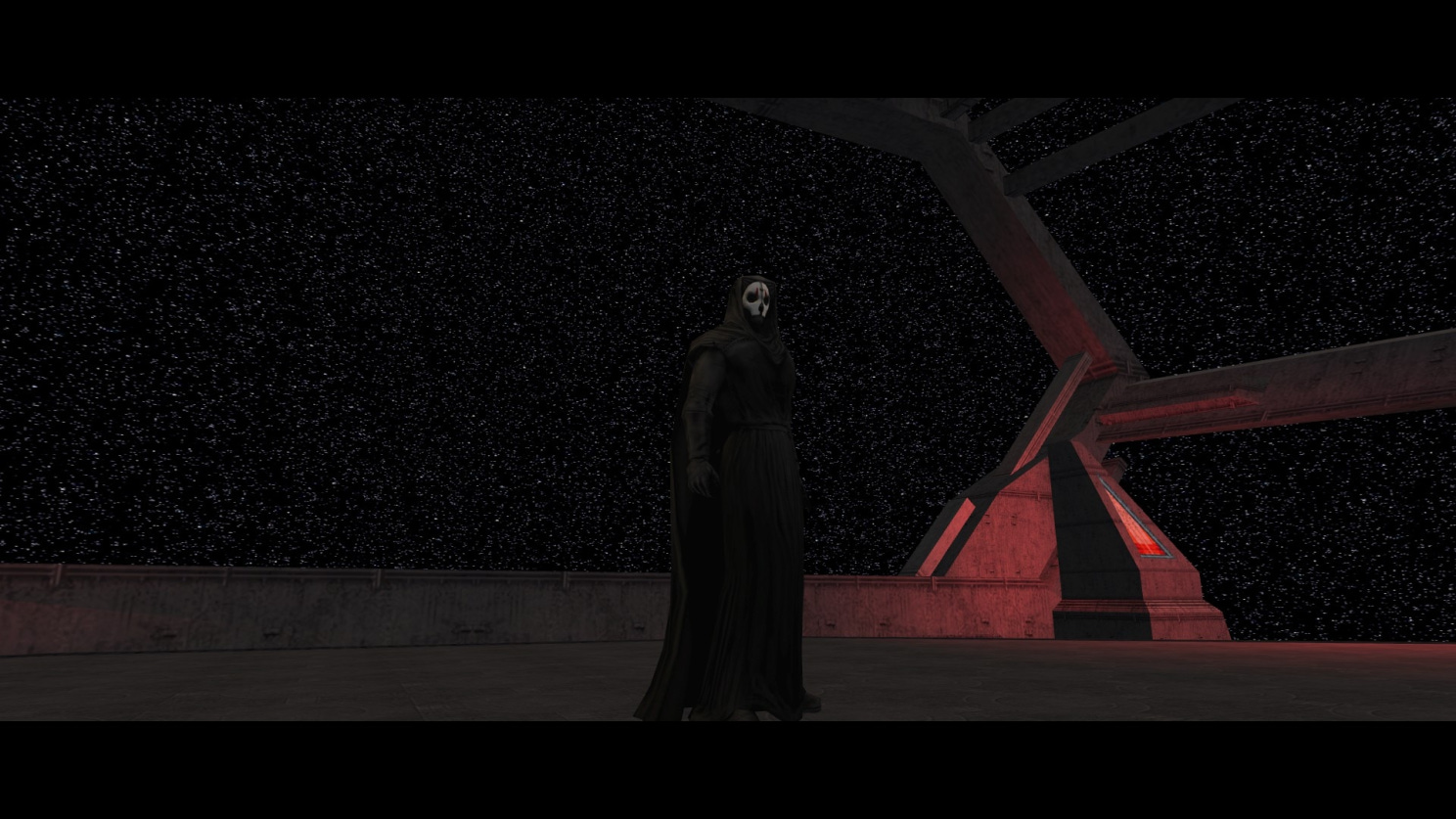
The villains are tragic. The Jedi Order is fractured. The whole thing reads more like The Empire Strikes Back than A New Hope, in tone.
It also shipped unfinished. Massive cuts to the third act, a rushed Malachor V finale, missing scenes that the development team simply could not get into the box in time. Den of Geek called it “gaming’s great unfinished symphony,” and the framing is exactly right:
“Knights of the Old Republic II is far from a victim of setbacks. It is a work of art that is equally compelling whether you are focusing on its broader strokes or the negative space between them.” — Matthew Byrd, Den of Geek, April 2018
A decade-plus later, the modding community spent years finishing what Obsidian could not, and the Sith Lords Restored Content Mod is now widely considered the definitive way to play the game.
KOTOR II is essential. Misunderstood at launch, undercooked by external constraints, and artistically ambitious to a degree very few Star Wars games have ever attempted. Kreia and Nihilus alone are worth the price of admission.
The Fall Was Not Sudden... It Was A Long, Slow Drift
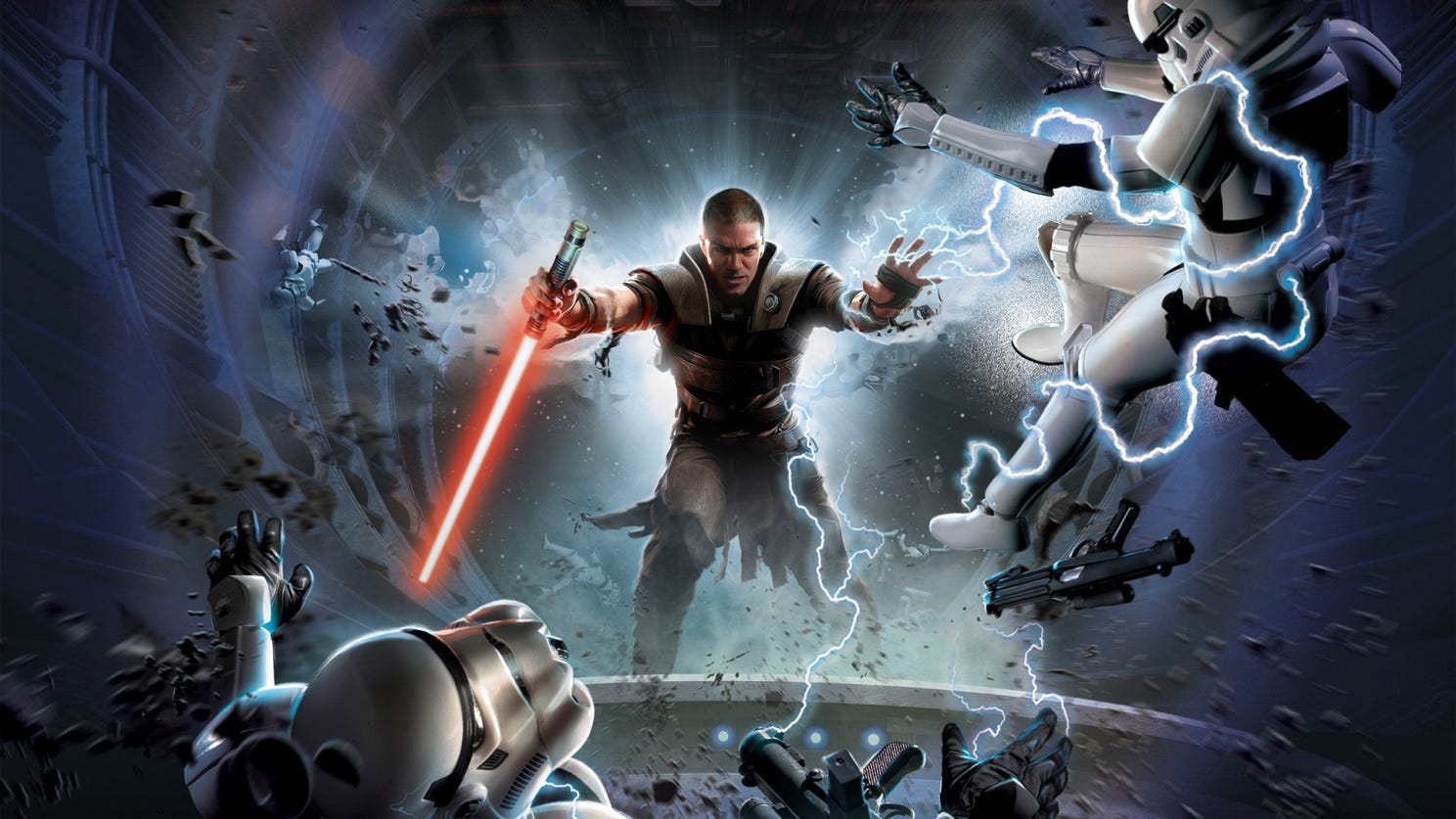
By the late 2000s, LucasArts had lost the plot. The talent that built the golden era had largely left.
Star Wars: The Force Unleashed in 2008 had genuine ambition but pinned its narrative on a generic emo protagonist named Starkiller and built around set-pieces that were increasingly hard to top, including the now-infamous sequence where you pull a Star Destroyer out of the sky with the Force. Force Unleashed II in 2010 threw out the nuance. Kinect Star Wars in 2012 happened, against everyone’s better judgment.
The Guardian, again, said it best:
“As the universe bloated and the timeline stretched, there seemed to be a compulsion to craft new characters and plotlines, knitting together the gaps between the cinematic key frames.” — Keith Stuart, The Guardian, April 2013
There was internal rot too. Multiple presidents in a short window. Force Unleashed III cancelled. Key creatives leaving. Star Wars 1313, the M-rated Coruscant-underworld game fans had been begging for, previewed at E3 2012 to enormous excitement and then never shipped.
When Disney bought Lucasfilm in October 2012 for $4.05 billion, the writing was on the wall. Six months later, in April 2013, Disney shut LucasArts down as an internal development studio and pivoted to a pure licensing model. Up to 150 jobs lost. Star Wars 1313 and Star Wars: First Assault dead in the water.
The official Disney statement, which still lands like a corporate dirge:
“After evaluating our position in the games market, we’ve decided to shift LucasArts from an internal development to a licensing model, minimizing the company’s risk while achieving a broader portfolio of quality Star Wars games. As a result of this change, we’ve had layoffs across the organization.” — Disney, via The Guardian, April 4, 2013
That was the end of LucasArts as a creative entity.
The EA Era... Mixed Report Card, Generous Grading
In May 2013, Disney handed Star Wars gaming to one publisher under an exclusive deal. Electronic Arts signed a ten-year exclusive license. That deal defined the next decade of Star Wars gaming, and the report card is, charitably, mixed.
Here is the cleanest way to think about it. The EA era has three different stories running through it, and they do not always agree with each other. The financial story is unambiguous. The creative story is mixed. And the fan story is, generously, complicated. Worth walking through each in order, because the gap between them is the actual story of the entire deal.
The financial story is the unambiguous part. Star Wars under EA was, and is, a juggernaut. Whatever else you want to say about the era, the numbers are not subtle.
On the Q3 FY2021 earnings call in February 2021, then-CEO Andrew Wilson laid out the scale of the EA Star Wars portfolio:
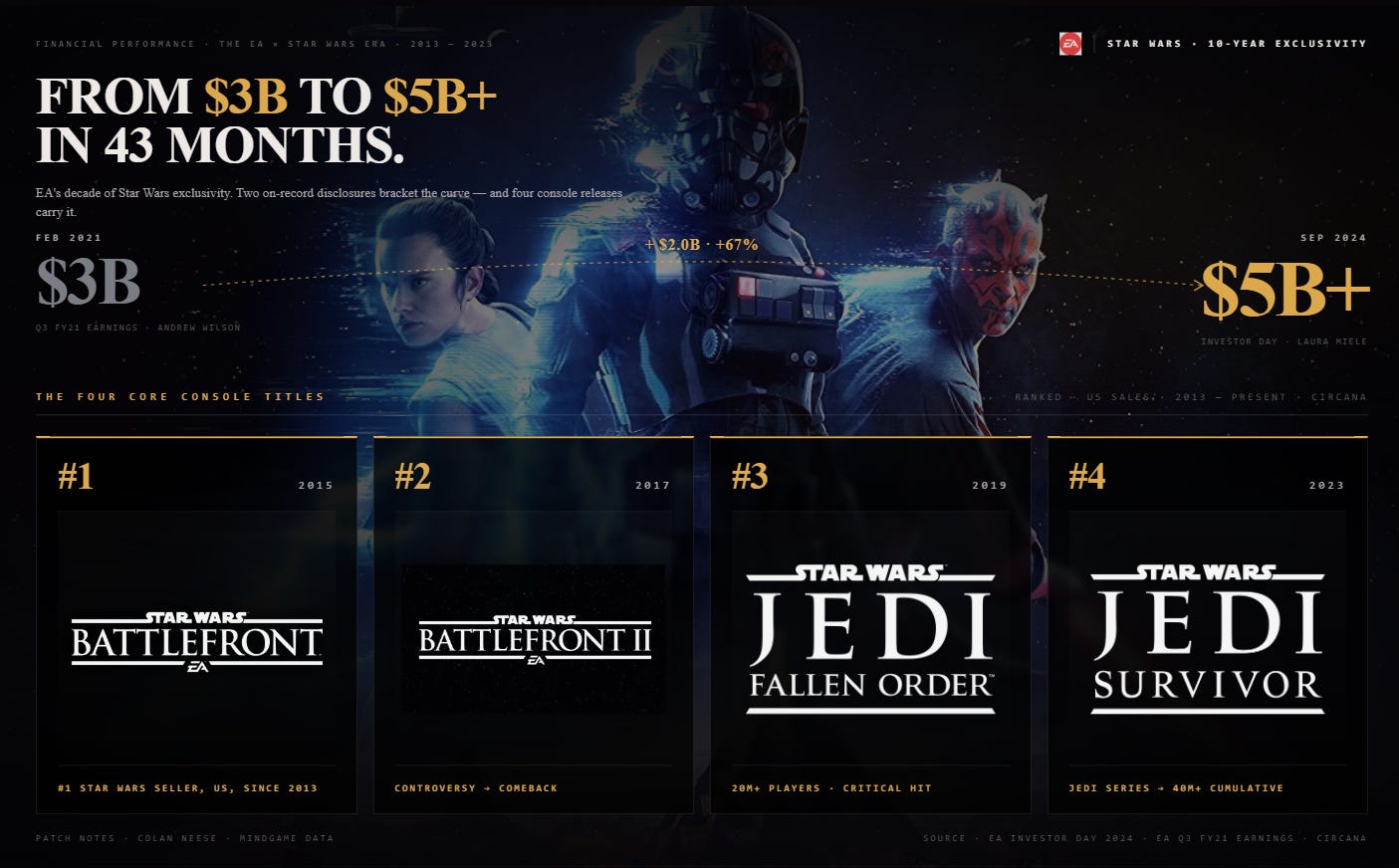
“We have generated a number of great franchises: Star Wars: Knights of the Old Republic, Galaxy of Heroes, Battlefront, Jedi Fallen Order, and most recently Squadrons. That represents over $3 billion life-to-date in net bookings and 52 million games sold.” — Andrew Wilson, EA CEO, Q3 FY2021 Earnings Call, February 2021
$3B+ in net bookings. 52M units. Star Wars: Galaxy of Heroes alone is a $1B mobile franchise inside that total. That was as of early 2021.
Three and a half years later, on EA Investor Day in September 2024, Laura Miele, then-President of EA Entertainment, gave the updated number:
“While we are early in production with our Marvel games, it’s important to note that the collaboration is actually founded on our successful history with Lucasfilm and Star Wars, where we have delivered some of the highest-quality and best-selling Star Wars games of all time with over $5 billion in net bookings... This impressive track record includes of course the Star Wars Jedi games, where over 40 million Star Wars fans have connected with Cal Kestis and his arc of becoming a powerful Jedi.” — Laura Miele, President EA Entertainment, EA Investor Day, September 2024
$3B by February 2021. $5B by September 2024. Roughly $2B added in three and a half years. Driven primarily by the Jedi: Survivor launch in April 2023, the long tail of Galaxy of Heroes monetization, and the continued performance of Fallen Order. The Jedi franchise alone has connected with 40M+ players.
The third data point sits on the US sales side. According to Circana sales data shared by analyst Mat Piscatella for May the 4th this year:
“Star Wars: Battlefront (2015) is the best-selling Star Wars video game in US tracked history, and Star Wars as a property ranks 7th overall in lifetime franchise full game dollar sales.” — Mat Piscatella, Circana, via GamesRadar, May 2026
EA holds the top four slots on Circana’s all-time Star Wars sales list. The 2015 Battlefront reboot at #1, Jedi: Fallen Order, Battlefront II (2017), and Jedi: Survivor rounding out the top four.
The EA Battlefront reboots were not my preferred Battlefronts. The 2005 Pandemic original is still the one I will defend. The steady stream of EA mobile Star Wars titles never quite landed for me personally either. But the data is the data, and the data is overwhelming. Star Wars under EA was a commercial machine. That part is settled.
The creative story is where it gets messier.
The wins were real, and one was extraordinary. Star Wars Jedi: Fallen Order (2019) was the first time, post-LucasArts, that Star Wars gaming felt like it really belonged to a creative team that understood the IP. Respawn Entertainment, with director Stig Asmussen, built the best modern Star Wars game on the merits, no caveats.
Asmussen came to Respawn from Sony Santa Monica, where he art-directed the original God of War trilogy and directed God of War 3. The Star Wars / God of War creative DNA pairing is a big part of why Fallen Order felt different from anything EA had shipped under the license to that point.
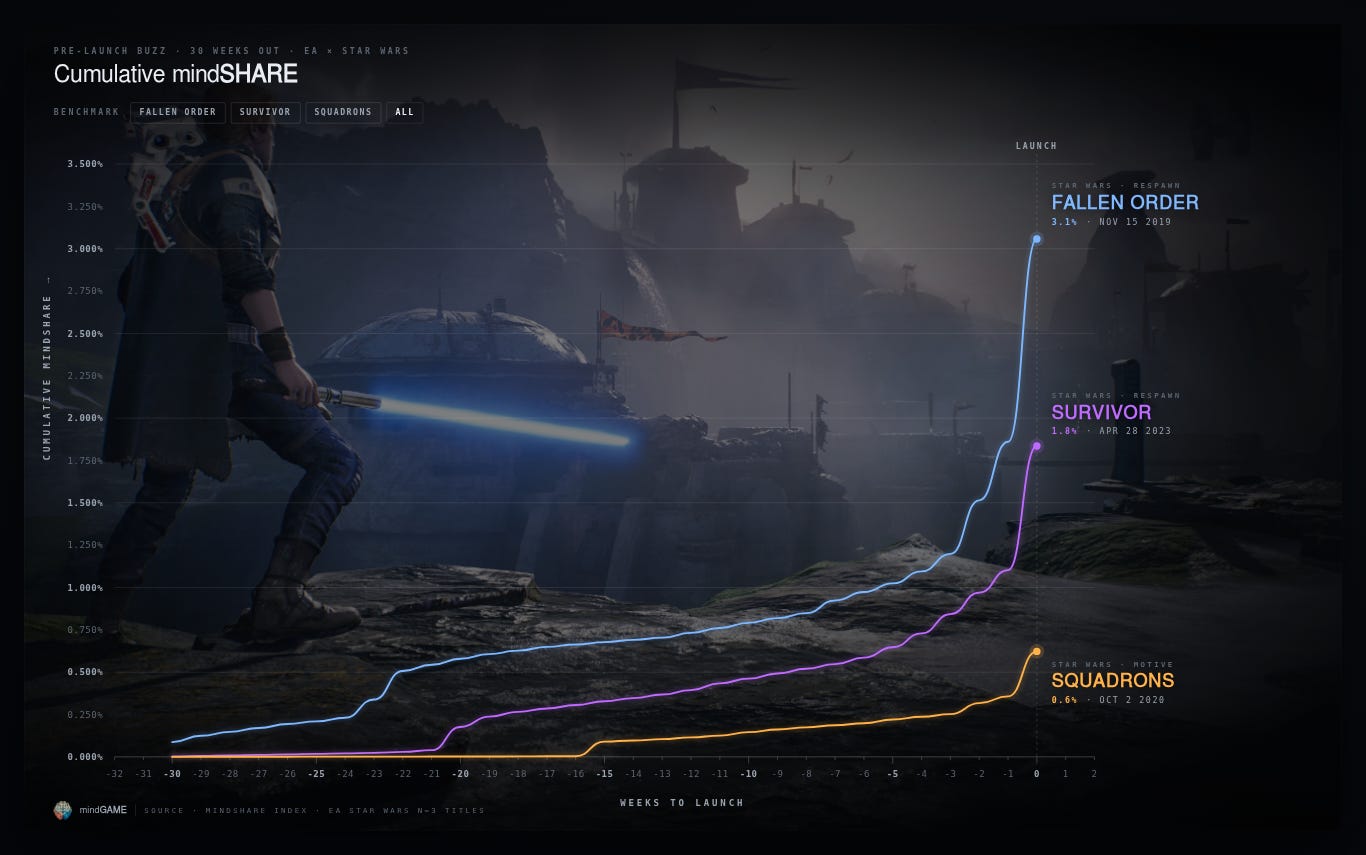
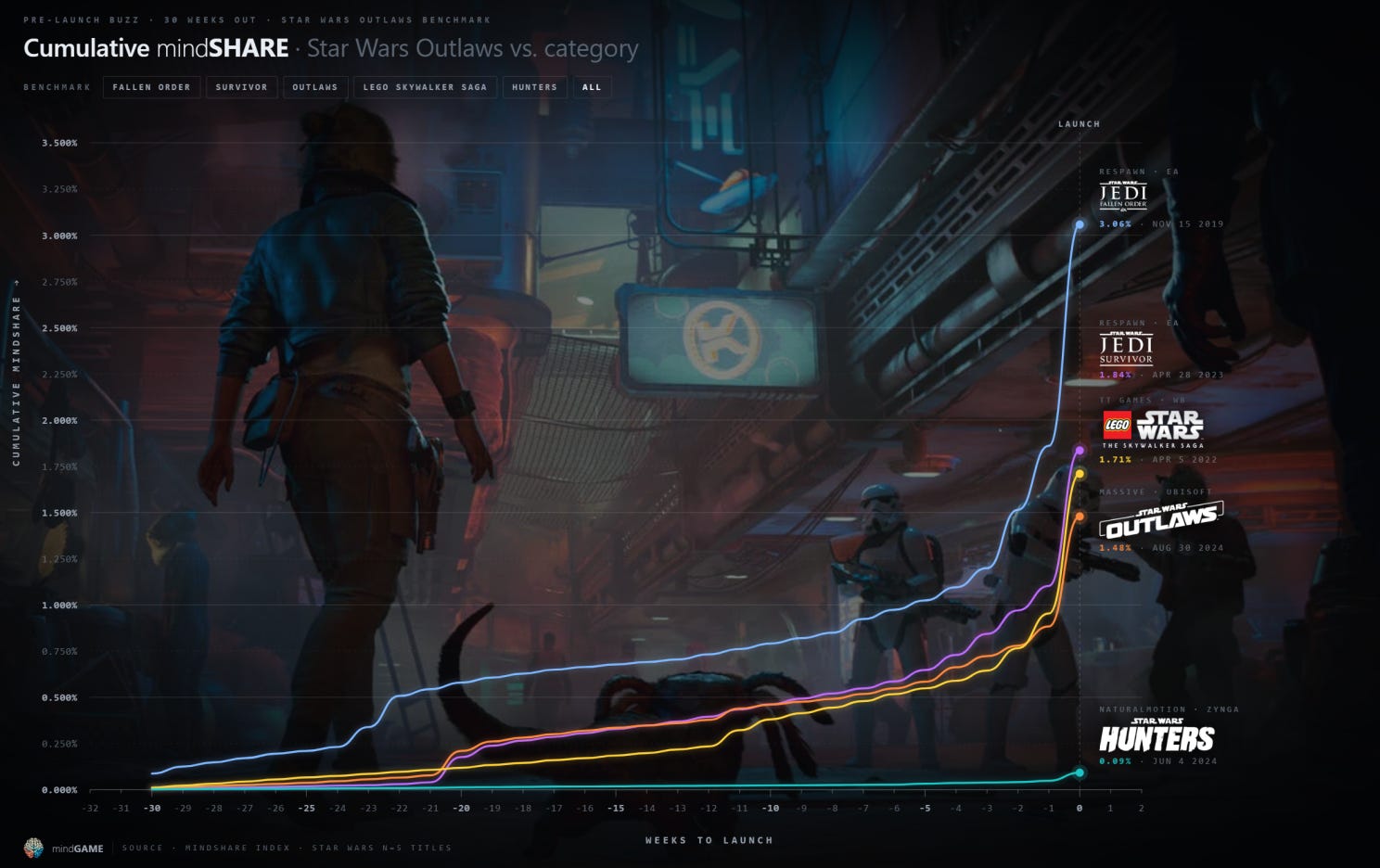
In our mindGAME tracking, Fallen Order launched at 3.06% cumulative mindSHARE, the highest of any Star Wars game we have ever tracked. The best-performing modern Star Wars release we have data on, period.
Bloomberg captured the broader significance:
“The games were widely seen as a triumphant comeback after a shaky decade for Star Wars video games under EA. Their success helped turn Respawn into one of EA’s top studios.” — Jason Schreier, Bloomberg, September 2023
Beyond the numbers, Fallen Order was a story win. Cal Kestis as a Padawan trying to survive the Jedi Purge clicked with the Star Wars community in a way no original Star Wars protagonist had since the original KOTOR cast.
The Inquisitor antagonist, Trilla Suduri, the Second Sister, was a former Jedi Padawan of Cere Junda... a fallen apprentice, a mirror of what Cal himself could become. Tragic, layered, and one of the more emotionally complex villains in any modern Star Wars story.
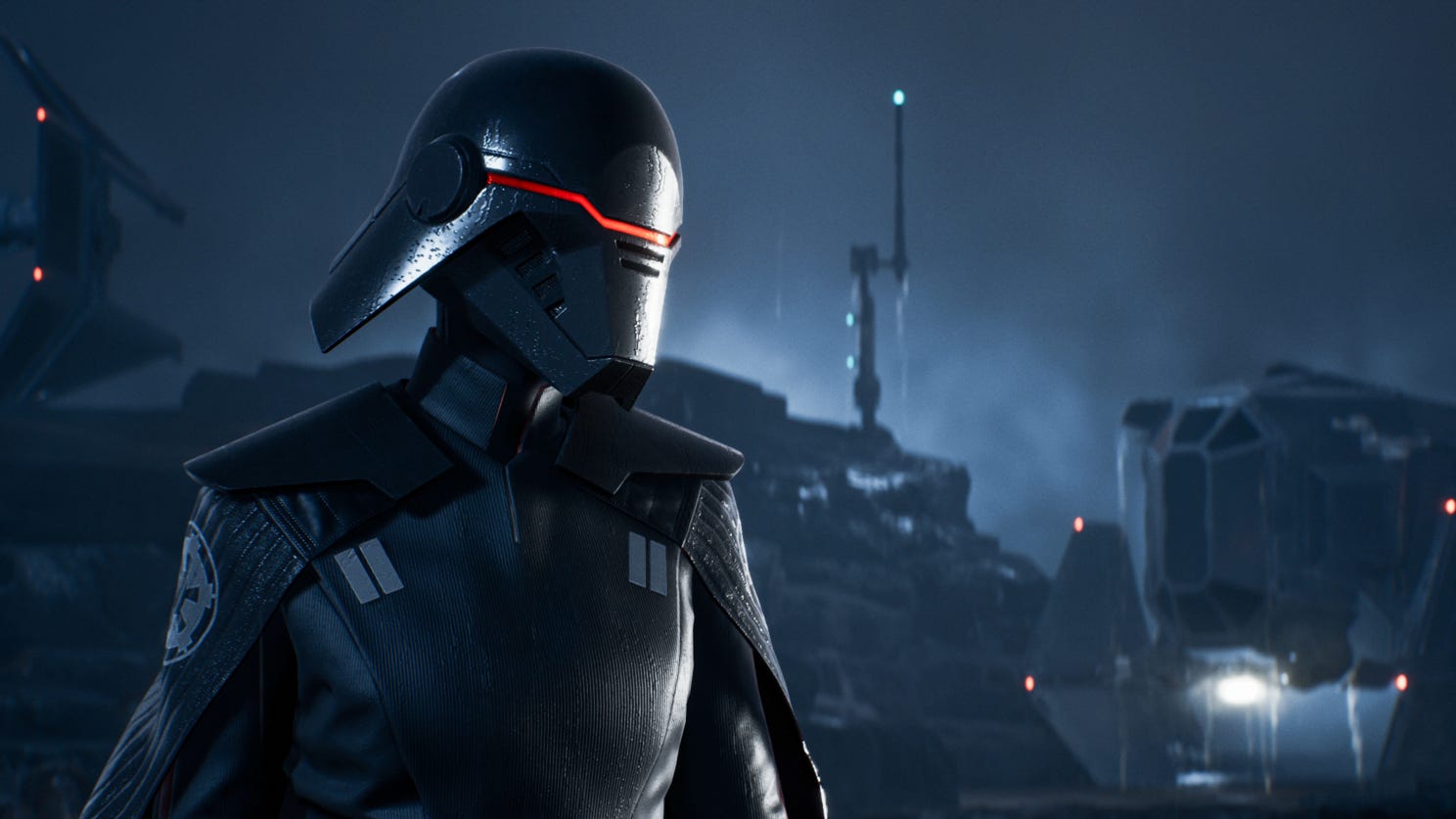
And then there is the ending. After Cal defeats Trilla in the Fortress Inquisitorius and Cere arrives to find a moment of redemption with her former apprentice, Darth Vader appears and executes Trilla on the spot. The Vader sequence that follows, with Cal and Cere desperately escaping, is one of the best Vader appearances in any Star Wars media, period. Cinematic, terrifying, and built around the kind of dread the films almost never have time to land.
Jedi: Survivor (2023) extended that promise. Squadrons (2020) was a niche but well-executed return to the X-Wing/TIE Fighter lineage.
The losses were also real, and they were loud.
Battlefront (2015) was a beautiful but content-thin reboot of the Pandemic series. Battlefront II (2017) launched into one of the worst loot-box scandals in gaming history. The EA community team’s reply on the Reddit controversy thread became, briefly, the most-downvoted comment in Reddit history.
EA had to publicly walk back the entire monetization model within weeks. Belgium and the Netherlands declared the loot-box mechanics gambling. The game eventually became a fan favorite after years of post-launch repair, but the launch itself was a disaster.
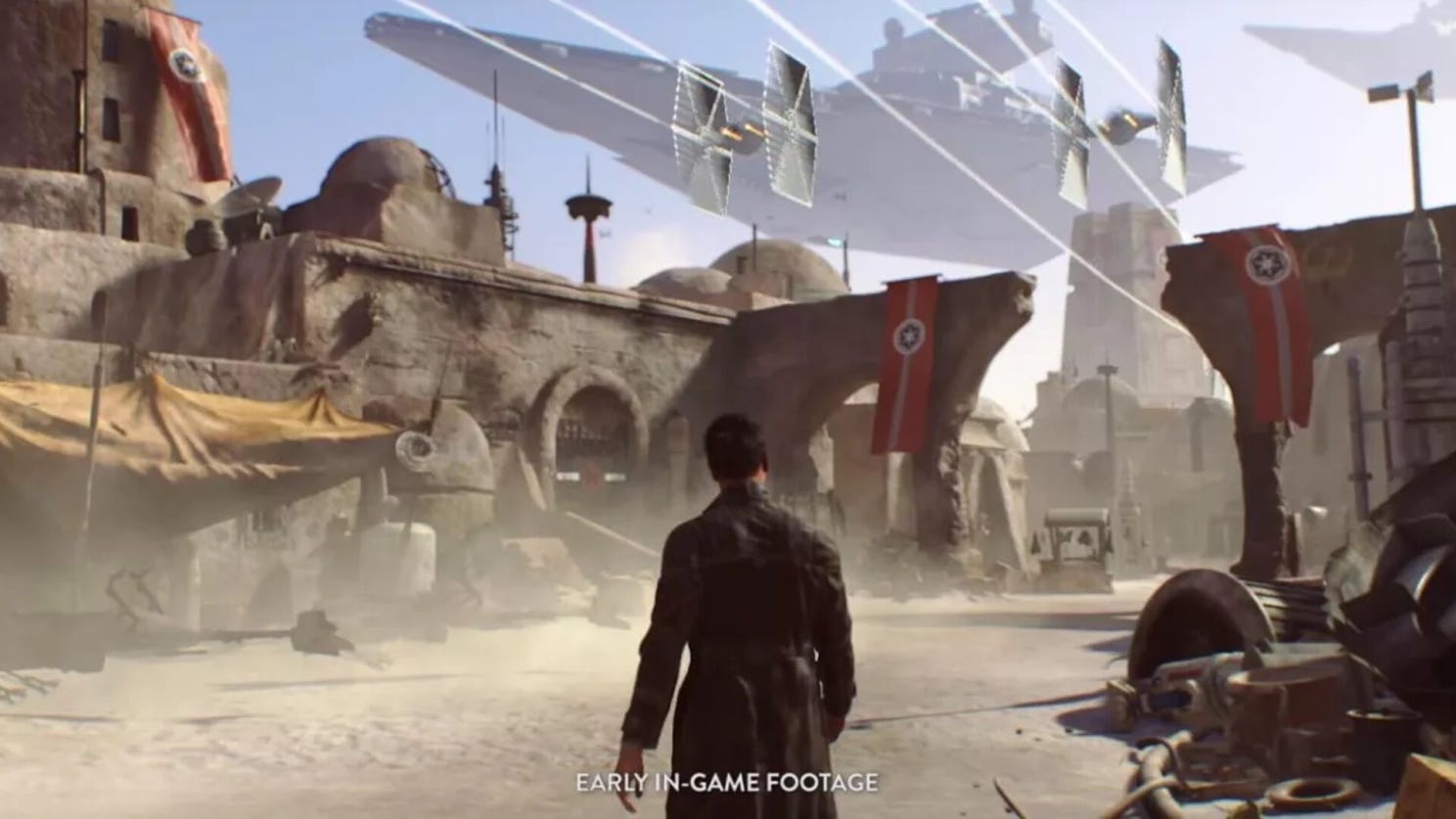
The cancellations told the rest of the story. Project Ragtag, the Amy Hennig-led Star Wars action-adventure that Visceral Games was developing, was cancelled in 2017 and Visceral was shut down. Jason Schreier reported in Kotaku that the project was killed in part because EA leadership could not see the linear single-player narrative game as a long-term revenue vehicle.
Multiple other Star Wars projects were cancelled in the back half of the deal. The pace of releases never matched what an exclusive license on the most valuable IP in entertainment should have produced.
And then there is the fan story, which is where the wheels really came off.
Even with $5B in net bookings and 40M+ Jedi players, the fan community spent most of the EA era visibly frustrated with how the deal was playing out. ScreenRant captured the prevailing fan view in 2020, about six years into the deal:
“Disney’s decision to give the Star Wars license to EA has hurt the franchise’s video game potential. Despite the company’s recent successes, overall output has been dismal compared to when LucasArts helmed Star Wars game publishing.” — Camden Jones, ScreenRant, February 2020
The output critique is hard to argue with when you line up the math. From 2002 to 2008, LucasArts published around a dozen good-to-great Star Wars games. From 2013 to 2019, EA published three: Battlefront, Battlefront II, Fallen Order. They also cancelled multiple Star Wars projects in the same window. The exclusive license on the most valuable IP in entertainment was producing a fraction of the slate fans had grown up on.
That is the actual EA era in three pictures. Commercially, it was a juggernaut. Creatively, it was a mixed bag with one extraordinary win and a long tail of disappointments and cancellations. With the fans, it was a slow-burn frustration with output that never matched the IP’s scale.
By 2021, Disney had seen enough.
The 2021 Reset... Lucasfilm Games Returns, And The Door Reopens
In January 2021, Lucasfilm rebranded its games division back to its original 1982 name: Lucasfilm Games. The exclusive Electronic Arts (EA) arrangement was effectively over (though EA continues to make Star Wars games to this day under a non-exclusive arrangement), and Lucasfilm Games, under VP and GM Douglas Reilly, signaled an open door for new partners:
“We’re looking to work with best-in-class teams that can make great games across all of our IP... so that all of our fans can enjoy the IPs that they know and love.” — Douglas Reilly, VP and GM, Lucasfilm Games, StarWars.com, January 2021
The reset was structured more like the LucasArts model of the 1990s. Best-fit creative partner per project. Oversight from the IP holder. Multiple publishers in the mix. A portfolio approach, not an exclusive licensee. The reveal cycle around the announcement was loud. WIRED reported that two flagship partnerships landed simultaneously... Ubisoft Massive on an open-world Star Wars title, and MachineGames at Bethesda on a new Indiana Jones game with Todd Howard executive producing. Both were teased as long-tail projects. Both were positioned as proof that Lucasfilm Games was back in the game-publishing business in a serious way.
Five years in, the post-2021 reset has produced three case studies worth digging into. The good. The disappointing. And the genuine head-scratcher.
The Good... LEGO Star Wars: The Skywalker Saga
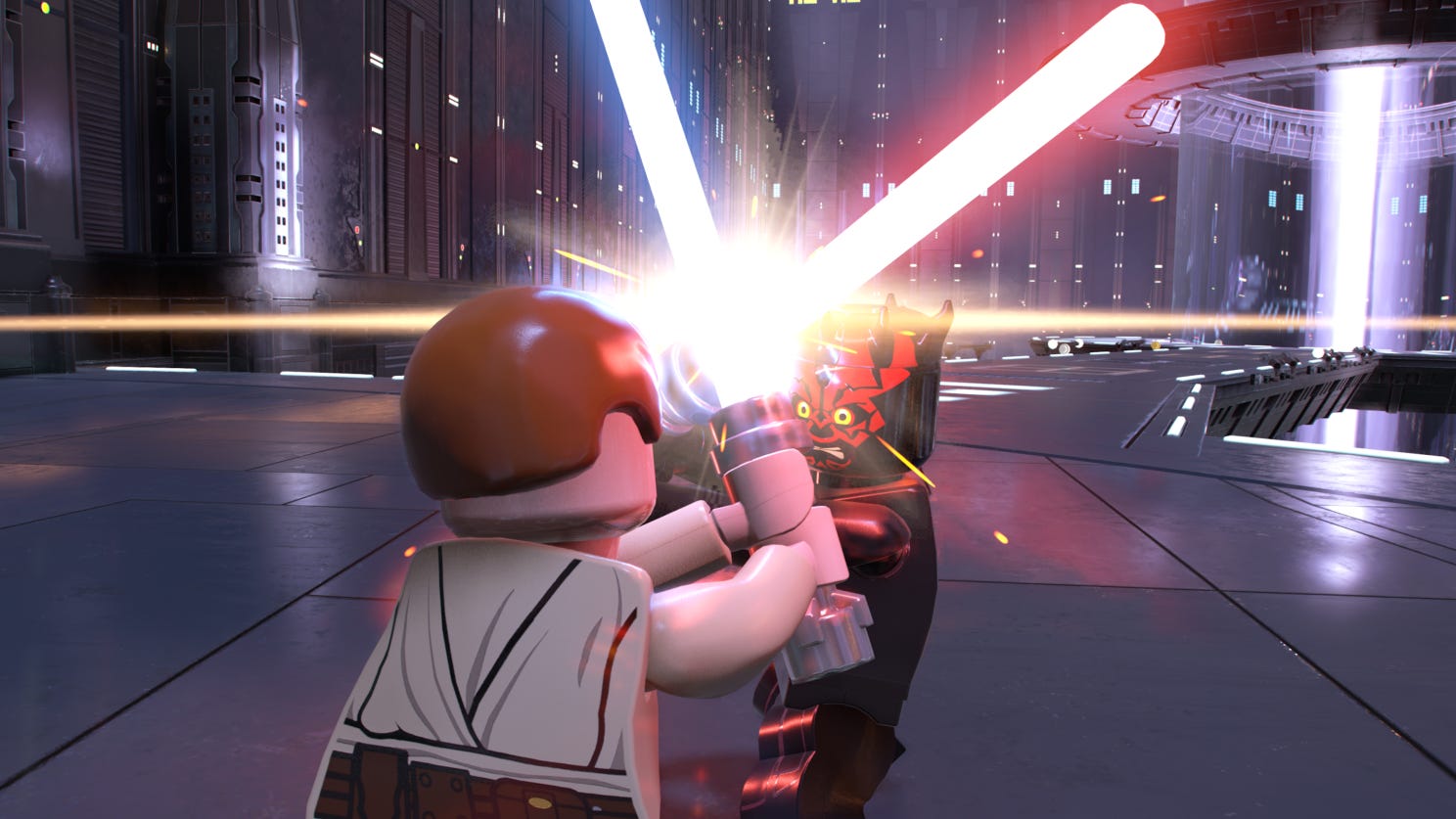
LEGO Star Wars: The Skywalker Saga ( TT Games Ltd / Warner Bros. Games / Lucasfilm Games, April 2022) is the standout post-reset success, and it is not particularly close.
The setup was ideal. TT Games developed, drawing on what is now nearly two decades of LEGO videogame DNA going back to that original 2005 LEGO Star Wars title. Warner Bros. Games published, leaning on a global publishing infrastructure. Lucasfilm Games provided the IP oversight. Three different specialists, each playing to strength, on a property that had every reason to land.
What is wild, in retrospect, is that the game landed at all. Polygon’s reporting in March 2022 detailed a development cycle that was, candidly, brutal. Five years of work. Three delays. A switch to a new internal engine called NTT that staff had pushed against in favor of Unreal. Reports of crunch culture, management turnover, and feature creep that ate years of work. TT Games’ own statement framed it as ambition meeting reality:
“Lego Star Wars: The Skywalker Saga is the most ambitious title the studio has ever undertaken. The team is determined to deliver a wonderful Lego experience to our players, and we are giving the game the time it needs to deliver on that aspiration.” — TT Games spokesperson, via Polygon, March 2022
Despite all of that, the launch numbers were exceptional.
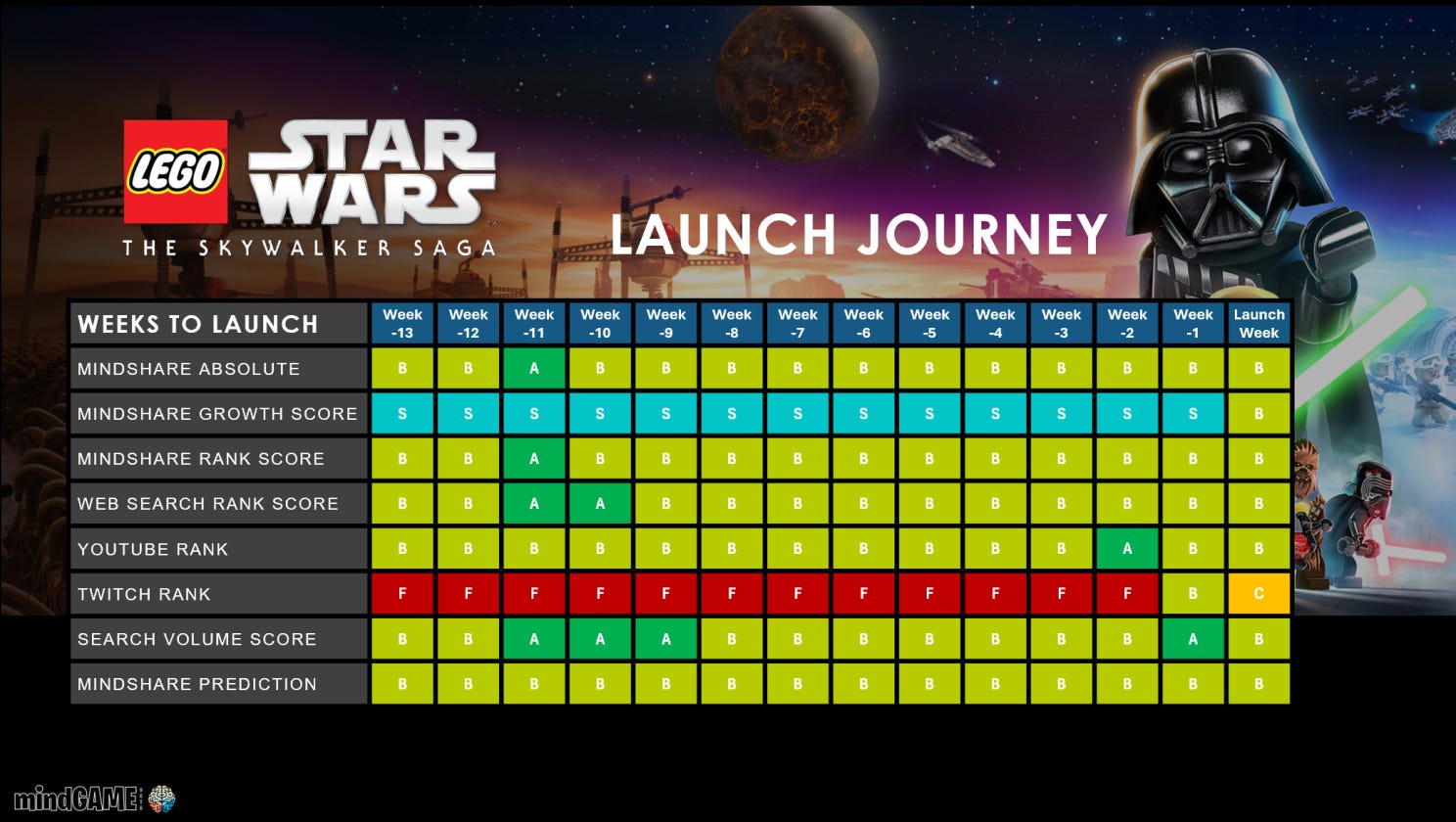
In our mindGAME Data tracking, The Skywalker Saga launched at 1.71% cumulative mindSHARE. That put it at #20 globally on launch week, behind only the biggest live-service titans and a handful of major releases. It hit #11 in Search with 6.55M searches in launch week alone, #29 on YouTube for video, #36 on Twitch for streaming. The trajectory across all four dimensions of attention was, by Star Wars-game standards, exceptional.
The commercial story matched. The game became one of the fastest-selling LEGO games of all time at launch and gave WB Games one of the strongest Star Wars commercial moments outside of EA’s exclusivity window. As I wrote earlier this year in How Adult Money Is Reshaping Play, the game ranked as the #20 largest game in the world that launch week, with the kind of cross-generational pull that defines great LEGO product.
What worked is exactly what you would expect to work, and it is worth pausing on the deeper reason here. TT Games has been working with Star Wars for decades. The original 2005 LEGO Star Wars: The Video Game was their breakthrough title, and the studio has been building Star Wars LEGO games continuously ever since. Every iteration has deepened the partnership and the IP fluency. By the time The Skywalker Saga shipped, TT had been making LEGO Star Wars games for nearly twenty years.
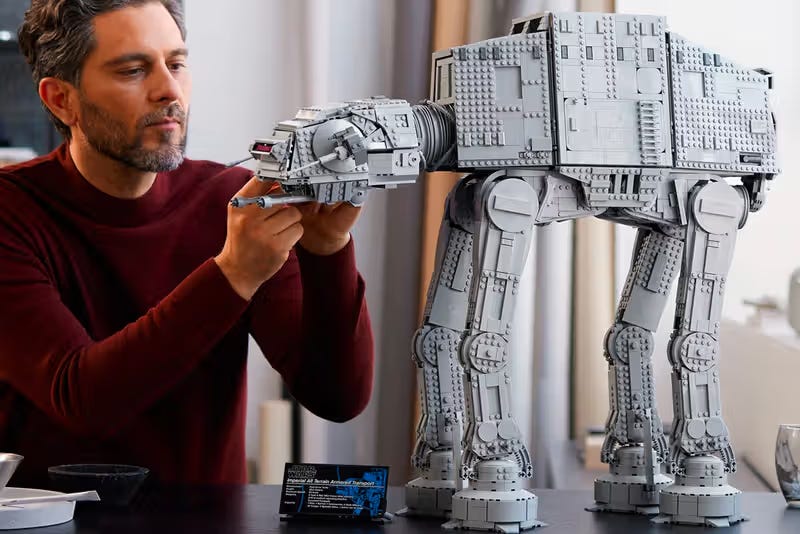
And here is the bigger truth that gets underestimated. LEGO and Star Wars are not just two compatible brands at this point. They are fused. LEGO Star Wars is core to LEGO’s modern identity. As I wrote in How Adult Money Is Reshaping Play, LEGO’s commercial turnaround in the 2000s was anchored by exactly this licensing strategy, with Star Wars as the early proof point. Walk into any LEGO store and Star Wars is front and center. Walk into any Star Wars fan’s home and there is a strong chance LEGO is part of the collection. The two IPs are now part of the same shared cultural ecosystem.
That depth is the actual reason The Skywalker Saga‘s development hell did not sink it. Twenty years of trust, IP fluency, and creative shorthand between TT, LEGO, and Lucasfilm carried it through. The Skywalker Saga is a win that happened in spite of its development hell, not because of it. Which makes the launch performance more impressive, not less.
This is the model. Multi-partner, IP-respectful, creatively differentiated, anchored by long-standing creative relationships. When the post-2021 reset works, it looks like this.
The Disappointing... Star Wars Outlaws
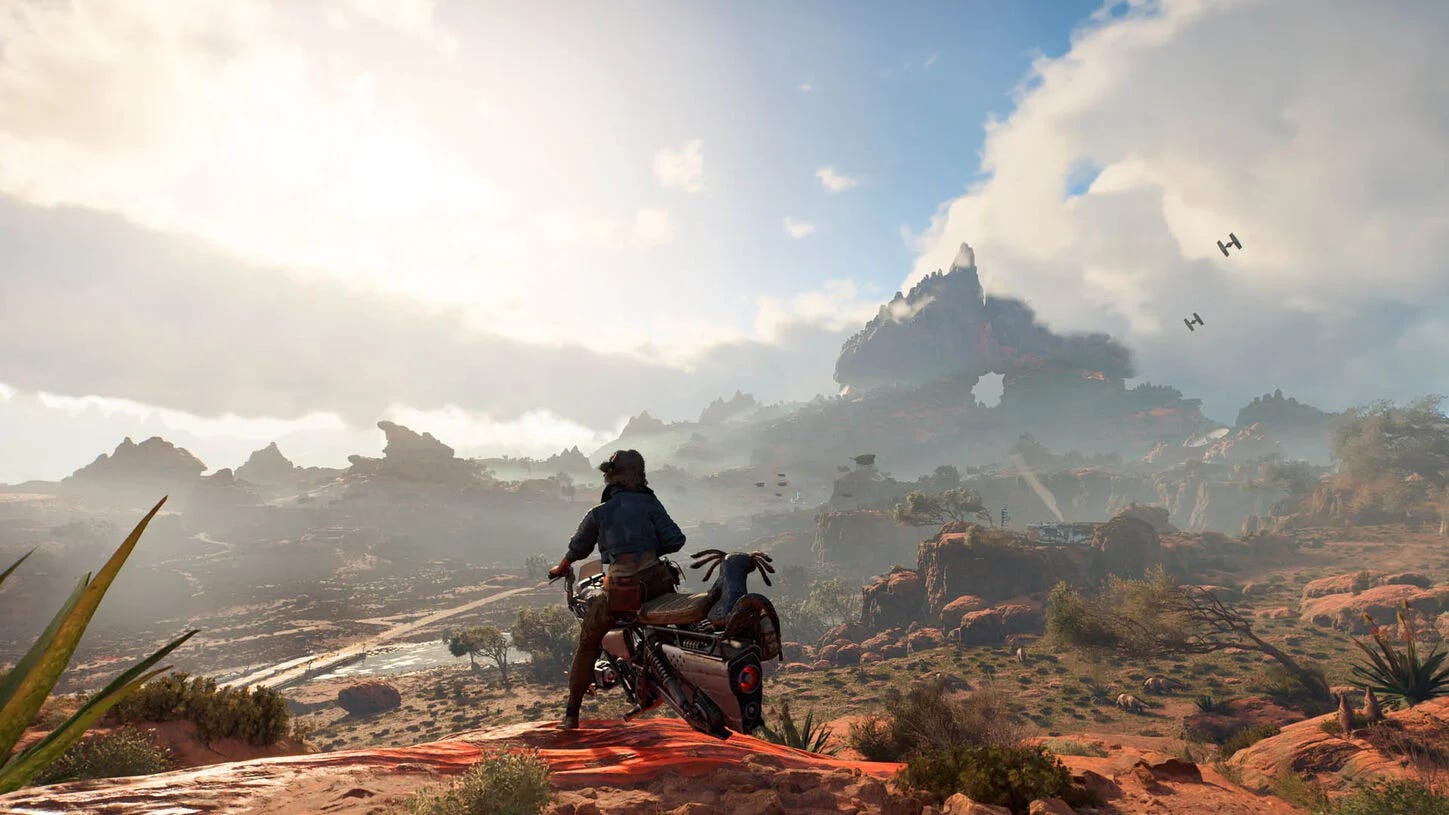
Star Wars Outlaws ( Massive Entertainment - A Ubisoft Studio , August 2024) was supposed to be the big one.
Three and a half years of anticipation. The flagship project of the entire post-2021 reset thesis. The first AAA Star Wars game from a non-EA publisher in over a decade. An open-world Star Wars adventure with a reportedly $200M+ development budget. When the partnership was announced in January 2021, Ubisoft CEO Yves Guillemot framed the opportunity in maximalist terms:
“The Star Wars galaxy is an amazing source of motivation for our teams to innovate and push the boundaries of our medium. Building new worlds, characters and stories that will become lasting parts of the Star Wars lore is an incredible opportunity for us...” — Yves Guillemot, Ubisoft CEO, WIRED, January 2021
That was the setup. Innovate. Push boundaries. Lasting Star Wars lore. Three and a half years later, the launch came in at 1.48% cumulative mindSHARE. That ranked #21 globally on launch week, #20 in Search with 4.86M searches, #17 on Twitch for streaming, and #35 on YouTube for video. Not a disaster on absolute terms. But for what it was, and where it was supposed to fit, the numbers were a real disappointment.
Stack it against the rest of the modern Star Wars era and the gap becomes obvious...
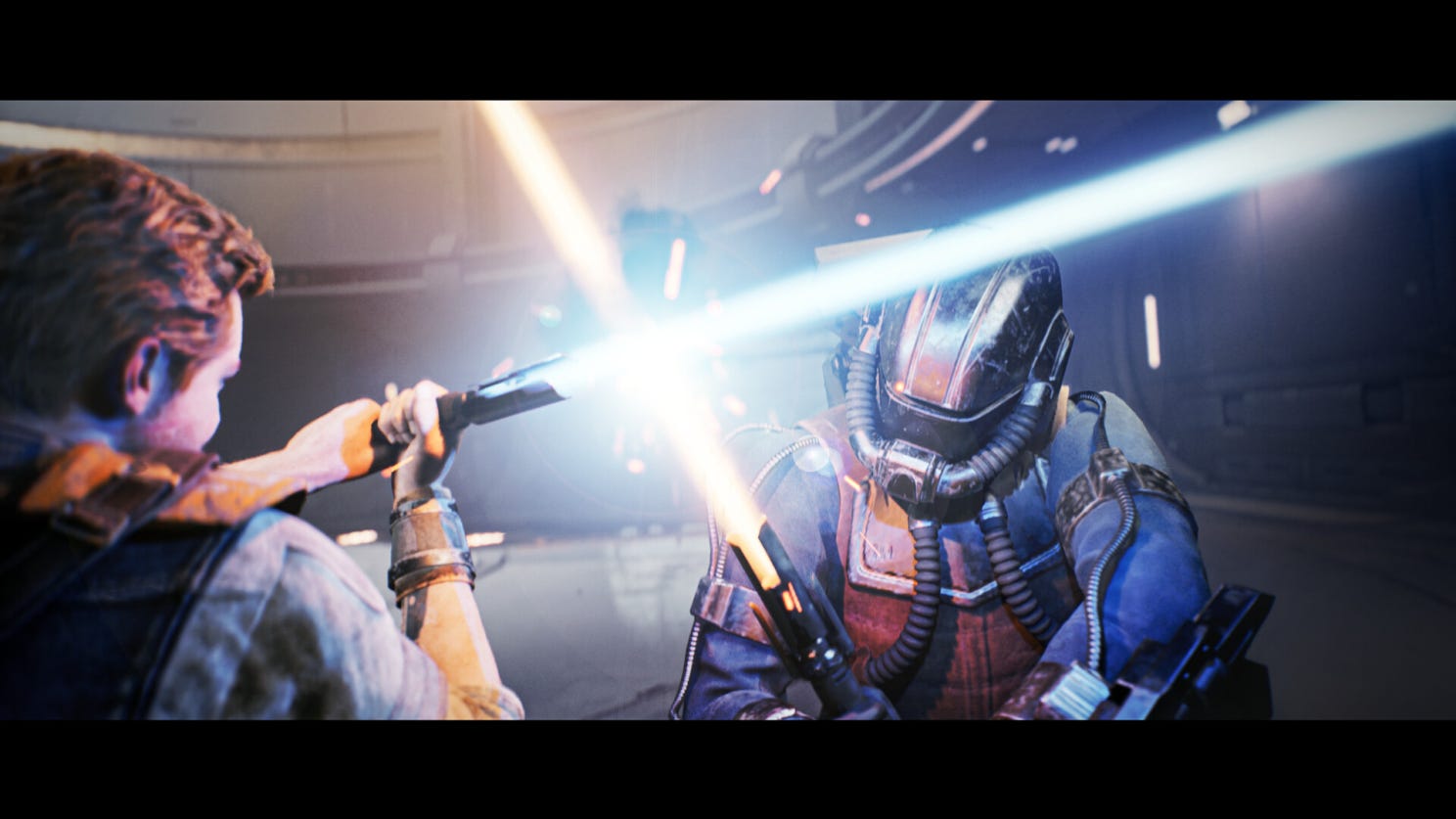
Jedi: Fallen Order (Respawn / EA, 2019) — 3.06%
Jedi: Survivor (Respawn / EA, 2023) — 1.84%
LEGO Star Wars: The Skywalker Saga (TT / WB Games, 2022) — 1.71%
Star Wars Outlaws (Ubisoft Massive, 2024) — 1.48%
A flagship Ubisoft AAA, with a $200M+ budget, fourth in the modern Star Wars era. Below both EA Jedi titles. Below the LEGO crossover.
By early 2025, Guillemot’s framing on the shareholder call had shifted dramatically. Gone was the “boundary-pushing” language. In its place, blame on the IP itself:
“Outlaws was released at a time when the brand that it belonged to was in a bit of choppy waters.” — Yves Guillemot, Ubisoft CEO, via IGN, January 2025
That framing does not hold up. Star Wars in 2024 was actually doing fine. Andor season two was critically acclaimed. EA’s Battlefront II was, eight years post-launch, smashing its own concurrent player records. Polygon framed the moment cleanly:
“On the surface level, Star Wars is in. Star Wars is hot. I want some Star Wars. Star Wars it’s gonna be.” — Petrana Radulovic, Polygon, June 2025
Outlaws was a Ubisoft execution problem, not a Star Wars brand problem. The IGN review flagged repetitive combat and “a few too many bugs at launch.” The pre-launch cycle was mired in a polarizing controversy around how Ubisoft was positioning the game. And Kay Vess, the protagonist, never clicked with the Star Wars community the way Cal Kestis did.
Ubisoft made the game Ubisoft makes. Open-world template, by-the-numbers gameplay loop, adequate but not extraordinary. Three and a half years of anticipation, $200M+ in spend, and the headline at the end of it all was the CEO blaming the most valuable IP in entertainment for an underwhelming launch.
The Head-Scratcher... Star Wars: Hunters
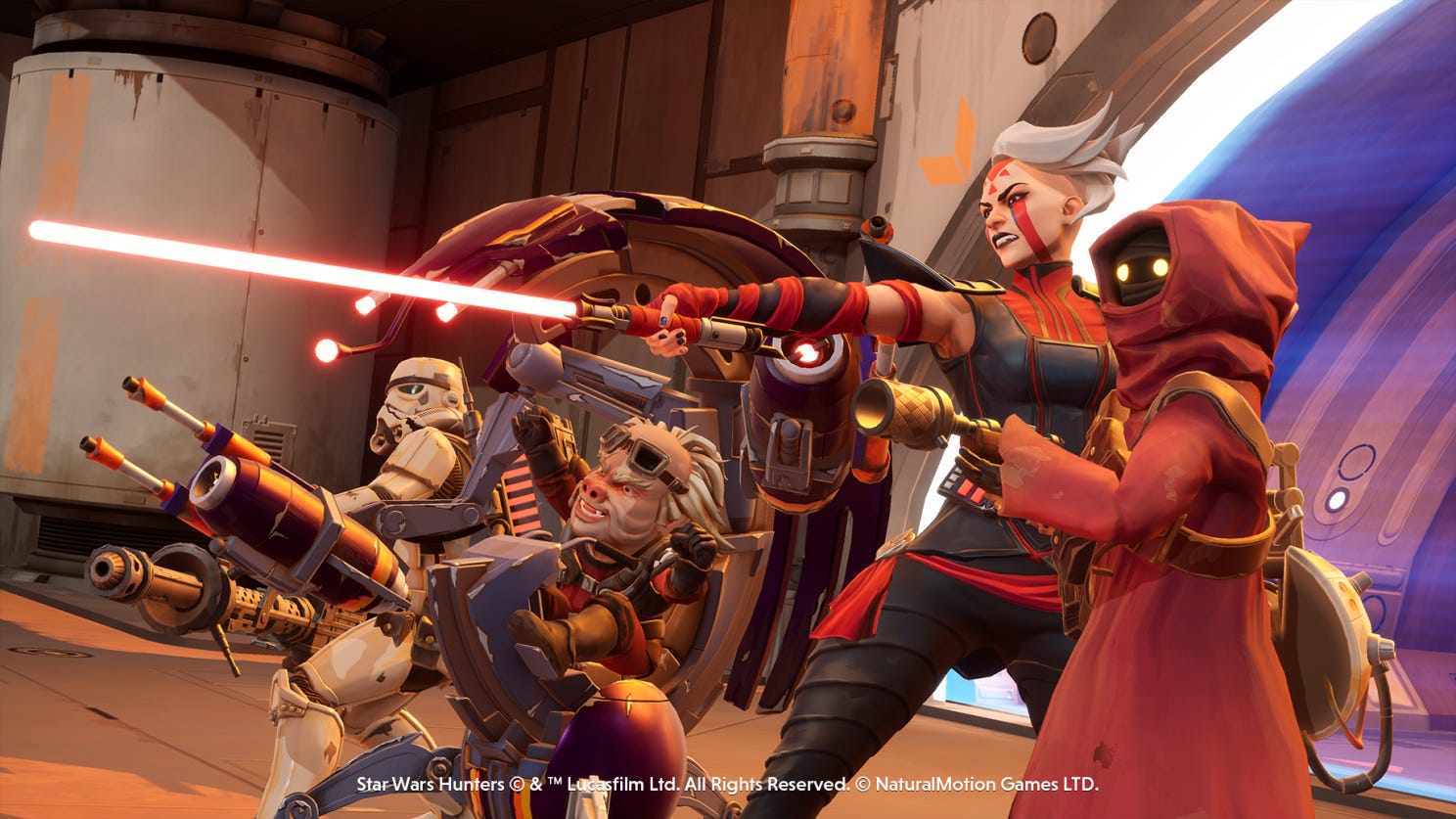
This one I have spent real time trying to make sense of, because the numbers are genuinely difficult to look at.
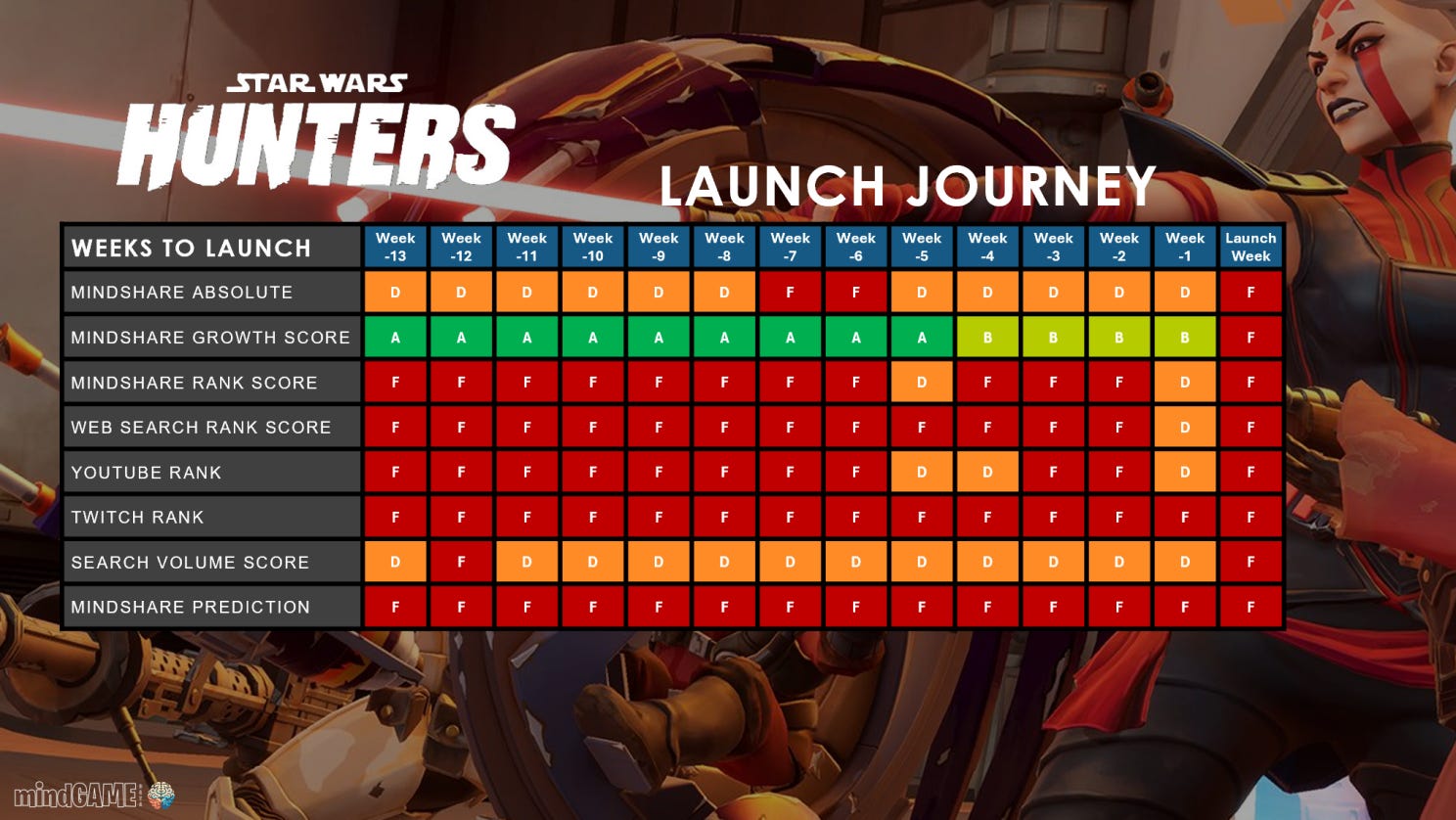
Star Wars: Hunters ( Zynga , June 2024) launched at 0.09% cumulative mindSHARE. That ranked the game #316 globally on launch week. #260 in Search with only 357K searches. #563 on Twitch. #332 on YouTube.
For context, ranks like these on launch week mean the game functionally did not exist in the conversation. We are talking about a Star Wars title that, at launch, was generating less attention than dozens of indie games and live-service updates that same week.
How did we get here?
Hunters was conceived in 2019 as a cross-platform competitive arena shooter for mobile and Nintendo Switch, designed around character-based PvP. The pre-launch posture was confident. Studio head Jeff Hickman, a Star Wars: The Old Republic veteran from BioWare who had moved to Zynga’s NaturalMotion division, told TheWrap in November 2020 that the studio was working closely with Lucasfilm and that the design philosophy was sound:
“You make a great game first. Star Wars is beloved, but if you put Star Wars aside for a minute, making a great game, no matter what the IP is, is the key to everything that we do.” — Jeff Hickman, Studio Head, Zynga, TheWrap, November 2020
That was the pitch. Confident. Premium mobile. Console-quality action. Multi-generational Star Wars audience. Zynga only invested in titles it expected to do $100M+ in annual revenue, and Hickman framed Hunters as that kind of bet.
The game shipped in June 2024, almost four years after that interview, after multiple delays. And by then, the picture had changed in a few critical ways.
First, the IP integration ended up constrained. Years later, Zynga CEO Frank Gibeau explained the structural problem:
“We had some issues with how we could explore the intellectual property. Could you play Darth Vader or could you not? That sort of thing.” — Frank Gibeau, Zynga CEO, The Game Business, July 2025
That tells you a lot. Zynga signed on for a Star Wars hero shooter, and then could not actually use the most iconic Star Wars heroes. The roster ended up filled with original characters built specifically for the game. Players who showed up wanting to play Darth Vader got... a Twi’lek bounty hunter named Rieve. Not exactly the same dopamine hit.
Second, the platform mismatch. Free-to-play mobile shooters live or die on organic install funnels. Call of Duty: Mobile and Fortnite on mobile have those funnels because the parent IP is everywhere. Hunters did not. Gibeau again:
“We built a great tech base and a fun game. The problem was it wasn’t a viable business. We weren’t able to generate the organic installs from the license.” — Frank Gibeau, Zynga CEO, The Game Business, July 2025
Translation: the Star Wars license, in this configuration, did not move mobile downloads. Without the iconic characters, without an organic funnel, with a competitive shooter market that had moved on from the 2019-era conditions in which the game was conceived, Hunters launched into a void.
Zynga sunset the game in March 2025, less than a year after launch. The autopsy is fairly clean. Wrong platform fit, wrong IP integration constraints, wrong moment in the competitive shooter cycle. The contrast between Hickman’s confident 2020 pitch and Gibeau’s 2025 post-mortem is its own story.
A genuinely curious case of a partnership that probably should not have been greenlit in the configuration it was greenlit in. Or, if greenlit, should have been reset earlier.
The Quick Hits
Beyond those three, the post-2021 reset has produced a handful of other releases worth a brief mention.
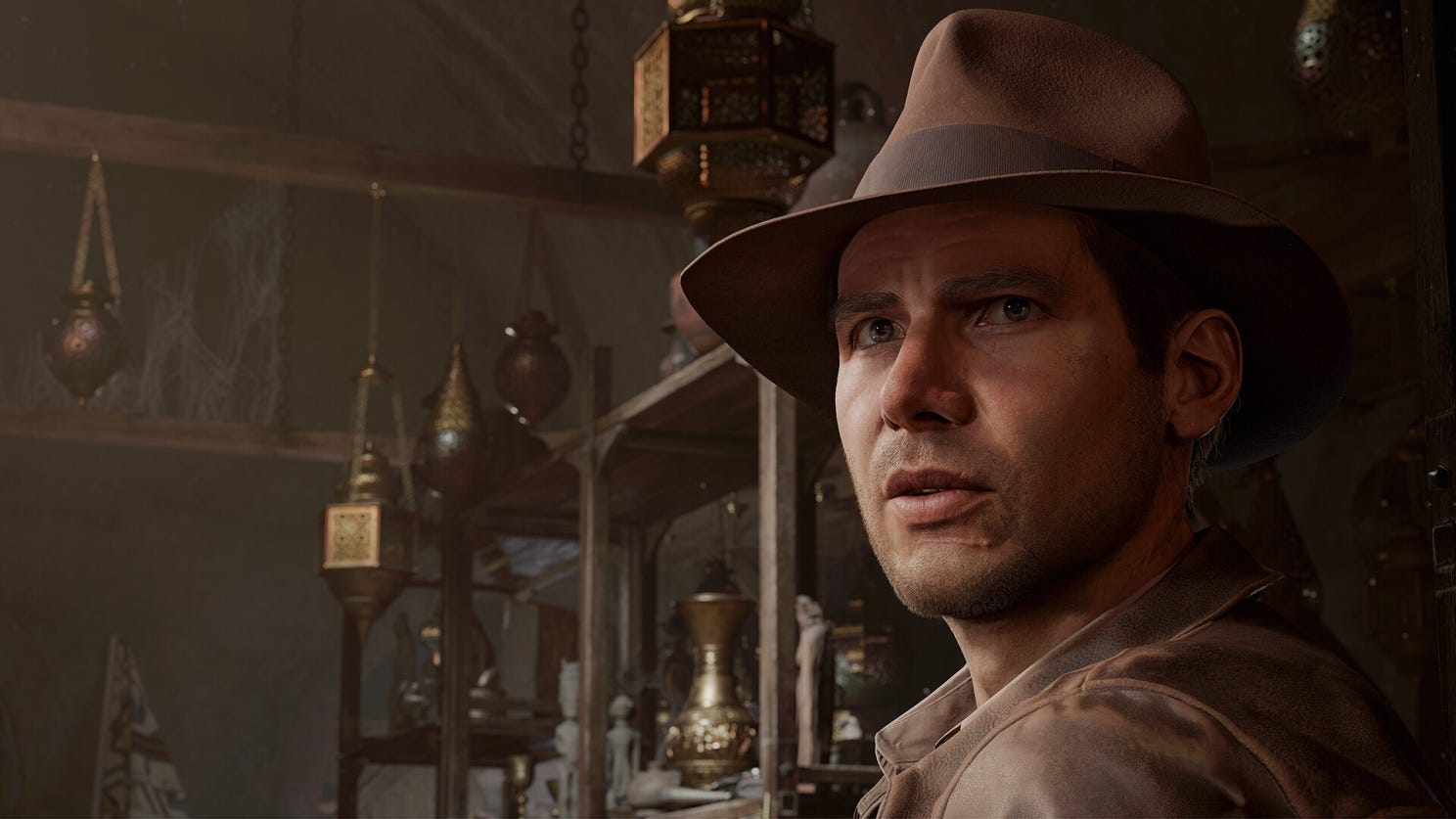
Indiana Jones and the Great Circle ( MachineGames / Bethesda Softworks / Lucasfilm Games, December 2024) was the other flagship partnership announced alongside Outlaws back in January 2021, with Todd Howard executive producing and MachineGames bringing the same studio DNA that made the modern Wolfenstein games sing. Critically beloved at launch. A genuinely great game.
But it was also a day-one Game Pass title, and that distribution choice gutted the standalone sales tail. As I wrote in The Game Pass Sugar High:
“Indiana Jones and the Great Circle entered the market with strong brand identity and glowing reviews... yet still lost 93% of its mindSHARE in record time.” — The Game Pass Sugar High, June 2025
This was not a game-quality issue. This was a windowing issue, the same one I have been writing about extensively in the Xbox context. Critical win. Commercial shortfall. Same release.
Star Wars: Squadrons (Motive Studio / EA, 2020) launched at 0.62% cumulative mindSHARE. A niche but well-executed return to the X-Wing/TIE Fighter lineage, but built for VR-curious flight sim fans rather than the mass Star Wars audience. Did what it set out to do, no further.
A handful of remasters and ports... Battlefront Classic Collection, Dark Forces Remaster, Bounty Hunter, Episode I Jedi Power Battles... have rolled out as catalog refreshes. Reasonable revenue, no needle-movers.
Five Years In... The Pattern Is Clear
So here is the post-2021 reset scorecard.
One real win. TT Games / WB Games / Lucasfilm Games delivering exactly what the multi-partner thesis promised, even with a development cycle that probably should have ended the project several times over.
One disappointing miss. A flagship Ubisoft AAA, $200M+ in spend, three and a half years of anticipation, ending with the CEO blaming the IP for the launch underperformance.
One head-scratcher. A Zynga mobile shooter built on a 2019 pitch that landed in a 2024 market the original premise no longer fit, with IP integration constraints that hollowed out the core hook.
And a quiet shortfall on the Indiana Jones side caused by distribution choices, not the game itself.
The pattern is becoming clear. The wins came from partners who respect the IP and play to their strengths. The losses came from partners who treated Star Wars as just another license, or built around constraints that hollowed out what makes the IP work in the first place.
But the slate ahead has me, for the first time in a long time, hopeful.
And with Filoni now sitting as President and Chief Creative Officer of Lucasfilm, the entire creative architecture of the franchise has just been handed to the person Lucas himself spent twenty years preparing for the role. The conditions are different now. The leadership is aligned. The slate is the most creatively diverse it has been since the original LucasArts era.
Which brings me to the snapshot of where the franchise actually sits in the market right now.
Where Star Wars Sits Today, And Where It’s Going
Now to the snapshot.
In our mindGAME tracking of the global gaming market, Star Wars as an aggregate IP currently sits at roughly 0.20% of total tracked attention across all games we cover. That includes everything live in the market right now, from EA’s catalog (Jedi: Survivor, Galaxy of Heroes, The Old Republic, Battlefront II, Fallen Order) to Outlaws tailing along, the LucasArts-era classics (the original KOTOR, KOTOR II, Empire at War) holding small but stubborn shares, the LEGO catalog, the recent remasters from Aspyr, and pre-launch attention bleed for Galactic Racer, Zero Company, and Eclipse.
Some context on what 0.20% means in attention terms.
A really important caveat worth front-loading here. Most Star Wars games are single-player. Single-player AAA titles ebb and flow with their launches. The typical pattern is sharp peak attention for roughly three weeks post-launch, then a steep decline that settles into a long, modest tail. Live-service games, by contrast, sustain attention indefinitely through content drops, seasons, and event cycles. FIFA / EA Sports FC, Fortnite, Call of Duty, Roblox, Minecraft... these franchises maintain attention floors that single-player IPs simply cannot match by structural design.
So when you compare Star Wars at 0.20% to the live-service titans, you are not comparing apples to apples. You are comparing two fundamentally different attention architectures.
The fairer comparison is against other major IP universes, especially those that lean single-player or single-player-heavy. Worth running that benchmark in our data.
Across the same Total Market data, here is where the major franchise IPs land in aggregate cumulative mindSHARE today...
Marvel: 0.68% — driven by Marvel Rivals at 0.36% on its own, plus Spider-Man 2, Contest of Champions, Miles Morales
Mario: 0.59% — Super Mario Odyssey, Super Mario 64, Mario Kart World, Super Mario Bros. Wonder
Star Wars: 0.20% — Jedi: Survivor, Galaxy of Heroes, SWTOR, Battlefront II, Fallen Order
Sonic: 0.16% — Sonic Racing: CrossWorlds, Sonic Frontiers, Sonic Mania, Sonic CD
DC Comics: 0.15% — Batman: Arkham Knight, Arkham City, LEGO Batman: Legacy of the Dark Knight, Injustice 2
Harry Potter / Wizarding World: 0.14% — Hogwarts Legacy at 0.13% alone
A few patterns jump out.
Marvel and Mario are roughly 3x Star Wars in aggregate share. That gap is real, and it is structural. Marvel has converted IP scale into more frequent, higher-budget releases across more platforms, and it now has a successful live-service multiplayer hit. Marvel Rivals alone, at 0.36%, is bigger than the entire Star Wars catalog combined. That single live-service title outweighs the cumulative attention of every released Star Wars game in our tracking. Mario benefits from Nintendo’s first-party release cadence and the live-service-adjacent dynamics of Mario Kart. Both franchises are doing exactly what Star Wars has not done in the post-2021 reset window.
Star Wars sits comfortably above Sonic, DC, and Harry Potter. Star Wars at 0.20% is meaningfully ahead of Sonic at 0.16%, DC Comics at 0.15%, and the Wizarding World at 0.14%. So the franchise is not at the bottom of the major-IP heap. It is in the middle.
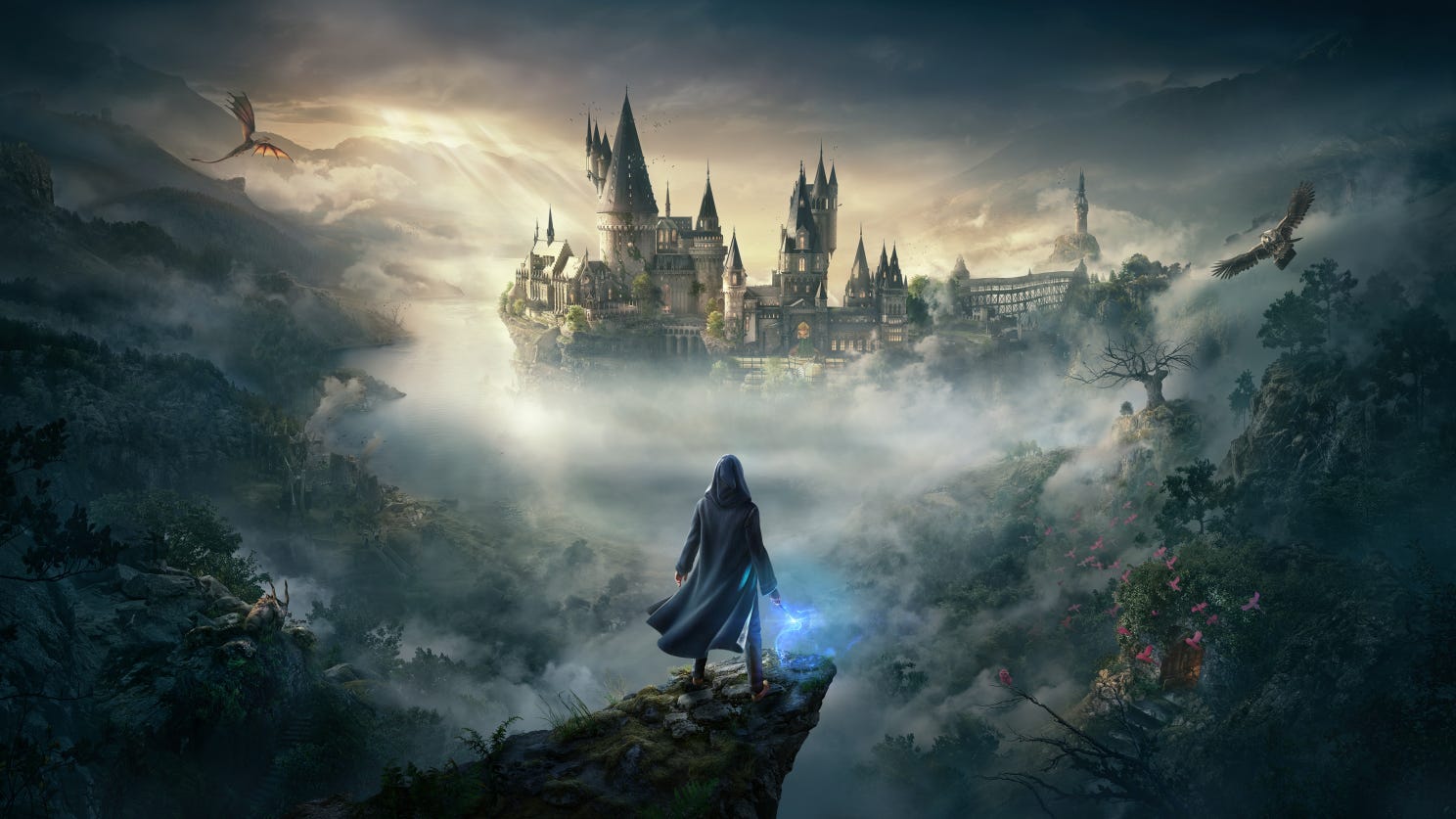
The Wizarding World is a one-title franchise. Hogwarts Legacy drives 0.13% of the franchise’s 0.14% aggregate share. The rest of the Wizarding World gaming portfolio is essentially noise in the data. That is the textbook definition of franchise fragility... one big release does all the work, and the rest of the catalog is not pulling weight. Star Wars, by contrast, has at least five active titles each contributing meaningfully to the aggregate share.
The takeaway: the IP is healthy and durable, but underleveraged. Star Wars is not punching at the level of its closest single-player IP peers (Marvel, Mario). It is comfortably ahead of the next tier (Sonic, DC, Harry Potter). The path to closing the gap to Marvel and Mario is the obvious one... more frequent releases at higher quality, or a successful live-service hit, or both. The post-2021 reset has not produced either yet. Outlaws should have been the AAA single-player swing that closed that gap. It was not. The current portfolio is doing roughly what an aging single-player catalog with sporadic releases tends to do.
But the slate ahead is where this story gets interesting. Because the post-2021 reset’s slowest stretch is now behind us. The next eighteen to thirty-six months of Star Wars releases are the most diverse, most creatively aligned slate the franchise has had in twenty years. Worth walking through them in the order I am most excited about, ending on the one I am most pumped to tell you about.
The Smaller Games On The Slate
A handful of Star Wars titles sit in the next 12-36 months that warrant brief context. Some are confirmed and dated. Some are confirmed and quiet. Some are confirmed and probably years away. None of them are the headliners..... at least in the current state (pre SGF)... but together they paint a picture of how broad the slate is becoming.
Star Wars: Eclipse
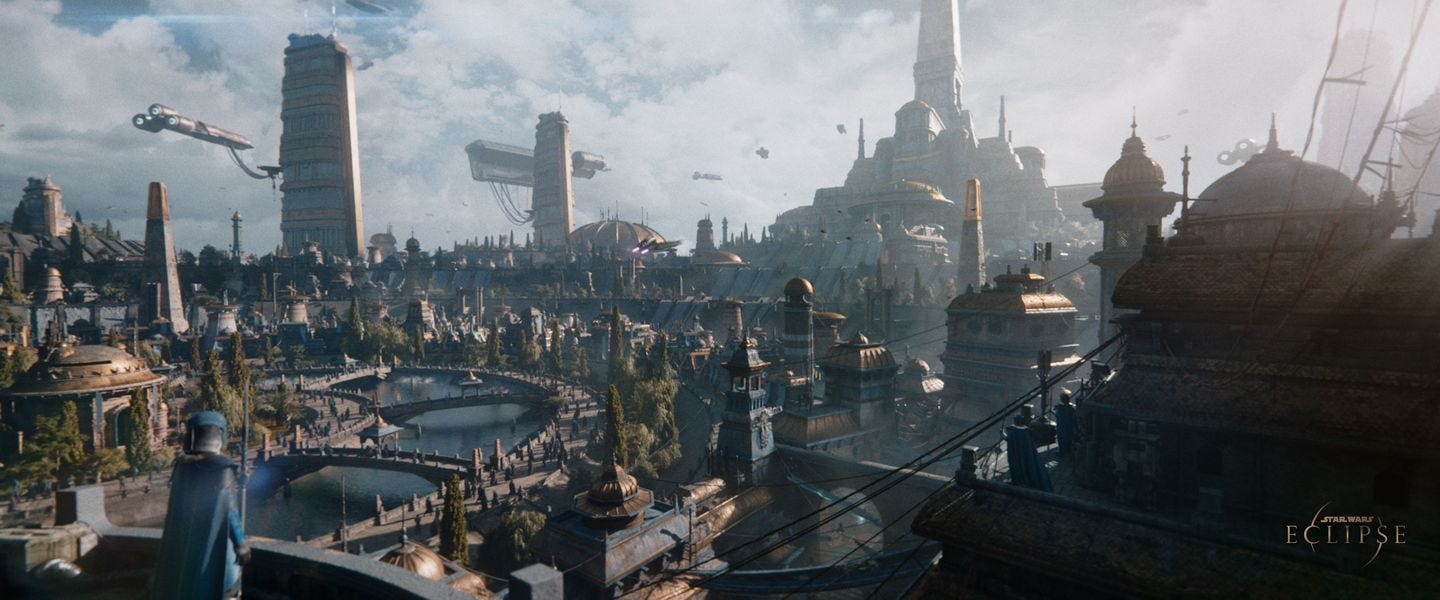
Announced at The Game Awards in December 2021, Star Wars Eclipse is being developed by Quantic Dream (Heavy Rain, Detroit: Become Human, Beyond: Two Souls) under their NetEase ownership. The game is set during the High Republic era, the period of relative galactic peace centuries before the Skywalker Saga. The official pitch from Quantic Dream and Lucasfilm Games at announcement landed cleanly:
“Star Wars Eclipse is an intricately branching action-adventure game that can be experienced in many ways, and puts the destinies of multiple playable characters in your hands... Choices have consequences. Every decision you make can have dramatic repercussions on your journey: alter your relationships, the locations you visit, the battles you fight, and even the fate of the characters themselves.” — Quantic Dream / Lucasfilm Games official site, December 2021
Quantic Dream is a polarizing studio. Their narrative-first, branching-storyline approach is genuinely distinctive. Their development cycles are notoriously long. And the project has had a rough pre-release period. After the 2021 reveal, a #BlackoutStarWarsEclipse boycott gained ground on social media as fans took issue with the workplace harassment allegations that had surfaced against the studio and founder David Cage in 2018 (Quantic Dream won an appeal in 2021 that tossed the lawsuit). Reports in 2022 via Polygon suggested the studio was struggling to hire for the project as a result. Eclipse lost its lead writer in 2024 when Adam Williams left to form his own studio.
The most recent on-the-record update came in October 2025, when Cage published a blog post titled “Writing a New Chapter” outlining a major strategic shift for the studio. Quantic Dream had moved beyond its traditional single-project model and was now developing multiple games in parallel, including a competitive multiplayer experience. Eclipse got exactly one sentence at the bottom of the post:
“Of course, development of Star Wars: Eclipse continues, and we are eager to share more with you in the future.” — David Cage, Quantic Dream blog, October 2025
That single sentence is doing a lot of work. Eclipse is alive. It is not the studio’s only project anymore. And there is no real news to share. Just a “still happening” reassurance buried at the bottom of a corporate strategy update that was actually about something else.
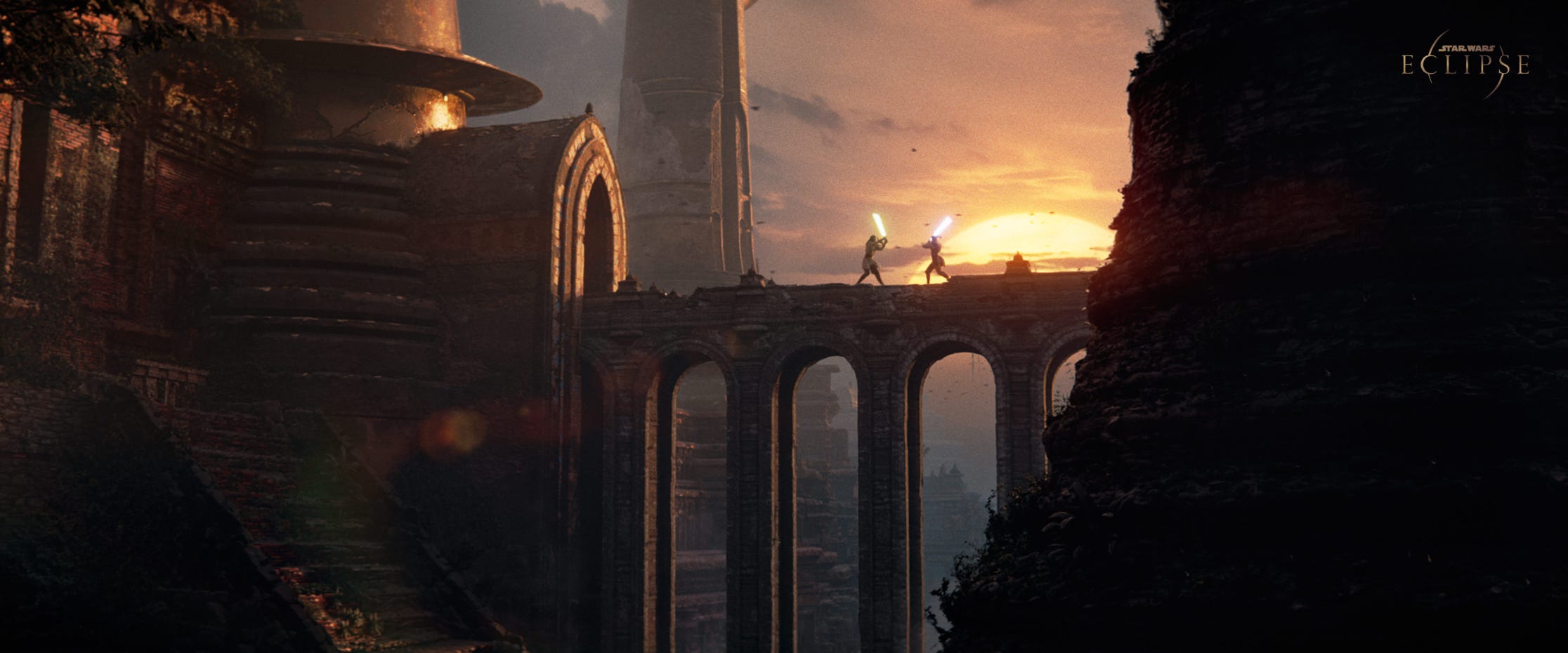
The most recent industry word, from Insider Gaming via Polygon in April 2026, was that “the game, at this stage, is still looking to be years off from completion.” Adding to the fog, Disney and Lucasfilm formally sunsetted the High Republic publishing initiative in 2025, which raises questions about the broader transmedia hooks the project was originally built around.
In our mindGAME tracking, Eclipse sits at 0.0010% cumulative mindSHARE in the broader market. That is essentially flatline. Attention this far out, on a project this delayed, is mostly speculation and search-engine residue.
Status: Years away, fundamentally uncertain, but a genuinely fresh creative angle if it ships. The High Republic setting alone is interesting. Whether QUANTIC DREAM can deliver, in the configuration the project is currently in, with Eclipse no longer the studio’s sole focus, is a different question. Watching from a distance, low-confidence on timing.
Untitled Star Wars Game by Amy Hennig
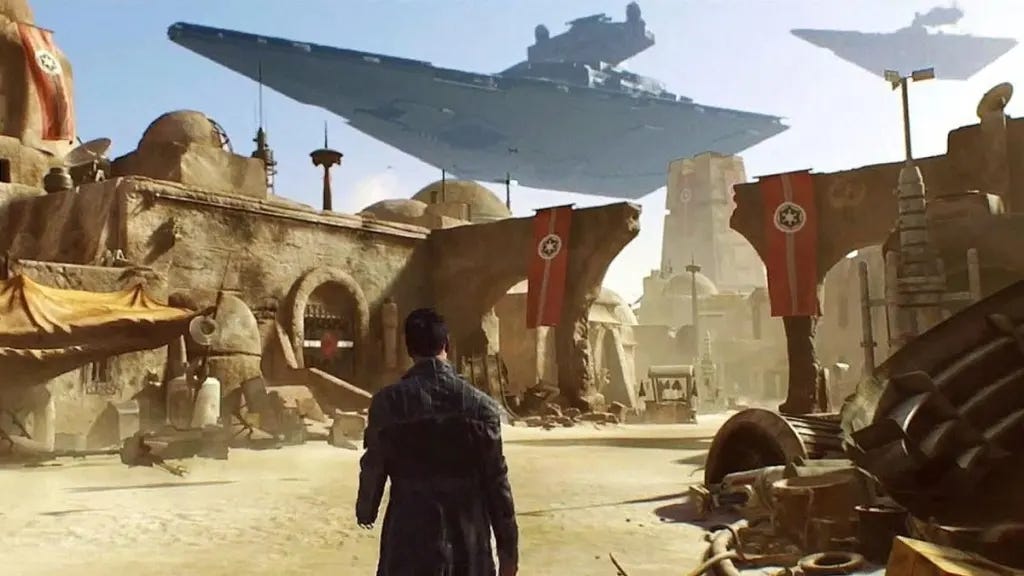
Announced in April 2022, Skydance New Media (led by Uncharted series creative director Amy Hennig) is working on a Star Wars action-adventure project for Lucasfilm Games. Hennig was previously the creative lead on Visceral’s cancelled Project Ragtag a decade ago, the Star Wars action-adventure game that became one of EA’s most public losses of the exclusivity era.
The reveal landed with real weight at the time. From the Skydance press release:
“I’ve often described how seeing Star Wars in 1977 essentially rewired my 12-year-old brain, shaping my creative life and future indelibly. I’m elated to be working with Lucasfilm Games again to tell interactive stories in this galaxy that I love.” — Amy Hennig, President, Skydance New Media, April 2022
The project was framed as a “richly cinematic action-adventure game featuring an original story.” Updates since then have been minimal. The project has been confirmed as still in development on multiple occasions but has not surfaced gameplay, a release window, or even a confirmed setting beyond the original framing. Some have speculated this could be a revival of the Project Ragtag concept, but that is fan speculation, not confirmed fact.
Skydance New Media has been quiet broadly. Their other major project, Marvel 1943: Rise of Hydra, has been delayed indefinitely, which adds context to the silence on the Star Wars side.
Status: Confirmed but quiet. Hennig’s track record is real, and a redemption arc on the Star Wars action-adventure space, after the Project Ragtag heartbreak a decade ago, would be poetic. But the silence has been long enough that fan expectations have, candidly, cooled. Still on the slate. Not currently driving meaningful attention.
Star Wars: Knights of the Old Republic Remake
The Knights of the Old Republic Remake has had one of the more public and painful development cycles of any modern Star Wars project.
Originally announced as a PlayStation console exclusive at the September 2021 PlayStation Showcase, with Aspyr Media as the lead developer. Less than a year later, Bloomberg’s Jason Schreier reported in July 2022 that the project had been put on indefinite hold:
“In a series of meetings throughout July, Aspyr’s two studio heads told employees that the project is on pause and that the company will look for new contracts and development opportunities... On June 30, Aspyr finalized a demo of the game, known as a vertical slice, to show to production partners Lucasfilm Ltd. LLC and Sony Group Corp. The developers were excited about it and felt like they were on track. The following week, the company fired design director Brad Prince and art director Jason Minor.” — Jason Schreier, Bloomberg, July 2022
A month later, Schreier reported again that the project had been transferred from Aspyr to Saber Interactive’s Eastern European studios. Embracer, which owned both studios at the time, confirmed the move in financial filings:
“One of the Group’s AAA projects has transitioned to another studio within the Group. This was done to ensure the quality bar is where we need it to be for the title.” — Embracer Group financial report, via Bloomberg, August 2022
The corporate “quality bar” framing is doing a lot of work in that statement. Worth letting it sit.
Embracer’s own financial troubles in 2023 and 2024 added another layer of uncertainty. The conglomerate’s failed $2B Saudi-backed investment, the layoffs that followed, and the eventual March 2024 sale of Saber back to its founder Matt Karch’s investment group for $247M all happened with the KOTOR Remake somewhere in the pipeline. The most recent confident update came from an unexpectedly informative source... Stephen Totilo’s Game File interview with Karch in March 2025:
“Saber is careful about what they say about what might be their most anticipated project, the long-awaited remake of Star Wars: Knights of the Old Republic. Karch confirmed during our flight that it is still in development. But, just as Wingefors used to be every time he was asked about the game when it was under Embracer, Karch won’t or can’t say more. His PR rep explained that they want to allow Star Wars owner Disney to take the lead in talking about games tied to that company’s characters.” — Stephen Totilo, Game File, March 2025
In December 2025, Totilo reported that Mad Head Games, one of the studios Saber kept in the Embracer split, is now leading development. And in a wild side note... a KOTOR II remake was reportedly in development as recently as March 2025, but has never been officially announced.
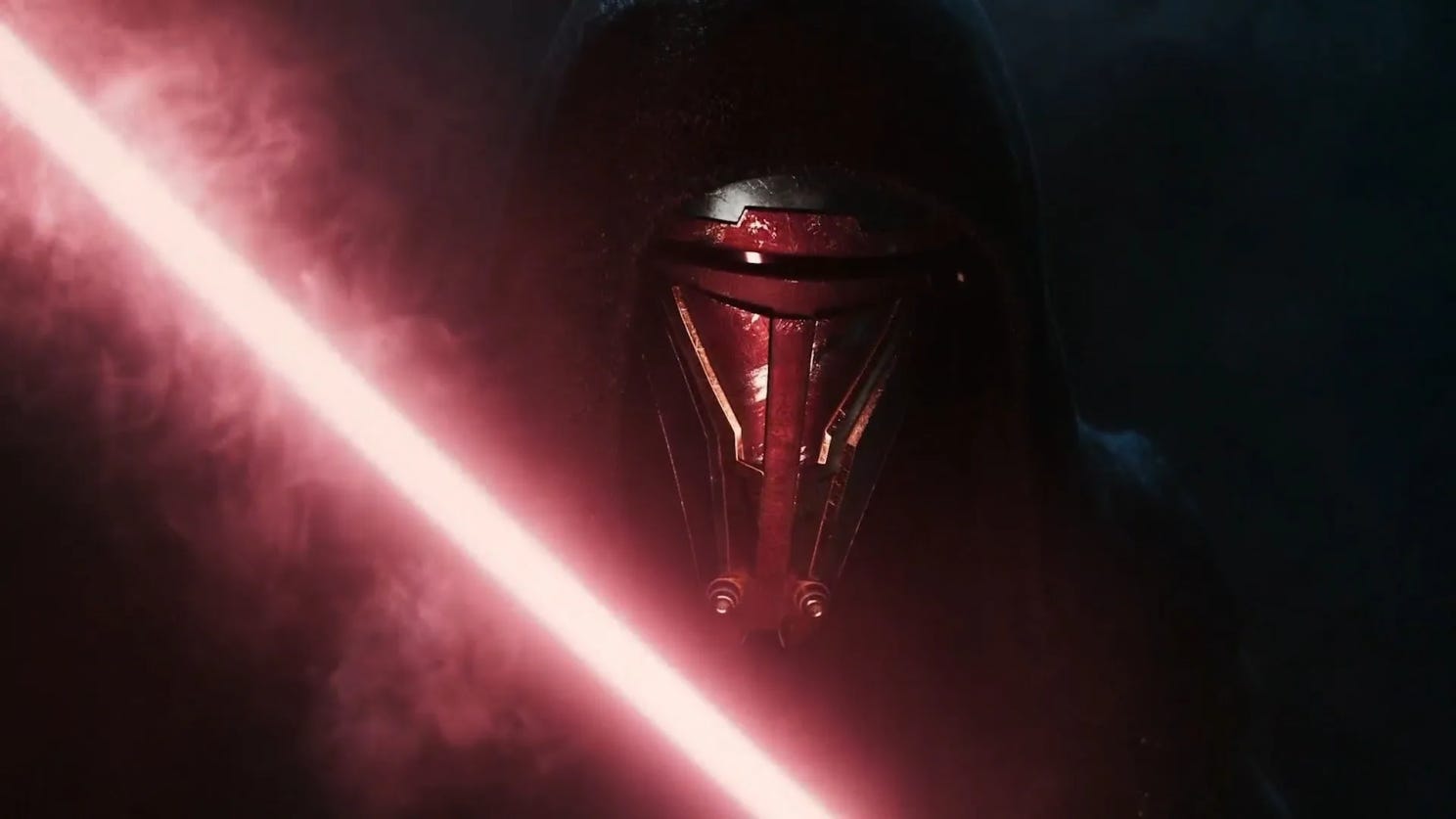
The most recent on-the-record update came in March 2026, when Saber Interactive‘s chief creative officer Tim Willits told IGN, simply, “Yes, it is still in development. That’s all I can say.”
For a generation of Star Wars and RPG fans, this is the project that should have been the easiest layup in modern gaming. KOTOR is foundational. The fan demand is huge. And yet, here we are, four-plus years past announcement, with no release window and a chain of studio-and-corporate complications.
Status: Genuinely unclear. After everything, it is hard to feel confident about timing or the configuration the game will eventually land in. But.... and this is the personal angle.... KOTOR is my favorite Star Wars game of all time, and I would be hard pressed to not give the remake a go if it ships. There is also a strategic case worth flagging. If KOTOR Remake actually lands before FOTOR, it could be additive rather than competitive. A well-executed remake of the original could prime the audience for the Old Republic era ahead of Casey Hudson’s new project. Done right, the two could feed each other. Done wrong, KOTOR Remake gets buried under the FOTOR hype cycle. Either way, I am rooting for it to ship.
Star Wars: Zero Company
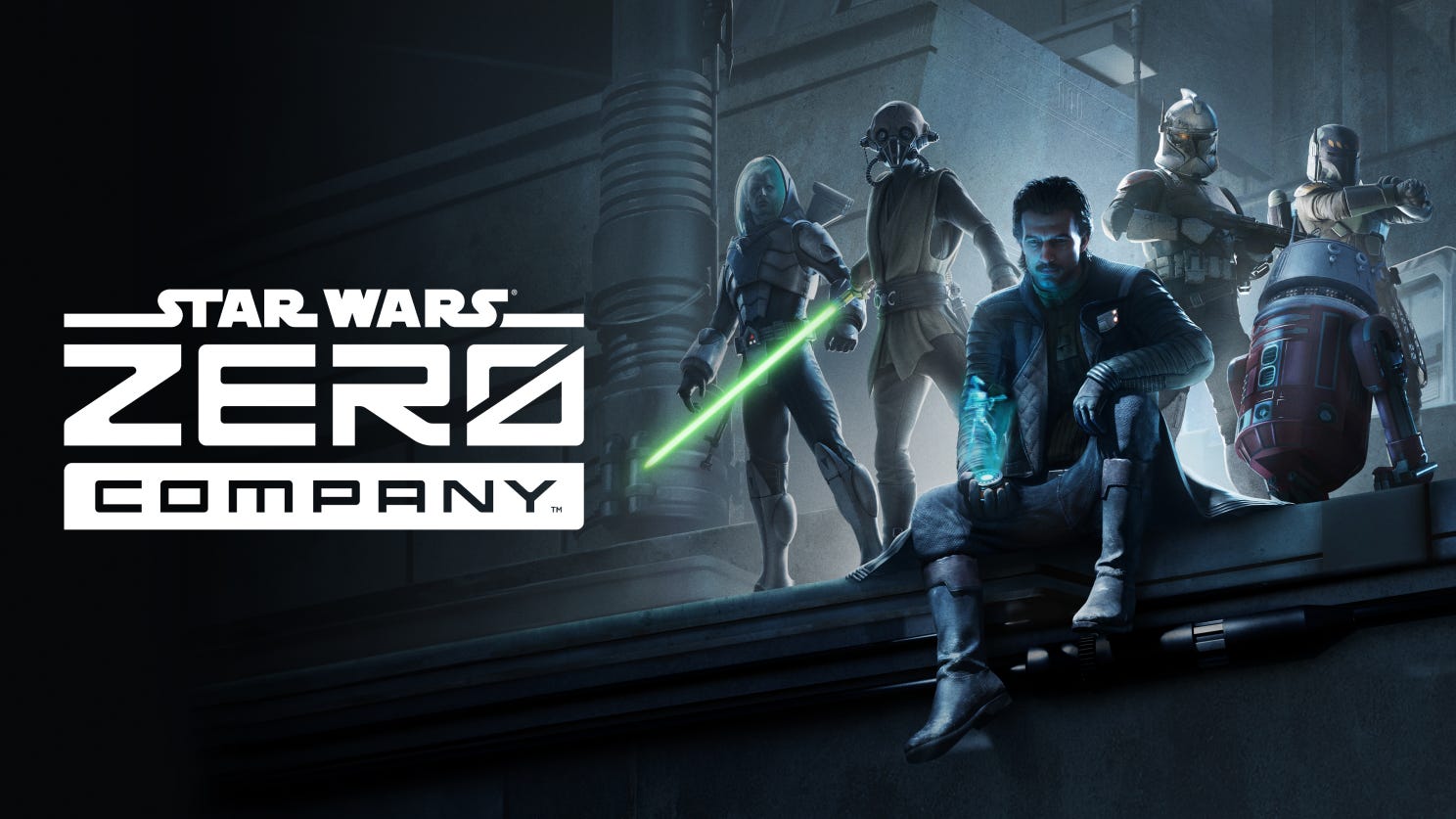
This is the most interesting “smaller” game on the slate, and it is worth more than a passing mention.
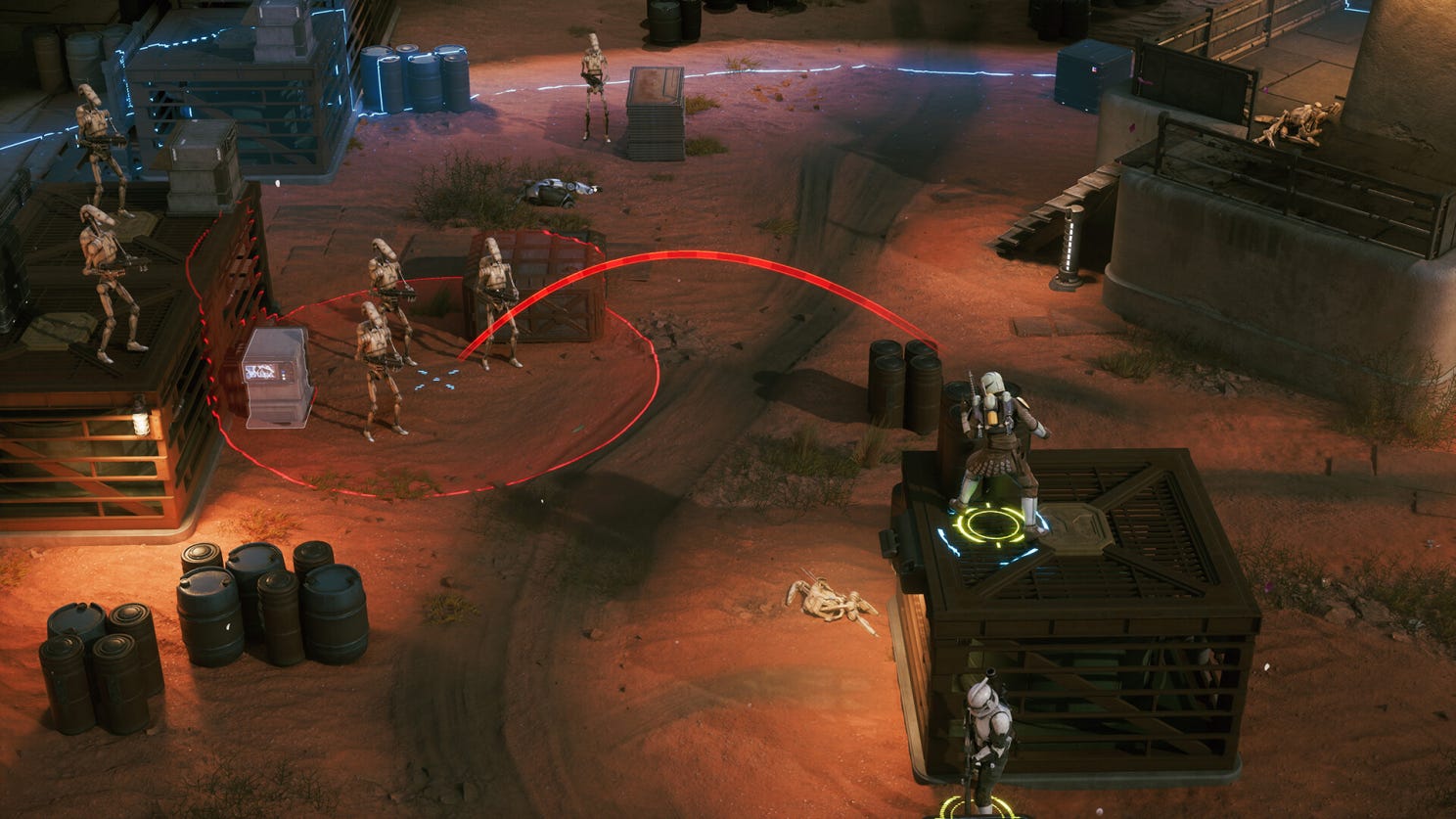
Star Wars: Zero Company was announced at Star Wars Celebration Japan in April 2025 as a single-player turn-based tactics game set during the Clone Wars. Players take control of Hawks, a former Republic officer leading an elite squad of mercenaries on covert missions. The game is being developed by Bit Reactor, founded in 2022 by Greg Foertsch, who served as art director across the entire modern XCOM series at Firaxis. Respawn Entertainment is collaborating, with Jedi-series writer Aaron Contreras leading narrative.
The XCOM DNA is the headline. Foertsch and his team have spent careers making the most respected turn-based tactics games of the last decade. PC Gamer’s framing on the studio visit captured the pitch as cleanly as anyone: “Mass Effect but with turn-based tactics and permadeath.” That is exactly the creative target.
Pointing that talent at Star Wars, in a Clone Wars setting, with Lucasfilm Games providing IP oversight and Respawn providing publishing infrastructure, is a creative pairing that maps very cleanly to the multi-partner thesis. Lucasfilm Games’ Executive Producer Orion Kellogg framed the partnership clearly on the reveal panel:
“For Lucasfilm Games, this is our strategy game. So we’re not saying, like, ‘Oh, can you make it less strategy-y?’ We want this to be a strategy game first and foremost, and it is, and that’s why we’re working with Bit Reactor.” — Orion Kellogg, Executive Producer, Lucasfilm Games, StarWars.com, April 2025
The Hawks-as-protagonist framing matters too. Kellogg again:
“We’re offering a character we haven’t seen before, a role we haven’t seen before. I don’t think I can point at another character in the Star Wars franchise and say, oh, that’s Hawks. And I think that’s because of this unique story that we’re telling and this unique timeframe digging beneath the surface of the Clone Wars.” — Orion Kellogg, Executive Producer, Lucasfilm Games, StarWars.com, April 2025
The setting matters in a different way. Inspired tonally by Andor, Rogue One, and the original trilogy, Zero Company is positioned as the gritty, ground-level Clone Wars story rather than the Jedi-and-Sith mythology lane. Locations include Serolonis from The Bad Batch, Vandor from Solo, and Mapuzo from Obi-Wan Kenobi. The base of operations is The Den, located on the Ring of Kafrene (a Rogue One deep cut). The squad includes Trick (a clone soldier with a haunted heart), Luco Bronc (an Umbaran sharpshooter still bitter about the Republic’s invasion of his homeworld), Cly Kullervo (a Mandalorian gunslinger from clan Verminoth), and Tel (a Tognath Jedi Padawan completing her fallen master’s last mission). Even the squad’s ship and its droid pilot, the Caisson and M-3VO, are originals. That level of canon-respectful world-building is the kind of detail that signals real IP fluency.
Foertsch’s design pitch on the emotional core hits something harder than tactics depth:
“This is a Star Wars game where you can really have a found family. You’re playing with multiple characters, leveling them up, building their relationships and their bonds. For me, ever since being a 4 year old seeing the original Star Wars in the theaters, it’s always been about found family.” — Greg Foertsch, CEO and Creative Director, Bit Reactor, StarWars.com, April 2025
That is exactly the kind of creative positioning that turns a niche genre swing into a meaningful brand expansion.
In our mindGAME tracking, Zero Company sits at 0.0030% cumulative mindSHARE in the broader market. Real attention for a turn-based tactics game still over a year from launch with limited reveal cycles to date.
And the timing on this one is shifting in real time. Bit Reactor posted to social on May 5, 2026 with new key art and the line “we’ll see you soon.” Most likely candidates for a more substantial reveal: Summer Game Fest on June 5, or the Xbox Games Showcase on June 7. Both are within the next four to six weeks. Which means the next data point on Zero Company is probably very close.
Status: Confirmed for 2026, no exact release date as of Star Wars Day 2026, mindSHARE currently at 0.0030% in our market data. Functional sleeper pick that is on the verge of graduating to confirmed contender. If the game lands at the quality level the team’s pedigree suggests, this is the kind of niche-positioned win that adds real diversity to the Star Wars slate.
Star Wars Jedi 3
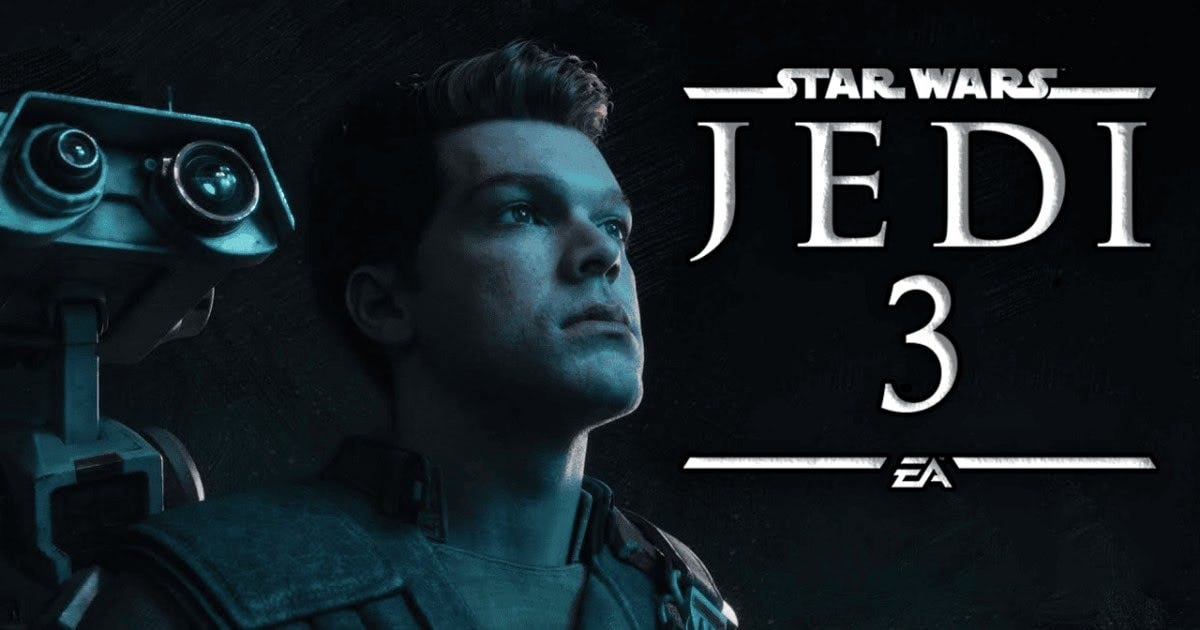
Confirmed by EA Investor Day in September 2024 as the final chapter of Cal Kestis’ story, completing the trilogy that began with Fallen Order in 2019 and continued with Survivor in 2023. Laura Miele’s framing was direct:
“This impressive track record includes of course the Star Wars Jedi games, where over 40 million Star Wars fans have connected with Cal Kestis and his arc of becoming a powerful Jedi. Respawn is working hard at bringing the final chapter of this thrilling story to players.” — Laura Miele, President EA Entertainment, EA Investor Day, September 2024
The wrinkle is that Stig Asmussen is no longer at Respawn or EA. Asmussen, the director and creative architect of the entire Jedi trilogy, departed in September 2023, shortly after Survivor shipped. He has since founded a new studio, Giant Skull, which is currently working on a D&D project. EA has confirmed veteran Respawn leaders are guiding the Jedi 3 team through the transition, but Asmussen’s specific creative voice was a defining ingredient on the first two titles. Whether Jedi 3 can stick the landing without him is the real open question.
Right now, this game is genuinely stuck in rumor territory. Beyond “Respawn is making it,” there is no hard information. No release window. No gameplay. No setting reveal beyond the obvious continuation of Cal’s arc.
But once that information drops, expect this title to pop. The two prior Jedi games are the best-performing Star Wars titles since 2019 in our mindGAME tracking. Fallen Order at 3.06% cumulative mindSHARE. Survivor at 1.84%. The Jedi titles have driven a meaningful chunk of the $5B+ EA Star Wars portfolio. The audience for this game is already there. It just needs the marketing reveal cycle to start.
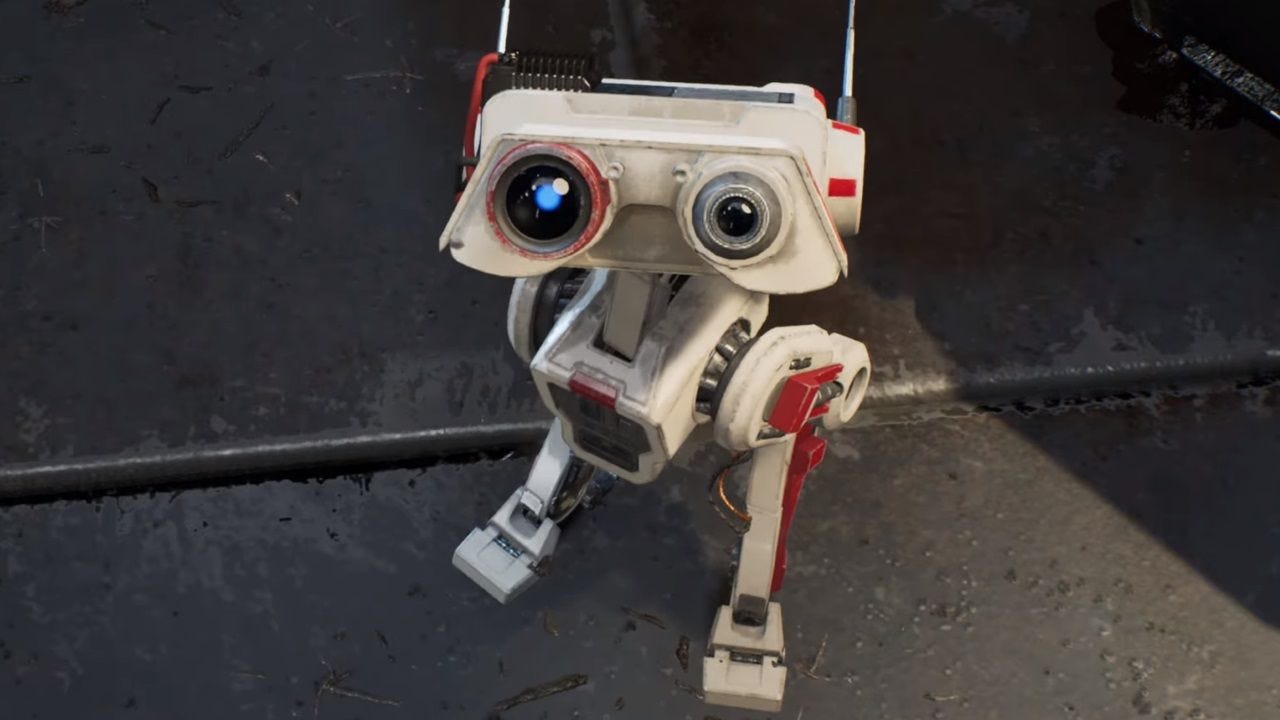
Status: Confirmed, no release window, in active development. Personally, I cannot wait for this game. I want to see how Cal and BD-1’s story ends. Presuming, of course, it does not end well for Cal... but you never know. Star Wars has a complicated relationship with letting its Jedi protagonists go gently. Just look at Ahsoka’s twenty-year on-and-off-and-on-again arc across canon. Hard to bet on a happy ending for any survivor of Order 66, but I would love to be wrong on that one.
The Two Trailers From TGA Last December That Stuck With Me
That’s the smaller games on the slate. Now to the two I am genuinely excited to write about. Both got their reveal trailers at The Game Awards last December. One is launching imminently. And the other... the other... is the most hyped game on my radar outside of GTA VI.
Galactic Racer Is The Pod Racing Comeback I Did Not Know I Needed
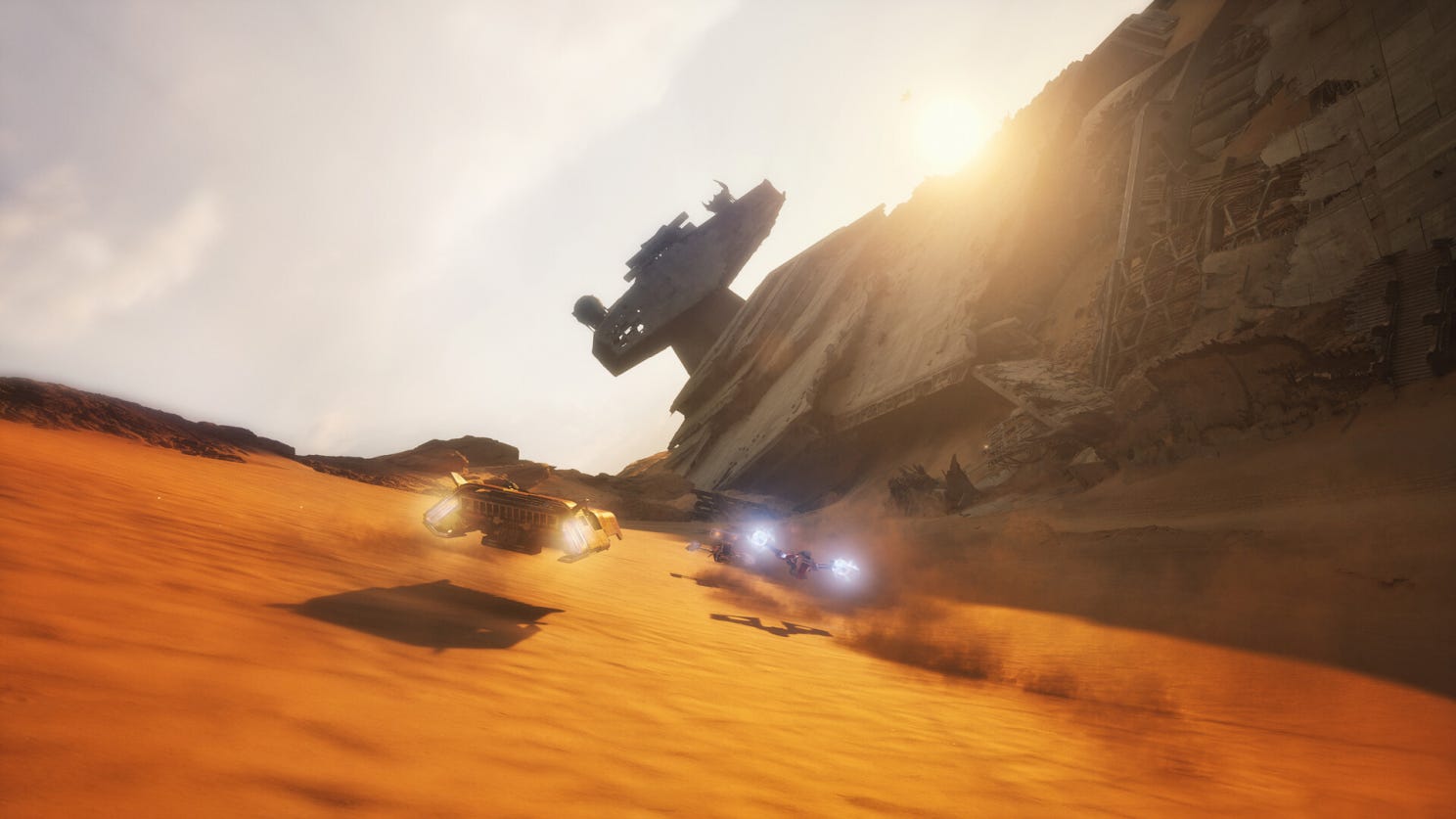
Star Wars: Galactic Racer launches on October 6, 2026. Developed by Fuse Games, published by Lucasfilm Games alongside Secret Mode.
This is the one that brings me back. Hard. Episode I Racer was, as I wrote earlier in this piece, one of my formative gaming experiences. Hundreds of hours of pod racing on the N64, alongside the Maul vs. Obi-Wan duel, was the only thing about The Phantom Menace that I unambiguously loved as a kid. Twenty-seven years later, the Star Wars racing genre is back, and the team behind it could not be more correctly cast for the job.
Fuse Games is staffed by Burnout and Need for Speed alumni from Criterion Games. The same studio DNA that defined arcade racing’s golden era through the 2000s and 2010s. CEO Matt Webster previously worked with Lucasfilm on the vehicle combat for Battlefront (2015) and Battlefront II (2017), so the partnership has institutional history. After founding Fuse in 2023, the team conceived Galactic Racer and pitched it to their old Lucasfilm partners, who shared the enthusiasm.
The setting is post-Return of the Jedi. Players take on the role of Shade, an outer-rim racer entering the Galactic League, an unsanctioned racing circuit born in the lawless frontier where the galaxy’s best pilots battle in dangerous events where only the bold survive. The campaign features tracks across Tatooine, Ando Prime, Lantaana, Sentinel I, and Jakku. Players will master landspeeders, speeder bikes, skim speeders, and pod racers. There is online multiplayer for up to 12 players. There is no season pass model. The game is a premium release at $59.99, $79.99 for the Deluxe Edition, with a Collector’s Edition for the absolute true believers.
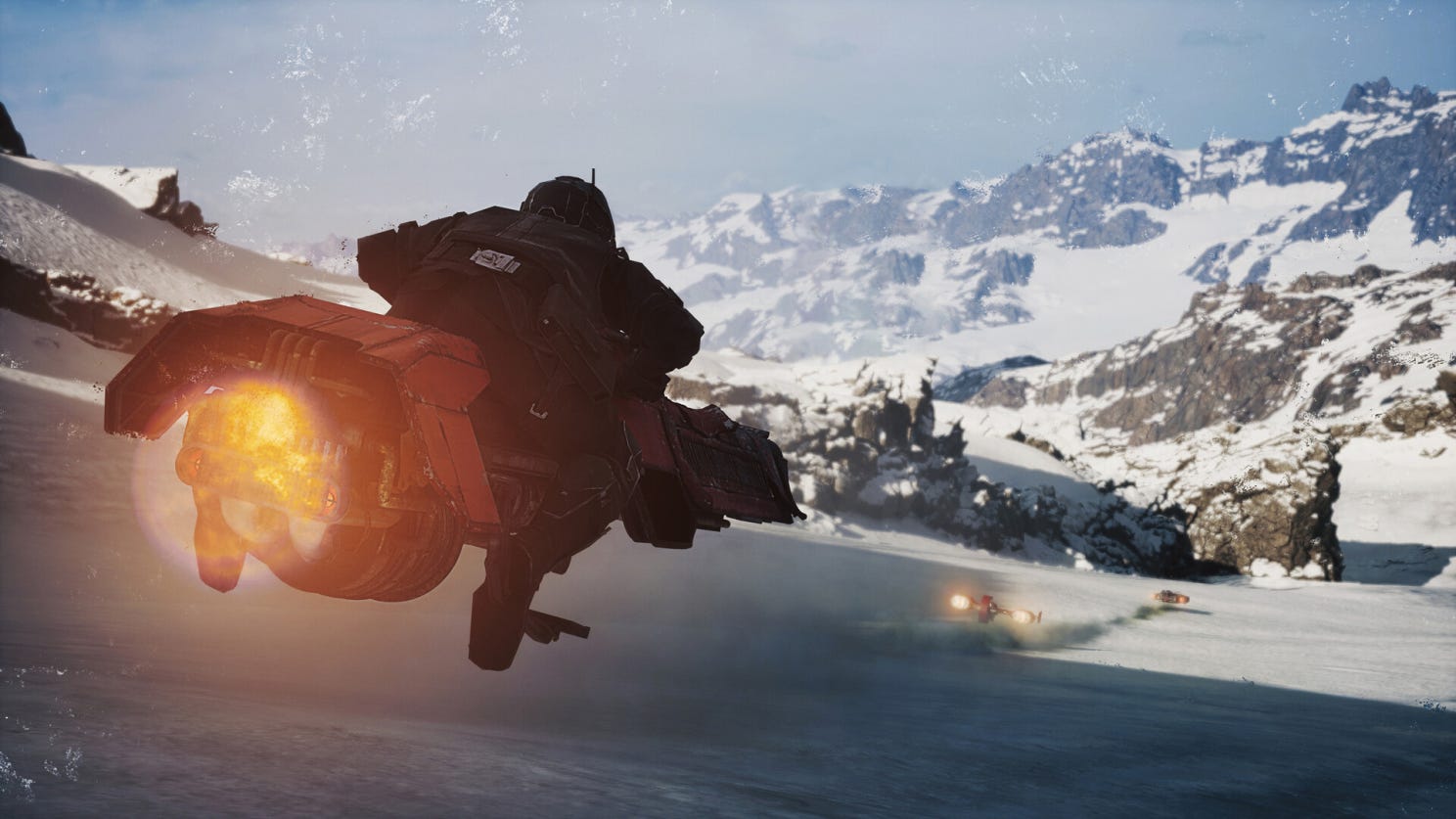
Webster told IGN the game’s tonal positioning clearly:
“You can’t make a Star Wars racing experience and not have Podracing.” — Matt Webster, CEO and Founder, Fuse Games, via GamesRadar, January 2026
That is exactly right. And the team understands that to land Galactic Racer, they have to thread a needle, honor the Episode I Racer DNA, modernize the gameplay with Burnout-quality arcade racing fundamentals, and ground the whole thing in canon-coherent world-building. Three things. Fuse Games has the studio pedigree to do all three.
The mindGAME data on Galactic Racer is a useful pre-launch read. As of Star Wars Day 2026, the game sits at week -23 (about 22 weeks from launch) with 0.0108% cumulative mindSHARE in our pre-launch tracking. That ranks the game at #30 out of 200 tracked pre-launch titles, and at 1.8x the median cumulative mindSHARE for pre-launch games at that same point in their cycle. Solid mid-tier pre-launch performance.
For context, the leaders at week -23 today include Heroes of Might and Magic: Olden Era, Forza Horizon 6, Marvel’s Wolverine, Subnautica 2, and 007 First Light. Galactic Racer is not at the top of the pre-launch pack, but it is meaningfully above median. The marketing ramp from now through October will determine whether this lands as a sleeper hit or a niche genre swing.
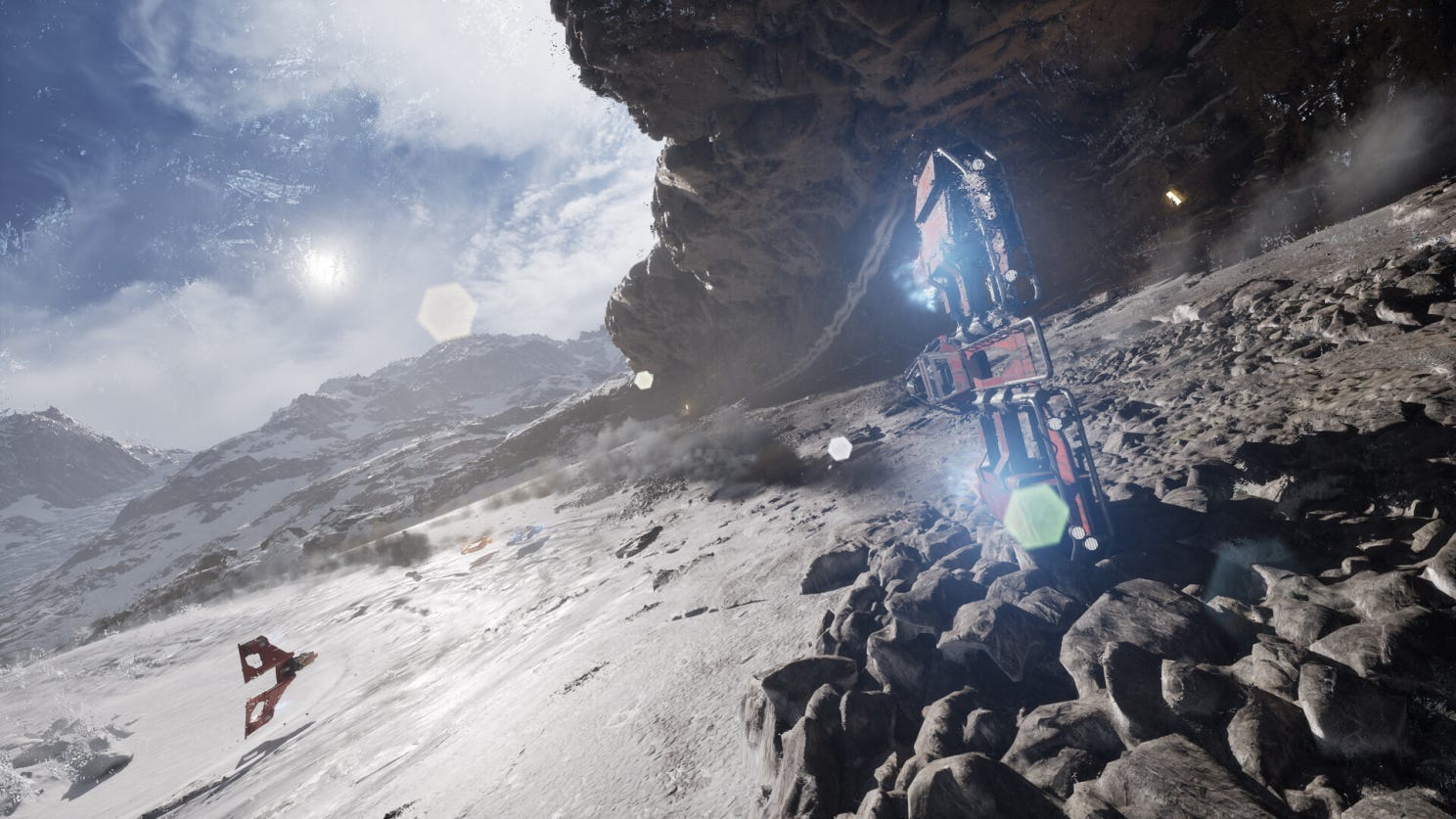
Status: Confirmed for October 6, 2026. The pod racing nostalgia tap is real. The studio pedigree is real. The premium-not-live-service framing is welcome. Galactic Racer does not need to be Game of the Year to be a meaningful win for Star Wars gaming. It just needs to be fun, look the part, and tap the audience that grew up on Episode I Racer. If Fuse Games hits those three marks, this is the kind of comeback that brings genuinely lapsed Star Wars gaming fans back into the conversation.
Which, increasingly, feels like the actual story of the post-2021 reset slate. Let me explain what I mean by getting to the one I am most pumped about.
Fate Of The Old Republic Has Me More Hyped Than Anything Outside GTA VI
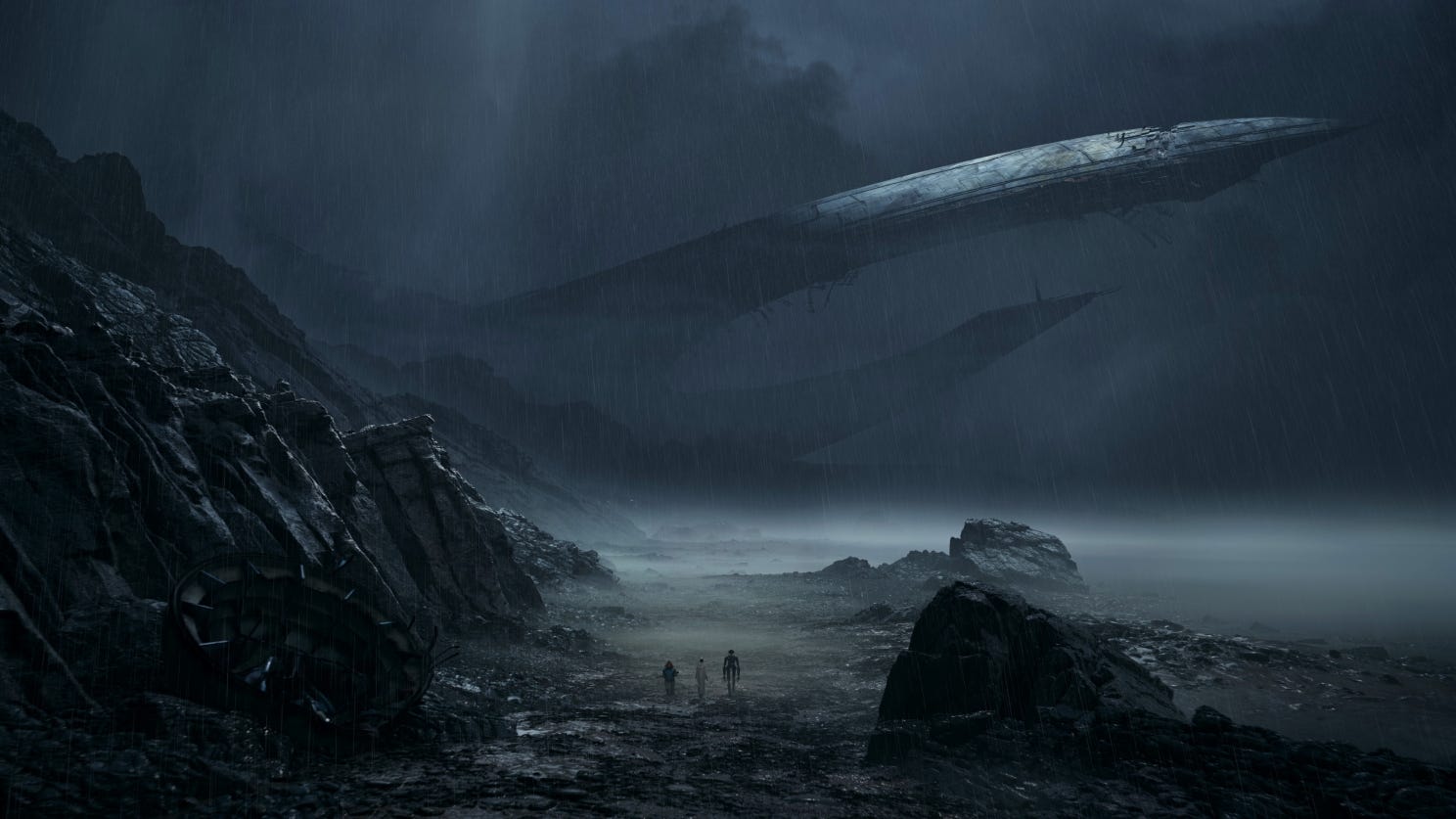
I want to be careful about the hype I am throwing at this game, because this thing is years away, and the gaming industry has burned every Star Wars fan who ever got too excited too early.
But this is different. Let me lay out why.
Star Wars: Fate of the Old Republic was announced at The Game Awards 2025 on December 11, 2025. Developed by Arcanaut Studios, in collaboration with Lucasfilm Games. Casey Hudson is directing. The same Casey Hudson who directed the original Knights of the Old Republic in 2003, then directed the original Mass Effect trilogy. Arcanaut is Hudson’s new studio, founded in July 2025 specifically to build this project.
“Conversations between our team and Lucasfilm Games led to an incredible opportunity to return to Star Wars, and once again we can hardly believe we’re working on such a special project.” — Casey Hudson, Director, Arcanaut Studios, StarWars.com, December 2025
“Star Wars has been an ever-present force in my life, from the time I saw the first movie in 1977 and throughout my career, where it’s been a constant source of inspiration.” — Casey Hudson, StarWars.com, December 2025
The framing from Lucasfilm Games’ Douglas Reilly is worth pausing on too:
“Fate of the Old Republic is not a direct sequel or continuation, but it is being built by people who helped shape that legacy. Throughout my two decades of working on Star Wars games, including Star Wars: The Old Republic, I have been fortunate to see firsthand just how much these stories mean to our fans. For us, this new project is about honoring that legacy by creating something in the same tradition of a deep, cinematic, choice-driven role-playing game. Reuniting with Casey has been a tremendous honor.” — Douglas Reilly, VP and GM, Lucasfilm Games, StarWars.com, December 2025
Spiritual successor to KOTOR. Set at the end of the Old Republic. Built by people who shaped the original. Single-player, narrative-driven, action RPG with light/dark choice mechanics at the core.
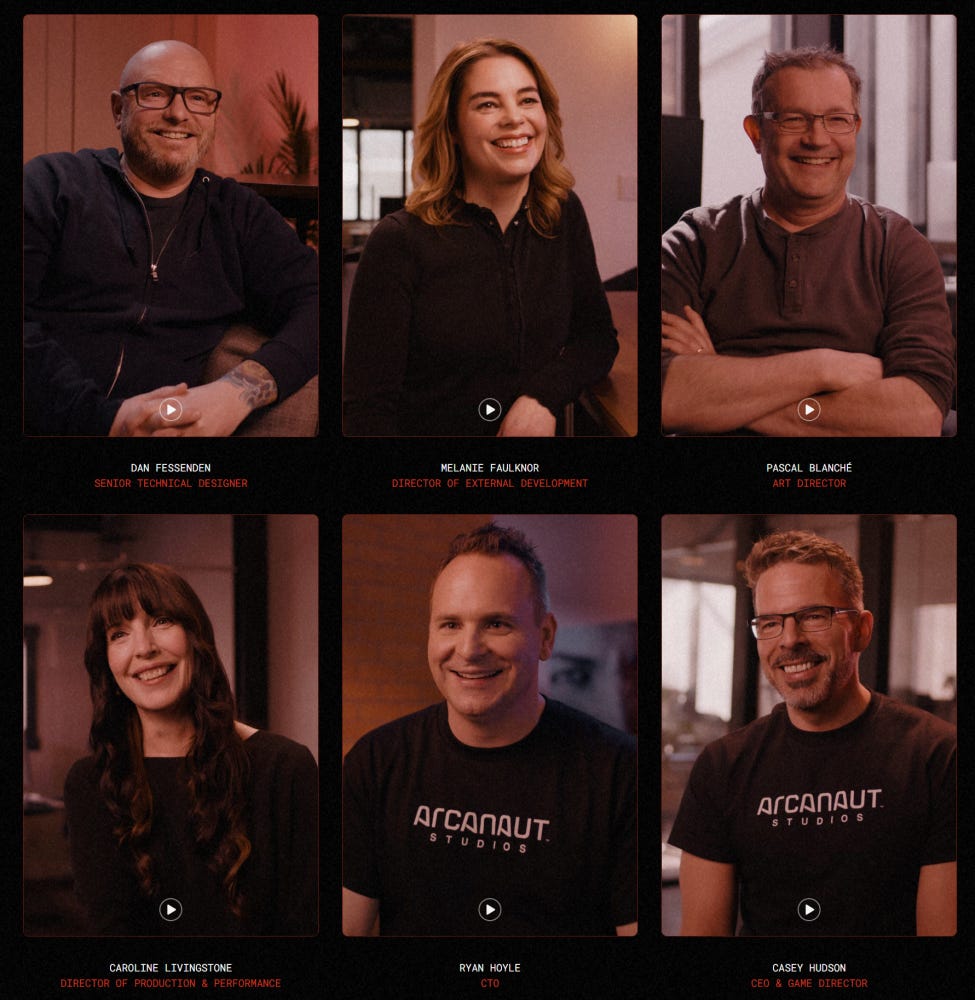
The team Arcanaut is building is the headline. On May 4, 2026 (this past Star Wars Day, which is exactly why I am writing this entire piece), Hudson revealed more of the creative team via Arcanaut’s website. The roster reads like a BioWare alumni reunion.
Casey Hudson, CEO and Game Director. KOTOR project director. Mass Effect trilogy creative architect.
Ryan Hoyle, Chief Technology Officer. Programmer on KOTOR and the original Mass Effect trilogy at BioWare.
Chris Bain, Chief Financial Officer. BioWare’s former director of business development.
Cordy Rierson, Chief Operating Officer.
Dan Fessenden, Senior Technical Designer. Credits include KOTOR, Mass Effect, Dragon Age: Inquisition, Dragon Age: The Veilguard, and Anthem.
Pascal Blanché, Studio Art Director. Joined Arcanaut in March 2026 from Ubisoft, with prior work at Behaviour Interactive, Wizards of the Coast, and Warner Bros.
Melanie Faulknor, Director of External Development. Former BioWare localization project manager and producer.
Caroline Livingstone, Director of Production.
Kotaku’s framing on the studio team build-out cuts to the chase: this is “a big BioWare reunion” of veterans from the studio’s golden era. The KOTOR / Mass Effect / Dragon Age creative DNA is being reassembled under one studio, pointed at a Star Wars RPG. That has not happened in twenty-three years.
On timing: Hudson has been clear, in his characteristically dry way, that this is not a 2030 project. From his Twitter response to “not till 2030” rumors:
“Don’t worry about the ‘not till 2030’ rumors. Game will be out before then. I’m not getting any younger!” — Casey Hudson, December 13, 2025
That is as close to a firm commitment as Hudson is going to give right now. Realistically, this game will land somewhere between 2027 and 2029. Arcanaut was founded in July 2025. The team is still building out. The project is in the early phase of development.
On the mindGAME data: Fate of the Old Republic sits at 0.0010% cumulative mindSHARE in our broader market data today, with the game still 80+ weeks (at minimum) from a probable release window. Functionally pre-launch noise at this distance. But the announcement trajectory matters. The Game Awards reveal generated meaningful one-week spikes in Search and Video. The May 4 team reveal generated another. The project is generating attention in the right shape for this stage.
Why I Am So Excited About This Game
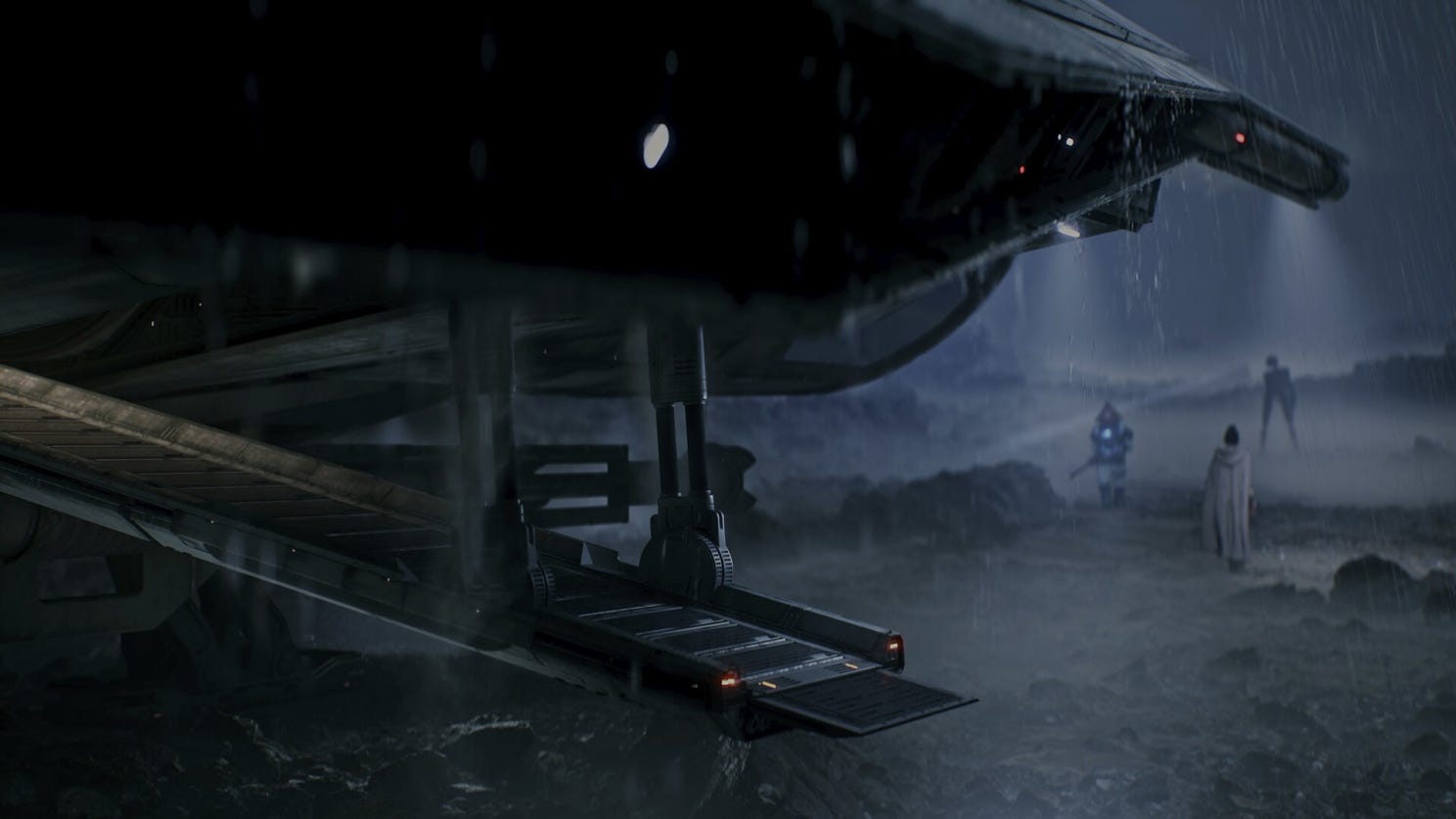
A few things that, taken together, make this different from any other Star Wars project on the current slate.
One. Casey Hudson personally directed the best Star Wars game ever made, and now he is back to do it again, with the same approach, in the same era, with key team members from the original. The closest analogous setup in modern gaming would be when Hideo Kojima left Konami, founded Kojima Productions, and started building Physint as a spiritual successor to his Metal Gear lineage. Hudson at Arcanaut on FOTOR is the same story arc. The creator returning to the genre they defined, on their own terms, with the right collaborators around them.
Two. The post-2021 reset has produced commercial wins (LEGO Skywalker Saga) and commercial misses (Outlaws, Hunters). FOTOR is the first project where the creative DNA matches the original LucasArts golden era of Star Wars RPG production. KOTOR was a partnership with BioWare. FOTOR is a partnership with Arcanaut, which is, functionally, a re-formed BioWare cohort. The model maps.
Three. The audience for this game is already there. KOTOR is foundational. Mass Effect is foundational. Dragon Age fans, even after Veilguard’s mixed reception, would show up for a Hudson-led Star Wars RPG without hesitation. When pre-launch marketing actually begins in earnest, expect this game to drive meaningful attention spikes well ahead of its release.
Four, and this is the bigger point. The slate ahead, taken as a whole, represents a real shift in how Star Wars gaming attention is being courted.
Galactic Racer (October 2026) brings in fans who grew up on Episode I Racer. The childhood-of-the-prequels nostalgia audience.
Zero Company (2026) brings in tactical RPG fans who want a gritty Andor / Rogue One Clone Wars story (Clone Wars!!!) without the Jedi-mythology baggage. The lapsed-strategy-fan audience.
Jedi 3 (2027ish) finishes the Cal Kestis trilogy. The 40M-strong modern Jedi audience.
Fate of the Old Republic (2027-2029) brings in the BioWare/RPG faithful. The KOTOR / Mass Effect lifers.
KOTOR Remake (if it actually ships) reactivates the original KOTOR cohort. The Old Republic believers.
And families would still get LEGO Star Wars treatment, if TT Games does another entry. There has been no announcement, but if a follow-up to The Skywalker Saga happens, it would almost certainly cover the Disney+ era (Mandalorian, Andor, Ahsoka) that the LEGO franchise has not yet touched.
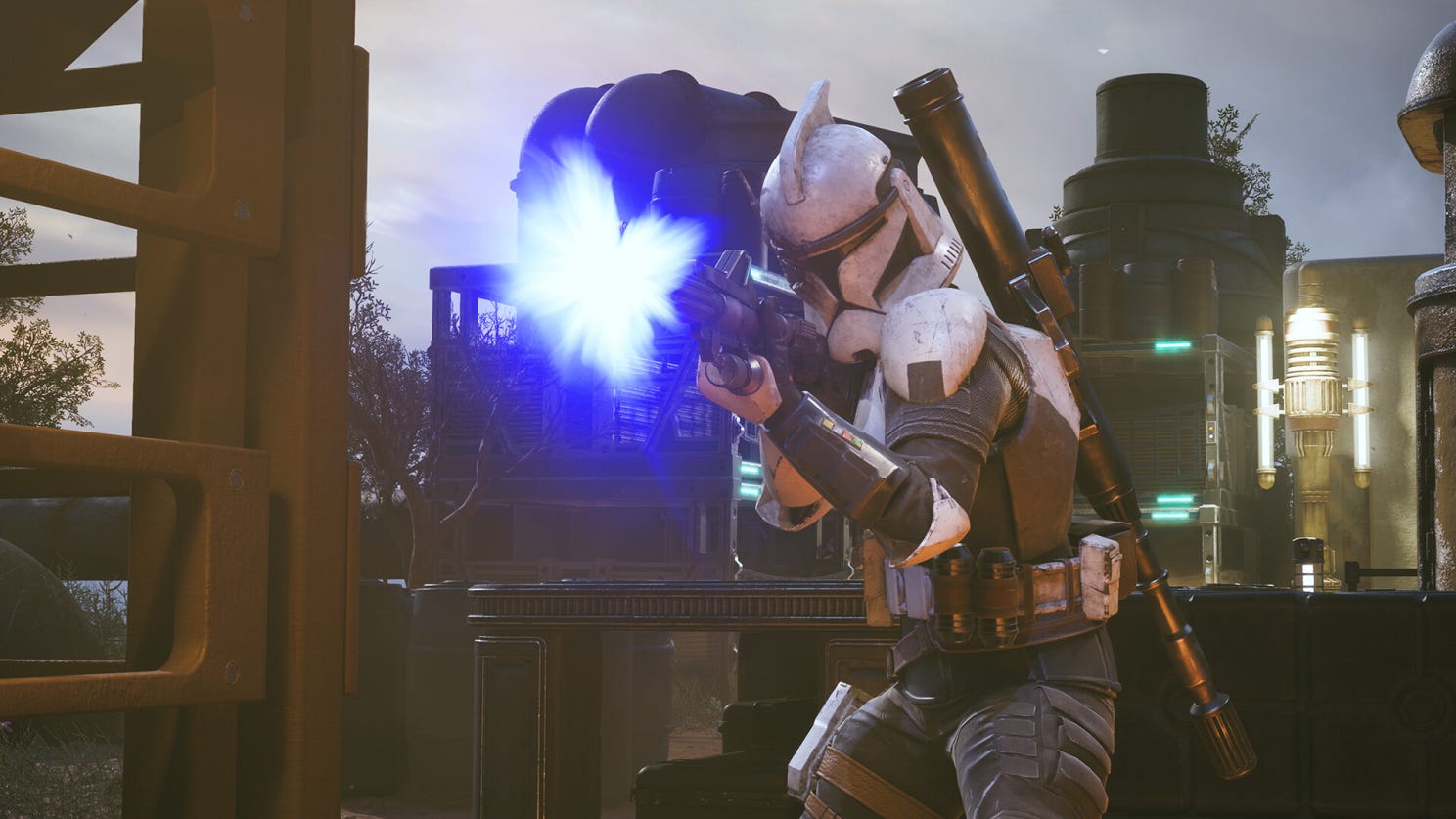
That is five-to-six distinct fandoms being courted in parallel, by partners specifically chosen for fluency in those exact lanes. That is the most diverse audience-targeting strategy Star Wars gaming has had since the original LucasArts era, when X-Wing fans, Jedi Knight FPS fans, Rogue Squadron arcade fans, KOTOR RPG fans, and LEGO family fans were all being served simultaneously by different studios, all overseen by one IP holder with a portfolio approach.
We are, possibly, maybe, finally, at the start of a new era for Star Wars gaming.
I am not overclaiming here. The post-2021 reset has produced real misses. Outlaws underperformed. Hunters failed. Eclipse may never actually ship. KOTOR Remake is still uncertain. The slate could disappoint in any number of ways. Multiple titles could slip, get cancelled, or land below expectations.
But the conditions are right in a way they have not been right in twenty years. Filoni is President and Chief Creative Officer of Lucasfilm. The portfolio approach is working at the IP-management level (Reilly’s team has been consistent). The partner roster is the strongest it has been since LucasArts. And the creative DNA on the headline projects, Hudson at Arcanaut, Foertsch at Bit Reactor, Webster at Fuse Games, is exactly the right kind of pedigree for the projects they have been handed.
If even three of these games land at the quality level their teams suggest, Star Wars gaming will reset its share of attention upward in a meaningful way. And we get to finish the Cal Kestis story. That alone is reason to be excited.
So... bringing this back to where I started this whole piece.
Am I hyped about the future of Star Wars after watching Maul: Shadow Lord? Absolutely. That show was the kind of creative high point that resets your expectations for what the franchise is capable of when the right people are pointed at it.
Am I seeing things in gaming that give me hope Lucasfilm Games is actually finding the right partners for the right projects? Yes. The TT Games / WB Games partnership delivers. The Bit Reactor / Respawn pairing is the right team for a tactics game. Fuse Games is the right team for a Star Wars racer. And Casey Hudson at Arcanaut on FOTOR is, full circle, the right team for a Star Wars RPG. Those are good bets.
Will there be duds along the way? Of course. Cancellations? Almost certainly. Eclipse could fall apart entirely. KOTOR Remake could continue drifting. Jedi 3 could miss without Asmussen at the helm. Some of these games will not land where their teams hope they will. That is just how this industry works.
But I like the bets they are making. The slate is the most thoughtfully constructed Star Wars gaming pipeline since the original LucasArts era, and the leadership above it (Filoni at the creative top, Reilly at the games portfolio level) is aligned in a way it has not been in two decades.
I am stoked about where Star Wars is going. More than I have been in a very, very, very long time.
Star Wars is so deeply woven into the history of this industry that watching it find its footing again, with the right partners and the right leadership and the right slate, is genuinely a great thing to see. The franchise that helped invent space combat sims, lightsaber action, choice-driven RPGs, and family co-op platformers deserves to have its next chapter executed at the level its history demands.
For the first time in a long time, it actually feels like that is what is being built.
GTA VI Will Crush It... But The Console Install Base Is A Real Risk
If FOTOR is the game I am most hyped about as an RPG fan, then GTA VI is the game I am most fascinated by as someone who watches industry-wide attention dynamics for a living.
I want to start somewhere unusual for a GTA VI think piece. Not at the budget. Not at the trailer. Not at the “is it really coming this year?” debate. Let me start at the console.
“GTA Buyers Are In For A Console Price Shock”
In yesterday’s The Game Business newsletter, Chris Dring sat down with Mat Piscatella, Senior Director and lead games analyst at Circana. The conversation covered a lot of ground (the new US charts methodology, exclusives debate, Game Pass pricing) but the line that stopped me cold was about GTA VI’s launch reality.
“Those folks who don’t pay a lot of attention, but have heard that GTA is coming, and that’s a lot of people, they will show up and go, ‘GTA is finally out. I’m going to pick it up.’ And then... ‘A $1,000 console!’ There’s going to be a price shock for a lot of people. And yeah, I said $1,000 because I’ve just already assumed we’re going to get more price increases. I hope we don’t.” — Mat Piscatella, Senior Director, Circana, via The Game Business, May 2026
Piscatella followed with the structural reframe of where the console market actually is right now:
“What’s going on across pricing in the US has made the console audience shift towards higher income households really quite rapidly. Well over half of video game hardware buyers are $100,000-plus household income level. And the average price of hardware has gone from $250 in 2019, and we’re probably going to exceed $500 just a few years later. All the dynamics of the console market have changed quite dramatically in these last few years. It’s no longer a mass market video game device; it’s a video game device targeted to high income households.” — Mat Piscatella, Circana, via The Game Business, May 2026
That is the most important sentence I read this week, and it has nothing to do with Star Wars or Xbox or any of the other narrative threads pulling the industry’s attention right now.
The console market in 2026 is not the console market that GTA V launched into in 2013. It is structurally different. Higher income concentration. Smaller install base relative to what it would have been at lower price points. Fewer mass-market consumers willing to drop $500-$650 on hardware to play the new game everyone is talking about. That is the backdrop GTA VI is launching into.
And one more critical detail before I get into the math. GTA VI is launching console-only on November 19, 2026. PlayStation 5 and Xbox Series X|S only at release. PC version coming later, with no announced date. So all the unit math at launch runs through the console install base. Not the broader gaming audience.
The Real Risk Is Not The Game. It Is The Xbox Install Base.
Here is the part of the math I cannot stop thinking about, and where I think the framing on GTA VI’s launch needs to start.
When GTA V launched in September 2013, the combined PlayStation 3 + Xbox 360 install base sat at roughly 145-150M consoles globally. PlayStation 3 was around 78M units in market. Xbox 360 was around 68M units. Xbox was roughly 45% of the combined console audience for that launch. That gave Rockstar a massive cross-platform install base to convert against. GTA V did 11.21M units / $815.7M on Day 1, hit 16M units / $1.15B in Week 1, and crossed 29M units shipped within six weeks. The conversion rates on the existing console base were extraordinary.
Now look at where GTA VI is launching into.
The current PS5 install base is roughly 92.2M consoles per Sony’s most recent disclosures. That is up from where PS3 was at the equivalent moment in 2013. PlayStation is, on its own, in a stronger position than it was for GTA V’s launch.
The Xbox Series X|S install base is roughly 34M consoles globally. That is roughly half of where Xbox 360 was at GTA V’s launch. Xbox cratered through this generation. The strategic missteps, the lack of system-selling exclusives, the pivot to Game Pass and multiplatform that I have written about extensively, all of it added up to an Xbox base that is structurally smaller than the brand had been at any equivalent point in two decades.
The combined PS5 + Xbox Series base lands at roughly 126M, which is 16-19% smaller than the combined PS3 + Xbox 360 base at GTA V’s launch.
That is the math that matters. Not because GTA VI will sell fewer units than GTA V. I would actually bet the other side of that. GTA VI will outperform GTA V on raw units. The Rockstar brand strength, the cultural moment, the thirteen years of pent-up demand for a new mainline GTA (the longest gap between mainline releases in the franchise’s history), the global market expansion since 2013, all of it points to GTA VI shattering the GTA V Day 1 number. An entire generation of gamers who were too young to buy GTA V in 2013 are now adults primed for GTA VI. The latent demand is enormous.
Pre-launch attention data backs this up. GTA VI sits at 0.7467% cumulative mindSHARE at week -29 in our pre-launch tracking, more than 60x the median pre-launch game at the same distance from release.
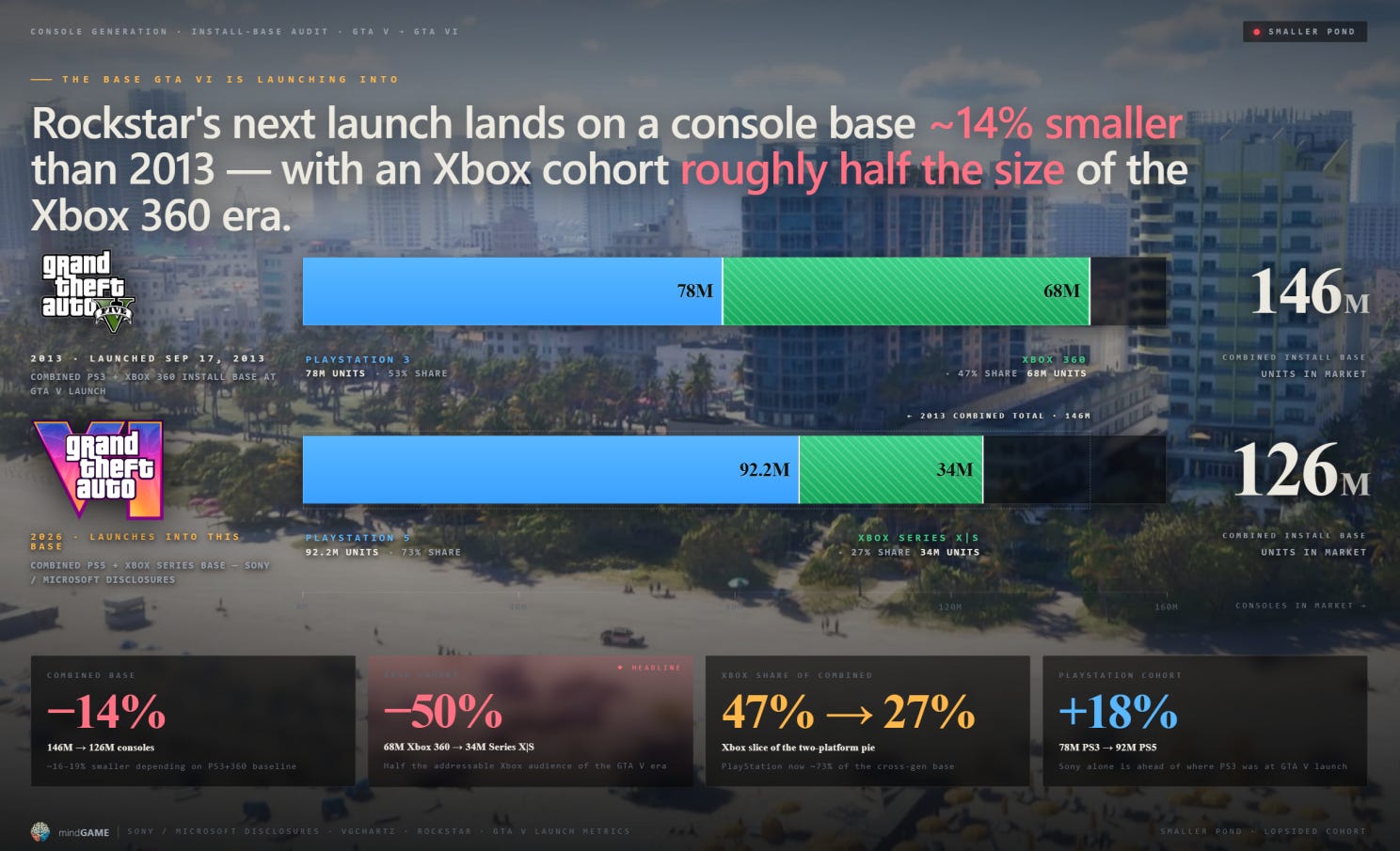
But the path to that bigger number is harder than people are talking about.
To outperform GTA V on units against a 16-19% smaller console base, GTA VI has to capture a meaningfully higher share of that combined console audience. Specifically, the lost Xbox base means GTA VI has to dominate share-of-voice across both PlayStation and Xbox in a way that compensates for the missing 30-35M Xbox 360 units that simply do not exist on Xbox Series.
That is the real risk. Not the game. Not the marketing. Not the cultural moment. It is the structural reality that the Xbox half of the console market collapsed.
GTA V converted at scale across two healthy platforms. GTA VI has to convert at a higher rate against one healthy platform (PS5) and one structurally diminished platform (Xbox Series). PlayStation is set up to do its job. Xbox is the wildcard.
Rockstar is, of course, the studio most likely to pull this off. The pre-launch attention numbers suggest they will. The bet I am making is that GTA VI captures share-of-attention at a level that no other launch in console history has ever managed, because of the cultural moment, not in spite of the structural setup.
But I am not surprised that Strauss Zelnick is openly worried.
Zelnick Knows. The Press Tour Says So.
Strauss Zelnick has been on a notable press tour in the past two weeks. Two interviews in particular are worth pulling from. Bloomberg’s Jason Schreier sat with him on May 4, 2026. Stephen Totilo at Game File interviewed him a few days earlier at the iicon event in Las Vegas, publishing on May 6.
Across both interviews, the signal is the same. Zelnick is calm, measured, and openly aware of just how high the stakes are.
The Bloomberg framing was the headline-grabber:
“I think here our goal is to deliver to consumers something that’s never been experienced before. Being on the sidelines but pretty close to the front of the sidelines is very, very exciting. And terrifying. Because the expectations are so high.” — Strauss Zelnick, Take-Two CEO, via Bloomberg, May 2026
That word, terrifying, from a CEO who is known for being unflappable, is doing a lot of work. Zelnick is not a guy prone to hyperbole. As he told Totilo:
“I tend to default to being very calm. I’m not a person who freaks out easily.” — Strauss Zelnick, Take-Two CEO, via Game File, May 2026
So when this guy says expectations are terrifying, he means it. The pressure is real, and it is rational.
The Bloomberg piece also confirmed several key data points:
GTA VI launches November 19, 2026. Confirmed date.
Wall Street analyst forecasts for Day 1 are landing around 25M units sold, which Schreier reported is the high end of internal expectations
Schreier reported that anything in the 10M range would be considered disastrous relative to the expectations the market has built up. That framing came from Schreier’s reporting, not directly from Zelnick on the record
On the console-only launch decision, Zelnick offered the kind of carefully understated framing that, in context, is doing real work:
“We’ll see how it works out.” — Strauss Zelnick, on the console-only launch, via Bloomberg, May 2026
Five words. From a CEO defending a strategic decision worth multiple billions of dollars in potential revenue. That is not the language of someone who has perfect confidence in the path. That is the language of someone navigating real uncertainty.
The Game File interview added important texture on the broader cost and risk environment. Zelnick walked Totilo through how the math of the games business has changed:
“Once upon a time, you could work on a property that you weren’t that excited about... but there certainly was a time early in the business when you could put out something that you knew was going to be middle-of-the-road, and you knew it would make money. You just did the math. You said, ‘It’s going to cost me this to make it. I’m going to sell that many units minimally. I’ll be fine.’ Those days are long gone.” — Strauss Zelnick, via Game File, May 2026
“We’re a mature business. We’re growing, but we’re mature. And so you enter in with trepidation and hopefully great discipline, recognizing that even getting to break even when you spend the kind of money we spend is not a given.” — Strauss Zelnick, via Game File, May 2026
The cost escalation context Zelnick offered was striking. He referenced his early-90s days running Crystal Dynamics:
“When I started [in the game] business, I was the pre-revenue CEO of Crystal Dynamics, and a triple-A game in those days was a million dollars. And then Crystal was at the front of the line of doubling it to two million dollars. So clearly game dev costs have skyrocketed.” — Strauss Zelnick, via Game File, May 2026
A $1M to $2M AAA budget in the mid-1990s. Reports on GTA VI’s budget have ranged from $1B to over $2B, depending on which leak you trust. Even at the low end, GTA VI’s budget is roughly a thousand times the AAA standard from when Zelnick first entered the industry. That is the cost reality he is now managing the launch of.
And the candor that hit hardest came on Civ VII. When Totilo asked about the franchise’s recent struggles, Zelnick took the L on the record:
“Every time there’s a new Civ, the team at Firaxis thinks about: ‘How do we push the envelope far enough that it makes sense to buy this new game? And how do we preserve what people love enough so that they’re not disaffected?’ And we got it wrong with Civ VII... what we tried to do was a bridge too far, from the consumer’s perspective.” — Strauss Zelnick, via Game File, May 2026
That is a CEO publicly admitting his company missed on a recent flagship release. Civ VII’s struggles are not GTA VI’s struggles. But the willingness to take the L on Civ VII signals something important... Zelnick is not spinning narrative on his GTA VI commentary either. When he says expectations are terrifying, that is the honest read.
My Bet... GTA VI Captures Record Share Of Attention
I am betting GTA VI crushes it. Outperforms GTA V on raw units. Record Day 1, record Week 1, record six-week shipments. The pre-launch attention numbers, the thirteen years of pent-up demand, the cultural moment, all of it points to a launch unlike anything we have seen in console gaming history.
But Zelnick is right to be worried. And the structural risks I laid out earlier (smaller console base, the Xbox collapse, the price-shock dynamic, console-only launch) could make the headlines messy in the first six weeks post-launch. Analysts will compare GTA VI to GTA V on raw unit conversion rates, fail to adjust for the smaller installed base, and write “GTA VI underperformed expectations” pieces that miss the actual story.
This is exactly where mindGAME’s reframe matters. The right question is not “did GTA VI beat GTA V on Day 1 units.” It is how much share of total global gaming attention did GTA VI capture at launch, and can it sustain that share through the GTA Online successor mode for the next decade? That is the metric that will define this launch. Not the raw unit number.
GTA Online turned GTA V into a decade-long earner that crossed 225M units lifetime and second-place all-time behind Minecraft. The GTA VI Online successor is where the real commercial story lives. Day 1 is the cultural moment. The next ten years is the business.
Trust the attention share. Bet against the lazy unit comparison. And keep an eye on Xbox specifically, because how Xbox Series performs as a GTA VI platform is going to tell us more about the future of that brand than anything else, and frankly, more about the lasting damage Phil Spencer wrought during his terrible, misguided tenure than any retrospective ever could.