

Enter At Three, Buy At Thirty-Three... Spider-Man, Nintendo, And The Flywheels That Endure

Follow me here… or on LinkedIn
Welcome back, everyone... and welcome to the dog days of summer. I weighed the entire fall last week, and honestly, I’m not sure there’s much left to relitigate... GTA VI dominates (they literally have a Netflix special now), everyone else fights for what’s left, that’s the season. That said, quiet doesn’t mean settled... there are still a few shoes to drop. I’m still waiting on that Zelda Direct I flagged last week, the one where Nintendo finally puts a date on the Ocarina of Time remake. And Gamescom is right around the corner. I can’t imagine it changes much about the fall lineup, but who knows... last year Silksong fell out of the sky. Could it happen again? Possibly. What’s more likely is a wave of games staking their claims to Q1 and Q2 of next year, so all eyes there... and expect the news cycle to run a little slower until we get to Cologne.
In the meantime, I could spend a few thousand words on Palworld (they are running the TCG market right now), but not today. Another company has my eye for next week... one that could not care less about the fall and is charging at it with a full slate anyway.... but I kinda want to watch how the data plays put over the next week... so I am going to put a pin in that one.
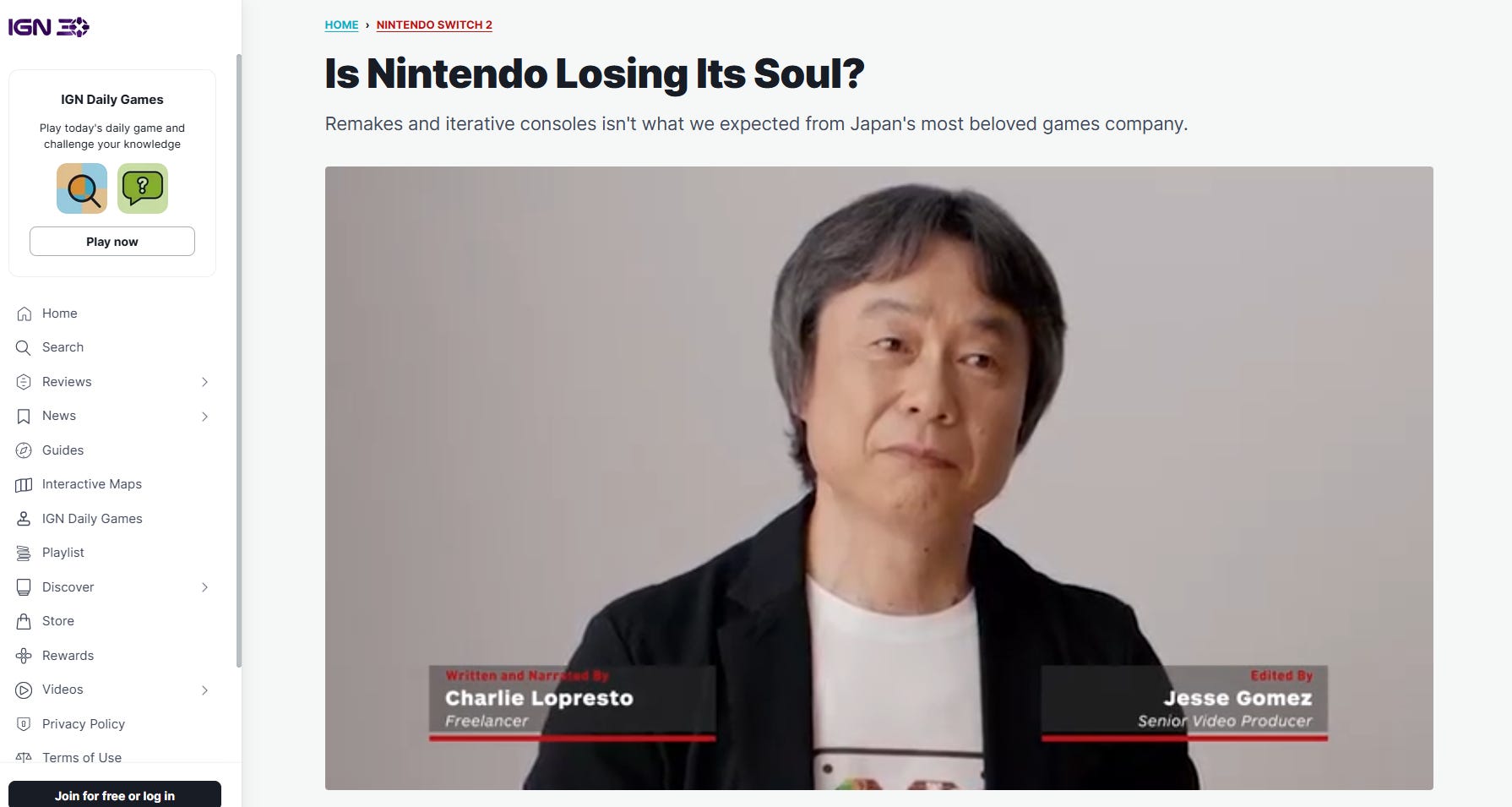
So instead, two things have been sitting on top of my mind. Nintendo reported earnings this week, closing the books on year one of Switch 2... and right on cue, the headlines grabbed the number that sounds scary. Sales down 9.5%. Hardware down 34%. Read literally any other line of the report and a different company appears... operating profit up 150%. The gap between those two numbers is where all the bad Nintendo takes live, and this was a big week for bad Nintendo takes.... looking at you IGN.
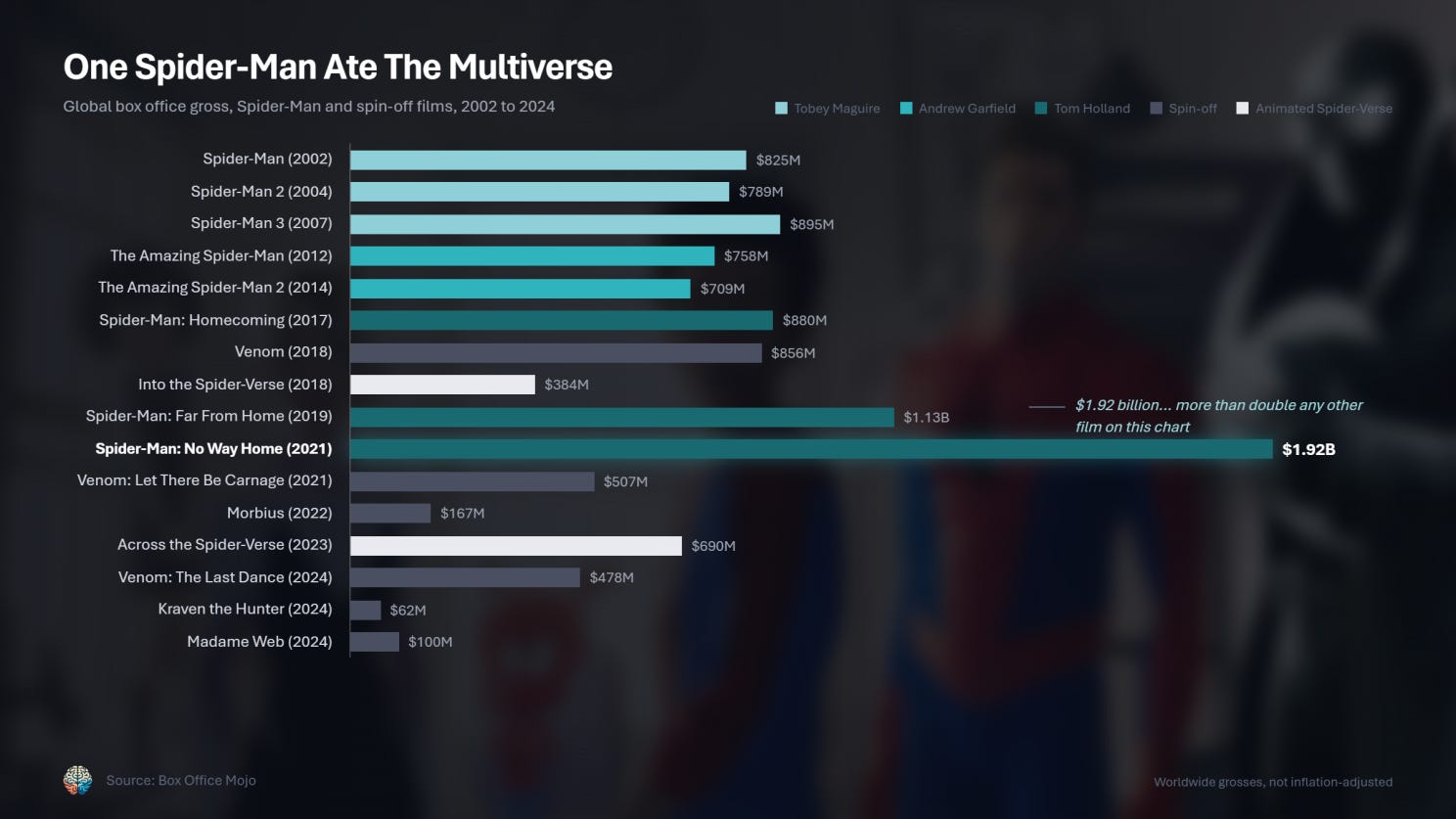
Before we get to Nintendo, though: I saw Spider-Man: Brand New Day. Billion-dollar movie in under a week. Biggest domestic opening of all time... past Endgame, which still holds the global crown. Only one other superhero movie has crossed a billion dollars since No Way Home did it back in 2021. Spider-Man hands the genre its biggest weekend in years, right after a stretch where Marvel underperformed and DC flat-out bombed. So is the MCU back? Or is Spider-Man simply one of one? Plenty of ink has been spilled on that question this week... so I want to pull it together into the three themes I think actually explain it.
But at the core, these two stories are really one story. Disney and Nintendo are both built on flywheels... machines that start people young and feed every piece of the business into every other piece. Review the Switch 2 after one full year and you see a flywheel enduring. Watch this Spider-Man weekend and you see what Disney at its best does better than anyone else... the whole machine firing at once.
Let’s get into it.
Brand New Day... Three Lessons From The Biggest Opening Of All Time
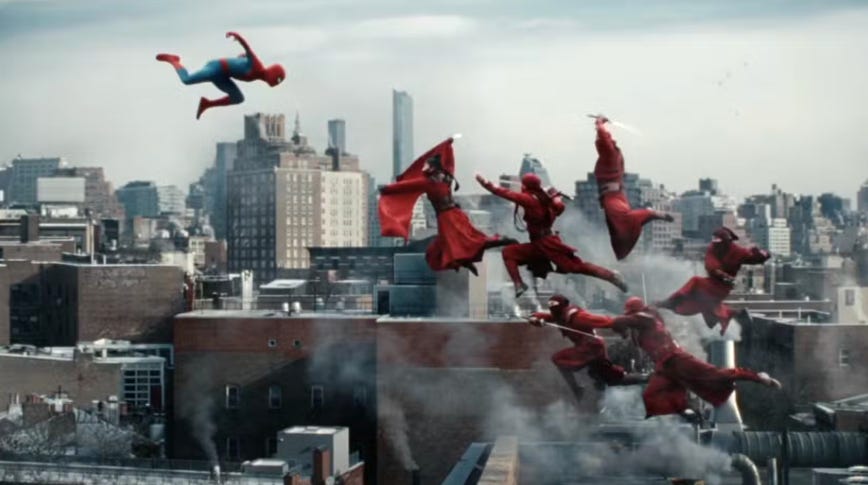
First, the review, and I’ll keep it spoiler-free. Brand New Day is a solid movie. Not the best Spider-Man movie ever... I’m not doing that discourse... but a genuinely great Peter Parker movie. I choose those words carefully, because it was merely a fine Spider-Man movie. The best Spider-Man villains live in both of Peter’s lives at once... they press on the man and the mask simultaneously, and that tension is the engine of every all-timer this franchise has produced. This movie never puts one of those at the center of its plot, and the rogues gallery was sitting right there. I wrote a full review on LinkedIn earlier this week, spoilers included, down to exactly who I would have swapped in... check it out once you’ve seen the film.
The audience has voted, though, and my quibbles don’t really matter much outside the fan community... math is math and money is money. The better question is how Spider-Man pulled off the biggest weekend in movie history at the exact moment the rest of the superhero business is shrinking... including parts of the MCU... and I keep coming back to three lessons. One starts in preschool. One is about an empty throne. And one lives in our data.
Lesson One: Spidey And His Amazing Friends... The Flywheel Starts At Three
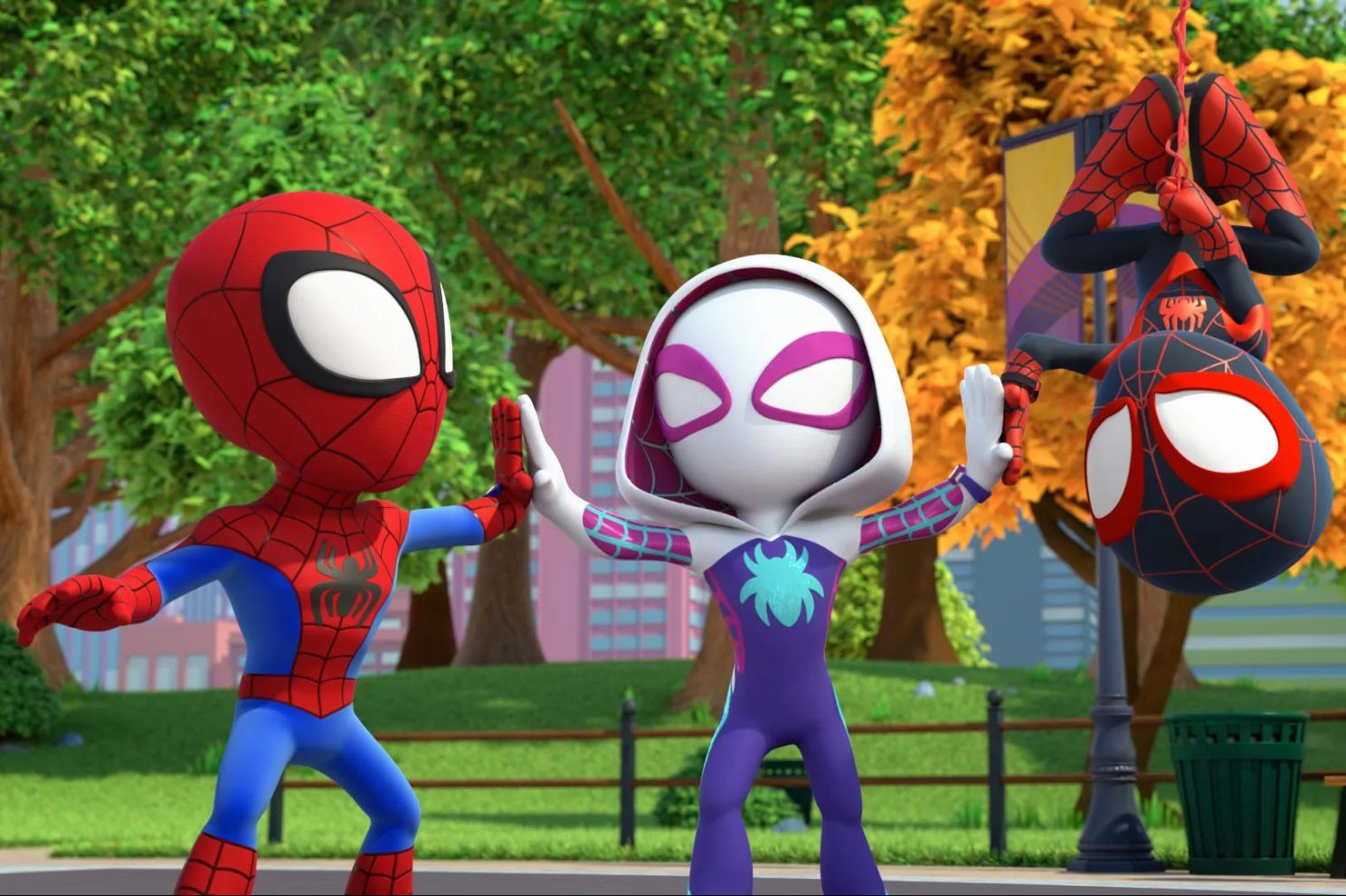
My son is seven, and my daughter turns five soon. And in my house, the second biggest show on Disney+... behind only Bluey, an untouchable number one... is Spidey and His Amazing Friends. This is the show that introduced both of my kids to Spider-Man. Not the movies, not the games, not me. A preschool cartoon did it, with three spider-people at the center: Spidey, Spin, and Ghost-Spider... Peter Parker, Miles Morales, and Gwen Stacy, translated for the sandbox set. My son has been watching since season one aired. He is, quite literally, named Miles Parker... yes, after both Spider-Men... so you could say this household was predisposed. My daughter followed soon after and went straight down the Ghost-Spider path, and she has never looked back.
Dismiss it as kiddie content at your own risk, because the numbers are staggering. Per Nielsen data reported by the Wall Street Journal this week, the show has been watched for roughly 1.25 billion hours since its 2021 debut... enough to make it Marvel’s most popular television series, ever, across 18 years of output. A toddler cartoon out-watched every prestige swing Marvel Studios has taken. Kevin Feige knows exactly what he has:
“The dream for a fictional character is to be able to resonate across generations for generations.” — Kevin Feige, President, Marvel Studios, via The Wall Street Journal
What makes the show work is the translation job. The writers take the actual rogues gallery and map every villain to an emotion a four-year-old actually deals with. Lady Ock isn’t destroying the world... she’s self-centered. Gobby is a prankster who won’t quit with the pumpkin pranks. Rhino is a bully. Sandman throws temper tantrums. Electro is just plain rude. Zola, a Captain America villain pulled from the wider Marvel universe, is a show-off... and in the newest season, Venom arrives as Symbie, who simply makes a mess.
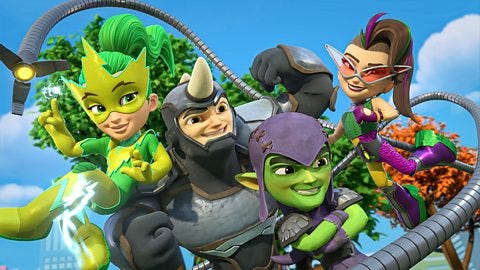
Every episode is a preschool behavior lesson wearing a supervillain costume. My kids knew this rogues gallery before they could read. That’s lore acquisition at an age when most franchises can’t even get in the door. The showrunner has been open about what survived the preschool translation... the thing that’s core to Spider-Man’s ethos, handed down to kids who can’t read yet:
“Even with all the changes, the show’s creators tried to keep what they see as the essence of their superhero. “Spidey always does the right thing, even if it’s hard,” Wilcox said. “That’s why he translates so well to fans of every age.” — Harrison Wilcox, Showrunner, Spidey and His Amazing Friends, via The Wall Street Journal
Then there’s the music. If you’ve been wondering what Fall Out Boy is up to these days, the answer is that Patrick Stump has spent the last five years writing preschool bangers, serving as the show’s songwriter and composer across multiple albums... and honestly? The songs slap. “Do the Spidey” is genuinely not terrible. “Time to Spidey Save the Day” sits at nearly 47 million lifetime streams on Spotify, with the theme song at 35.7 million.
I’ll go further: “A Merry Spidey Christmas” made my best Christmas songs list last year, and it still holds. None of this is an accident. Disney took a millennial icon and used him to bridge what would normally be insufferable toddler music into something parents can survive on the four hundredth listen... which means the kids keep watching and listening. Nothing Disney does in this realm is a mistake.
The Journal saw the same machine I see in my living room:
“[The series] starts three- and four-year-olds on an escalator of Spider-Man content that leads them to TV shows and movies aimed at grade-schoolers, teenagers and adults.” — Ben Fritz, via The Wall Street Journal
And that... that is what Disney does better than anyone on the planet. Disney builds flywheels, and flywheels start young. The toys hit at age two. Amazing Friends LEGO sets bridge into big-kid LEGO. From there, the show graduates them to Your Friendly Neighborhood Spider-Man, then the Spider-Verse films, then the Tom Holland movies. Disney Jr. isn’t stopping at one, either... Iron Man and His Awesome Friends premiered last year and rebrands to Avengers: Mightiest Friends in 2027. The preschool universe is now the template.
My kids rode every step of the escalator, which is why, when Brand New Day arrived, they weren’t discovering Spider-Man. They were cashing in years of fandom. Multiply that across every Gen Alpha household inside those 1.25 billion hours and you start to understand opening weekend.
Here’s how you know the flywheel is working, and I’ll admit upfront this is not science: the backpack count. Walk any elementary school pickup line in America and count what the kids are carrying. Spider-Man wins by a mile, and it’s not just one Spider-Man... it’s a mix of classic Peter Parker, Miles Morales, and Ghost-Spider, all three spider-people the show put on equal footing from day one.
My daughter is living proof of the pattern. She does not care about Belle or Sleeping Beauty... what she’s drawn to, personally, are heroine-based, action-oriented protagonists. Not saying that’s every kid, but it’s a real lane. K-Pop Demon Hunters owned last summer for that exact reason. Ghost-Spider has owned our household for her entire life.
And while I’m here... a free note for the Mouse: Disneyland needs more Spider-person merch... specifically not the Spider-Man, but Miles Morales Spider-Man and Gwen Stacy Ghost-Spider. This is a character the Journal notes is Disney’s second most lucrative consumer-products brand, behind only Mickey Mouse himself... and yet we go every year, and Avengers Campus has a Spider-Man ride, Peter Parker Spider-Man everything, and next to nothing for the two characters my kids’ generation actually gravitates toward. The ride is great. Classic Spider-Man merch is fine, but Disney built a three-lane on-ramp to this fandom... and the gift shop at the end only carries one of the spiders. I’m sure it gets fixed over time, but that’s my one major note in an otherwise masterful machine.
A masterful machine that, it turns out, has been playing with no defense on the field. Because the second reason Spider-Man broke through has nothing to do with anything Disney did... it’s about what DC didn’t.
Lesson Two: Where’s Batman... And What Is DC Even Doing?
Sometimes you’re early on a take, and the moment that proves it hasn’t arrived yet. Back in May I asked a simple question: where’s Batman? My son’s introduction to the character wasn’t a movie, a show, or a cartoon... it was LEGO Batman, a video game, because the ecosystem that hands Batman to each new generation simply doesn’t exist anymore. He asked me, dead seriously, whether Batman is rich. He didn’t know. Here’s how I put it then:
“My kids, in 2026, have basically two options. Bat-Wheels, the preschool Batman series that they tolerate more than enjoy. And LEGO Batman... That’s the entire kids’ Batman shelf, and we have been Batman-starved for years.” — Patch Notes, May 2026
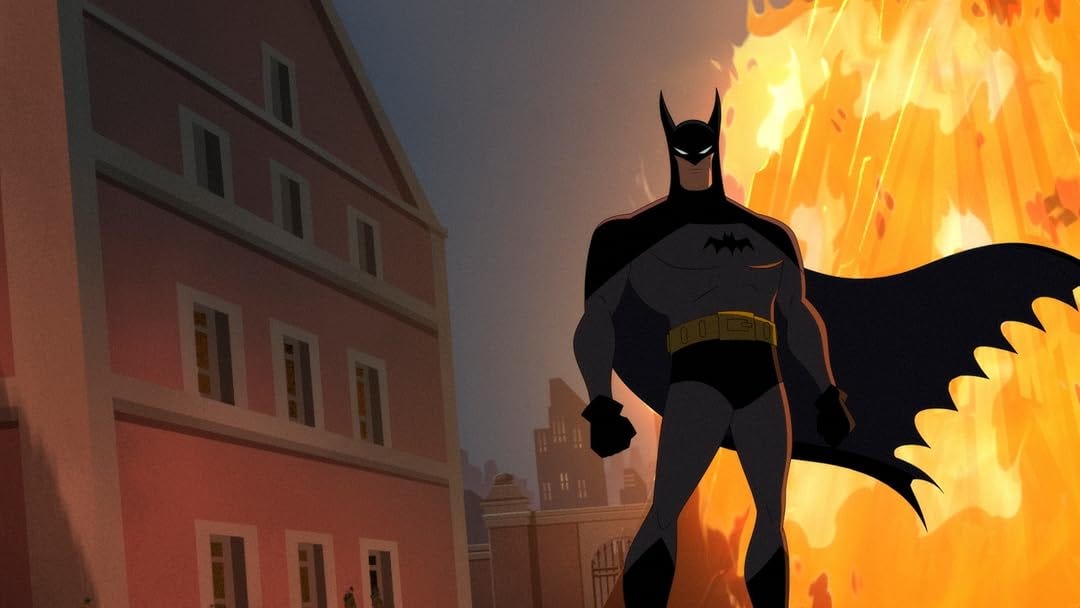
Nothing since has changed my mind, and the summer arguably made it worse. DC’s best current output is genuinely good television I am personally enjoying... Batman: Caped Crusader, Bruce Timm’s 1940s noir spin on Prime that I’m working through right now, the Harley Quinn show with its dark adult humor, The Penguin as the prestige drama... and every bit of it is made for me, not my kids. They can’t touch any of it. Batman was nowhere at Comic-Con either, as I covered last week, a no-show on the industry’s biggest stage while Marvel ran Hall H. The most popular character DC owns, by miles, has been relegated to content for people my age.
Run the slate through one question... who is this for? Peacemaker: not kids. Creature Commandos: not kids. Supergirl: one of the biggest superhero bombs in history. Lanterns: a prestige HBO drama about Green Lantern, which sounds interesting to me and reaches nobody under forty. A Jimmy Olsen series: who asked? Man of Tomorrow makes three of the first four DCU films Superman-related. And then there’s Clayface... a horror movie about a character who is not a tier one Batman villain. Tier one is Joker, Two-Face, Penguin, Bane.
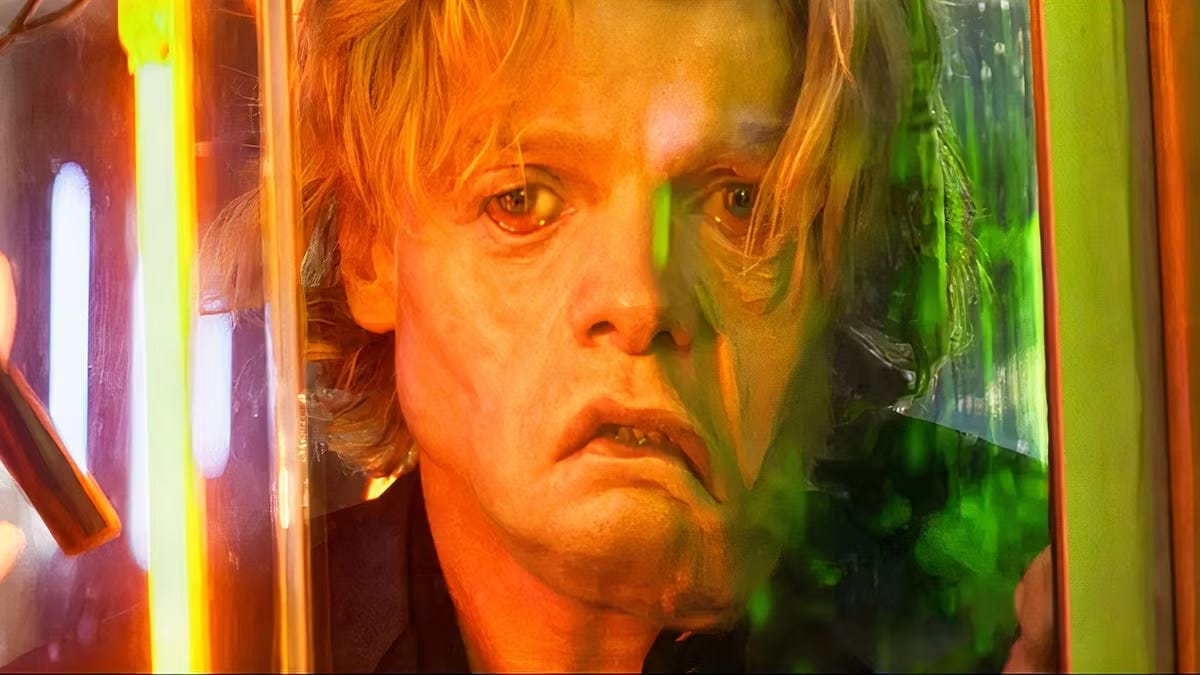
Clayface sits somewhere around tier three... a side character, relatively speaking, and I’ll spare you my full villain rankings for another week. A horror movie is, by definition, more adult fare for adults... and my kids don’t even know Clayface belongs to Batman, because outside of a couple of one-off Batwheels cameos, nothing exists that would ever teach them. Paul Tassi at Forbes asked the same question this week about DC’s character choices, and he isn’t wrong in his thoughts.
None of this is a knock on James Gunn the filmmaker. What he did with Guardians of the Galaxy was astounding, and the first one remains my favorite MCU film by a mile. The slate he’s greenlighting, though, reads like a collection of projects for James Gunn, not projects that build a fandom. Forget which heroes DC is picking... look at who they’re aiming at. If every project targets people who are already fans, already adults, already in the building, what’s the ceiling of this IP? You cannot grow a franchise by exclusively serving its oldest constituents. Four-quadrant is how fandoms get built, and DC isn’t attempting two of the quadrants.
Disney just taught this lesson from the other direction. Wonder Man was a good show... I watched it, I enjoyed it, I was sad to see it cancelled. And Disney was still right to cancel it, because a show made for TV critics and forty-five-year-olds who opine about their childhoods through a mature lens doesn’t feed a flywheel that needs all audiences. Disney learned. DC is currently building an entire universe out of Wonder Mans.
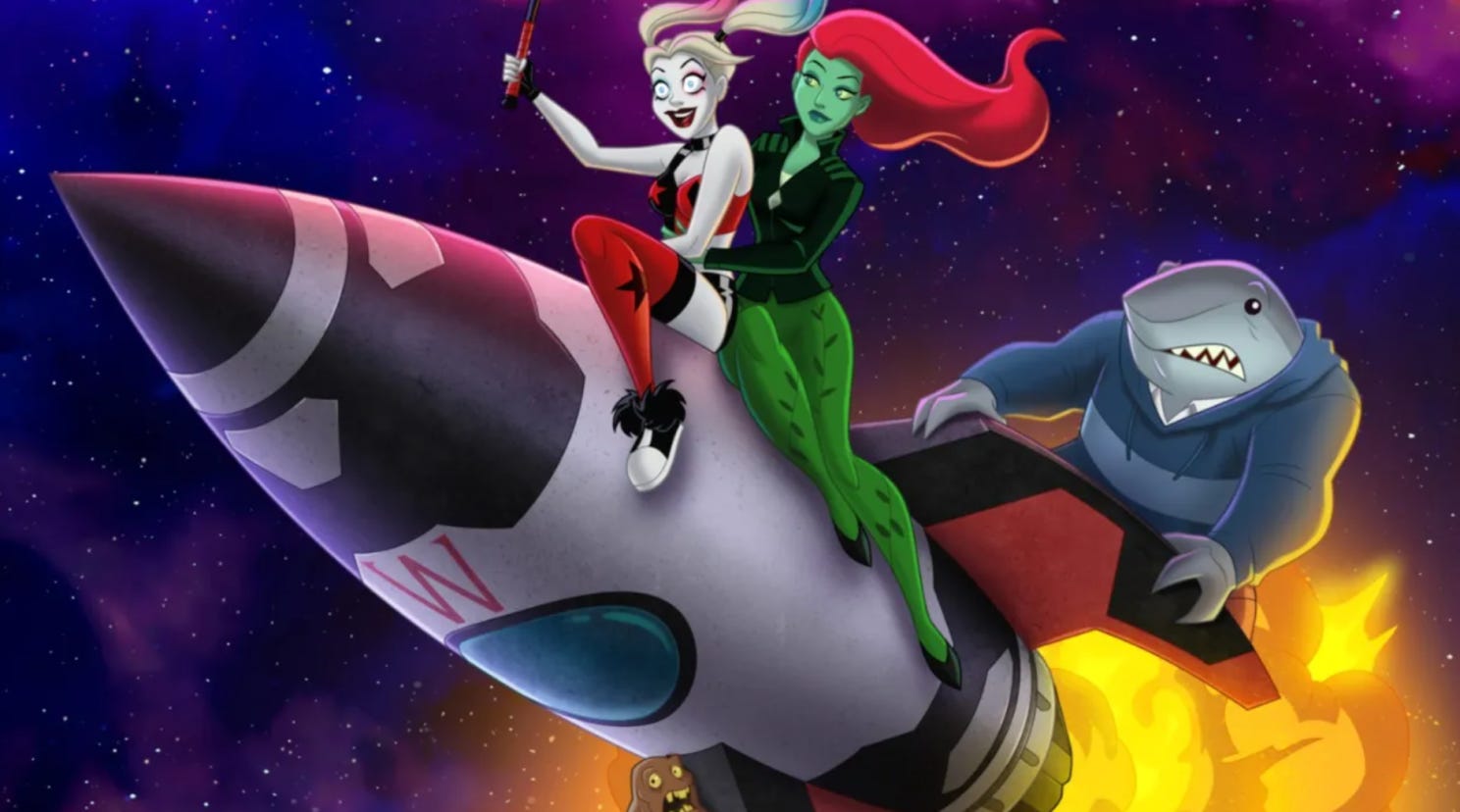
So what does any of this have to do with a Spider-Man movie grossing a billion dollars in four days? Everything. And I’ll even grant the skeptics their premise... maybe superheroes really are getting less popular with kids overall, a generation opining for its own things instead of ours. Fine. Take that at face value, and the math still favors Marvel, because DC has abdicated the entire younger generation and left every last one of those kids for Marvel to grab.
Chasing an aging audience to no clear end while building nothing underneath means that if the superhero pie shrinks, Marvel owns a disproportionate share of whatever remains. Sure, the ceiling on some Marvel movies may come down. Their floor keeps rising... and a high floor sustains a healthy franchise business for as long as Marvel keeps learning the lesson. Judging by Disney’s earnings and everything happening on the Disney+ side, they have: grow the kids, then cash in across movies, games, parks, and merch. Brand New Day’s opening weekend is that floor showing itself at the box office... a fandom DC never contested, all cashing in at once.
Which brings me to the third lesson, because the movies are only half of Marvel’s machine. The other half is the one this newsletter was built to measure.
Lesson Three: The Games Are The Proof... And The Data Catches The Flywheel Spinning
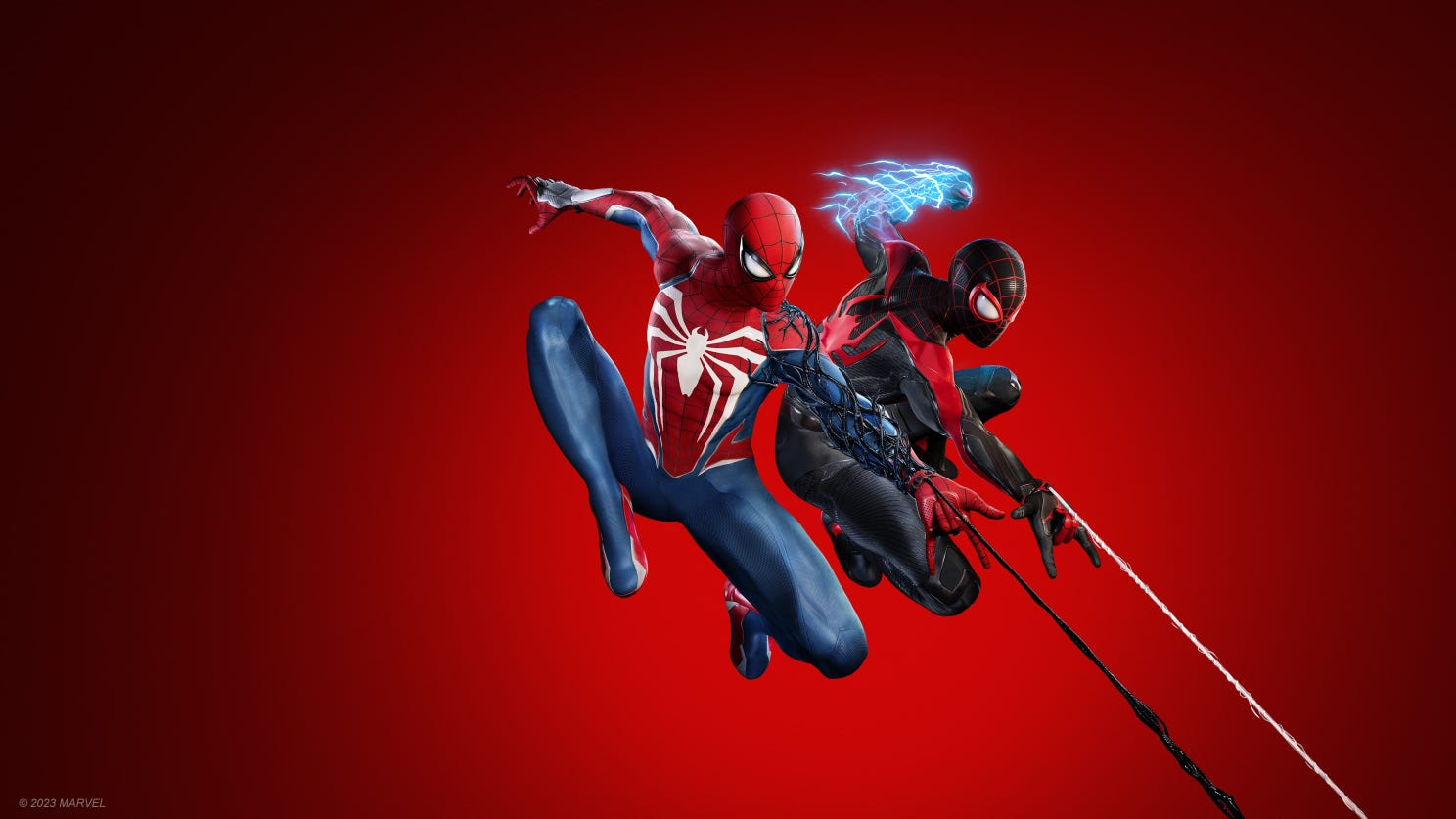
Whatever you think of Marvel’s screen output these last few years, the gaming side has been clicking for half a decade. Miles Morales in 2020. Spider-Man 2 in 2023, the fastest-selling PlayStation Studios game ever at launch. Marvel Rivals arrived in late 2024 and became a genuine phenomenon. Marvel Snap before that. MARVEL Tōkon: Fighting Souls launches this very week, and Wolverine lands September 15. Not everything worked... Marvel’s Avengers is the cautionary tale in the pile... but across the portfolio, Marvel Games’ licensing strategy has been a net win on any honest scorecard, with each hit raising the floor for the next one. None of it stayed contained to gaming, either, because the movie that just broke the opening weekend record is openly built on top of it.
Don’t take my word for that. Cretton’s stunt team are Insomniac obsessives who brought screen grabs of their own gameplay into production:
“I am not a gamer, but I’ve played the game, but I surrounded myself with people who were obsessive gamers. So a lot of the people in our stunt department loved playing those video games. So they would do screen grabs of their play and bring it in and say like, “Can we pull this move off?” So that was a great inspiration for things.“ — Destin Daniel Cretton, Director, Spider-Man: Brand New Day, via Polygon
Tom Holland went further on the red carpet, admitting he was up the night before his own premiere playing Spider-Man 2:
“A lot of the action. A lot of the finishing moves. I was actually playing the game last night. I couldn’t sleep last night, I was so excited about today. I was trying to figure out what I was gonna do, and I was like, ‘I’ll just throw the game on and have some fun.’ For me, a lot of those finishing moves, a lot of our stuff was influenced by that stuff.“ — Tom Holland, via IGN, per PSU
The connective tissue runs deeper than stunts, too... the film introduces Jean DeWolff, the cult-favorite NYPD captain from the comics whose legacy gave Insomniac’s games Yuri Watanabe. Movies borrowing from games that borrowed from comics. Entry points don’t matter to this flywheel... a cartoon, a game, a movie, a comic they all feed each other now.
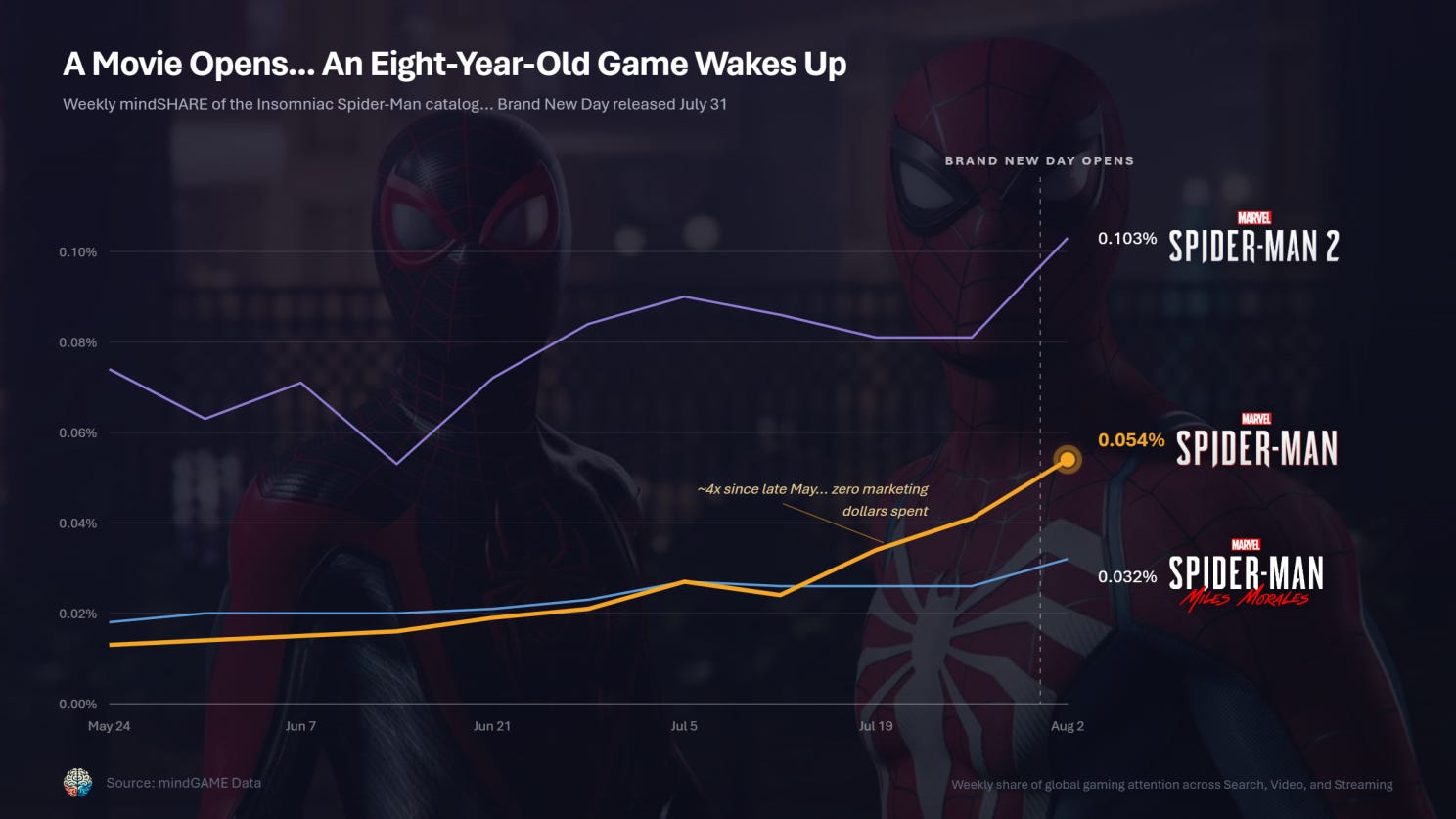
And in mindGAME, the halo from the movie is measurable, immediate, and landing exactly where the flywheel theory says it should. Marvel’s Spider-Man, the original 2018 game, has climbed from 0.014% weekly mindSHARE in late May to 0.054% the week of the movie’s release... roughly 4x, on an eight-year-old game running zero marketing. Spider-Man 2 jumped to 0.103% that same week, its best of the summer. Miles Morales rose right alongside. Nobody spent a dollar promoting these games. A movie opened, and an entire back catalog saw a spike with fans looking for other mediums to engage with the Spider-Man IP.
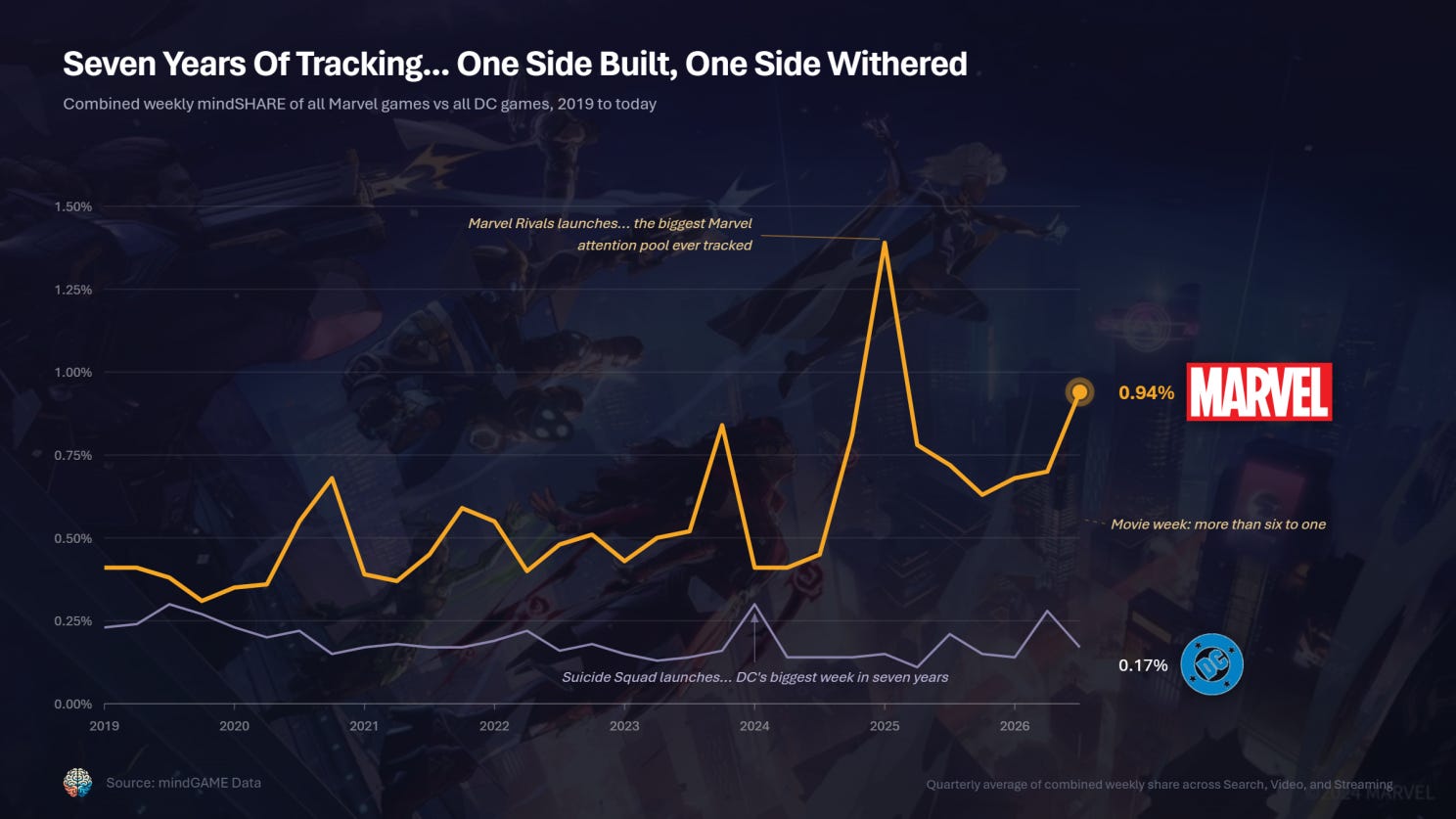
When our tracking began in January 2019, Marvel and DC games lived in the same neighborhood... Marvel held roughly half a percent of weekly gaming attention, DC around a quarter. Seven years later, that neighborhood is unrecognizable. Marvel built, game after game, and the portfolio compounded to the point where Marvel titles now command nearly a full percent of global gaming attention in a given week... double where they started. DC withered to 0.154%, and what remains runs on a previous decade.
The biggest DC gaming attention pools today are Arkham Knight, Arkham City, and Arkham Asylum... a 2015 game, a 2011 game, and a 2009 game, carrying the entire franchise. DC’s biggest attention week across all seven years of tracking? February 2024, the launch of Suicide Squad: Kill the Justice League, one of the industry’s most expensive failures. Their peak was a flop’s opening weekend. Marvel’s peak was Rivals arriving and sticking... still the single biggest Marvel attention pool in gaming today, twenty months after launch.
Where’s Batman? Not in gaming either. And this is where the question stops being about my kids’ backpacks and starts being about franchise economics, because gaming is where fandom gets built between the movies. It’s where the next film finds its inspiration... Brand New Day just proved that on the record. It’s the floor under the whole franchise, the daily attention that keeps a character alive when there’s nothing in theaters. The Arkham games were exactly that machine for Batman... an entire generation’s Batman fandom was forged in Rocksteady’s Gotham. Then DC stopped feeding it, the same way they stopped feeding kids’ TV, and the floor has been sinking for seven straight years while Marvel’s kept rising.
The Marvel machine rolls on from here. Wolverine gets its September moment, the on-ramp into Marvel’s X-Men era... and it’s no coincidence Avengers: Doomsday is marching the same direction. Spider-Man’s halo is simply this cycle... X-Men is the next one.
Put the three lessons together and the record weekend stops looking like a surprise. Say what you will about Marvel’s movie output... Spider-Man, over the last half decade, has been remarkably healthy, and the Disney machine is a big part of why. The cartoons reach the youngest audience, the games reach the older one, the movies pull everyone into the same theater... every age bracket covered by a different arm of the same operation. DC declining to even compete removed whatever pressure might have checked it. So even if the superhero genre itself has shrunk, Spider-Man’s share of voice within it has only grown... and Marvel grows by proxy. A billion dollars in four days is what that looks like when it all cashes in at once.
One other company in this industry runs the same playbook. Movies pulling in new fans, characters handed down generation to generation, hardware and software feeding each other for decades... a flywheel Disney would recognize, built an ocean away. Its earnings dropped this week, and right on schedule, most of the coverage read them completely wrong.
Growth Is Growth... Reading Nintendo’s Year One Without The Panic
Two numbers came out of Kyoto this week, and they appear to describe different companies. Net sales: down 9.5% to ¥517.8 billion. Operating profit: up 150.5% to ¥142.5 billion, with the margin exploding from 9.9% to 27.5%. Both are true. The first tells you Nintendo isn’t selling hardware at launch-quarter pace anymore, which no console in history ever has. The second tells you what this company actually is once the box stops flying and the ecosystem takes over.
Now, roughly $300 million of that margin pop is refunded IEEPA tariffs flowing back through cost of sales... tariffs Nintendo notably ate rather than passing on to consumers... plus a ¥22 billion currency tailwind. Real factors, and the underlying story survives them: software carried the quarter, first party hit 82.6% of the software mix, and digital crossed 61.5%. The flywheel doing exactly what the flywheel was built to do... which made it a strange week for the discourse, because the takes arrived before the numbers did. IGN questioning Nintendo’s soul. A bear thesis making the rounds about collapsed attach rates and PC doom. Three retorts, in ascending order of how much the take annoyed me.
Nintendo Remakes Nintendo... That’s Not A Soul Problem
Right on schedule with earnings week, IGN published the hand-wringer. The thesis, in the piece’s own words:
“Nintendo is still no stranger to charming, bespoke bangers, but the remake slate, the Switch 2’s less-than-inspired existence, and Shigeru Miyamoto’s public embrace of the Mario Galaxy Movie’s mid-ness all raise a question that a lot of Nintendo fans would rather not sit with too long. Has Nintendo lost its soul?” — Charlie Lopresto, via IGN
I’ve seen this movie. Back in March, I wrote about the concern-trolling problem... the industry’s habit of manufacturing Nintendo worry at the exact moments Nintendo is winning, most recently when Bloomberg recycled its own 2018 “Switch loses shine” framing seven years later, nearly word for word, about a console that went on to sell 150 million units:
“I don’t know what to call this pattern other than what it is. Concern trolling. A publication with a large audience finding a data point that fits a negative narrative, packaging it as breaking analysis, and moving on before the outcome proves them wrong.” — Patch Notes, March 2026
The soul essay reads like the prestige version of the same genre, and the remake exhibits collapse on contact with Nintendo’s own history. Star Fox always remakes Star Fox... that is what the franchise is. Star Fox 64 was itself a reimagining of the 1993 original, and Star Fox Zero retold the same story again in 2016. A gorgeous new Star Fox that plays like Star Fox isn’t a lost soul... it’s the most faithful possible expression of a franchise whose entire identity is a barrel roll through the same beloved run. Our mindGAME data says the audience agrees: the Star Fox remake posted 0.96% cumulative mindSHARE through launch... out-drawing Metroid Prime 4, the fully new game that shipped last year, at 0.59%. People wanted the remake more than the new thing, and Nintendo gave it to them. Some soul crisis.
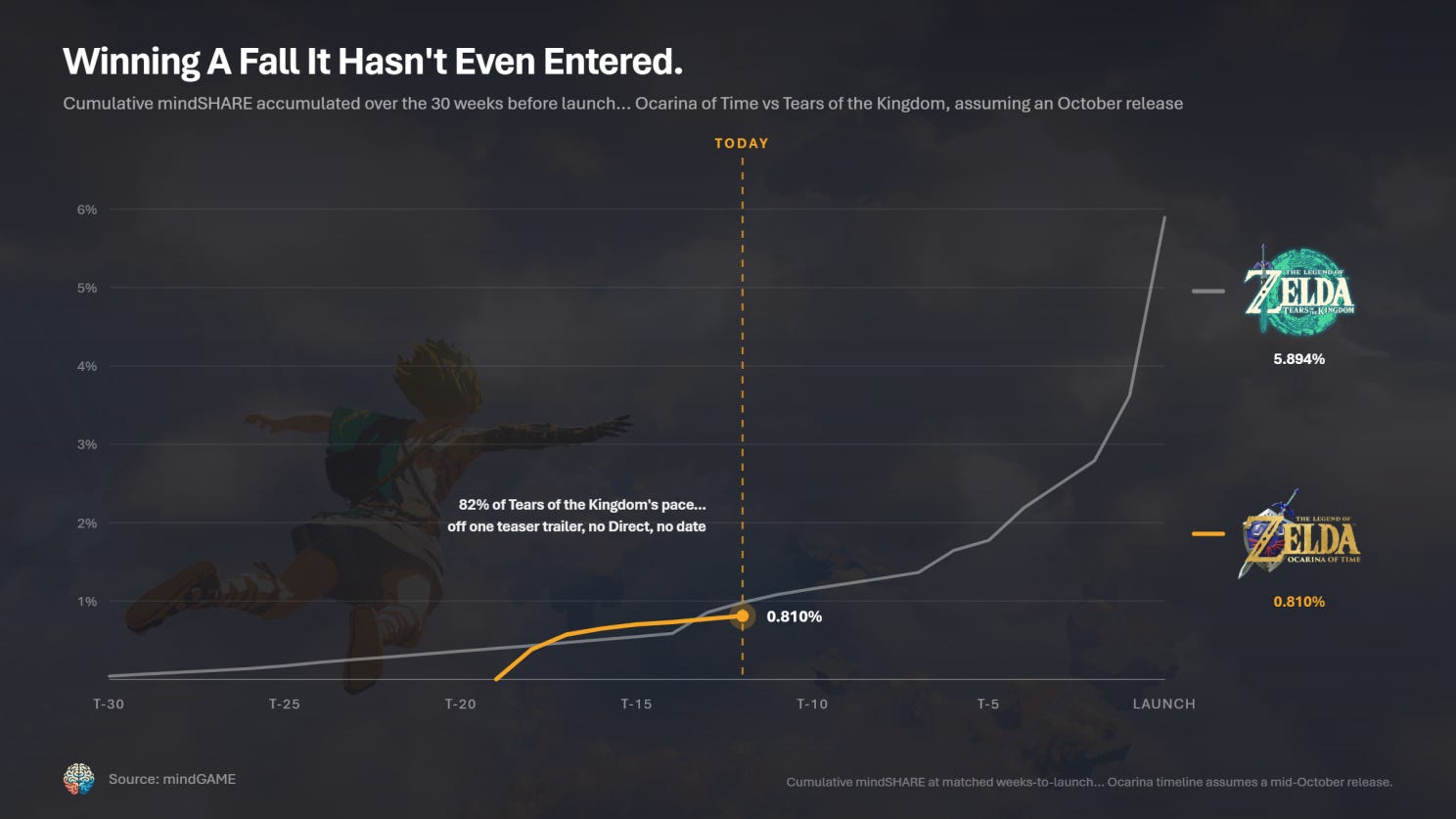
Zelda tells the same story. The complaint is a second Ocarina remake instead of a new Zelda... settle down. Tears of the Kingdom came out three years ago, Echoes of Wisdom... another fully new Zelda... came out two years ago, and Nintendo has a long history of remaking Zeldas between new ones: Ocarina 3D, Majora’s Mask 3D, Wind Waker HD, Twilight Princess HD, Skyward Sword HD, Link’s Awakening rebuilt from scratch in 2019. Ocarina itself hasn’t been remade in fifteen years... revisiting the most celebrated game ever made, on that schedule, is about as uncontroversial as decisions get in this industry. Per our data, the new Ocarina is already sitting at 0.85% cumulative mindSHARE more than twenty weeks from launch... ahead of Wolverine, the second-biggest game of this entire fall. The audience the think pieces claim to speak for is voting with its attention.
Then there’s the charge underneath it all:
“The Switch 2 is, by all commercial metrics, a massive success, and Nintendo is still delivering great games on the regular. Surprise hits like Tomodachi Life and Donkey Kong Bananza are still bursting with the company’s trademark magic, but it seems like for every soulful smash there’s either a misfire like Metroid Prime 4, or, well, not a whole lot. GBA Pokemon roms sold at full price and paid upgrades for the back catalog. It’s the sound of a satiated company happy to tread water.” — Charlie Lopresto, via IGN
Read that again. Massive commercial success... great games on the regular... surprise hits bursting with trademark magic... followed immediately by the eulogy. The evidence and the verdict don’t live in the same paragraph, and the “misfire” doing the heavy lifting is Metroid Prime 4... a famously troubled development that Nintendo salvaged, shipped, and sold millions of copies of anyway.
Every gaming company on earth misses... no exceptions, no era, no publisher. Holding Nintendo to a standard where anything short of a home run per at-bat means the soul is gone isn’t analysis... it’s a purity test no publisher alive could pass. As for the back-catalog complaint, that’s the remake complaint wearing a different hat... Nintendo has been re-releasing its catalog platform after platform for over thirty years. This is not new behavior... it’s the behavior.
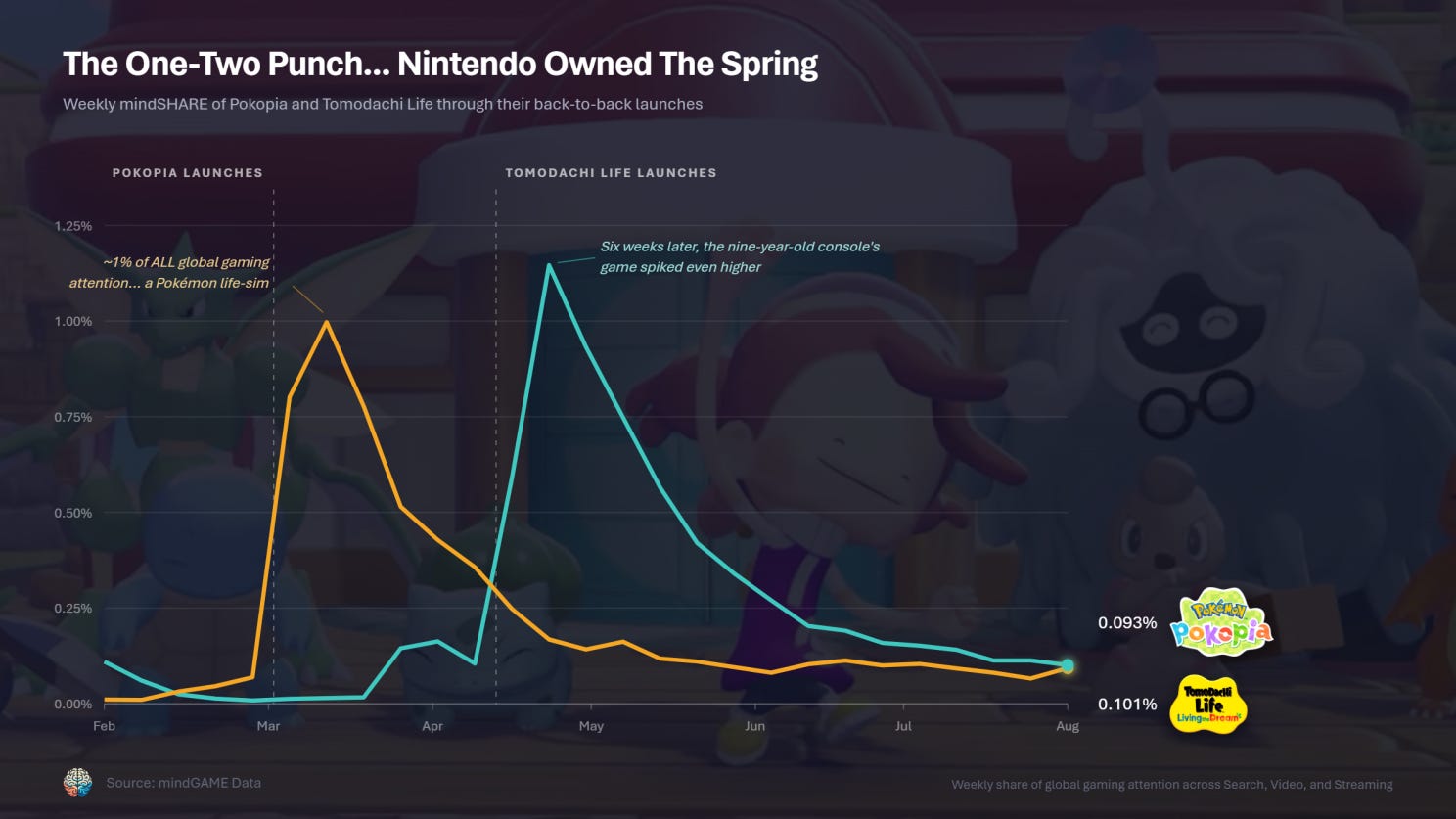
Meanwhile, look at what actually shipped this past year: Donkey Kong Bananza, a genuine hit and Game of the Year contender. Tomodachi Life, a “surprise” so large Nintendo called it out on this very earnings report at over 8 million sold... a Switch 1 game thriving across both consoles in year nine. Splatoon Raiders, technically a brand-new game, shipped three weeks ago. Kirby Air Riders, the sequel to a game from over twenty years ago that fans wanted forever but never believed would actually get made... and Sakurai made it anyway. By the essay’s own definition, the most soulful greenlight imaginable.
My current GotY Pokopia, a Pokémon life-sim that exists nowhere else in gaming... the genuinely new invention I’ve argued is Nintendo’s shot at its own Minecraft. Mario Kart went open world. New Fire Emblem next month, new Xenoblade next year. The company ships new inventions and lovingly rebuilt classics side by side, constantly... critics ignore the hits and point at whichever releases build their case. Selection bias dressed up as soul-searching.
A soul check should look at the whole body of work... and a company with 130 million annual playing users, doing exactly what it has done for forty years at some of the strongest software margins in the industry, doesn’t appear to have lost anything. Bloomberg did a version of this story in 2018 and the Switch sold 150 million. They did it again this March... a production-trim piece landing on a stock already down roughly 40% from its peak, shaving another 6% on publication and wiping out the rally Pokopia had just delivered. Now it’s IGN turn... and the Nintendo machine keeps not caring... while driving all sorts of value to its customers
What Is The Switch 2 Supposed To Be?
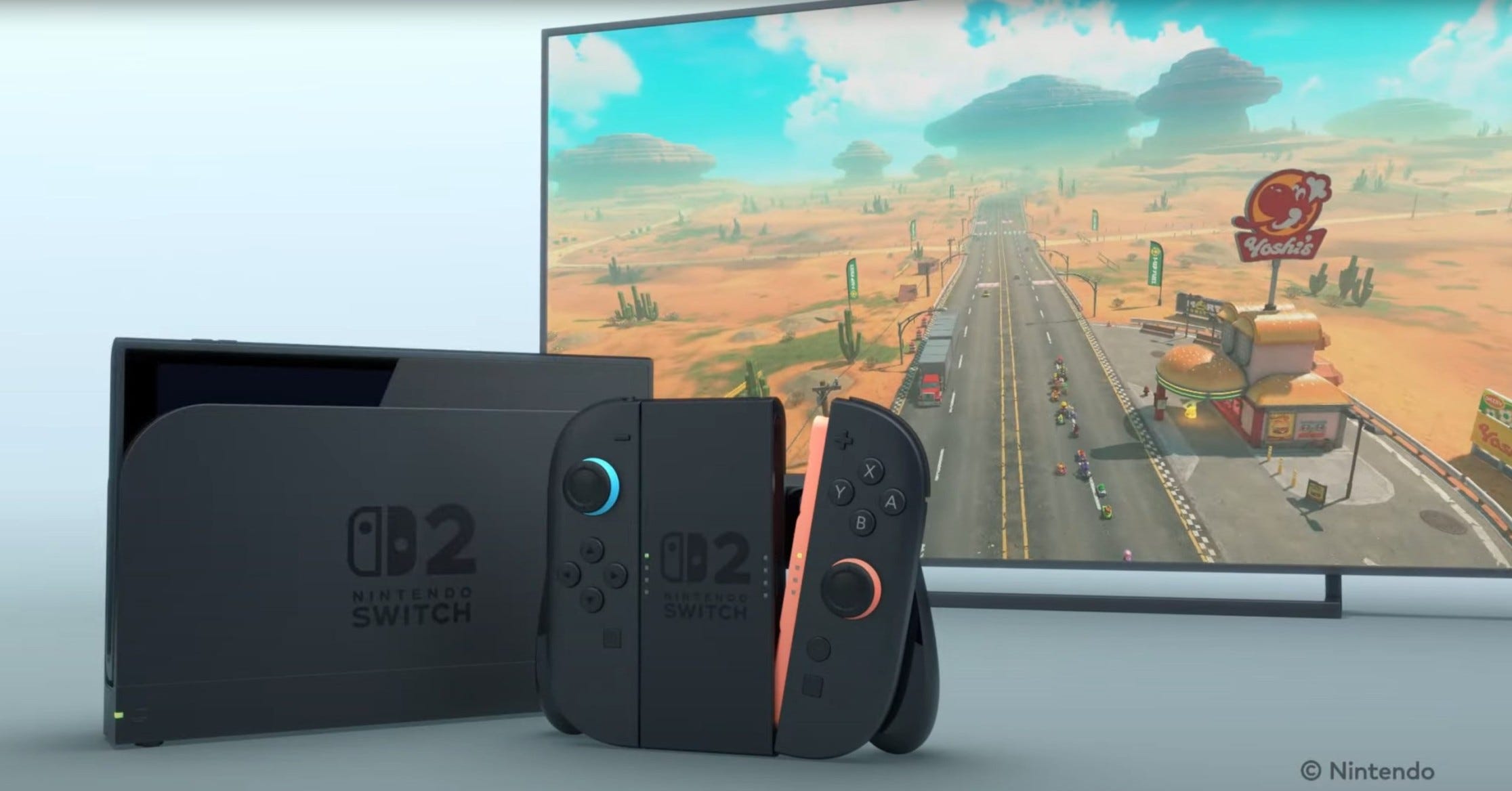
The soul essay’s second charge deserves its own section, because it’s the one Wall Street quietly shares... and one that Nintendo can’t seemingly escape:
“Surely Nintendo would follow up the runaway success of the Switch with another seismic piece of hardware to fly in the face of the futile quest for graphical perfection. Its answer was the Switch 2: the Switch, with more graphics. While not unappreciated given the dismal resolution and framerates of the original console, running the same playbook with some extra juice under the hood was a perfectly whelming decision from a company we’re used to seeing dazzle us. It’s exactly what everyone else does.” — Charlie Lopresto, via IGN
Notice the trap being set. This industry has tarred and feathered Nintendo for the Wii U for over a decade... a scarlet letter nobody lets them forget, the cautionary tale trotted out every time a platform holder takes a big hardware swing. Then Nintendo leans into the most successful form factor it has ever built, and the same commentariat calls it uninspired. Damned if you dazzle, damned if you iterate. So which is it? Do you want them gambling on the next Wii U, or do you want them compounding the thing that works? You don’t get to charge them for both.
My answer to the header’s question has been on the record since December:
“Switch 2 is not some wild reinvention of the console. It is, quite literally, a better Switch... It is an Apple style move, iteration rather than reinvention, and it works because the point of Switch 2 is not to surprise you. The point is to make it easier to keep playing Mario Kart, Donkey Kong, Zelda, and Pokémon for another decade.” — Patch Notes, December 2025
Apple locked the iPhone’s slab a decade and a half ago and has shipped refinements ever since... and outside one famous essay about the state of Cupertino’s soul, which was about broken AI promises rather than iterated hardware, nobody accuses Apple of losing anything by making a better slab. Nintendo found its own slab... a handheld hybrid you can dock... and until a genuine technology paradigm shift arrives, the smart move is Switch 2, Switch 3, OLED-style revisions between, on multi-year cycles because game hardware shouldn’t ship annually. The form factor is solved. Solved form factors get iterated, not reinvented.
And the iterated slab is selling like a revolution. Switch 2 moved 19.86 million units in year one... in tracked US history only the Game Boy Advance has sold faster through nine months, per Circana. This quarter’s sell-through ran ahead of the original Switch’s equivalent second-year pace, on Nintendo’s own slide, through a price revision in Japan. The forecast holds at 16.5 million, and that “conservative” number sets up an uncomfortable milestone for someone else: Switch 2 sits at 23.7 million units after thirteen months, while the Xbox Series consoles... on the market almost six years, with Microsoft long past reporting numbers... are estimated around 35 million.
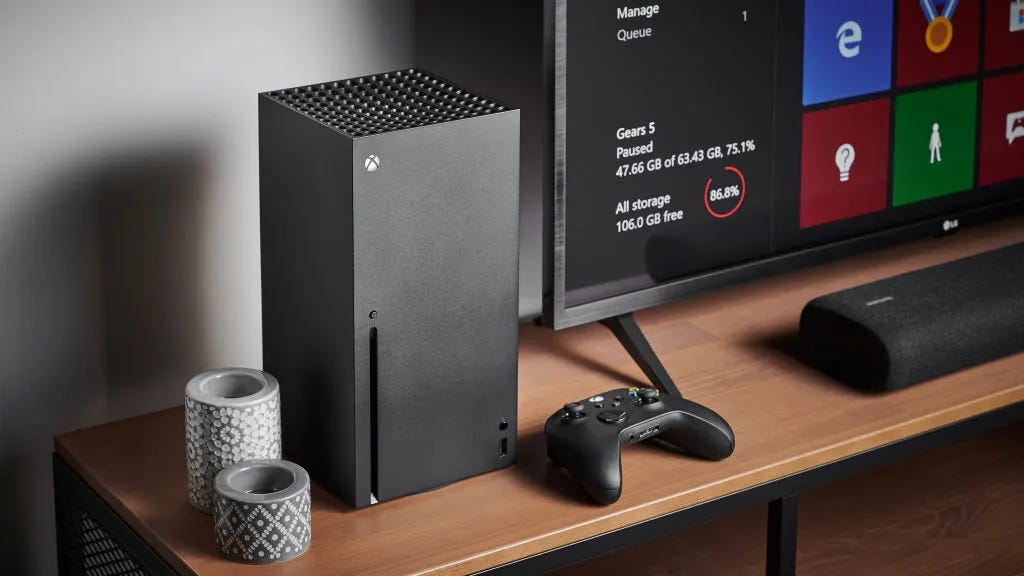
Run the current pace forward and Switch 2 passes the entire Xbox install base somewhere between this holiday and next spring, at roughly a year and a half old. A second year comping down from the biggest launch in company history isn’t a warning sign... it’s arithmetic, and the arithmetic is lapping a competitor six years into its generation.
The hardware case settles on that scoreboard... software is where the deeper skepticism aims. A bear thesis from Accrued Interest made the rounds recently arguing Nintendo doesn’t deserve a software multiple... I’ve spoken with the author, sharp guy, worth reading... and the Apple framing is exactly where we part ways:
“Any time someone compares a company to Apple, one of the most dominant businesses in human history, my first instinct is to be skeptical. The company’s fiscal 2026 results, released this May, reveal the structural reality: Nintendo is a cyclical hardware company whose software economics are weaker than launch headlines imply.” — Simeon M., via Accrued Interest
Skepticism of Apple comparisons is healthy. “Cyclical hardware company,” though, is a strange diagnosis to hang on a quarter where hardware shrank and operating profit rose 150%... the software economics just carried the whole report. The thesis’s centerpiece is the attach rate... software units per console... adjusted to strip out bundled copies:
“Strip the bundled copies out and the organic attach rate, games people actually chose to buy with their own money as a separate decision, was 1.82.” — Simeon M., via Accrued Interest
Measured against the razor-and-blades console model, 1.82 looks alarming... measured against what the Switch 2 actually is, it’s the model working. I covered this in March: 84% of early Switch 2 buyers already owned a Switch 1 and arrived with entire libraries in hand... an upgrader with forty games isn’t a weak customer, an upgrader with forty games is the entire point. The accounting hides the rest.
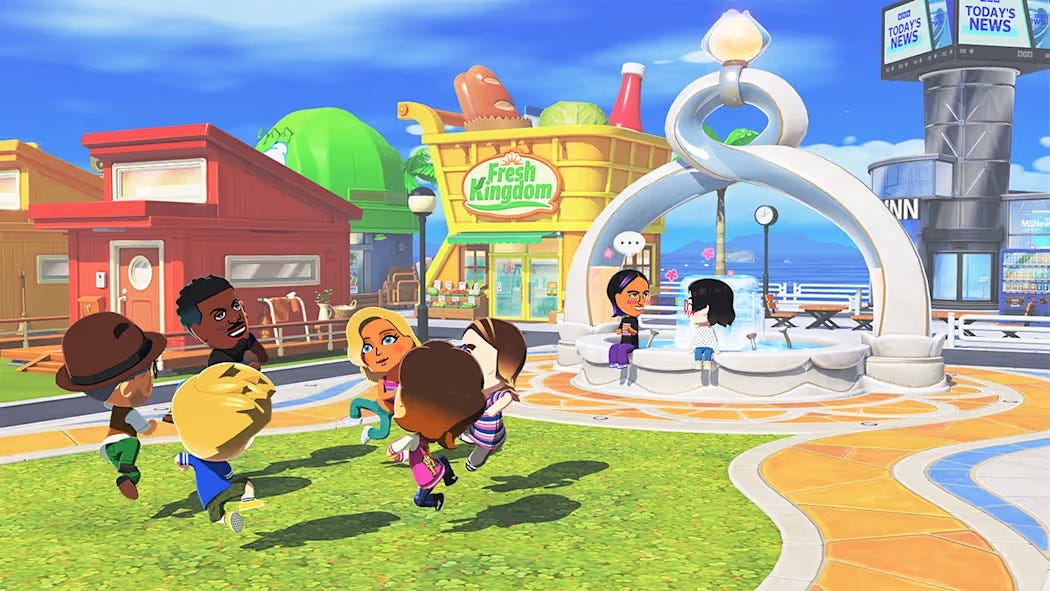
Tomodachi Life has no Switch 2 version... every one of its 8 million copies books to the Switch 1 line, including every copy bought by a Switch 2 owner playing it on the new machine, which Nintendo’s own report says is happening at scale. Even cross-gen titles split by format, packaged copies counting as Switch 2 software and downloads as Switch 1. All told, Switch 1 software grew 38.6% to 33.81 million units in year nine... an ecosystem selling more software than ever, with a meaningful slice of it invisible to Switch 2 attach-rate math by construction.
Nintendo, right now, is standing with two feet in two ponds... one in the Switch 1 pond, one in the Switch 2 pond... and it hasn’t pulled the trigger on forcing the migration. That’s a choice, and it’s the right one. Over 150 million Switch 1 devices sit in homes, their owners still buying software... the old pond spends, and this quarter proved it. Hardware audiences move like iPhone audiences: some people upgrade day one, plenty happily run a five-year-old device, and you keep serving them because they keep paying you.
The premium experiences will migrate to Switch 2 over time, and they should. If Nintendo is still launching its biggest titles across both consoles in year four or five, write that concern piece... I’ll co-sign it. Penalizing them for not amputating a 150-million-unit audience in year one, though? Any operator on earth makes the same call. You don’t cut off the hand before the gold crosses the bridge.
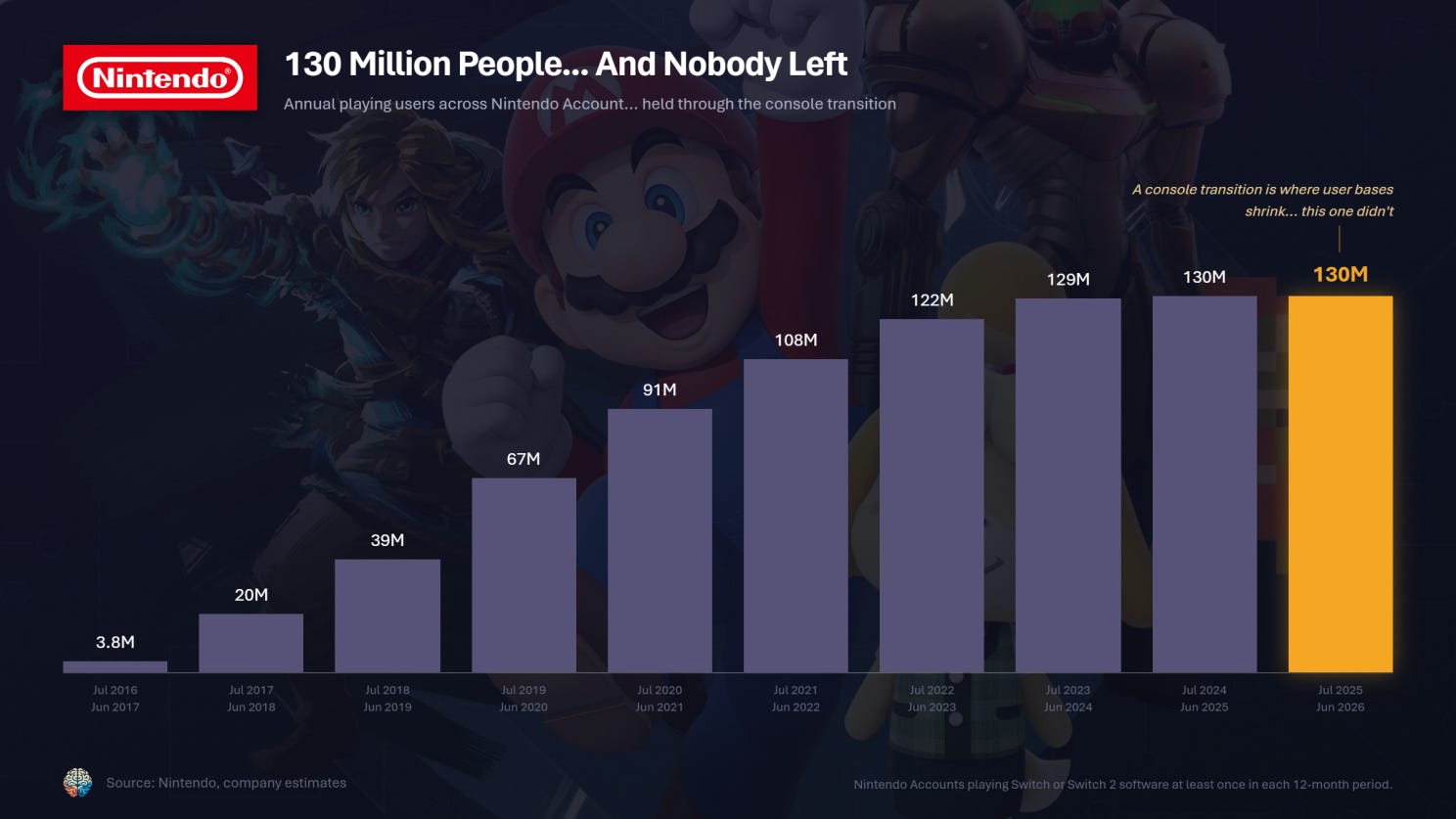
Retention backs the whole thing up... 130 million annual playing users, held through the transition, up from 108 million across a window where most of gaming handed its COVID cohort back. People graduate upward to what is quite literally the same device, their entire library travels with them, and Nintendo Account carries the relationship across generations.
Our attention data catches the same cycle from altitude. Set the COVID anomaly years aside and Nintendo’s share of global gaming attention... Nintendo, The Pokémon Company, and Pokémon GO combined... spent the Switch 1 twilight working its way down, bottoming in 2024 as the old console aged out and the new one hadn’t arrived. A tick up followed in 2025 with launch.
Now the real move: 2026 is running roughly 18% above last year, the strongest sustained climb anywhere in our seven years of tracking. Attention share breathes with the hardware cycle... it exhaled through the Switch 1 twilight, and Switch 2 is the inhale.
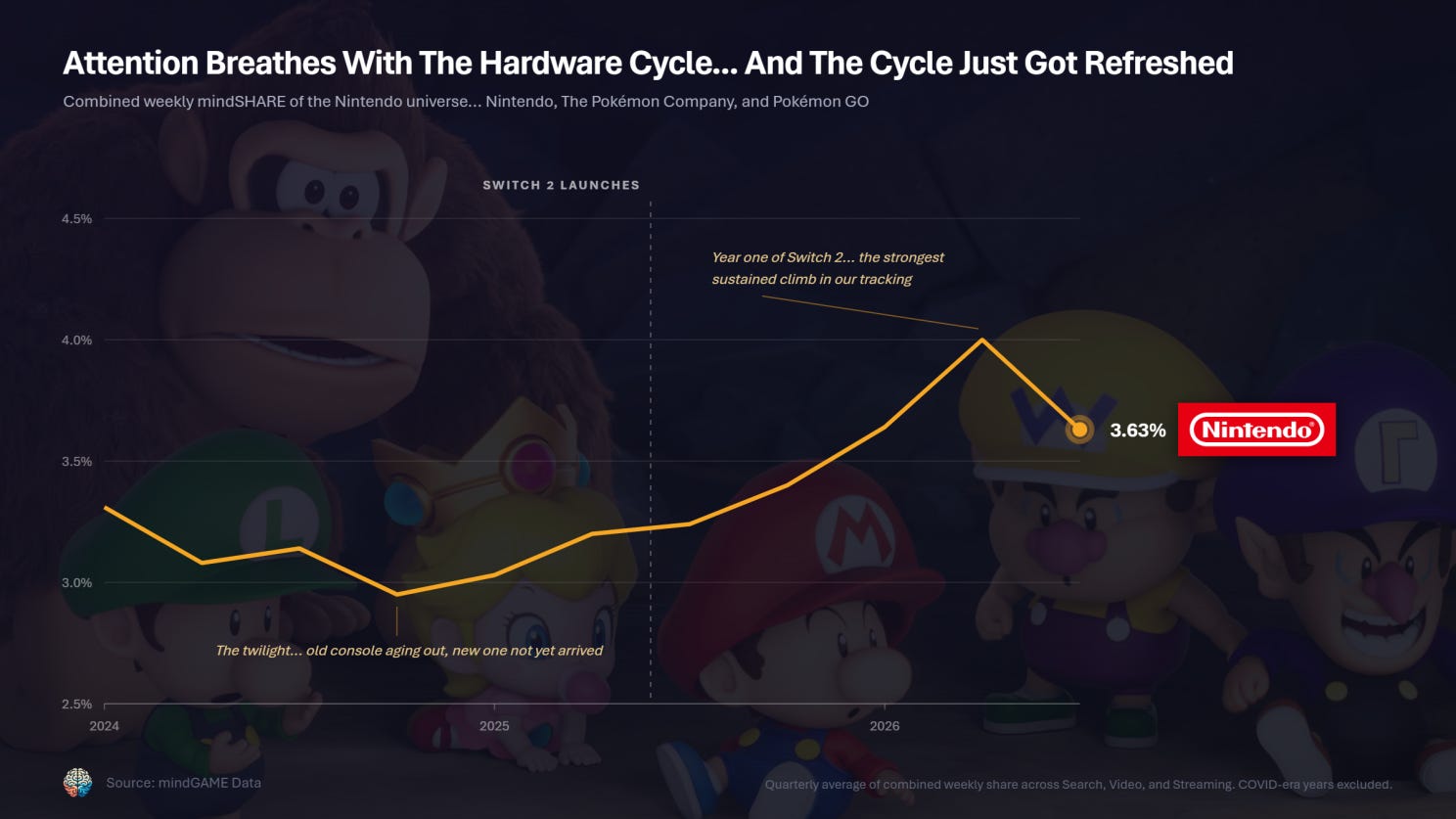
So what is the Switch 2 supposed to be? Not a reinvention, and not a razor waiting for blades. A renewal... of the device, the library, the account, and the attention all at once.
Underneath the renewal sits the flywheel, and this quarter offered another clean look at it: first-party titles made up 82.6% of every game sold on Nintendo’s platform. Four out of five. Consumers don’t buy this hardware for specs or teraflops... they buy it on a promise. Quality, at a reasonable price. Great games, again and again, even when one of them is a lovingly rebuilt classic... and the audience seemingly couldn’t care less about the remake discourse, because the attention data shows them leaning in, not walking away.
Nintendo makes the promise, keeps the promise, and the flywheel turns... hardware sells software, software justifies hardware, and 130 million people stay in the loop. That’s why this company succeeds over and over and over again while the commentariat re-litigates whether Nintendo has lost its soul... magic... or whatever word you want to use.
Keeping the quality promise is Nintendo’s job. Keeping the price promise, it turns out, is being handled by Nintendo’s competitors... who spent the last year making everything else in gaming radically more expensive.
The Value Curve Only Bends One Way
Back to the bear thesis, because its biggest argument isn’t about Nintendo at all... it’s about everyone surrounding Nintendo:
“Sony and Microsoft have already capitulated to this reality, which raises Nintendo’s stakes rather than lowering them. Sony now ports its former exclusives, Spider-Man, God of War, to Steam as a matter of course. Microsoft ships day-and-date on PC. A well-equipped PC already plays both competitors’ catalogs, which means Nintendo’s IP quarantine is the only remaining reason anyone must buy a dedicated console. That’s not a wider moat. It’s Nintendo betting the whole console on each new game clearing the bar, with little margin for error.” — Simeon M., via Accrued Interest
Except the snapshot has already expired. Sony ended the PC-port era for its single-player exclusives in May... Hermen Hulst told PlayStation Studios staff that narrative first-party games stay on PlayStation, Ghost of Yotei’s PC version got scrapped outright, and the multiplatform language quietly vanished from Sony’s own strategic filings. Xbox is running the same reversal from further behind: Asha Sharma has said a platform “must have exclusive content,” and Microsoft now promises at least one console exclusive per year, starting with Gears of War E-Day.
Both companies spent years renting out their crown jewels, watched what it did to their hardware, and are walking it back... reverting to the strategy Nintendo never left. Exclusive software sells hardware. The oldest rule in the business went out of fashion for about three years, the companies that abandoned it paid for the experiment, and now the industry is drifting back toward Kyoto’s model while the bear case still lists that model as the liability. “IP quarantine” isn’t the fragile bet with little margin for error... it’s the strategy both competitors just adopted at full price.
Then there’s the price obsession... the Switch 2’s fifty-dollar increase, the eighty-dollar Mario Kart, treated as evidence Nintendo is pushing itself out of reach. That framing ignores what happened to everything else. The PC market Nintendo supposedly loses buyers to is in the middle of a full-blown component crisis... DRAM prices rose roughly 170% over the past year as AI datacenters devoured global memory supply, and Gartner projects the crunch running into 2027. IDC calls the resulting PC prices “structurally higher”... not a spike, a new floor... with Dell and Lenovo warning customers of 15-20% increases for systems shipping later this year.
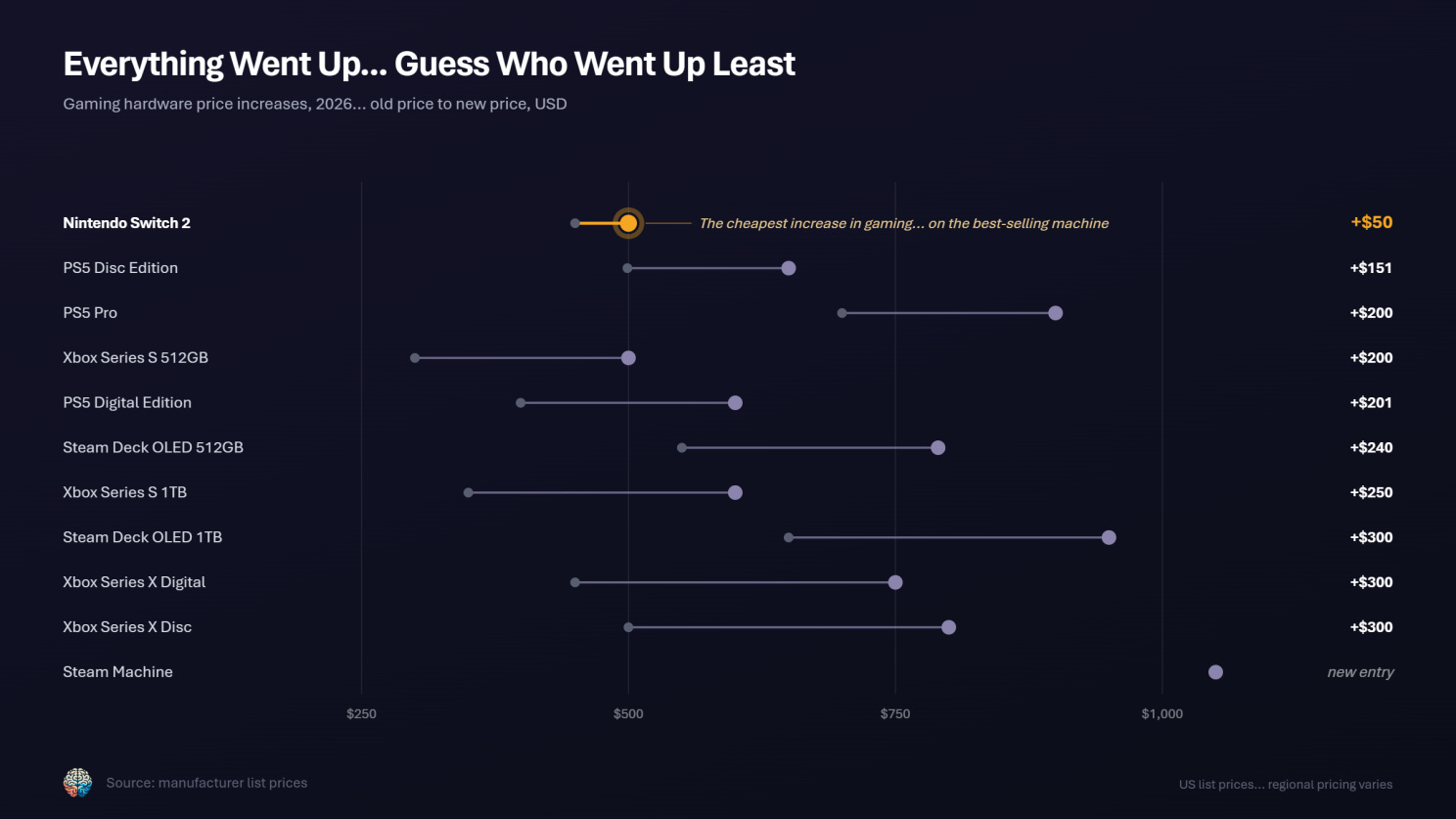
One documented budget build went from $489 to $668 in three months, a 35% jump, and Gartner projects the sub-$500 gaming PC effectively disappearing by 2028. Flagship GPUs are touching five thousand dollars. I own a prebuilt... the same machine costs roughly double what I paid for it. Anyone who has actually priced a gaming PC knows the “PC is the value play” argument died in the component aisle, and the people still making it haven’t been to Best Buy lately.
Line the machines up the way a family standing in that Best Buy aisle actually does. A gaming PC that plays the big third-party games: north of a thousand dollars and climbing. A PS5 or Xbox: hundreds more than they launched at, after multiple price increases. A Switch 2: five hundred bucks, price held, tariffs eaten rather than passed on... and now getting the core third-party spine on Nintendo’s own slide this quarter.
Madden. EA Sports FC. Call of Duty: Modern Warfare 4. Elden Ring. The one genuine knock on Nintendo hardware was always “it doesn’t play the big games”... and that knock is dissolving in real time. Half the price of a serious PC, plays the sports titles and the shooters, plus an entire universe of games that exist nowhere else. The value spot on the demand curve has an owner, and the gap is widening every quarter the memory crisis runs.
So run the bear case backward. Exclusivity was supposed to be Nintendo’s fragile last moat... the industry just voted it the whole strategy. Pricing was supposed to be Nintendo’s vulnerability... the market made Nintendo the cheapest serious option in gaming without Nintendo lifting a finger. The thesis measured Nintendo against a world that stopped existing sometime this spring.
Again... Growth Is Growth
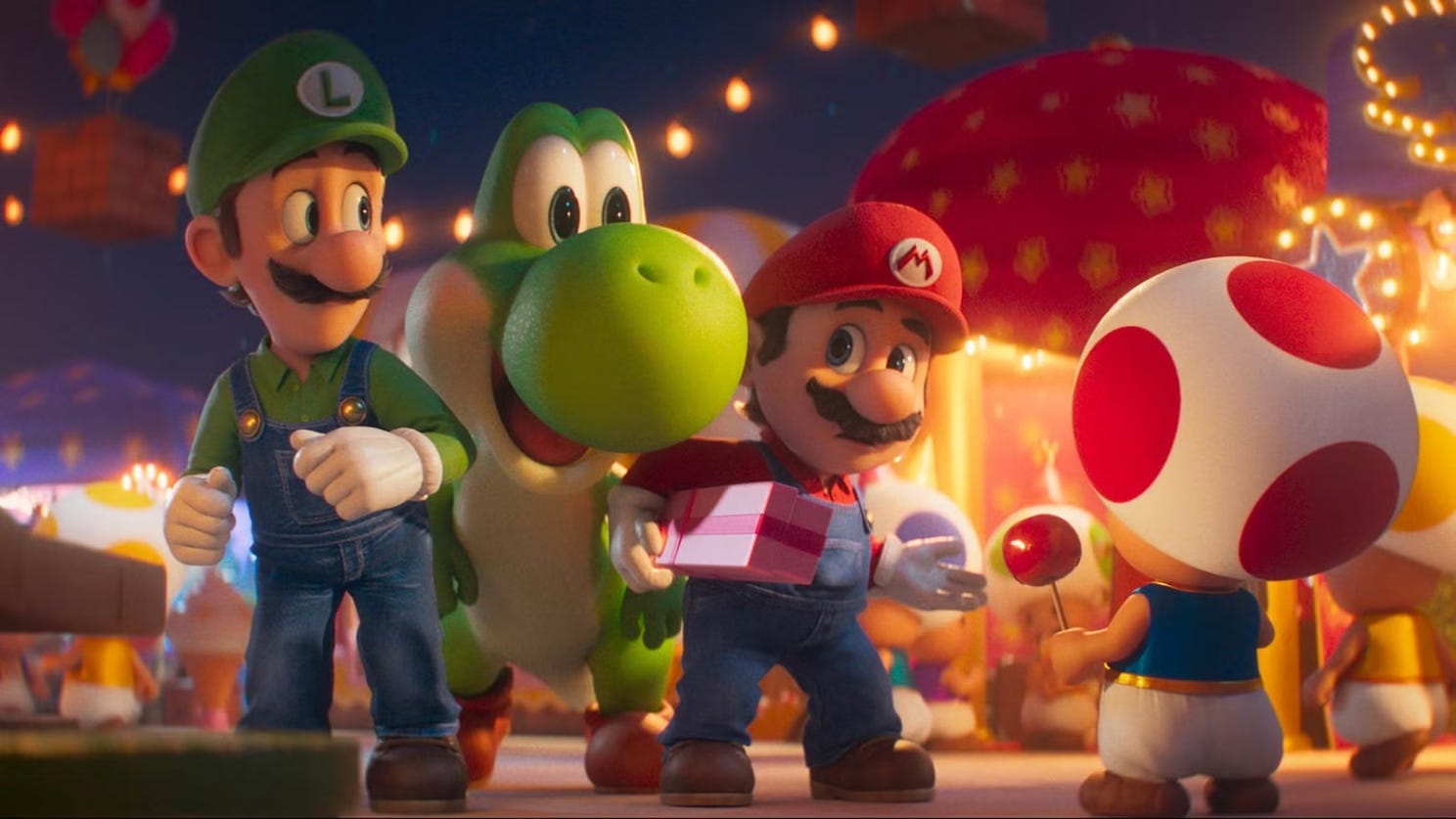
One more number from this week’s report deserves the spotlight, because it’s the piece the soul-searchers and the bears both skipped: IP-related income more than doubled this quarter, up 107% to ¥34.8 billion. The Super Mario Galaxy Movie crossed a billion dollars at the box office... the second-biggest video game film in history, behind only its own predecessor. Nintendo’s own materials describe the movies as contact points for people in regions where consoles never reached, a first handshake with characters that eventually leads back to the hardware. A live-action Zelda arrives in 2027, landing in the same era as the Ocarina of Time remake... the movie introducing a new generation to Hyrule right as the definitive way to play its most celebrated story ships on Switch 2.
Sound familiar? It should. Everything the first half of this issue said about Disney... start them young, serve every quadrant, let every piece of the business feed every other piece... is the playbook Nintendo has spent the last decade deliberately building toward. The core loop is forty years old: characters sell hardware, hardware sells software, software mints the next generation of fans. The transmedia layer is the recent addition, and a striking reversal... this is a company that got burned by a Mario movie in 1993 and locked its characters in the vault for twenty years.
Nintendo didn’t need to study Disney from afar to learn the lesson, either... the proof was sitting inside their own house. Pokémon is the most valuable media franchise on the planet, and it got there on exactly this model: an animated show running for nearly thirty years as the perpetual on-ramp, trading cards in every backpack, movies, plush, mobile... every piece feeding the games, the games feeding every piece. Nintendo owns roughly a third of The Pokémon Company alongside Game Freak and Creatures, with plenty of power in that relationship, and they watched the flywheel mint generation after generation of fans for three decades. The last ten years of moves... the Universal parks deal, Super Nintendo World, a billion-dollar animated Mario, now a second one, a live-action Zelda on deck... are Nintendo running the Pokémon playbook across the rest of the portfolio. Which is to say, the Disney playbook. Start them at three, and they never leave.
Disney built the flywheel, and Spider-Man just showed the whole industry why you build one. Through the stretch when the MCU underperformed and the discourse wrote Marvel’s obituary, Spider-Man carried the torch... the preschool cartoon kept compounding, the games kept the fandom fed, and when Brand New Day arrived, all of it cashed in at once. Now the machine pays Disney back with new energy across the entire franchise, and the question of whether the MCU is “back” almost misses the point... the flywheel never stopped.
Nintendo is assembling that same machine deliberately, piece by piece, in public, for Mario and Zelda and everything else in the vault... quiet, compounding, and easy to underestimate between the headline moments. Two companies, one design... the fans who enter at three are still buying at thirty-three.