

Bungie Outlasted Every Owner It Ever Had... This Time It Couldn't Outlast Itself

Follow me here… or on LinkedIn
Welcome back to Patch Notes. Honestly, I am under the weather this week, and have been since the family came back from a holiday with the same bug tearing through all of us at once. The whole house has been down for the count, moving at roughly half speed, and I came close to handing this one off entirely... the industry mostly kept things quiet outside of the 007 First Light launch. A couple of things were still rattling around in my head, though, and I couldn’t quite let them go. So here we are.
Quick housekeeping before we get into it. I’ll be in Los Angeles next week for Summer Game Fest, working the various events across the week. If you’re going to be around, find me... drop a note on LinkedIn or Substack, or wave me down on the floor. Always a highlight of my year on the calendar. On the data side, mindGAME’s Summer Game Fest scoring won’t be live until Tuesday, June 9, the week after the show wraps. We will be the fastest to it in the industry, though... that I’ll promise anyone working in games. Winners, losers, the full breakout across Search, Video, and Streaming. If you have a game showing during SGF week and you’re curious how it actually moved attention, reach out to mindGAME Data after June 9 and we’ll set up a demo of the tool with your game’s read built in. A few of our existing clients will get an exclusive early peek at the SGF winners and losers via our account scoring system ahead of that public window.
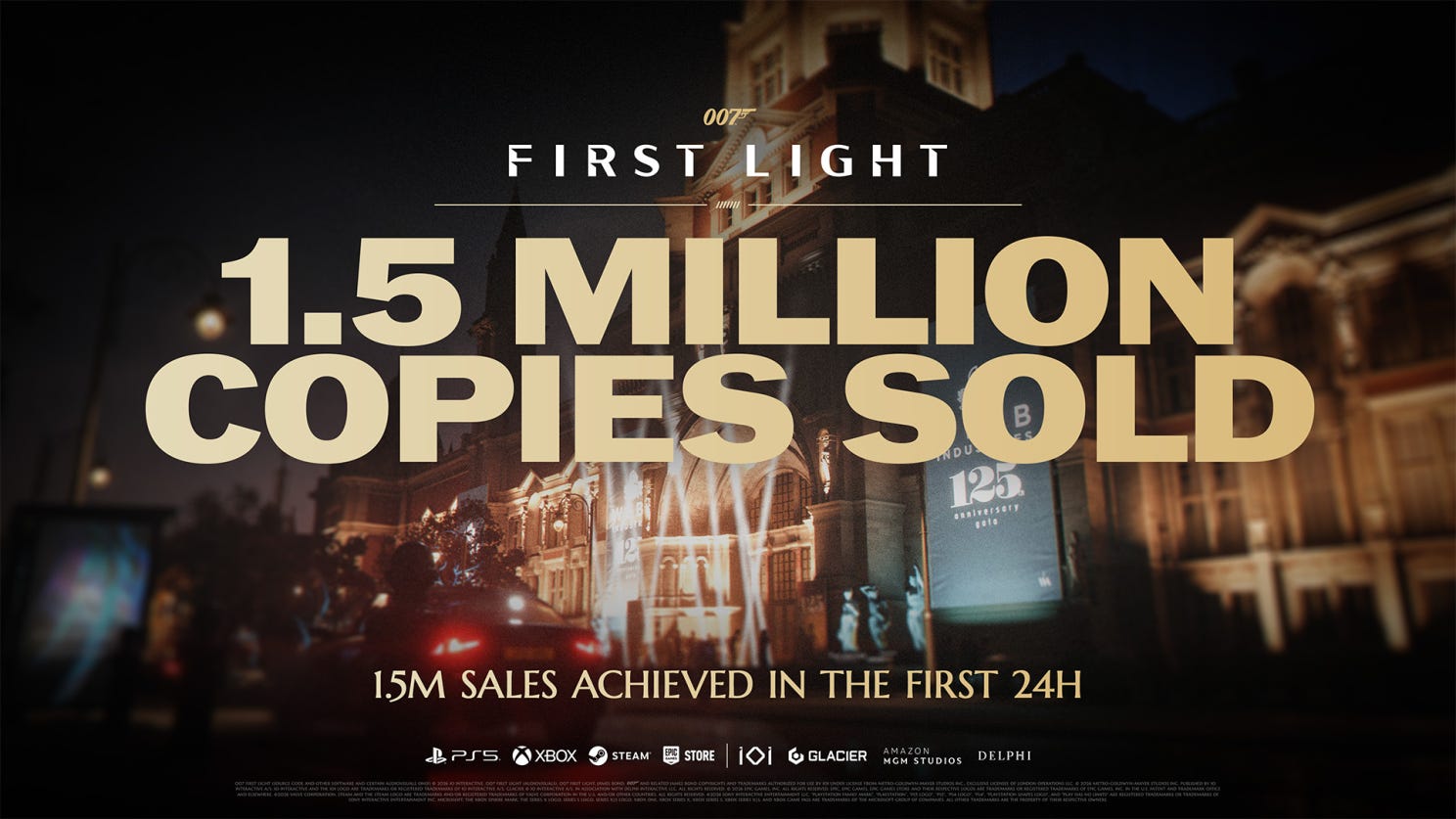
That brings me to Bond, briefly. IO Interactive came in at roughly 1.5 million in sales at launch, which lines up almost exactly with where I had it going in. Curious how the opening weekend rolls out from here, but the early read is sitting right inside the range I was projecting. As a paying customer, based on the last six months of my coverage, I’d guess IOI is rolling their eyes at me by now. A genuine shrug from my end... look, I’m a gamer, I bought your game with my own wallet, and I’m queued up to play it this weekend. Excited as ever to get into it.
That said, I do want to plant the flag one more time, because the launch read still holds. This game would have done meaningfully better had it not shipped into the shadow of Forza Horizon 6. The attention economy is zero-sum, there’s only so much oxygen in any given week, and Forza was a vortex pulling all of it into one room. Had Bond held its original March date, or moved into the empty June window I argued for in April, I’m very confident it breaks through at a materially larger scale given the reviews and everything else we’re seeing. It is what it is. And before anyone calls that Monday morning quarterbacking... it isn’t. We have the data. The case has been made many times now, and I’m not going to beat a dead horse on it here. Only so much attention to go around in any given week, and nothing in this market is immune to that math. Bond wasn’t. Batman either... which is the bridge into the rest of this week’s piece.
A few things on my mind this week... LEGO Batman and the broader Batman franchise, the Bungie news that’s been sitting on my chest for seven days, and a preview of the games I’m watching going into Summer Game Fest.
LEGO Batman: I Hate Being Right... And This Week, I Am
Let me move from the game I called to the other game I called... and this is the one I’d happily have been wrong on. I wanted LEGO Batman to break out. The data hasn’t been kind to that hope, and it genuinely bums me out, because the game itself deserves a much better launch than the calendar gave it.
Six weeks ago I wrote about the shadow effect... the attention tax every adjacent launch pays when two tentpoles land inside the same five-day window. LEGO Batman: Legacy of the Dark Knight was the cleanest pre-launch case study in the data at that point. Search momentum had been building nicely into May. Then Forza Horizon 6 and Subnautica 2 hit, and within a week LEGO Batman’s search volume compressed 27% week over week, with cumulative mindSHARE rank actually sliding backwards from 150 to 192 in a stretch where it should have been climbing aggressively into launch. That was the receipt going in. The launch read just landed on top of it, and it’s a miss against the only fair benchmark this game has.
Here’s where it sits. LEGO Batman launched at a 0.92% mindSHARE score. The only fair benchmark for a LEGO TT Games Ltd title is another LEGO TT title, and the cleanest one in the modern era is LEGO Star Wars: The Complete Skywalker Saga, which launched at 1.71% at the same point in the lifecycle. That comp matters here for two reasons. Skywalker Saga is the most recent TT LEGO release before this one, with a four-year gap between them and nothing in between. It’s also the closest thing we have to a Warner Bros. Discovery era LEGO comp, with one asterisk worth flagging... Skywalker Saga technically released three days before the WBD merger officially closed in April 2022. LEGO Batman is, in practical terms, the first TT LEGO title to launch fully under WBD’s tenure, four years in the making. That makes Skywalker Saga the benchmark by default, and against it, this is a 1.85x gap. A miss against the bar TT had earned for itself.
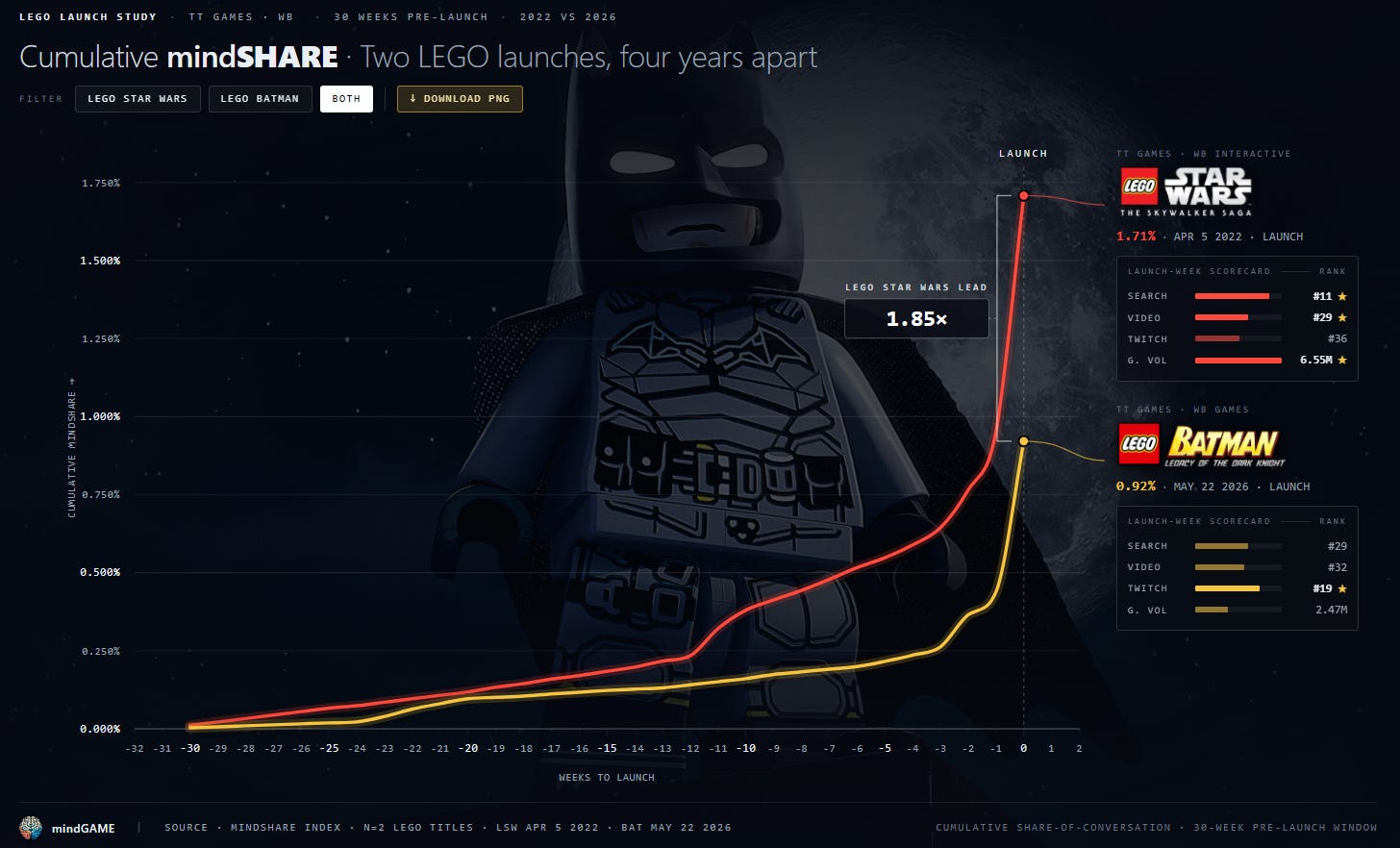
The channel split tells you why. On Search, the Google read, Skywalker Saga was ranked #11 globally at launch on the back of 6.55 million weekly queries. LEGO Batman ranked #29 on 2.47 million queries. The volume difference there is the more telling number... not the rank gap, the raw query gap. People weren’t looking for this game at anywhere near the scale they were looking for Skywalker Saga, and that’s the signal that actually matters when it comes to the broader audience showing up. Video, the YouTube read, was closer in absolute terms, with Skywalker Saga at #29 against Batman at #32, but Star Wars still finished on top. The one channel where Batman actually won was Streaming, the Twitch read, where LEGO Batman landed #19 against Skywalker Saga’s #36... and that’s a fun little win in its own right, because it tells you streamers showed up for the LEGO Batman bit specifically. Arkham-style combat, the rogues gallery, the silly takedowns, all of that is good streaming material. The broader audience just didn’t follow them in.
None of this changes what I actually think of the game itself, though. Let me get to that.
An Arkham Game For Kids
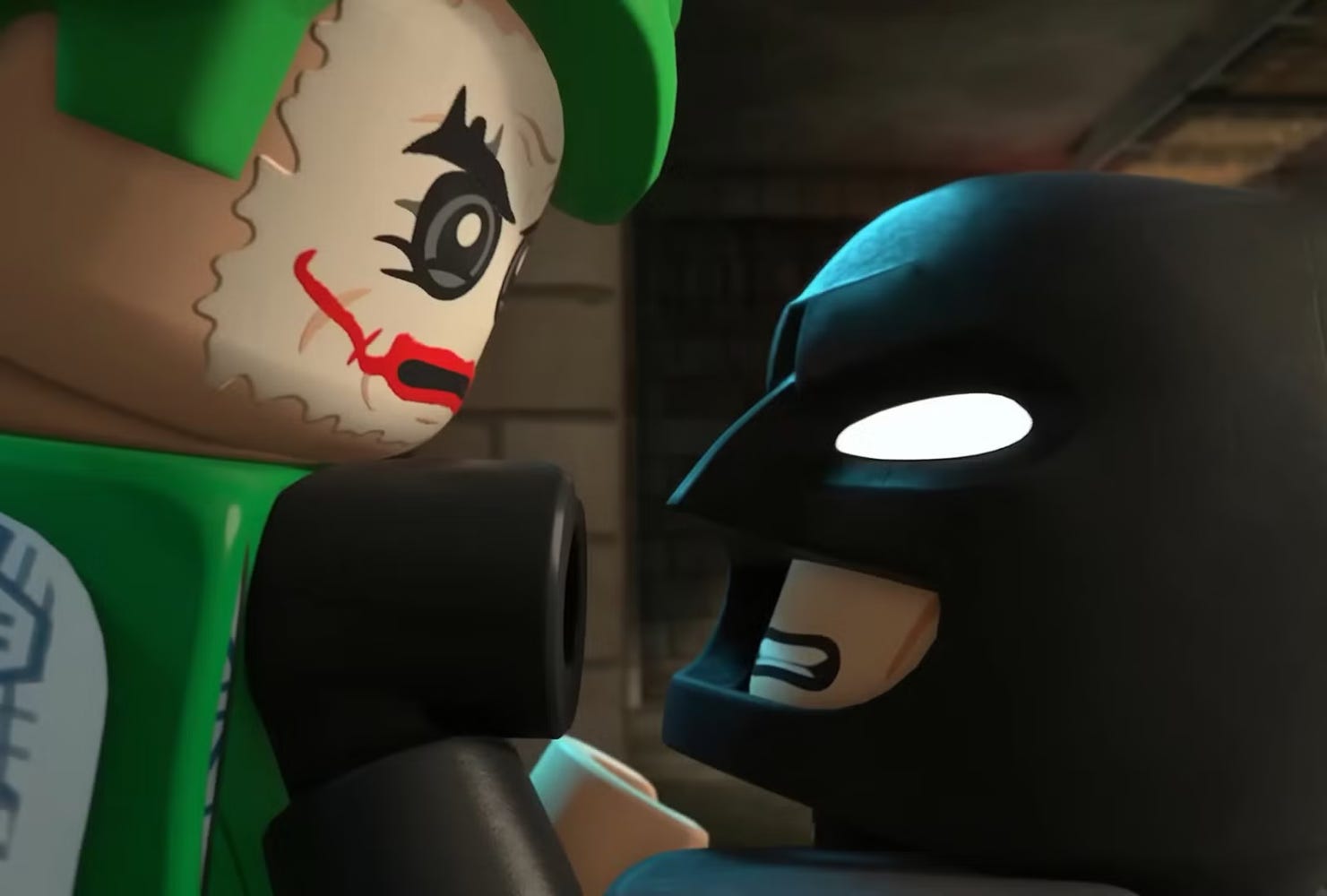
Greg Posner asked me on the Player Driven stream this week whether I’d actually played LEGO Batman with my son. Two answers... yes, absolutely, and yes, we love it. Let me separate my review from his, though, because they are honestly not the same review, and the gap between them is part of what’s worth writing about.
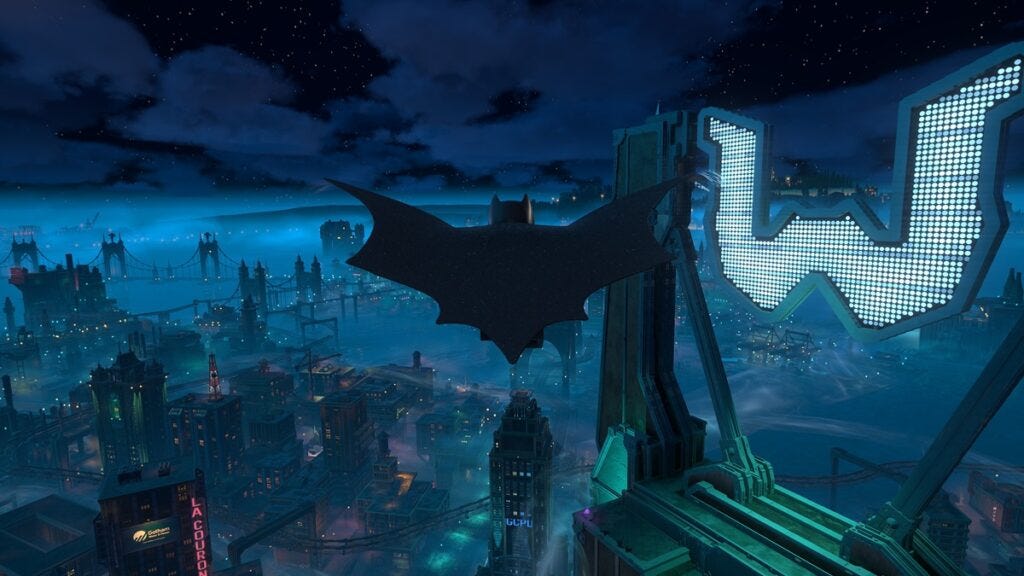
I think this game is outstanding. What TT pulled off, in the cleanest way I can put it, is an Arkham game for kids... stylistically, sure, that’s all over the marketing, but more importantly from a play perspective. One of my favorite stretches in the early hours is the onboarding into the League of Shadows. I’ll keep the spoilers to that opening sliver, but what TT is really doing there is teaching you the grammar of an Arkham game under the guise of a LEGO one, where your minifig takes a hit and bursts into a pile of bricks before respawning around the corner. You sneak around to break line of sight, the little question marks popping over enemy heads exactly like the Rocksteady games taught us. Climb to a perch and Arkham would call this an Inverted Takedown, the move where Batman drops down and leaves the guy dangling from the rafters as a warning to the rest of the room. Here, it’s a leap down, a clobber with a fish, and the guy goes face-first into the floor without anyone else in the room noticing.
That DNA is everywhere in this game, and it’s different by design. The whole thing oozes love letter from every pore... to Batman, to the Nolan films, to every cinematic and animated and comic version of the character that has ever existed. At the same time, TT is sanding the sharper Arkham edges down into something a six-year-old can actually hold, which I think is exactly the right call. The villains land the same way. You get a Ra’s al Ghul who reads as pure comic-book Ra’s, and a Ra’s who tips his hat to Liam Neeson’s take from Batman Begins, and both versions live happily in the same game. Movies, shows, comics, the whole canon... it’s all in here, and as a lifelong Batman guy, I adore it.
My Six-Year-Old’s Review
So did he like it? Short answer, yes. He’s been asking me to play every night this week, which is the only review that actually matters in our house. Greg and I got into the longer version on the Player Driven stream today, and what struck me most isn’t whether my son enjoys the game... it’s how differently he plays this one compared to what we did together with LEGO Star Wars: The Complete Skywalker Saga this winter.
This is a harder game than he’s used to. The control layout asks more of him than Skywalker Saga ever did... triangle for one thing, R1 for another, L1 for the next, grapple here, punch there, dodge into the moment. Six years old is right at the edge of where that kind of input complexity becomes a real lift, which means I’m playing this game with him, not next to him. The second controller comes out, I drive the harder stuff, and we work through it as a team. He’s picking up the rhythm faster than I expected, but it’s still nowhere near as breezy as Skywalker Saga was for him.
None of which is a bad thing in my book. He’s challenged, he’s engaged, he’s coming back for more. The bar he had to clear with Skywalker Saga was lower, and the bar here is higher, and I actually like that the game is pushing him forward as a player. That’s part of what good kids’ content does. But it also surfaces something bigger that I want to write about for a minute, because it’s been sitting in my head since we started playing.
Where Did Batman Go?

Here’s where this gets bigger than a video game. The shape of how my son plays LEGO Batman, the constant questions he asks me about who these characters are, the blanks he keeps filling in as we go... none of that is really about the game. It’s about Batman, the franchise, and what has happened to it across his entire little life.
Let me take a step back, because the picture this paints is bleak. Growing up, Batman was everywhere for me. Batman: The Animated Series defined the character for an entire generation of kids in the 90s. The Burton films, then the Schumacher run, then the Nolan trilogy. Justice League and the wider DC animated universe spinning off of all of it. The Arkham games arrived in 2009 and quietly redefined what a licensed superhero game could be. And then The LEGO Batman Movie in 2017, Will Arnett running an extended victory lap after The LEGO Movie hit. The wave carried clean through the mid-2010s, with no real gap between Batman projects that mattered. There was always something Batman to be talking about.
And then it stopped. The Arkham series finished its run with Arkham Knight in 2015 and never came back, despite Rocksteady still being there the whole time. Matt Reeves brought The Batman in 2022, and as good as that movie is, have you actually seen it? It’s incredibly dark, and not a kids’ movie under any honest definition. After that... nothing. No new mainline Batman game in the years since, unless you count Suicide Squad: Kill the Justice League, which featured Batman as a villain to be eliminated. That isn’t a Batman game. It’s the inverse of one.
Animated content has been thin too. The adult Harley Quinn show on Max is the rare exception, a great show, but emphatically not for kids. Same goes for The Penguin, the live-action prestige series in the Matt Reeves film universe... excellent, also not for kids. And honestly, if anyone reading Patch Notes can point me at kids’ Batman content I’m missing, please reach out, because I’ve been looking. My kids, in 2026, have basically two options. Bat-Wheels, the preschool Batman series that they tolerate more than enjoy. And LEGO Batman, the game we just spent the last several hundred words discussing. That’s the entire kids’ Batman shelf, and we have been Batman-starved for years.
Now compare any of that to what my kids have had with Spider-Man over the same window.
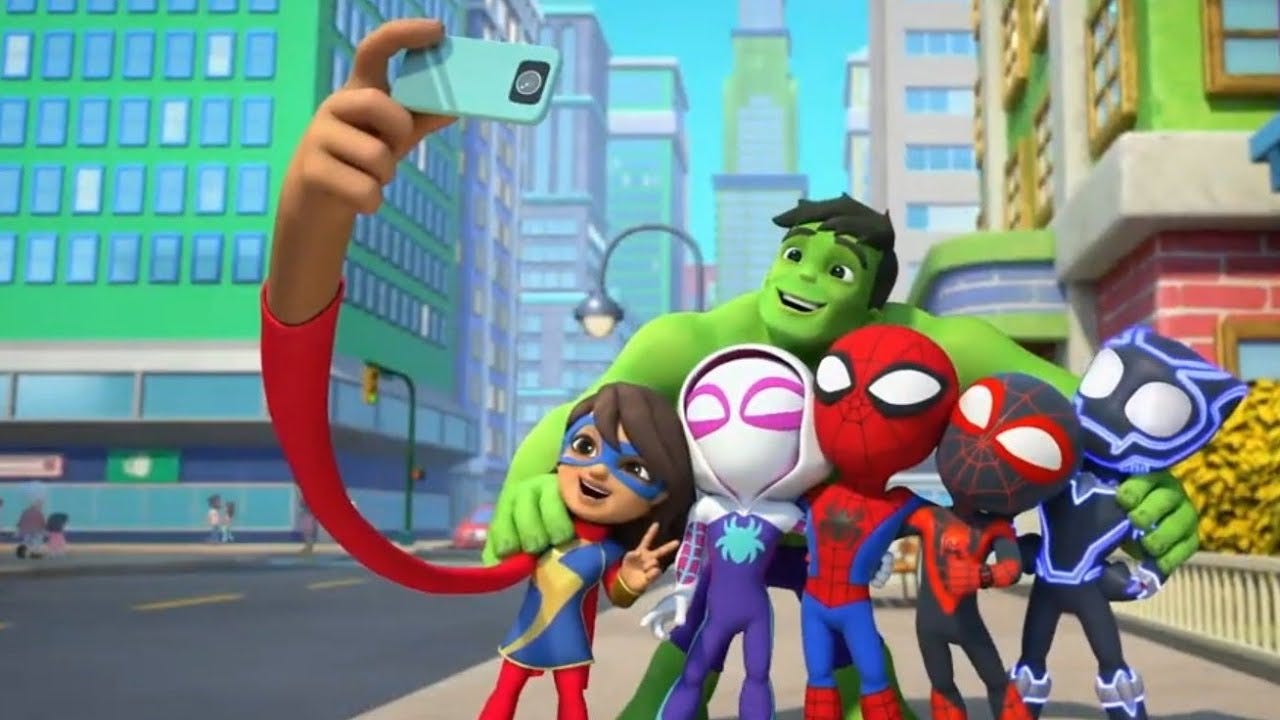
My son was born in 2019, my daughter in 2021. Across both of their entire lives, Spider-Man has been everywhere. They have watched the Spider-Verse films, all of them. The Tom Holland run has been a regular rewatch in our house, with No Way Home on heavy rotation and Brand New Day on the way this summer. Spidey and His Amazing Friends has been a constant since they were both old enough to point at a screen. And that’s just the film and TV layer. On the PlayStation side, the Insomniac run has dropped Marvel’s Spider-Man 2 and Marvel’s Spider-Man: Miles Morales squarely inside their lifetimes, with the original Marvel’s Spider-Man sitting on the shelf for whenever the older one is ready to discover it. So much Spider-Man, in other words. Across every screen, every platform, every entry point. A genuine generational flywheel running in real time.
Which is how LEGO Batman ended up becoming my son’s actual introduction to Batman the character. He asked me, dead seriously, partway through the opening hours... “Is Batman rich?” And I had to sit with the fact that he genuinely didn’t know. The rogues gallery is a blank slate for him too. He pointed at the League of Shadows beats and asked who the guy was. Penguin, same thing. He knows the Joker, barely, and the rest of the canon’s iconic villains are essentially strangers to him. What dawned on me, sitting next to him with the controller, is that this game is doing the job an entire ecosystem used to do. BTAS did that work for me when I was his age. The Burton films and the Nolan trilogy and the Arkham games and even the LEGO Batman Movie all did it for the generations between us. None of that exists for him right now. LEGO Batman is the only Batman he has.
A Hot Potato With A Cape
All of which loops straight back to the WB Games stuff I keep writing about. The reason Batman doesn’t have a coherent IP strategy right now is because Batman keeps changing owners. AT&T bought Time Warner back in 2018. The whole machine then got shuffled to Discovery, which merged with WarnerMedia in 2022 to form Warner Bros. Discovery. And now it’s mid-handoff again, this time to Paramount Skydance in the $110 billion deal that was confirmed in February and is expected to close later this year. None of those deals are the problem on their own... that’s just business. The downstream consequence is the problem.
Here’s the consequence in a single stat. Across the last half decade, TT Games has shipped exactly two LEGO games. This one, and LEGO Star Wars: The Complete Skywalker Saga. LEGO is one of the top-selling video game franchises in history, north of 200 million units across two-plus decades, and the output across the last five years amounts to two titles. Some of that is honest development time, particularly given how ambitious LEGO Batman: Legacy of the Dark Knight is. The rest of it is what happens when a crown-jewel relationship sits inside a conglomerate that can’t stop changing hands. No stability up top means no consistent output downstream, across LEGO, across Batman, across every IP that lives under the same corporate roof.
Why Does Every Game Have To Be Forever?
One last beat on this game before we move on, because it’s been bothering me in a different direction, and I haven’t fully worked it out yet.
As a completionist, I am going to disappear into LEGO Batman for the next several months. Hunting every brick, every unlock, every minifig, every easter egg buried across 86 years of Batman canon. This is, frankly, my kind of game. But my six-year-old is a different player with different needs, and for him this game is a lot. Maybe too much. Coming off The Complete Skywalker Saga together this winter and rolling straight into this one, the shape is unmistakable. This is built to be a forever game.
Somewhere along the way, every game became a hundred-plus-hour commitment, and I don’t fully know when that happened or why. The love letter I’ve been praising all section, the deep lore, the easter eggs stacked on easter eggs, the 100 unlockable suits across every era of Batman... all of that is wonderful for me, and it might be too much for the kid this game is ostensibly being made for. There’s a version of LEGO Batman that’s tighter, shorter, and easier to finish with a six-year-old. That version isn’t this game. This game wants to live with you for a year.
Maybe that’s the right call commercially, and maybe it’s the wrong one creatively, or maybe it’s just a thing I’m noticing for the first time now that I’m playing kids’ games with an actual kid. Part of me wonders if it’s tied to the broader industry puzzle... fewer games shipping, each one stretched to fill a 150-hour fantasy, all of them quietly competing with Roblox for the same infinite afternoon. If you can’t beat Roblox on hours, maybe you try to match it. I don’t know. There’s probably a future Patch Notes piece in here once I find the right angle.
And here’s where the forever-game thing turns from an abstract industry observation into something that has actually been hurting all week. Because while LEGO Batman is the new forever game in my house, my actual forever game just got told this week that it doesn’t get to be forever anymore. After more than a decade as the live game I always knew I could come back to, the one that lived alongside my Twitch years and everything that came after as a quiet constant in the background... Bungie announced seven days ago that development on Destiny 2 is ending. It has hurt in a way I haven’t felt about a franchise in a long time.
So let me get into it.
Bungie Has Outlasted Every Owner It Ever Had... This Time It Might Not Outlast Itself
I Have Been A Bungie Lifer Since The LAN Party Days
Let me start with where this comes from, because this one is personal in a way most of what I cover is not.
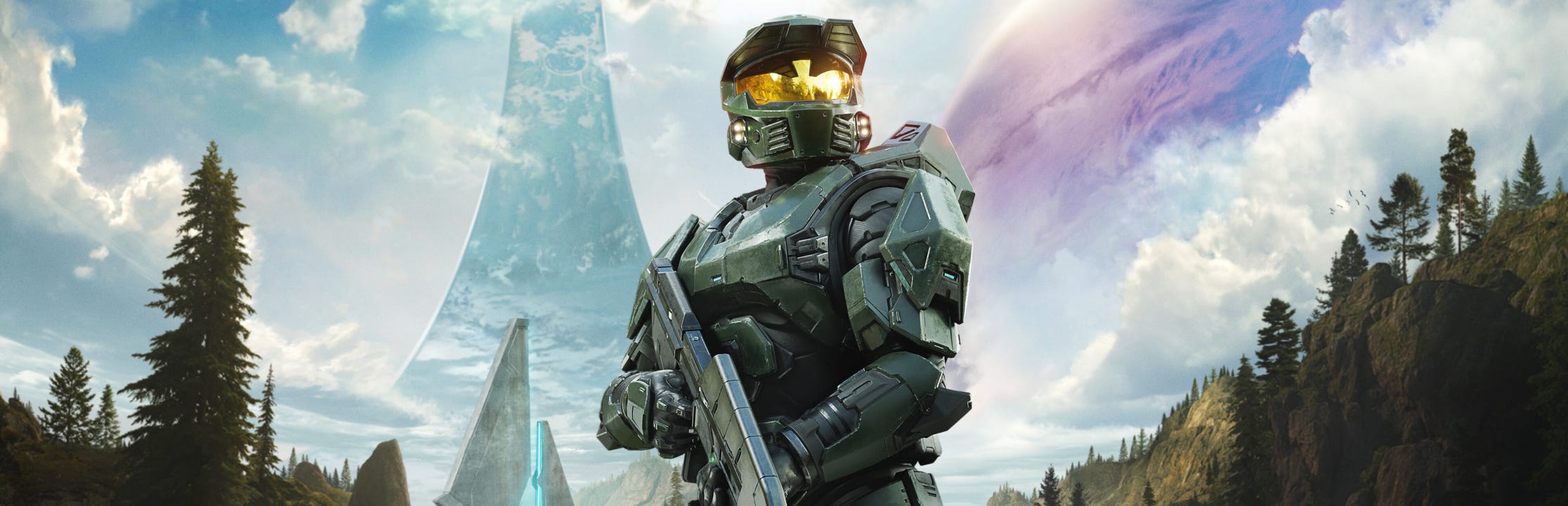
I got into Xbox the same way a lot of people my age did. Halo. I put thousands of hours into Halo: Combat Evolved and Halo 2 as an undergrad, and to this day Halo 1 is the greatest LAN party game ever made, no contest. My college roommates and I would set up in the dorms and run Blood Gulch for hours, then square off against other squads across the dorm LAN, talking trash the whole way. Those guys are lifelong friends now, and that game is a big part of why. Outside of GoldenEye, Halo is the franchise that made me a shooter player in the first place.
So I followed Bungie everywhere after that. Halo 2 I played into the ground. Halo 3 I loved. Halo Reach might be my favorite Halo outside of the first two, and to me that whole stretch is the golden era of the old Bungie. When Bungie handed Halo off and walked away, I think the franchise got materially worse... I have never warmed to the first couple of Microsoft-era Halo games, and even the most recent one I would call fine at best, nowhere near the bar Bungie set. So when the studio left to build something new, I went with them. Whatever they made, I was going to play it.
What they made was Destiny. My honest memory of vanilla Destiny is that the game was good but the loop was simple, almost boring, and I kept playing anyway because it was Bungie. Then I hit the Vault of Glass. I started running LFGs, grinding the raids and the Nightfalls, and that is what turned Destiny from a game I was politely finishing into a game I genuinely loved. The raids were the hook. They were always the hook.
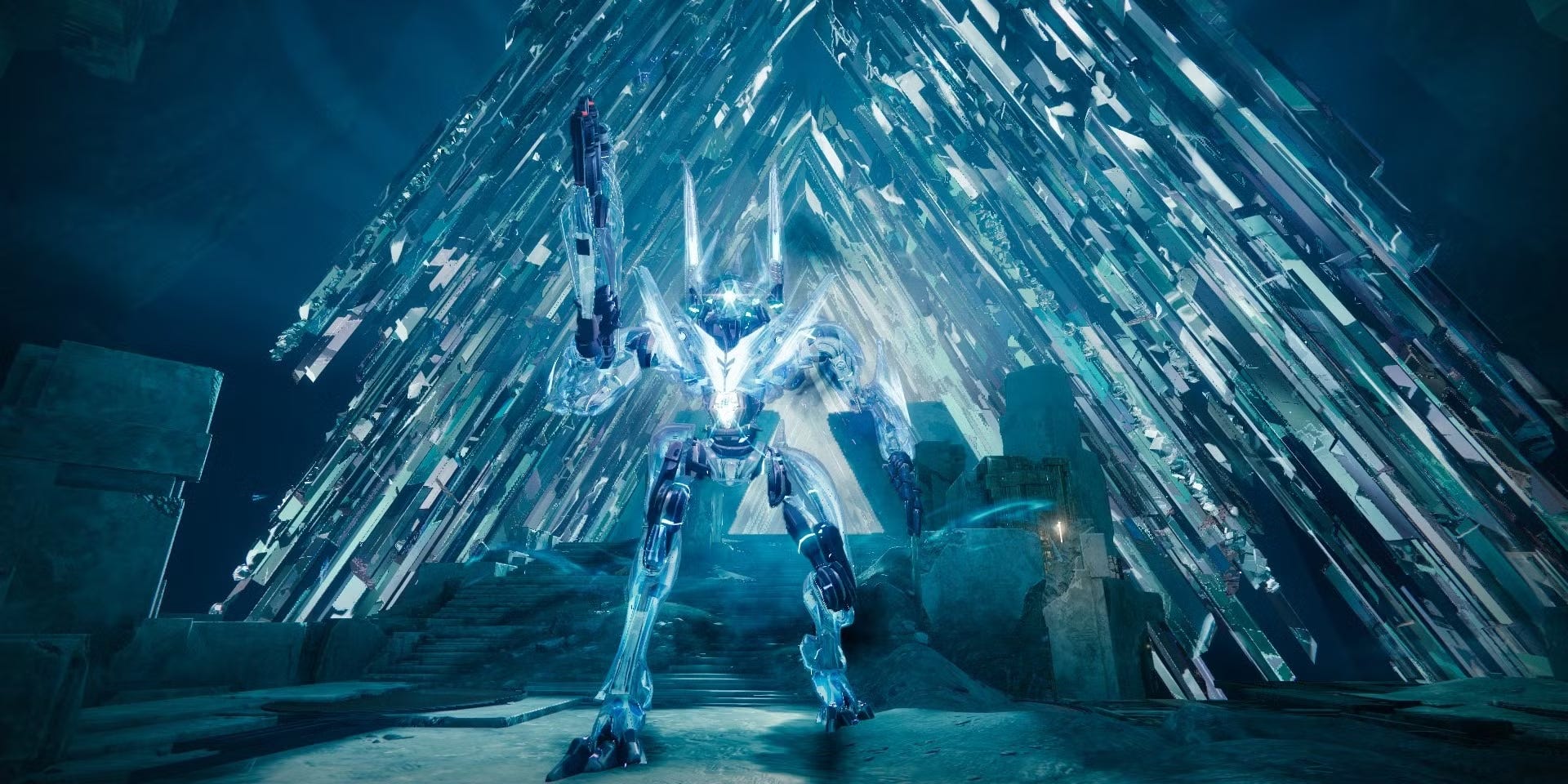
That hook ended up shaping my actual life. When I joined Twitch, the way I bonded with my new teammates was Destiny. I brought it up in my interview, told them I was a die-hard Destiny player, and we spent fifteen or twenty minutes just talking about the game before the actual interview started. Destiny broke the ice on a job that changed my career. For years after that, it was a fixture. My peak Destiny moment was The Taken King... I adored that expansion, Oryx, the whole storyline, all of it. I ran King’s Fall religiously, every single weekend, fighting Oryx with a raid group I assembled out of LFGs. After I got married, I had a routine. Saturday and Sunday mornings, six to nine, I raided, then went about my weekend. That was the rhythm of my life for a long stretch of the 2010s.
Destiny 2 carried it forward. I went all in on the big expansions, and Forsaken was the peak of that second chapter for me... that raid, the Dreaming City, everything they layered into that world. I used to joke the Dreaming City was the Night Elf corner of the Destiny universe, and I meant it as the highest compliment. Then life got in the way. Family, work, all of it. I became a famously lapsed Destiny player, the guy who follows the game lovingly from a distance but cannot find the runway to get back in. By the time I heard how good The Witch Queen was, too much had happened for me to onboard cleanly, and that gap is exactly why I have argued for years that a Destiny 3 was the obvious move... a clean re-entry point for the millions of us who fell off but never stopped loving the IP. Then The Final Shape landed as the natural endpoint to a decade of story, and I always assumed Destiny 3 was next. It wasn’t. And here we are.
So understand the lens going in. I am not coming at this as a neutral analyst. I’m writing as someone who loves this IP, who built real friendships inside it, and who is genuinely bummed it is ending this way.
The First Marriage: Microsoft Saved Bungie, Then Couldn’t Hold It
To understand why Destiny is ending the way it is, you have to go back to how Bungie behaves when somebody owns it. The pattern is older than Destiny, older than Halo even, and it starts with a company that was nearly dead.
By 1999, Bungie was in trouble. The studio had shipped Myth II: Soulblighter the previous November with a catastrophic bug... an uninstaller that, instead of removing the game, could wipe the entire contents of whatever directory it was installed in. Bungie recalled all 200,000 copies and replaced the discs, a fix that cost the company roughly $800,000 it did not have. Cash-strapped and scrambling, the studio brought in executive vice president Peter Tamte to find money. Take-Two Interactive stepped in first, taking a 19.9% equity stake and grabbing North American distribution rights to four Bungie titles, Halo and Oni among them. That stopgap kept the lights on, but it didn’t solve the deeper problem, which was that Bungie was a small independent studio trying to build something the size of Halo without the size of company to fund it.
Enter Ed Fries, head of Microsoft Game Studios, who was staring down a different problem entirely. Microsoft was about to launch the original Xbox and had no killer app to anchor it. Tamte called Fries about an acquisition, and the timing was perfect for both sides. On June 19, 2000, Microsoft announced it had acquired Bungie outright, buying out Take-Two’s 19.9% stake in the process, in a deal the Wall Street Journal later reported analysts valued at $20 million to $40 million. Take-Two walked away with the Myth and Oni properties. Microsoft walked away with Halo and the team that was building it. The strategic logic was naked... Microsoft needed a system-seller, and Bungie’s unfinished project became Halo: Combat Evolved, the launch title that turned the Xbox from a long shot into a real console. Halo: Combat Evolved sold over eight million copies. It is not an exaggeration to say Bungie saved the Xbox.
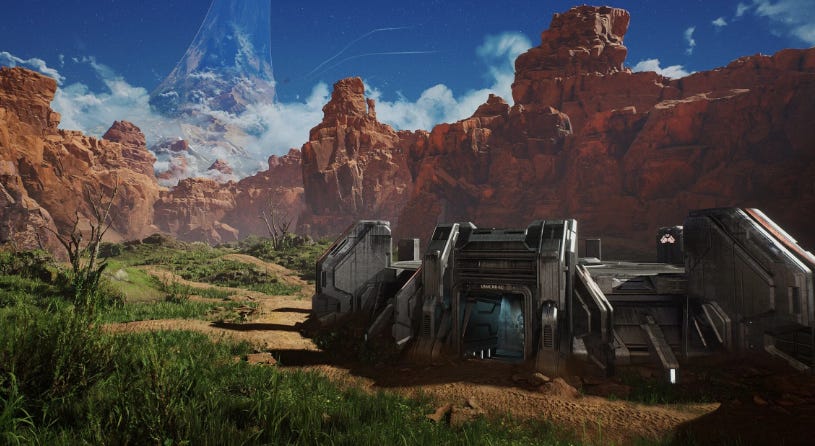
Here is where the pattern announces itself. Even inside the company that rescued it, Bungie spent the entire relationship resisting the embrace. Steve Haske’s oral history of Halo for VICE, which is the best single document of this era and which I leaned on heavily this week, is wall-to-wall with the friction. Microsoft tried to put Bungie in standard private offices, the closed-door programmer-centric layout the company ran on, and Bungie refused, demanding open cubes so they had to tear the walls back out. The studio was placed down the hall from the Encarta team, and as Marty O’Donnell put it, you could not have found two more diametrically opposed cultures in one building. Microsoft employees would wander through Bungie’s space like it was a zoo exhibit, and it got territorial enough that a Microsoft keycard wouldn’t open Bungie’s doors. The team physically towed Microsoft cars out of its parking lot. None of this was an accident. It was identity, and Marcus Lehto, the art director who designed Master Chief, named it for what it was.
“It was just our default approach to put up a giant iron wall to protect ourselves and what we thought was our culture, which we saw as eroding.” — Marcus Lehto, Halo art director, on the Microsoft years (VICE, “The Complete, Untold History of Halo,” 2017)
The work itself was brutal in a way that would echo through everything Bungie touched afterward. Halo 2, the game that launched Xbox Live and defined online console multiplayer, nearly broke the studio making it. The team cut the entire third act. The ending shipped as an abrupt cliffhanger that O’Donnell still calls one of the worst in video game history, and the crunch behind it left scars. Mission design lead Paul Bertone did not mince words about how the sequel came together.
“It was basically a death march to the end. Nobody will say anything different, and if they do they’re just trying to sugarcoat it.” — Paul Bertone, Halo 2 design lead, on the final stretch of development (VICE, 2017)
That phrase, “this is such a typical Bungie story, as it happens over and over again,” is O’Donnell’s, and it is the thing to hold onto. Overreach, crunch, a near-death scramble, then a hit pulled out of the fire at the last second. The studio has run that loop its entire life. It ran it on Halo, it would run it on Destiny, and it is, in a slower and sadder register, running it right now.
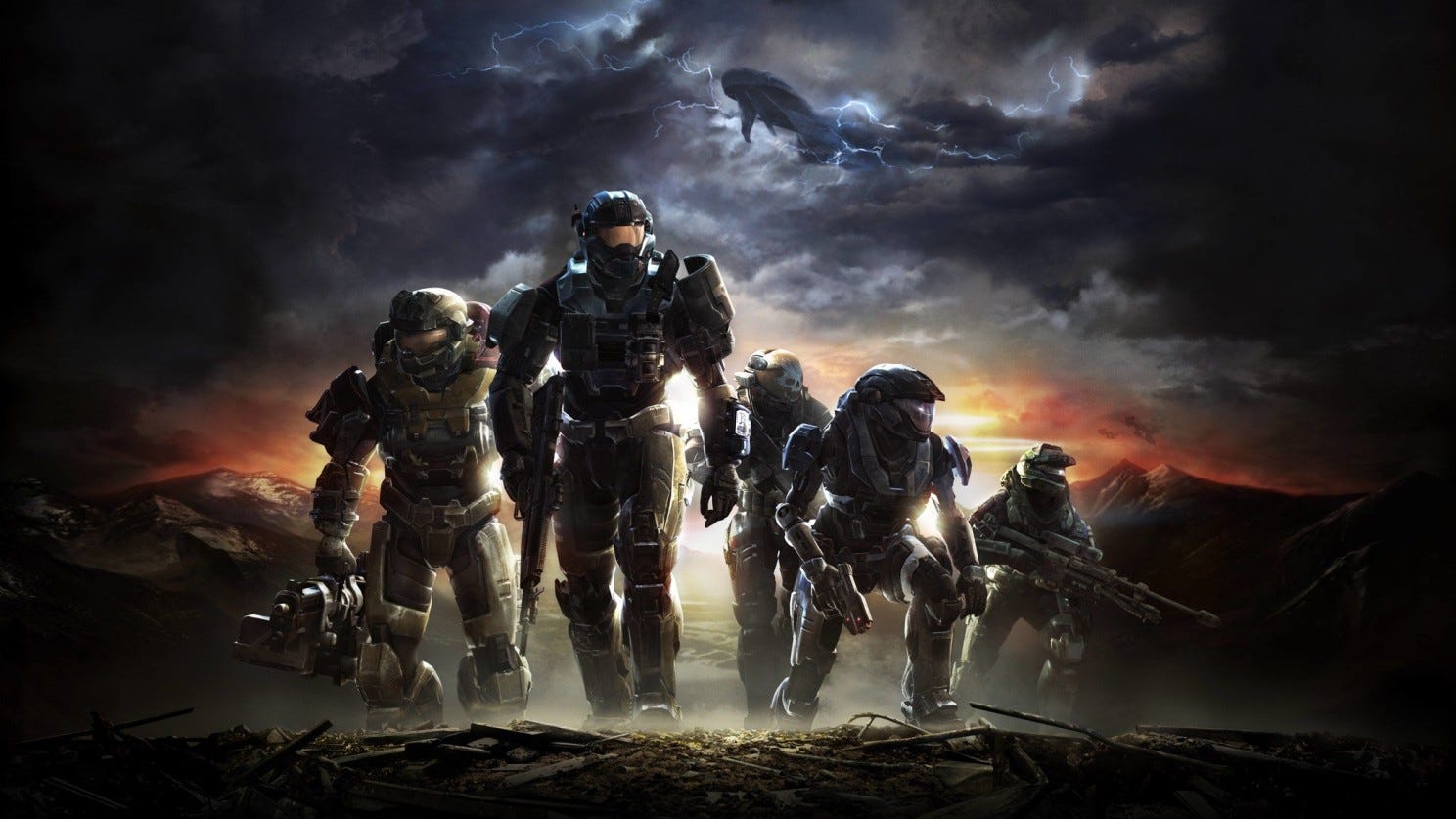
By 2007, with the original Halo trilogy complete, Bungie wanted out, and the timing made the move almost absurd. The studio announced its independence on October 5, one week after Halo 3 launched to more than $300 million in sales, one of the biggest game launches the industry had ever seen, with the franchise on pace to clear a billion dollars in total sales by year’s end. Bungie walked at the absolute peak. Microsoft kept the Halo IP and an undisclosed minority stake in its newly freed studio. The official line from Redmond strained to call it anything other than what it was.
“This is not a divorce. This is the best way for us to pursue a long-term relationship with Bungie.” — Shane Kim, head of Microsoft Game Studios, October 2007 (Wall Street Journal)
It was a divorce. The 113 developers in that unmarked Kirkland building got their freedom back, and Bungie said so in its own voice that Friday morning, posting to its Weekly What’s Update that the company had long been built on creativity, originality, and the freedom to pursue ideas.
“Microsoft agreed, and rather than stifle our imagination, they decided it was in both our best interests to unleash it.” — Bungie, Weekly What’s Update, October 2007 (via the Seattle Times)
Read those two statements next to each other and you have the whole dynamic in miniature. Microsoft insisting it was not a divorce, Bungie all but describing a jailbreak. Sit with the full picture for a second. The studio walked away from the single most valuable thing it had ever made, the franchise that still prints money for Microsoft today, one week after handing them a record-breaking hit, because staying owned was the worse outcome. That is the first divorce, no matter what Shane Kim wanted to call it, and it tells you everything. This studio would rather give up Halo than give up itself.
The Second Marriage: Activision Bankrolled The Dream Bungie Couldn’t Afford Alone
Freedom is expensive. Bungie left Microsoft with its independence and its culture intact, but it also left without the franchise that had funded everything, and it carried ambitions far bigger than its bank account. The studio wanted to build a shared-world shooter on a scale nobody had attempted, a ten-year living universe, and Pete Parsons, then COO, framed the ambition in terms that now read as almost unbearably optimistic. He told Kotaku the goal was for people to put Destiny “on the same shelf they put Lord of the Rings, Harry Potter or Star Wars.” That kind of swing needs a publisher with deep pockets. In April 2010, Bungie found one, signing a ten-year exclusive publishing deal with Activision.
The terms were staggering for the era. Activision committed a reported half a billion dollars across the life of the agreement, bankrolling development and marketing in exchange for the publishing rights, while Bungie, crucially, retained ownership of the Destiny IP itself. The deal also bound Bungie to something it had never done... a fixed, annualized release cadence, the same machine that drove Call of Duty to print money every single November. IGN’s Ryan Geddes caught the strangeness of the pairing the week it was announced, calling it “a harsh juxtaposition of fierce independence and perceived corporate monstrosity.” That tension never went away. It just went quiet while the money flowed and the dates held.
The Honeymoon: Destiny Stumbled, Then The Taken King Saved It
Then the work started to buckle under the calendar, and the most revealing account of how badly comes from Jason Schreier, whose reporting on Destiny’s development for Kotaku remains the definitive teardown of what went wrong. In the summer of 2013, roughly a year before launch, Bungie went into panic mode. Project lead Jason Jones and senior leadership were unhappy with the story that writing lead Joe Staten and his team had spent years building, deeming it too linear and too much like Halo, and Jones issued an edict that gutted the project from the inside.
“Starting now, Jones told the studio, they were going to rewrite Destiny’s story from scratch.” — Jason Schreier, “The Messy, True Story Behind The Making Of Destiny” (Kotaku, 2015)
Staten, O’Donnell, and others pushed back hard, warning there was no feasible way to reboot a story this late, but the decision held. The team scrapped plot threads, overhauled characters, and stitched what remained into a game that shipped, by the accounts of six people who were there, as a kind of Frankenstein. Staten left Bungie not long after. The deeper rot was structural, and one developer traced it to the exact thing the Activision deal had imposed.
“A lot of the problems... are the results of having an unwavering schedule and unwieldy tools.” — A Bungie developer, on Destiny’s development (Kotaku, 2015)
Here is the strange part. None of that stopped Destiny from becoming a phenomenon, at least on the balance sheet. When it launched on September 9, 2014, Activision moved more than $500 million of the game into retail and first-party channels on day one, recouping its entire reported development investment within twenty-four hours and crowning Destiny the biggest new franchise launch in industry history. Bobby Kotick told investors the game was on track to become Activision’s next billion-dollar brand. The commercial story and the critical story, though, were two different things. Reviews were mixed, fans openly mocked the threadbare narrative, and the gap between Bungie’s Lord of the Rings ambitions and what actually shipped became the defining frustration of the game’s first year. Destiny sold like a hit and reviewed like a disappointment, which is its own kind of pressure.
What happened next is the part that made me fall in love with the game, and it is the part that matters most for understanding what Bungie can do when the work comes together. In September 2015, Bungie shipped The Taken King, the expansion that retroactively fixed Destiny. It rebuilt the progression, deepened the endgame, and gave the world the narrative spine it had been missing, with King’s Fall standing as one of the finest raids the studio has ever designed.
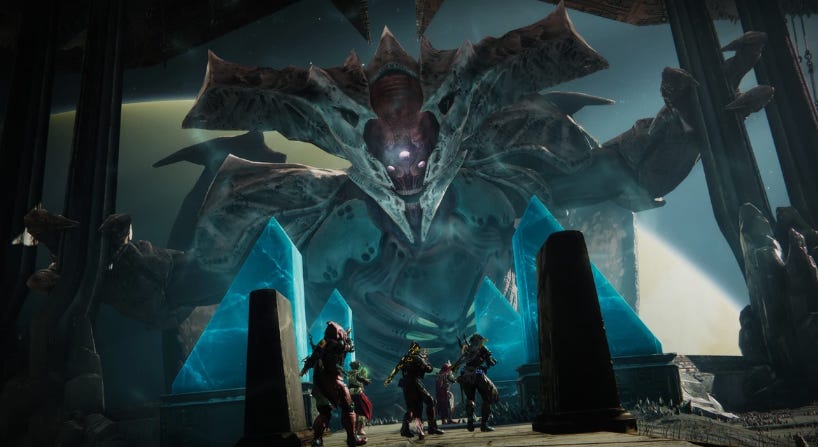
The numbers backed up the redemption, and Activision did not hide its enthusiasm. The company’s Q3 2015 results, filed that November, laid out just how big the bounce was.
“Day-one downloads broke PlayStation records, day-one engagement saw the highest number of active players in Destiny’s history... and the Destiny community has climbed to over 25 million registered players.” — Activision Blizzard, Q3 2015 results (SEC 8-K filing, November 2015)
The lift wasn’t confined to Destiny. The Taken King helped power Activision Publishing to its highest-ever third-quarter non-GAAP operating income, with company-wide monthly active users up 17% year-over-year and record Q3 digital revenue of $697 million. By the time Activision closed the books on the year, daily engagement had climbed north of three hours per player, and the studio’s 25 million-plus users had logged nearly three billion hours inside the world Bungie built.
Then there is the detail that matters enormously for where this story eventually lands. Buried in that same filing, Activision noted something about where all those players were gathering to watch.
“Since its launch, Destiny has become the most watched console game on Twitch.” — Activision Blizzard, Q3 2015 results (SEC 8-K filing, November 2015)
Hold onto that line. Destiny was not just a game people played, it was a game people performed, a world that lived on streams as much as on consoles, and that fact will close this entire section years later in a way nobody at Activision could have scripted in 2015. The machine worked when Bungie was allowed to make the thing it actually wanted to make.
That lesson carried, unevenly, into Destiny 2.
The Cracks: Destiny 2 Recovered, Then Activision Let It Go
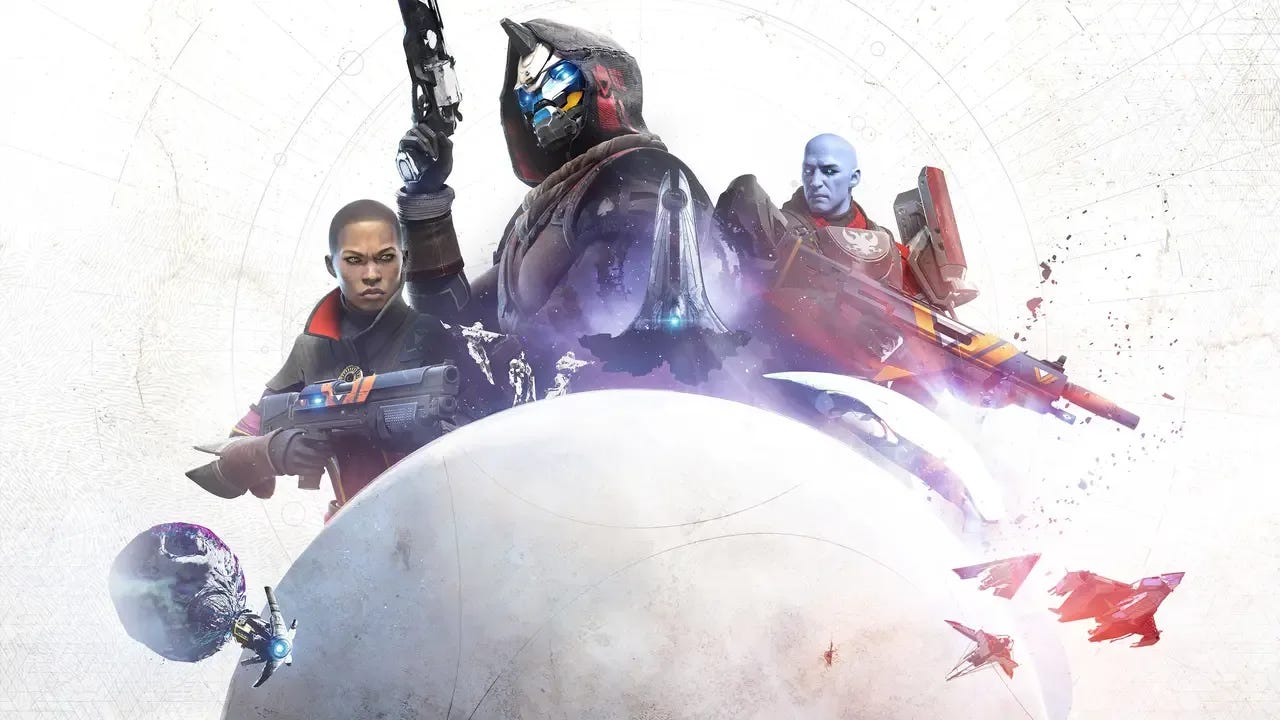
Destiny 2 launched in September 2017 as a deliberate course correction in the opposite direction. Where the first game had been too obscure and grind-heavy for newcomers, the sequel streamlined everything, stripping out the esoteric systems and resetting every character to zero in a bid to pull in the widest possible audience. Commercially, it worked out of the gate. Destiny 2 was the best-selling console game in the U.S. year-to-date that fall, outsold the original, and delivered the biggest PC launch in Activision Publishing’s history. Critically, it reviewed better than Destiny 1.
The hardcore hated it. The streamlining that courted new players gutted the depth the dedicated community had spent three years learning to love, and the population that had logged those three billion hours felt abandoned. Bungie spent the next year doing what Bungie does, tearing the game back down and rebuilding it mechanic by mechanic, and the effort culminated in September 2018 with Forsaken, an expansion that once again represented the studio at its best. Forsaken was rapturously received. It restored the grind, deepened the endgame, and brought the lapsed faithful home.
This is the exact moment the marriage detonated, and the detail that makes it so revealing is that it broke at a creative high, not a low. On its November 2018 earnings call, with Forsaken winning back the community, Activision told investors the expansion had not hit its financial targets. COO Coddy Johnson put it in the careful language of a company managing analyst expectations.
“We have not yet seen the full core re-engage in Destiny, which has led to the underperformance against expectations to date.” — Coddy Johnson, Activision COO, Q3 2018 earnings call (via Kotaku, November 2018)
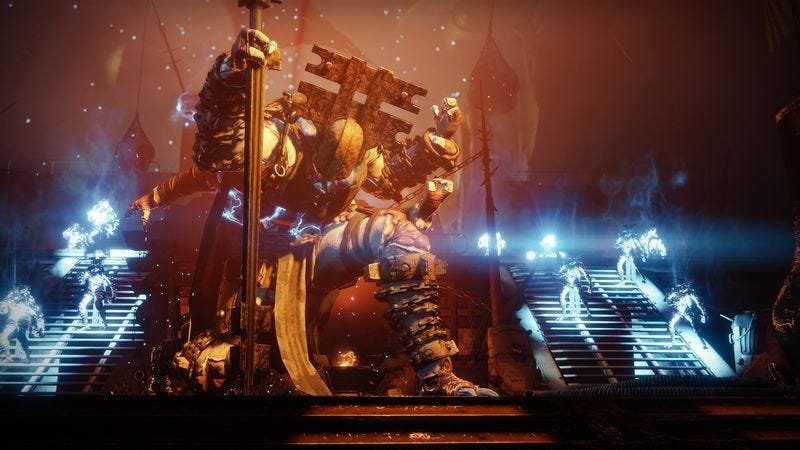
The framing landed badly, and not just inside Bungie. Activision was calling a beloved expansion a disappointment while signaling to Wall Street that the fix would be faster content and new forms of monetization, which read to players as a threat to jam more aggressive microtransactions into a game they had just fallen back in love with. The numbers, for what it is worth, were hardly a flop in absolute terms. Forsaken drove more digital revenue in its launch month than anything else on the market, and Destiny 2 had been the third best-selling game of 2017. The problem was never that Destiny sold badly. The problem was that it did not sell like Call of Duty, and an annualized publisher with sky-high expectations had no other way to grade it.
Then Bungie did something it almost never does. It fought back in public. Destiny director Luke Smith answered the earnings-call framing directly, on Twitter, refusing to let his team’s work be branded a failure.
“We are not disappointed with Forsaken. We set out to build a game that Destiny players would love, and at Bungie, we love it too.” — Luke Smith, Destiny franchise director, November 2018
Community manager David “DeeJ” Dague piled on with his own pointed bit of shade, tweeting about fond memories of the adventures Bungie had shared with Activision at events around the world, the kind of warm farewell language you only use when you have already decided you are leaving. Reading it now, the subtext is obvious. Bungie was done.
The Divorce: Bungie Bought Back Its Freedom, Activision Booked A Profit
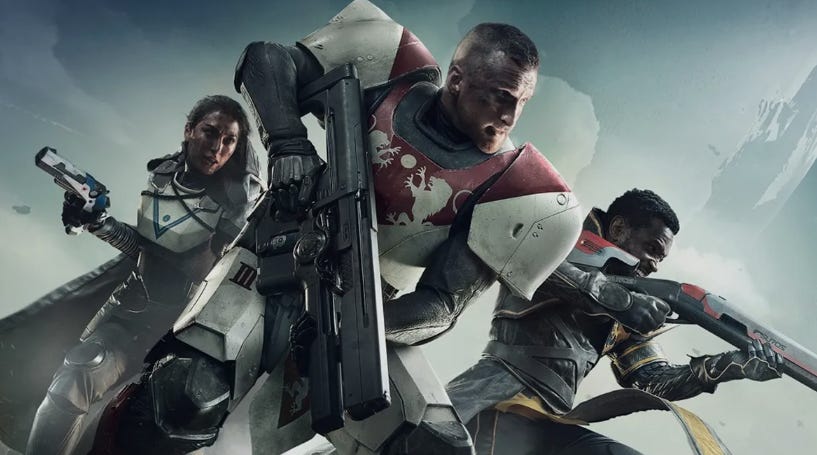
The breakup, when it came, was set up months in advance by a lifeline from an unexpected direction. In June 2018, the Chinese gaming giant NetEase invested more than $100 million in Bungie, taking a minority stake and a board seat, with the stated goal of helping the studio build new worlds beyond Destiny. At the time, Pete Parsons went out of his way to insist Activision remained a great partner. In hindsight, the money looks like exactly what it turned out to enable... a war chest big enough for Bungie to buy its own freedom.
On January 10, 2019, it did. Bungie announced it was splitting from Activision and taking Destiny with it, assuming full publishing rights for a franchise that had, by then, sold over 50 million games and expansions. The official statements were gracious, thanking Activision for an eight-year run, but nobody covering the industry mistook the tone. Jason Schreier, reporting the split for Kotaku, cut straight to what it actually was.
“This has been coming for years. Activision and Bungie have had a rocky relationship since before Destiny 1 even shipped.” — Jason Schreier, on the Activision split (January 2019)
What happened inside Bungie’s offices when the deal closed tells you everything about how the studio felt to be free. According to Schreier’s reporting, employees cheered and popped champagne.
“Employees cheered and popped champagne, according to one person who was there.” — Jason Schreier, “Bungie Splits With Activision, Keeps Destiny” (Kotaku, January 2019)
The terms of the exit were as telling as the celebration. In a later SEC filing, Activision disclosed that it had agreed to transfer the Destiny publishing rights back to Bungie in exchange for cash and Bungie assuming Activision’s ongoing customer obligations, and that the termination let Activision recognize $164 million in GAAP revenue, $20 million in net bookings, and $91 million in operating income for 2018. Read that again. Activision booked a profit on the way out the door, walking away from a franchise it had just spent years complaining about, while Bungie, likely drawing on that NetEase money, paid to reclaim the thing it had built. Activision got to call the divorce a win on its balance sheet. Bungie got to call it freedom. Both were right.
So here is where we stand before Sony ever enters the story. Twice now, Bungie had been handed to a corporate giant, and twice it had clawed its way back out with the thing it cared about most intact. With Microsoft, it kept its culture and surrendered Halo. Against Activision, it kept Destiny and surrendered the publisher. Each divorce left the studio leaner, freer, and somehow stronger than before, and each one followed the same arc Marty O’Donnell named a decade earlier... overreach, crunch, a near-death scramble, then a triumphant escape at the last second. That track record is precisely why the Sony deal looked, at the time, like the one that might finally work.
When Sony came calling in 2022, the question was never whether Bungie could survive another owner. It always had. The real question, though it would take four years and a $3.6 billion price tag to surface, was what happens when a company built to escape its owners finally signs with one it cannot leave.
The Third Marriage: Sony Bought The One Thing Bungie Could Never Outrun
On January 31, 2022, Sony Interactive Entertainment announced it was acquiring Bungie for $3.6 billion, a number that closed a few months later at roughly $3.7 billion after adjustments. Read the structure of that deal closely, because it is the whole story in miniature. Sony was buying 100% of Bungie’s shares, but nearly a third of the total, around $1.2 billion, was not purchase price at all. It was retention money, deferred payments to the employee-owners of a private studio, structured to vest over several years and conditional on those people staying.
That detail matters because it tells you what Sony was actually worried about. Bungie had walked away from Microsoft. Bungie had walked away from Activision. The single biggest risk in buying a studio with a two-for-two record of escaping its owners was that the talent would simply leave, so Sony built a $1.2 billion golden handcuff into the deal and called it an incentive plan. Everyone involved understood the history. The price tag was, in part, a bet that money could buy the one thing no previous owner had managed to secure... Bungie staying put.
The public framing leaned hard on independence, the word Bungie had organized its entire existence around. In the official statement announcing the deal, Parsons sold it as a partnership that would protect the very thing every prior owner had threatened.
“In SIE, we have found a partner that fully supports us and wants to accelerate our vision... all while valuing the creative independence that is the heartbeat of Bungie.” — Pete Parsons, Bungie CEO and Chairman, acquisition announcement (January 31, 2022)
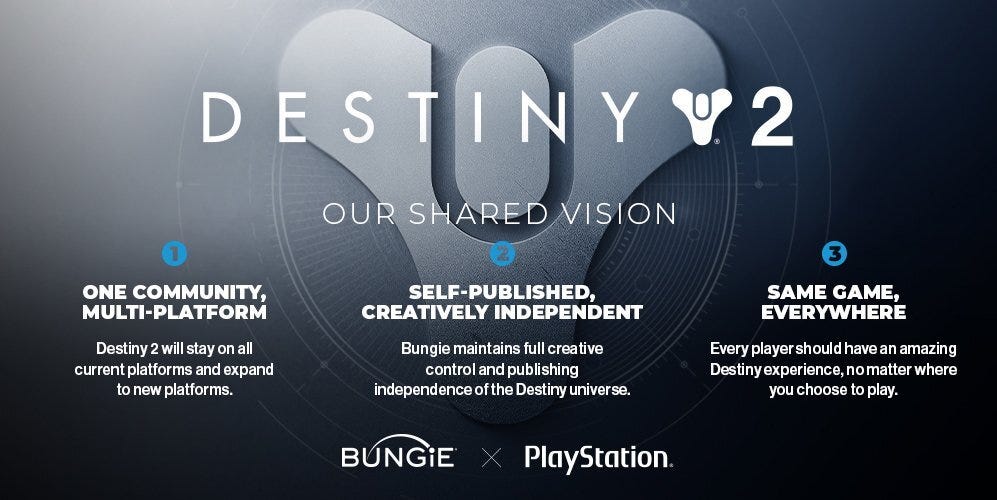
Bungie’s own FAQ doubled down, promising fans the studio would stay self-published, creatively independent, and committed to one unified community across every platform, Xbox included. And in a detail that reads as almost unbearable in hindsight, Bungie leadership reportedly assured employees, per the Washington Post, that the Sony deal would not result in layoffs or restructuring.
What Sony was really buying, underneath the Destiny franchise, was expertise. PlayStation had spent a generation as the home of cinematic single-player blockbusters, and it had watched the industry tilt toward live service, toward the persistent, monetized, years-long online worlds that Bungie had spent a decade mastering with Destiny. Sony had committed to launching more than ten live-service games before March 2026, and Bungie was meant to be the teacher. CFO Hiroki Totoki said so directly on the earnings call announcing the deal.
“Our studios will learn from Bungie, that is a strong wish we have... the Bungie side is willing to work closely with us.” — Hiroki Totoki, Sony CFO, FY2021 Q3 earnings call (February 2022)
Jason Schreier, reporting for Bloomberg, read the move for exactly what it was, framing the acquisition around Sony’s subscription and service ambitions rather than the Destiny franchise itself, the same live-service pivot I broke down in my piece on PlayStation’s quiet long-game strategy. The logic was sound on paper. Buy the best live-service operator in the business, then let it tutor a first-party portfolio that had never built games this way.
The premise was reasonable.... execution is where it came apart.
The Unraveling: The Rebellion That Always Saved Bungie Had Nowhere Left To Go
The trouble started almost immediately, and it followed the oldest Bungie script there is. Overreach. Flush with Sony’s money and the freedom to chase its three-franchise dream, the studio expanded fast, spinning up multiple incubation projects on top of its two main games, hiring aggressively, and stretching its talent across more bets than it could fund. Then the post-pandemic gaming boom that had justified all of it evaporated. By the time the bill came due in 2023, Bungie was, in the words it would later use itself, running in the red.
The first cut came in October 2023, when Bungie laid off roughly 100 people, around 8% of the studio, alongside a delay to The Final Shape that traced back to the disappointing launch of the Lightfall expansion. Jason Schreier’s reporting at Bloomberg, which became the essential chronicle of Bungie’s decline the same way his Kotaku work had chronicled the Activision years, laid out just how far the studio had fallen short. In a meeting two weeks before the cuts, executives told staff the studio was running 45% below its revenue projections for the year, with Parsons blaming weak player retention after Lightfall.
What makes that round so cruel is the sequence, and Schreier captured it in a single line that stuck with me.
“Two weeks ago, staff were told they were projected to miss revenue targets by 45%. Employees were galvanized to get things on track... then came surprise layoffs.” — Jason Schreier, Bloomberg, on the October 2023 cuts
The studio froze salaries, froze hiring, and slashed travel, and the people who had just been rallied to fix the numbers were the ones who lost their jobs. That 45% gap set off the chain of events that would define the next three years.
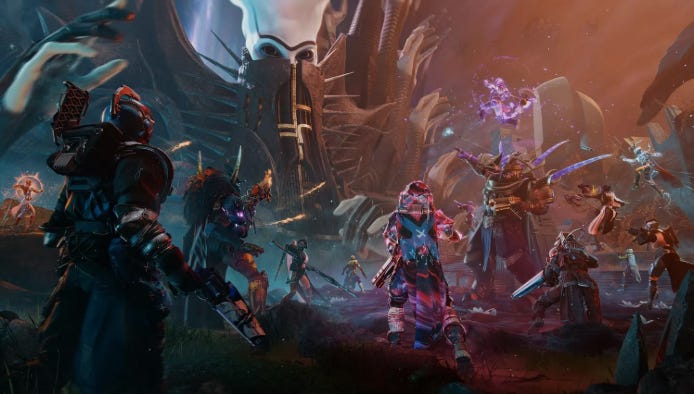
What makes the second round so brutal is the timing. In June 2024, Bungie shipped The Final Shape, the capstone to a decade of Destiny storytelling and one of the most rapturously received things the studio had ever made. The Final Shape was a creative triumph by every measure that did not appear on a balance sheet. Six weeks later, on July 31, 2024, Bungie laid off 220 people, 17% of the studio, gutting its workforce from roughly 1,300 down to about 850, cancelling an incubation project called Payback, and folding another 155 employees into Sony proper. The cuts hit, by the company’s own admission, most of its executive and senior leadership roles. Pete Parsons owned the failure in a public memo, and the language he chose is the thesis of this entire section.
“We were overly ambitious, our financial safety margins were subsequently exceeded, and we began running in the red.” — Pete Parsons, Bungie CEO, layoff memo (July 31, 2024)
That is the Bungie loop, named by its own chief executive. Overreach, then a near-death scramble, the same arc Marty O’Donnell described back in the Halo days. The difference this time is what came after. In every prior cycle, Bungie hit the brink and then pulled off the escape, the Taken King save, the walk from Microsoft, the buyback from Activision. The rebellion always had somewhere to go. This time, there was no door, and the people inside knew it. Schreier’s Bloomberg account of the reckoning captured a studio turning on the leadership that had presided over the collapse.
“Most of the people were critical of Chief Executive Officer Pete Parsons, saying he had failed to take accountability for his own bad bets.” — Jason Schreier, “Sony’s Bungie Faces Reckoning After Mass Layoff” (Bloomberg, August 2, 2024)
The detail that stuck with me, the one that turns this from a balance-sheet story into a human one, is the mantra. Schreier reported that Parsons and other leaders had long preached something they called “Bungie magic,” the confident belief that the studio could make anything work out, the same swagger that had carried it through every prior near-death scramble.
“Some said Parsons and other company leaders spoke of ‘Bungie magic’... a confident mantra... that they can make anything work out.” — Jason Schreier, Bloomberg (August 2, 2024)
The magic was the whole problem. It had always been real before, the thing that pulled The Taken King out of the fire and won the independence fights, and this time it ran straight into a wall of bad bets and a parent company that was no longer going to absorb the cost.

By 2025, the escape hatch was gone. Pete Parsons, the CEO who had championed “Bungie magic” and steered the studio into Sony’s arms, stepped down in the middle of the year, replaced by studio head Justin Truman. The independence Parsons had called the heartbeat of Bungie was quietly flatlining, and Sony said so out loud. On an August 2025 earnings call, CFO Lin Tao walked investors through what was happening to the studio in language stripped of any sentiment.
“At the time of acquisition we were offering a very independent environment... this independence is getting lighter, and Bungie is shifting into a role which is becoming more part of PlayStation Studios.” — Lin Tao, Sony CFO, FY2025 Q1 earnings call (August 2025)
Read that against everything that came before. The word Bungie had organized its entire existence around, the thing it gave up Halo to keep and bought back Destiny to protect, was now “getting lighter” on a Sony spreadsheet, erased by the one owner it could not walk away from. There was a clause in the acquisition contract that let Sony absorb Bungie into PlayStation Studios if it missed certain revenue targets, and that clause was now being pulled.
Then came the money, and the money does not lie. Sony’s accountants took a knife to Bungie’s value across fiscal 2025, recording a ¥31.5 billion impairment in one quarter, tied directly to Destiny 2, and the language Sony used to justify it is the entire thesis of this piece rendered in accountant’s prose.
“The level of sales and user engagement have not reached the expectations we had at the time of the acquisition of Bungie... we recorded an impairment loss against a portion of the assets at Bungie.” — Sony, FY2025 Q2 earnings disclosure (November 2025)
A second, larger write-down followed after Marathon’s launch, ¥88.6 billion in the fourth quarter, bringing the full-year total to ¥120.1 billion, roughly $766 million erased from Bungie’s books in a single fiscal year. Sit with that figure. Sony paid $3.6 billion for Bungie, and in one year wrote off more than a fifth of the entire purchase price, a public accounting admission that the bet had gone badly wrong.
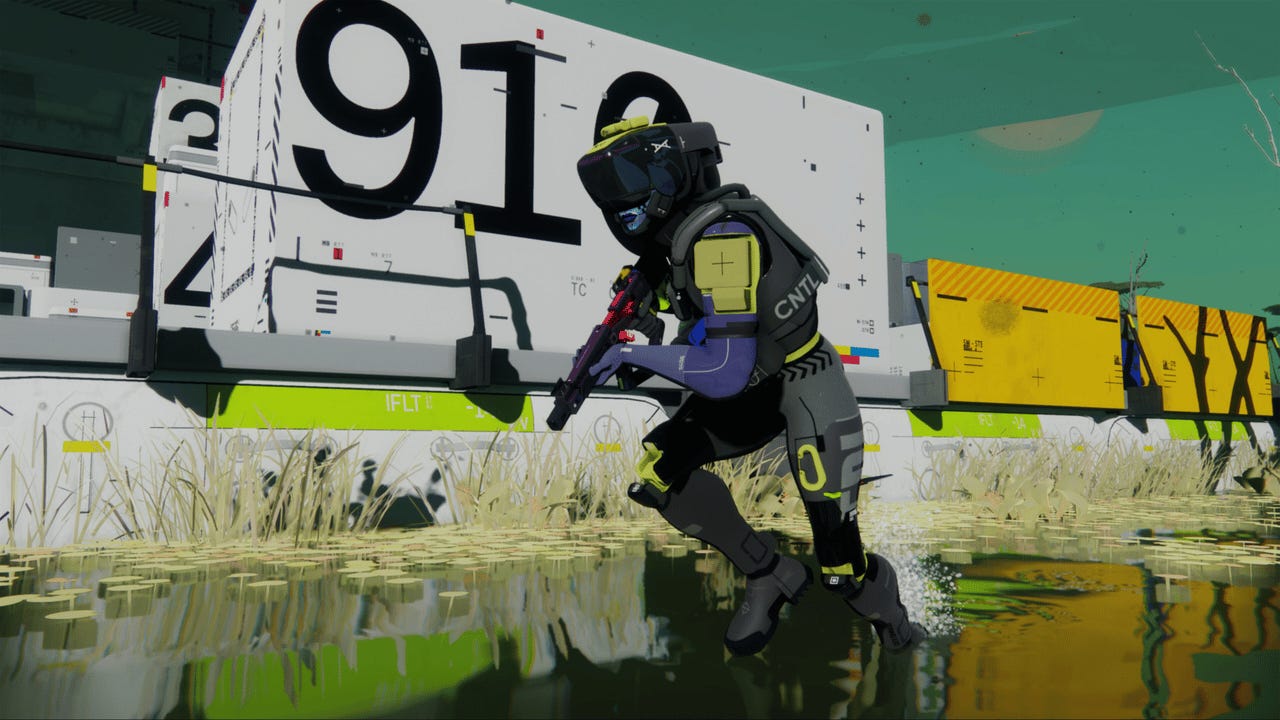
Marathon was supposed to be the answer, the new franchise that justified the whole acquisition, the live-service flagship Bungie was meant to teach Sony to build. It launched on March 5, 2026, the studio’s first wholly new IP since Destiny in 2014, a $40 extraction shooter that actually reviewed reasonably well, sitting around 85% on Steam at launch. The reception did not save it. Marathon sold an estimated 1.2 million copies and generated roughly $55 million in its first few weeks, then bled the majority of its launch audience almost immediately, numbers nowhere near what a $3.6 billion bet demanded. The teacher could not pass its own test.
Which brings us to today, and the announcement that prompted this entire piece. On May 21, 2026, Bungie confirmed that Destiny 2 will receive its final live-service content update on June 9, a free sendoff called Monument of Triumph, ending nearly a decade of continuous development on the game that defined the studio’s last era. Hours later, Jason Schreier reported the part Bungie did not announce.
“Sony Group Corp.’s Bungie unit is planning a significant number of layoffs as it ends development on the long-running online shooter game Destiny 2.” — Jason Schreier, “Bungie Plans Layoffs After Ending ‘Destiny 2’ Development” (Bloomberg, May 21, 2026)
The detail that lands hardest is the one underneath the layoffs. There is no Destiny 3 in production. There is no greenlit successor for the Destiny 2 team at all. After a decade of building one of the most devoted communities in gaming, Bungie is ending its flagship with no announced future for it, redirecting what remains toward keeping Marathon alive. And according to reporting from both Schreier and Forbes’ Paul Tassi, almost no one inside Bungie knew Destiny 2 was ending until it was announced, with some staff having begged leadership to tell the team sooner. The people who built the world found out alongside the players.
So here is where the pattern finally breaks. Three times Bungie was owned, and three times the same loop ran... overreach, crunch, a near-death scramble. The first two times, the rebellion had somewhere to go. It walked from Microsoft and kept its soul. It bought its way out of Activision and kept Destiny. Each time, the escape was the happy ending. This time, there is no owner to escape, because Bungie is the owner now, a wholly owned subsidiary being absorbed into the parent it cannot leave, its independence written off on the same balance sheet as its value. The studio that spent thirty-five years refusing to be held finally signed with a partner it could not walk away from, and the rebellion that always saved it had nowhere left to run.
The history makes the prediction. Now the data tells you exactly how far it fell.
The Data Verdict: A Near Decade Of Decline, Confirmed In The Numbers
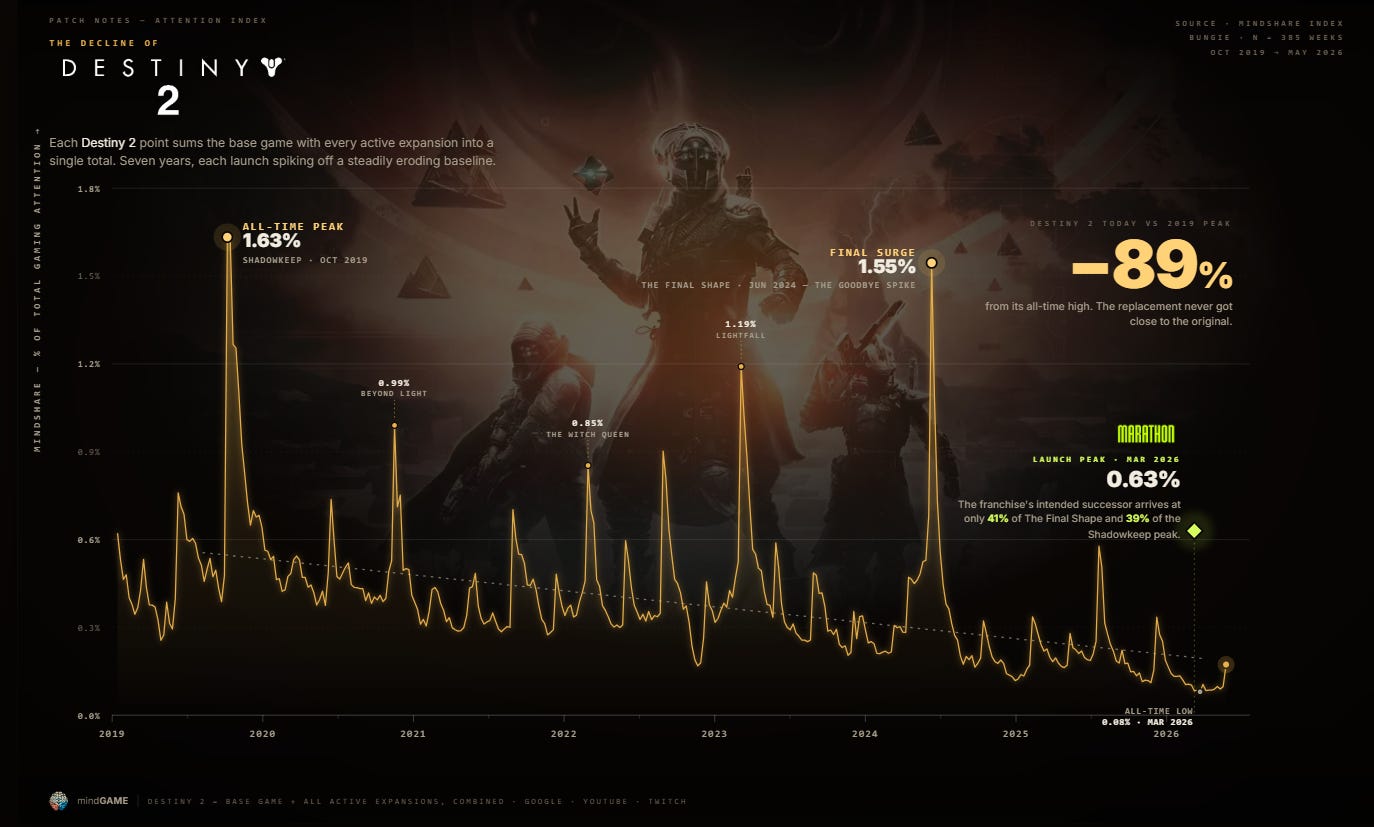
Here is where I bring my own data to the story, because mindGAME Data tracks exactly the thing this whole history has been circling... attention. mindSHARE is our measure of how much of the gaming conversation a title commands across the channels where games actually live, blending Google search, YouTube video, and Twitch streaming into a single percentage of total attention captured in a given week. It is the closest thing we have to a heartbeat monitor for a franchise, and Destiny’s chart tells the same story the reporting does, just in a cleaner line.
Start at the top. Destiny 2’s all-time mindSHARE peak landed the week of October 6, 2019, with the launch of Shadowkeep, when the franchise commanded a 1.63% share of all gaming attention, good for 12th overall across every title we track. That is the high-water mark, the number every later spike gets measured against. Then watch the expansions march downward at the peak. Beyond Light hit 0.99% in November 2020. The Witch Queen, despite being the most beloved expansion of the run, peaked at just 0.85% in February 2022, the same month the Sony deal was announced. Lightfall managed 1.19% in March 2023, a brief bump before the collapse the reporting later exposed.
The interesting wrinkle, and I want to be honest about it rather than flatten the story, is that the decline was never perfectly linear at the peak. What eroded relentlessly was the baseline between drops, the attention the game held in the quiet weeks, which fell further with every cycle. The expansions could still spike. The floor underneath them could not stop sinking.
And then came the goodbye, which is the single most telling data point in the entire set. The Final Shape launched the week of June 9, 2024, and Destiny 2 surged back to 1.55% mindSHARE, 12th overall, nearly matching the Shadowkeep peak five years earlier. Look closer at where that attention concentrated. On Google it ranked 13th, on YouTube 15th, but on Twitch it hit number 4, the highest single-channel rank Destiny 2 ever achieved in our data, with roughly 6.98 million weekly searches behind it.
That Twitch number is not an accident, and it is not really about the expansion. Destiny was built on Twitch, and Twitch was built partly on Destiny. The streamers who turned the franchise into a culture, ProfessorBroman, Gladd, Datto, the whole world-first raid-race ecosystem, came up alongside the game across a decade. When The Final Shape closed out the ten-year Light and Darkness saga, ProfessorBroman co-hosted the official Twitch Rivals broadcast of the Salvation’s Edge race, and the entire community gathered in one place to watch the story end. The number 4 on Twitch was not a launch. It was a wake. Everyone came together to say goodbye to the saga, and the data caught them doing it.
This Was Not Done To Bungie, It Was Done By Bungie
Now the verdict the whole pattern was pointing toward. After The Final Shape’s farewell surge, the floor gave out completely. By March 22, 2026, Destiny 2’s combined mindSHARE had fallen to 0.08%, ranked 197th overall, its lowest point in the entire history of our tracking. Our latest reading, the week of May 24, 2026, sits at 0.17%, 85th overall, with Google at 69, Twitch at 83, and YouTube at 88. Set the bookends side by side and the decline is total. From a Shadowkeep peak of 1.63% to where it sits today, Destiny 2 has shed roughly 89% of its mindSHARE. The franchise that once commanded a top-15 share of all gaming attention now barely registers inside the top hundred.
Then there is Marathon, the game that was supposed to make all of this worth it. It launched the week of March 8, 2026, and peaked at 0.63% mindSHARE, 22nd overall, with a Twitch rank of 11 and roughly 3.82 million searches behind it. Respectable on its own. Catastrophic in context. Marathon’s launch peak reached only 41% of what The Final Shape pulled and just 39% of the Shadowkeep high. The new franchise meant to replace Destiny arrived at well under half the altitude of the one it was replacing, and it has been bleeding attention ever since. Our data says what Sony’s $766 million write-down says, only earlier and in higher resolution. The bet did not work.
And here is the quiet, awful truth underneath this whole ending. Bungie did not want to build Destiny 3. The clean solve, the one the data begged for, the obvious lifeline, was the one thing the studio kept refusing to make. When Bungie did greenlight a next Destiny project, the spin-off codenamed Payback under Luke Smith and Mark Noseworthy, it cancelled the game and moved the team to Marathon. Per Jason Schreier‘s reporting, the studio has pitched Destiny ideas internally and backed off every time, and when the moment came to choose, it chose to end Destiny 2 and pour what was left into a brand-new IP instead.
“Bungie’s leaders had talked about ways to retool Destiny 2 to make it more approachable for new players, but earlier this year they instead decided to end development of the game, partly to shift resources to Marathon.” — Jason Schreier, Bloomberg (May 21, 2026)
That is the rebellion turned all the way inward. For thirty-five years, the instinct that made Bungie ungovernable was the refusal to be held, by Microsoft, by Activision, by anyone. The same restlessness that made it walk away from Halo and claw back Destiny is the thing that made it walk away from Destiny too, chasing the next new world rather than tending the one it had. There is no Destiny 3 in production, no greenlit successor, just a final update in June and a studio betting its survival on Marathon, a game already bleeding the audience Destiny spent a decade building.
So let me bring this back to where I started, because I did not write all of this as a neutral analyst. I wrote it as the guy who ran King’s Fall every weekend, who bonded with his future Twitch colleagues over this game in a job interview, who called the Dreaming City the Night Elf corner of his gaming life and meant it as love. The Final Shape’s number 4 on Twitch was a wake, and I have come to believe it was not only a wake for Bungie. It was a wake for Destiny too. Even if Sony wrote the check tomorrow and Bungie suddenly found the appetite to build it, a Destiny 3 would not reach me until 2030 or 2031, and I have to be honest with myself about whether I will still be in the season of life where I come back to a game like this by then. Probably not. That is the quiet grief underneath all the numbers. The door did not just close on the franchise... it closed on my way back to it.
What makes it sting is that this was not done to Bungie by some outside villain. I said as much to Greg on our stream earlier this week. Sony is the executioner here, yes, and it absolutely overpaid for a studio it is now writing down by the hundreds of millions. But the blade is not the cause. The cause is older and sadder than that, the same culture that put up the iron wall against Microsoft, that fought Activision over the calendar, that preached “Bungie magic” right up until the magic ran out. The thing that made Bungie Bungie, that fierce, ungovernable, we-would-rather-leave-than-be-owned spirit, is the same thing that made it impossible to hold together once the bets went bad and there was no owner left to escape. Rebellion was always the identity. This time it had nowhere to go, so it turned inward, and the studio walked away from the one franchise that could have saved it.
And the people who pay for that are not the executives who made the bets. Most of them got their retention money, their equity, their soft landings. The ones who pay are the developers, the artists, the community managers, the boots on the ground who built one of the most beloved worlds in gaming and are about to learn, per Bloomberg, how many of them are losing their jobs once the final update ships. They are not the reason Destiny is ending. Those people are just the ones left holding the bag. That is the saddest part of a genuinely sad story, and it is why I wanted to tell the whole thing, all the way back to a recalled copy of Myth II in 1998, rather than just react to a headline. Bungie outlasted every owner it ever had. It could not outlast itself.
What I’m Watching At Summer Game Fest
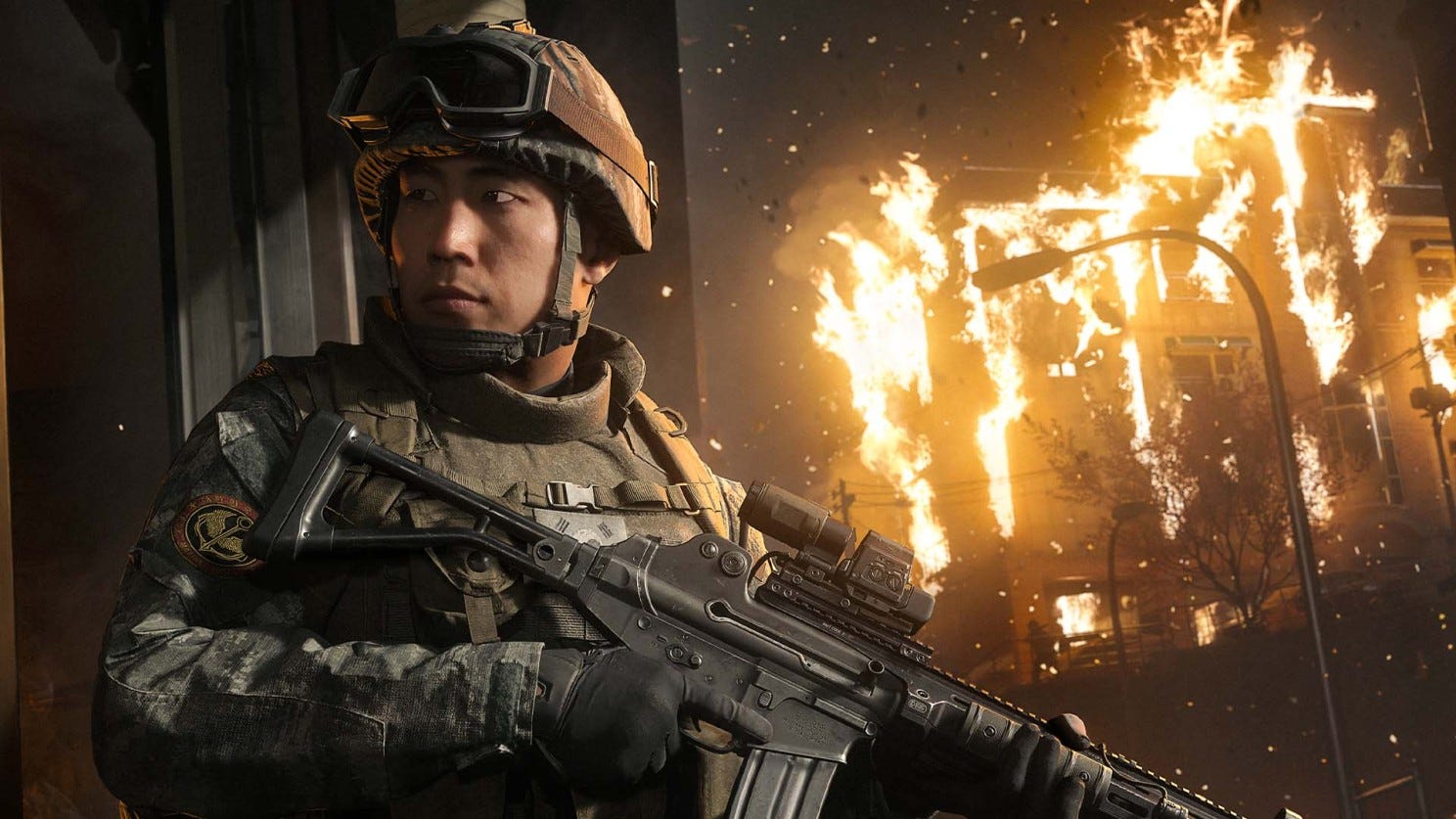
Let me end somewhere lighter, because it has been a heavy week and this is supposed to be the fun part. Next week I’ll be in Los Angeles for Summer Game Fest, and for all the doom in the back half of this newsletter, this is still the most optimistic stretch on the gaming calendar. A floor full of trailers, a few real surprises, and the annual game of sorting which of the hyped titles are actually real and which are vaporware with a sizzle reel. Our mindGAME read on the SGF winners and losers lands Tuesday, June 9. Here is what I’m personally walking the floor for, and what I’ll be watching the numbers on once they’re live.
Call of Duty: Modern Warfare 4 is the one I have zero hesitation about. Revealed just yesterday and locked for October 22, that timing is sharp, enough breathing room to clear the GTA VI blast radius in November. I think this is a billion-dollar game and a real candidate for the next S-tier title of the year. The hype train is moving and I can feel it leaving the station without needing a data pull to confirm it. The real question is whether Call of Duty can pull off a genuine comeback year after Black Ops 7, the worst-performing entry in the franchise since 2008. My read is yes. I’ll have the numbers Tuesday, but my gut says this is the one that prints, and I am more than ready to get into it next week.
Marvel’s Wolverine is the game that doesn’t need the marketing juice. Insomniac confirmed a September 15 launch and Sony is opening its June 2 State of Play with it, and I am as bullish on this as anything in the back half of the year. Here’s the tension I keep coming back to, though. Wolverine doesn’t need propagation help the way most launches do, the brand and the studio carry it, but it still has to break through hard enough to win the season. The comp set I’ll be measuring it against is Insomniac’s own catalog, Spider-Man, Miles Morales, and Spider-Man 2, because those launch curves are the only fair bar for what a top-tier Insomniac swing should do. After what they pulled off with Spidey, I trust this team with Logan completely, and a great showing makes my whole fall.
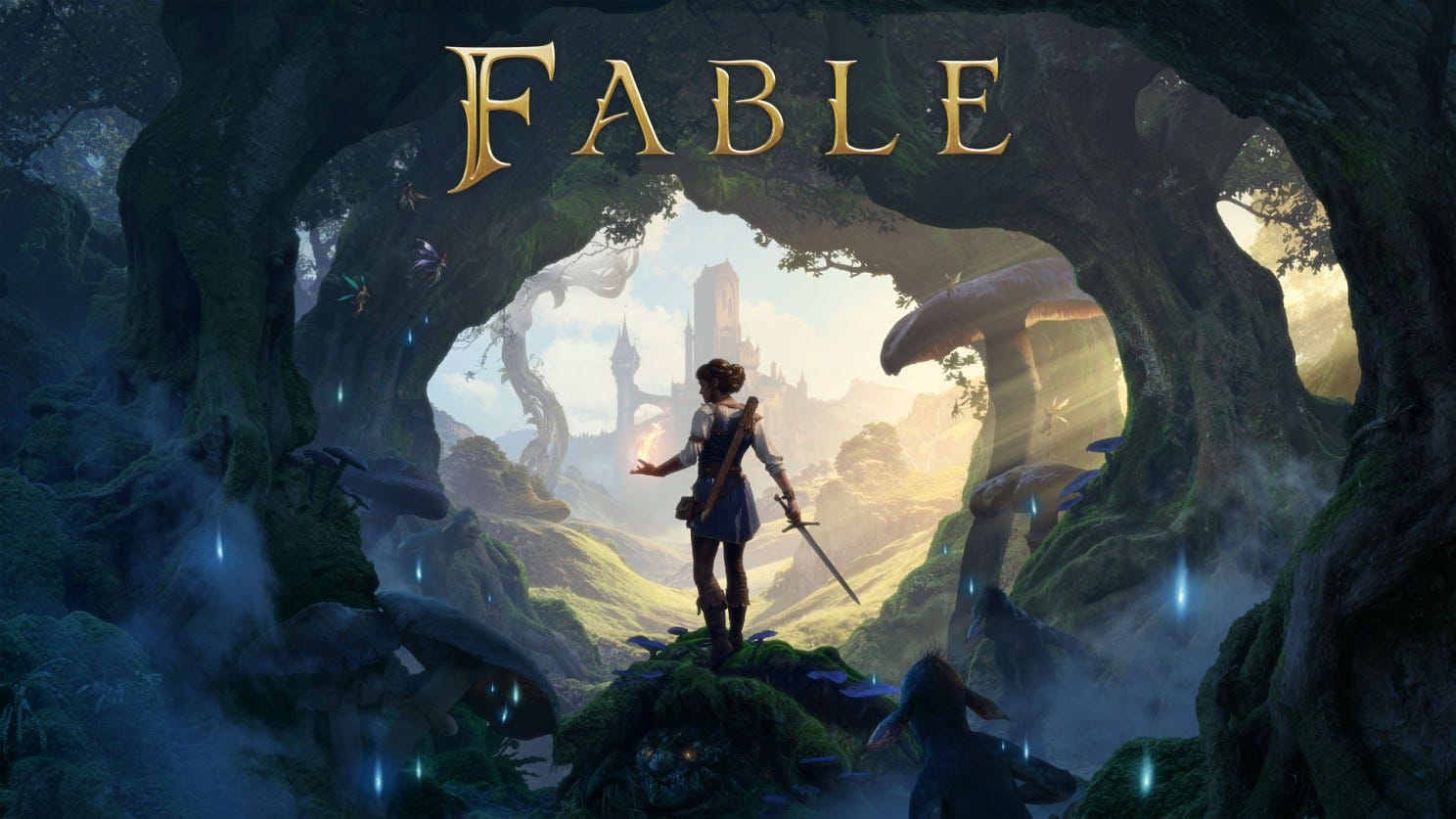
Fable was the most important game on Microsoft‘s board, and then, while I was literally drafting this, XBOX pushed it to February 2027. I had this one pegged as a 2027 game in my notes, so I’ll take the small victory. The reason matters more than the date. Xbox all but said the quiet part out loud, moving Fable out of a holiday window stacked against Grand Theft Auto VI so it can have, in Matt Booty’s words, a moment all its own. That is the shadow effect I have been writing about all year, now dictating first-party calendar decisions at the highest level. Given Playground’s Forza Horizon track record, I remain bullish on the studio, and Booty says we’ll get a major new look at the Xbox Games Showcase on June 7. I’ll be watching to see if the game justifies the runway.
Grand Theft Auto VI is the game that eats the world, and it is the gravity well everything else is bending around. Rockstar Games is holding firm on November 19, console-first, and as I wrote back in April, that windowing is effectively a PlayStation-and-Xbox-first story that leaves PC waiting. Here is the part that should scare every other publisher on the calendar. In our mindGAME data, GTA VI is already carrying a cumulative mindSHARE of 3.09%, twenty-six weeks before it launches, with no game to play and nothing to stream. It ranks as the 7th game in the world on Google search right now on the back of roughly 5.79 million weekly queries, sitting at 13th on YouTube, with effectively no Twitch presence simply because there is nothing to broadcast yet. Put that number in context. Forza Horizon 6, the single biggest launch in our data at the moment, posted a 4.87% cumulative mindSHARE in its actual launch week, fully marketed, fully playable, with a live audience. GTA VI is sitting at 3.09% half a year out with one foot still in the garage. This game is going to be a beast, and it is so big it pulls the attention oxygen out of every room it enters, which is exactly the problem for the next guy on the calendar. Just ask Fable.
Now to Nintendo, which deserves its own lane because the company plays by nobody’s calendar. They announce a Direct 48 to 72 hours out and never tip their hand before that, so all of this is pure rumor-mill reading. But if even some of what I’m hearing is real, the three that come up most are a new 3D Zelda, a fresh 3D Mario platformer, and a new Smash Bros. The one that would genuinely get me off my chair is the Zelda rumor, specifically an Ocarina of Time remake, which makes all the sense in the world given how aggressively Nintendo has been mining its back catalog. Read the broader board too, with LEGO leaning into more Zelda sets and the movie landing next year, and the table could be set for exactly that kind of remake moment. We shall see what the rumor mill actually delivers.
Then there’s Warner Bros. Games Corner, which is where my LEGO Batman frustration from the top of this piece comes home to roost. Warner has a couple of swings I keep hearing about, and the same problem hangs over both. Rumor one is a Rocksteady return to the Arkham well, a Batman Beyond project that would, mercifully, pretend Suicide Squad never happened, and I would be thrilled if it means walking away from that baggage for good. There’s also Hogwarts Legacy 2, which is the most obvious sequel in the entire industry given how the first one sold, possibly even teasing at the June 2 State of Play. Here’s my throughline, and it ties directly back to where I opened. Given how LEGO Batman: Legacy of the Dark Knight landed at launch, I am genuinely skeptical that WB in its current construct can market any of these games home. The story isn’t whether Warner announces Batman Beyond or Hogwarts Legacy 2. It’s whether whatever they announce gets marketed competently enough to matter.
So that’s my board going in. A lot of it won’t come to fruition, and I know that. I picked the big swings on purpose, because these are the games that actually move attention at scale, and attention is the whole game I’m in. The industry just handed me a genuinely sad story about a studio I love. Next week it gets to remind me why I fell for all of this in the first place. If you’re going to be at Summer Game Fest, find me on the floor or drop a line on LinkedIn or Substack. I’ll be the one talking too much about Modern Warfare 4 and quietly hoping somebody, somewhere, says the words “Destiny 3.”
See you next week.