

The Biggest Fall In Five Years Is Also The Smallest... Measuring The Grand Theft Auto Effect

Follow me here… or on LinkedIn
Welcome back, everyone... and welcome to the on-ramp. August is upon us, which means we’re about to hit the gas into the busiest stretch of the gaming calendar, the annual sprint that doesn’t let up until The Game Awards closes the year out in December. Betas, reveals, gamescom, the September pile-up, the October gauntlet, the November main event... it’s all coming, and it’s coming fast. Faster than usual, honestly, because this year the entire season bends around a single game. More on that in a minute, because I have a full month of data burning a hole in my pocket.
But before any of that, I owe you a trip report.
Back From San Diego... Five Trends And A Deadpool Story
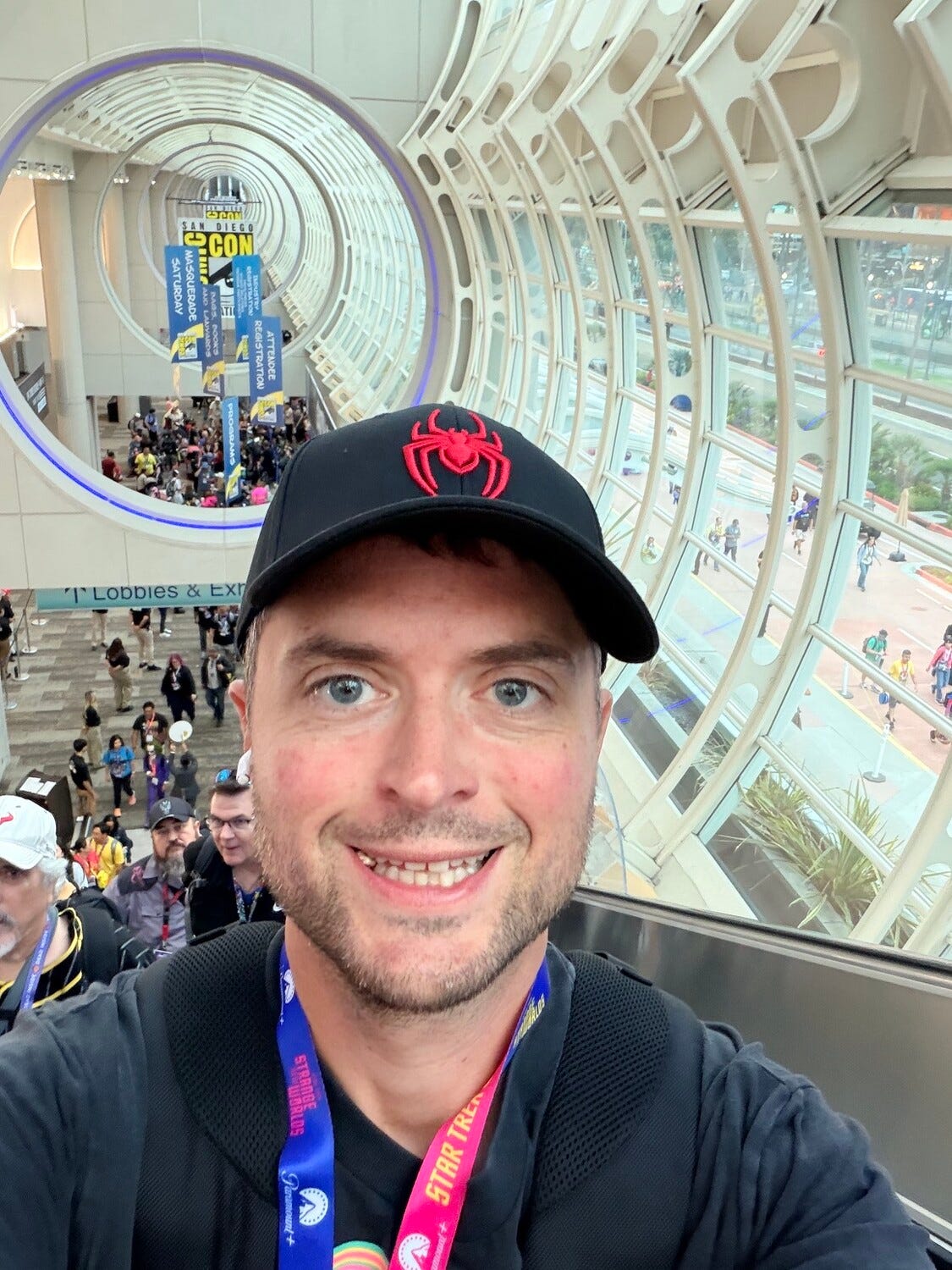
Patch Notes is back from San Diego Comic Con, my favorite annual tradition. My relationship with this show has evolved over the years... I went as a fan, then as a professional, and somewhere along the way I settled into the best version: professional fan. I take my kids every year now, which means I get to experience Comic Con twice. Once through my eyes, once through theirs. This year delivered on both counts.
Five trends stood out walking that floor.
Marvel’s Back... In Part Because Nobody Else Showed Up
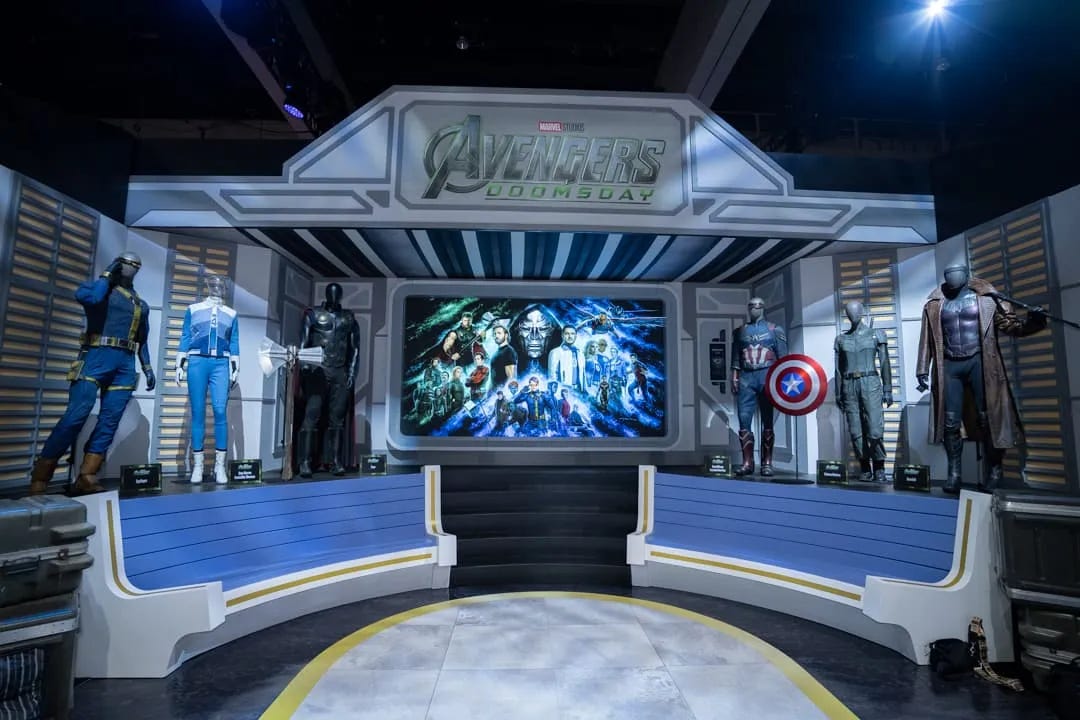
The biggest news of the weekend was Saturday’s Marvel panel, and half the story is who wasn’t standing anywhere near them. Marvel skipped 2025 entirely... this was a return, and it landed on a stage everyone else had quietly walked away from. DC didn’t run a movie slate panel at all. No Man of Tomorrow news, no Batman news, just Lanterns carrying the banner while James Gunn shot his movie in another state and posted that he can reach fans just fine from the internet. Maybe he can. What I heard on that floor was a fanbase that’s talked itself out of the whole project... people who genuinely believed Gunn’s universe might go toe to toe with Marvel, and have since downgraded their hopes to “make a great Batman movie and stop trying to build an entire universe.”
The comics side of DC is thriving, and that deserves its shout. Everything transmedia around those comics has gone quiet... no games, no movie news, no momentum... and the fans feel it. Star Wars sat this one out too, and no brand on earth needs the rebuild more. Now, Disney gets a partial pass on both counts... D23 is next month in Anaheim, and no company burns its announcements in San Diego when it owns a fan event up the freeway, so expect the real news there. The pass only covers so much, though. Marvel walked onto an empty stage and won the weekend by showing up.
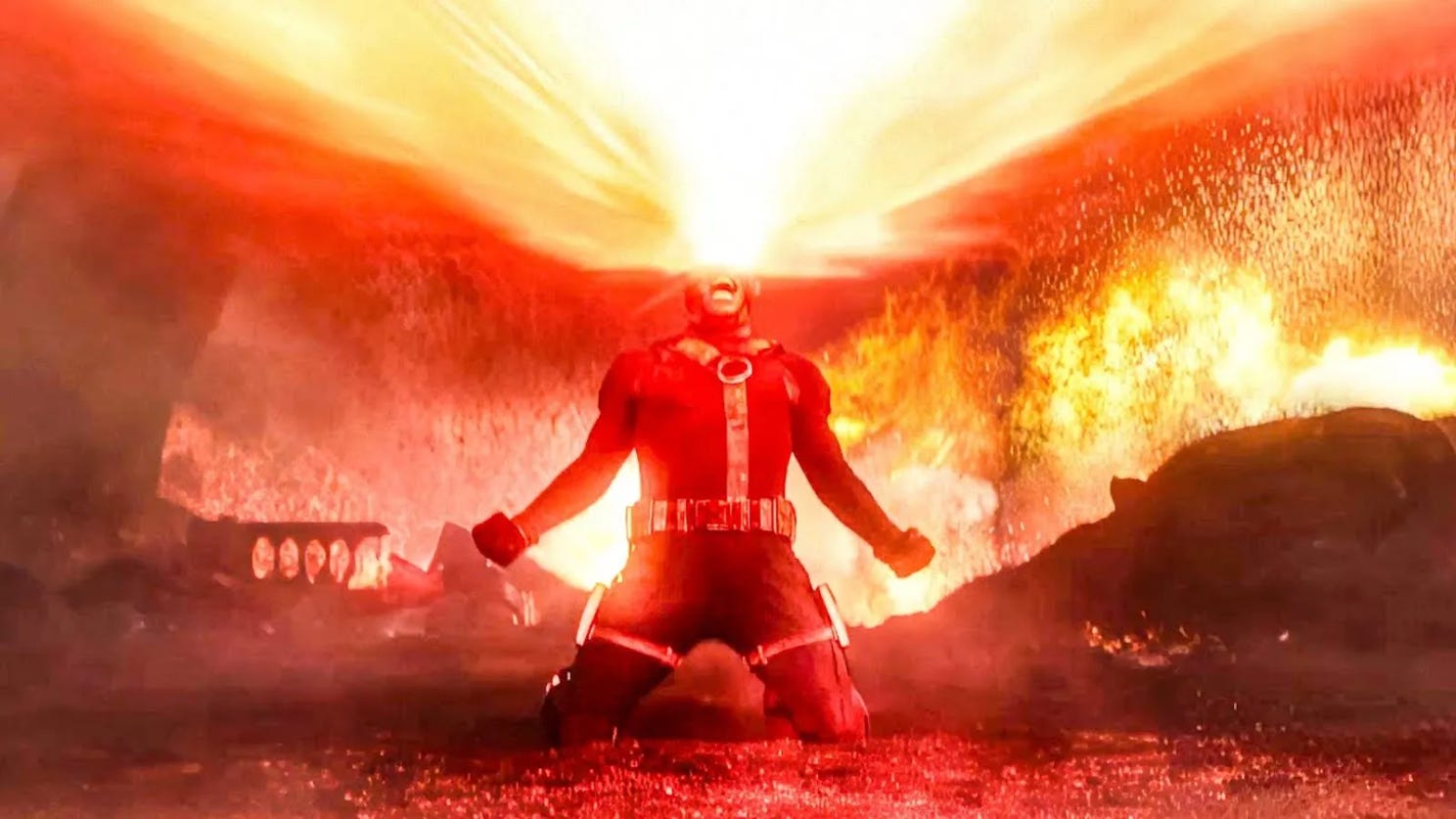
As for what they actually brought... the Avengers Doomsday trailer did its job driving hype, though every frame of it looks shot under the same glowing, color-graded ceiling. Stage one fight outside... an open field in Wakanda, actual sunlight, aliens pouring over a ridge... and I think the hesitant crowd comes along. Endgame already showed us what a finale looks like when the whole thing lives inside a studio dome, and people remember. The real electricity in that room was the X-Men. Cap being back didn’t move anyone... half the returning roster are characters nobody has a relationship with, and the running chatter in line was some version of “most of these people are getting killed off anyway,” which is probably true. What fans have wanted since the Fox era kept sanding the Sentinels down into something small and “realistic” is simple: a four-story Sentinel fighting a field of heroes. Feige puts that on screen and the movie wins, whatever happens around it.
The Black Panther recast landed softer in the hall than it did in my podcast feed. Fans took it with a warm shrug... glad they’re making more, the baton passes to the son canonically, that tracks, moving on. Ryan Gosling as Ghost Rider got the actual nerd-out. Rumored forever, finally real, and clearly positioned as a serious swing... the excitement is that Ghost Rider drags an entire corner of villains in with him, starting with Mephisto, who Sacha Baron Cohen already played in Ironheart. That show wasn’t very good. He was, and the through-line writes itself. My hope is this cracks the door open for everything stranded by the streaming era... Werewolf by Night remains one of the most underrated hours Marvel has produced, and if a hell-and-earth corner of this universe is spinning up, that’s exactly where it lives. Blade, the Doctor Strange rogues, some culmination film down the road... I’m in for all of it.
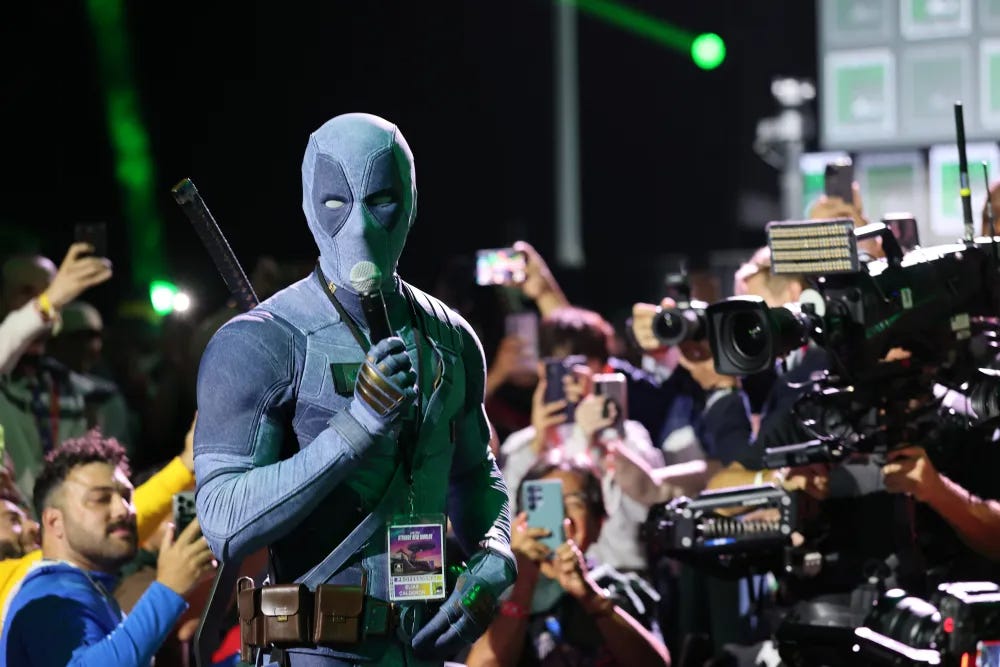
Of course, Marvel’s biggest moment of the weekend never touched a stage. Ryan Reynolds walking the floor in denim Deadpool became the show’s urban legend within hours... did you see him, did you get a picture, was he really out there. I can answer half of that. My kids and I walked directly past the guy and kept moving, because we were sprinting to the bathroom. No photo exists. My son looked up at him and asked why Deadpool was dressed in blue, I told him they were doing a spin on it, and off we went. So close... so far. The best part is I didn’t miss a thing, because I watched the full Hall H skit a minute after it happened, on Instagram, at dinner, from a better camera angle than anyone who camped out for a seat. That gap between being in the room and needing to be in the room kept nagging at me all weekend, and it runs underneath everything else I saw on that floor.
A Decade Ago... This Floor Looked Completely Different
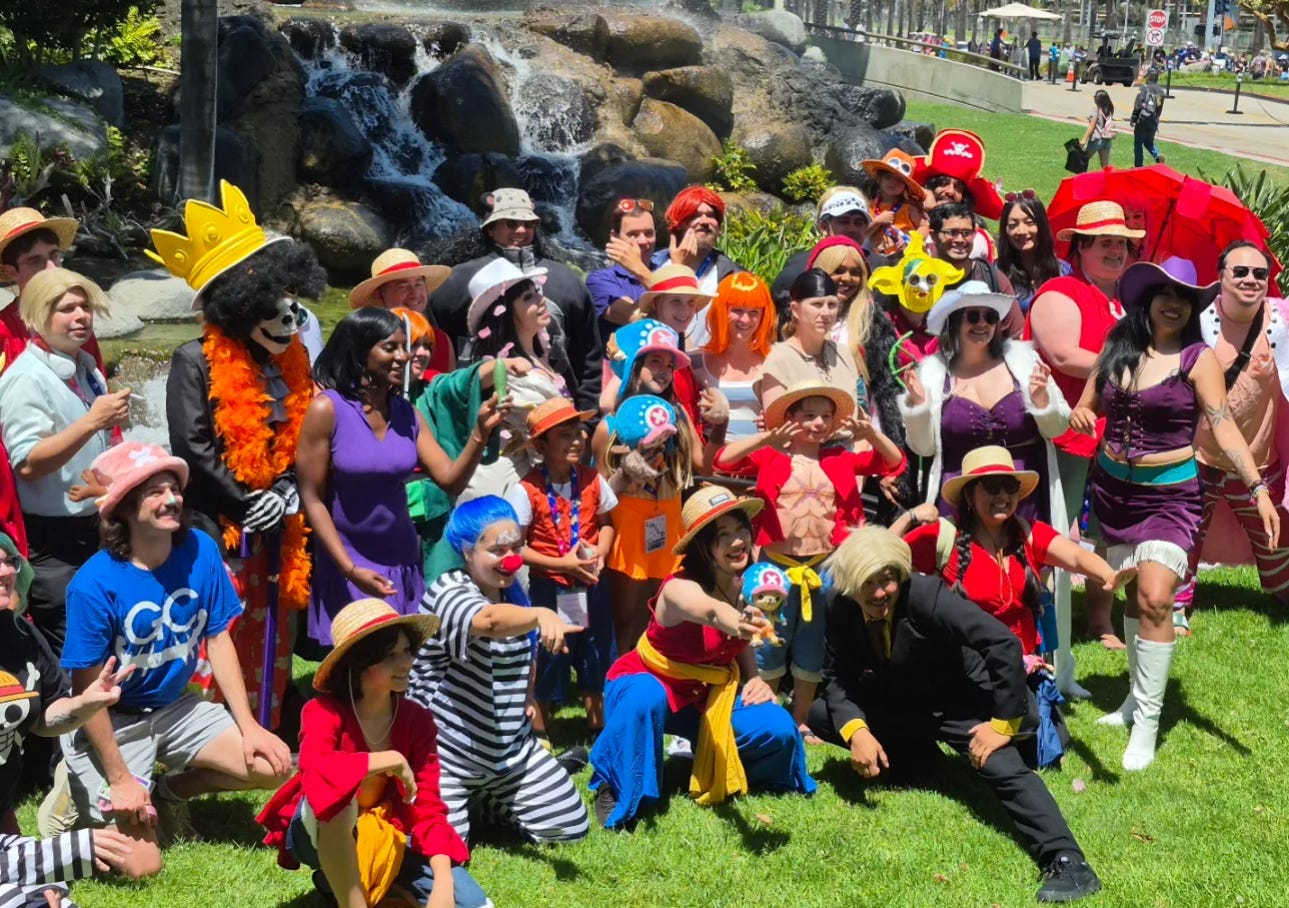
One conversation kept repeating all weekend: if this were the mid-2010s, One Piece would have owned a Hall H slot. The Netflix show is a genuine phenomenon, and I’ll die on this hill... it’s the most anime a live-action production has ever been allowed to be inside a Western studio. Nailed the casting, nailed the tone, nailed the way those characters bounce off each other. Any studio holding that property ten years ago books the biggest room, flies in the cast, and eats a full news cycle. Instead: nothing. The floor made the missed opportunity impossible to ignore, because the fans showed up anyway... more Luffys and Zoros than I’ve seen in a decade-plus of attending, an army of walking evidence for a panel that didn’t exist. House of the Dragon got no Sunday Hall H either, and the Sunday Game of Thrones panel used to be an institution you planned your whole weekend around.
Zoom out and the pattern is structural. Comic Con’s biggest era was built on television money... AMC pushing The Walking Dead, HBO turning Thrones into an annual pilgrimage, Netflix and Hulu and every broadcast network buying floor space to put a cable drama about aliens in front of 130,000 people. The whole ecosystem that funded those activations has spent five years getting crushed... COVID killed the momentum, the strikes froze the pipelines, and the consolidation era has these companies merging into each other faster than they can print new logos. Marketing budgets for linear shows evaporated, and the streamers that survived learned they could reach fandom through digital events without renting a corner of a convention center. Netflix runs its own show now. Some of the old players still hang on in diminished form, but the exhibit hall doesn’t lie... the clearest tombstone on the floor is that the legendary Warner Bros. mega-booth, for years the anchor of the entire hall, no longer exists. A solo DC booth stands where it used to be. One shrinking comics brand, holding ground an empire used to occupy... and that empire’s real estate didn’t sit empty for long.
Anime Took The Vacated Ground
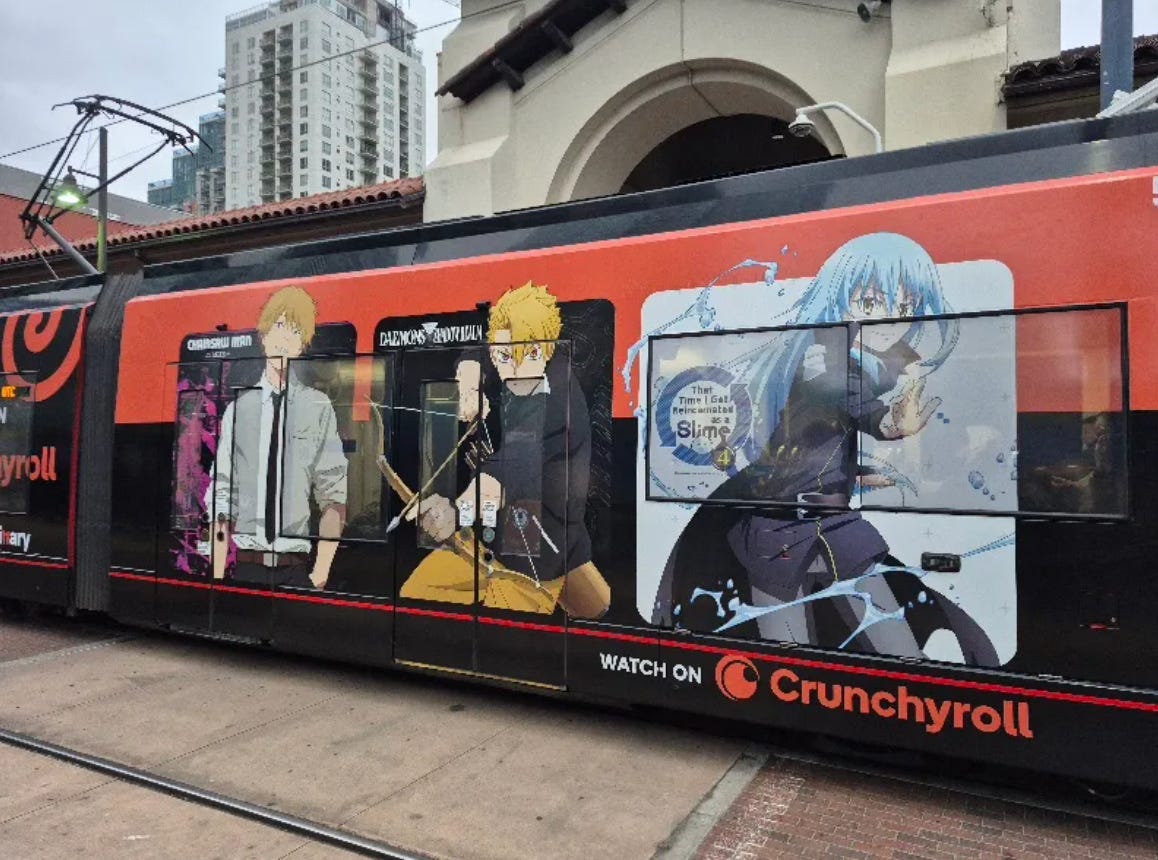
Walk that same side of the hall today and you’re in a different convention. Bandai Namco held three major spaces on this year’s floor, spread across dedicated Gundam, Dragon Ball, Naruto, Godzilla, and Tamashii Nations booths... they even used the show to reveal a new Gundam video game and throw Tamagotchi a 30th birthday party, the kind of multi-front franchise blitz Warner Bros. used to run for its fall TV slate. Crunchyroll built out a massive footprint celebrating ten years of My Hero Academia, complete with an animatronic activation and, for the first time ever, anime exhibits inside the Comic-Con Museum itself. Viz Media, Aniplex, Toei, Konami, Good Smile, Kotobukiya... the roll call goes on, every one of them holding bigger and better-positioned space than the year before. The cosplay told the same story the booths did: One Piece, Demon Slayer, Jujutsu Kaisen, and My Hero everywhere you looked, thick enough that whole stretches of the hall felt like Anime Expo with a comics section attached.
What gets me is the elegance of the exchange. Western television walked away from fandom’s biggest gathering because the economics stopped working, and anime moved into the exact same square footage because its economics have never been better... a medium compounding in America year over year, with merchandise margins TV marketing never had, selling directly to a customer who flew in specifically to spend money. The demand for spectacle at Comic Con never went anywhere. The supplier changed.
Gaming Still Sits At The Back Of The Hall
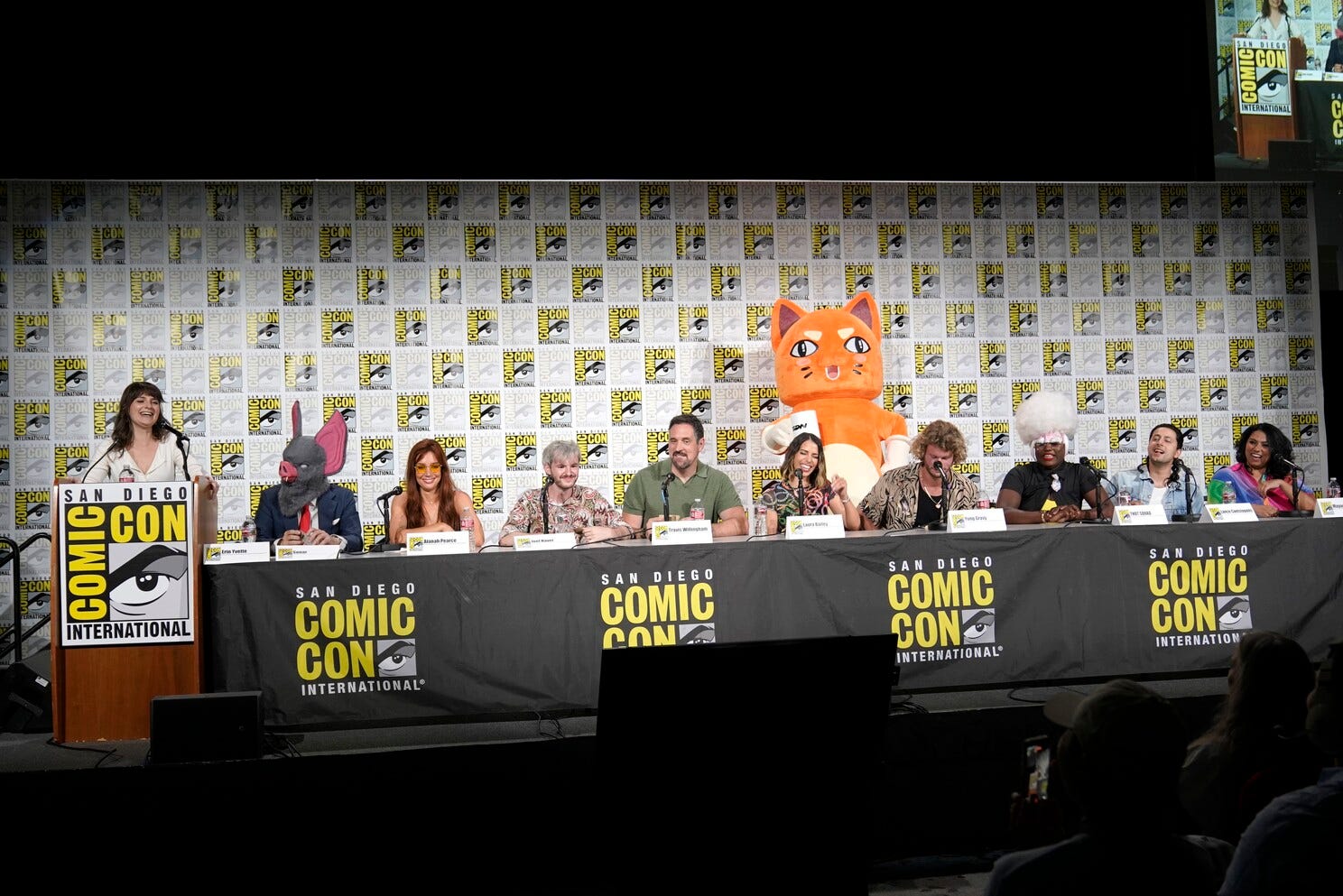
Before anyone emails me... gaming had a presence, and the panel side genuinely delivered. Dispatch packed a room and earned every seat of it. Wolverine got its Hall H moment, Tōkon and God of War ran panels of their own, and you couldn’t find an empty chair at any of them. The floor tells the other half of the story. Gaming lives at the far end of the exhibit hall, past the merchandise, past the comic dealers, past the toys, in a corner where three booths hold down the entire medium.
Nintendo never left, and I love them for it... they’ve even upgraded out of their old Marriott setup and into the hall proper. The Pokémon Company International ran one of the most packed booths at the entire show, and I can vouch firsthand, because we went back twice. Pikachu we only ever caught from a distance, but my daughter got her picture with Eevee both trips... her favorite Pokémon. Watching that line wrap around the booth all four days, Pokémon might have quietly won the floor. Xbox has popped up in that corner over the years, PlayStation too, but always as a visitor... nobody from this industry has ever planted a flag and owned the ground.
The contrast with what’s happening one aisle over is what kills me. Anime walked into this show and built an empire on a model gaming keeps ignoring... show up every year, sell directly to your fans, compound (but maybe you need discs to do that...). Meanwhile the biggest entertainment medium on the planet treats the biggest pop culture gathering in America as an afterthought. Some of that is calendar math... Gamescom sits a month later and no publisher splits its powder across two shows. Some of it is habit left over from the E3 era, when the industry had its own California moment and didn’t need to borrow anyone else’s. That moment has been dead for years, and nothing replaced it.
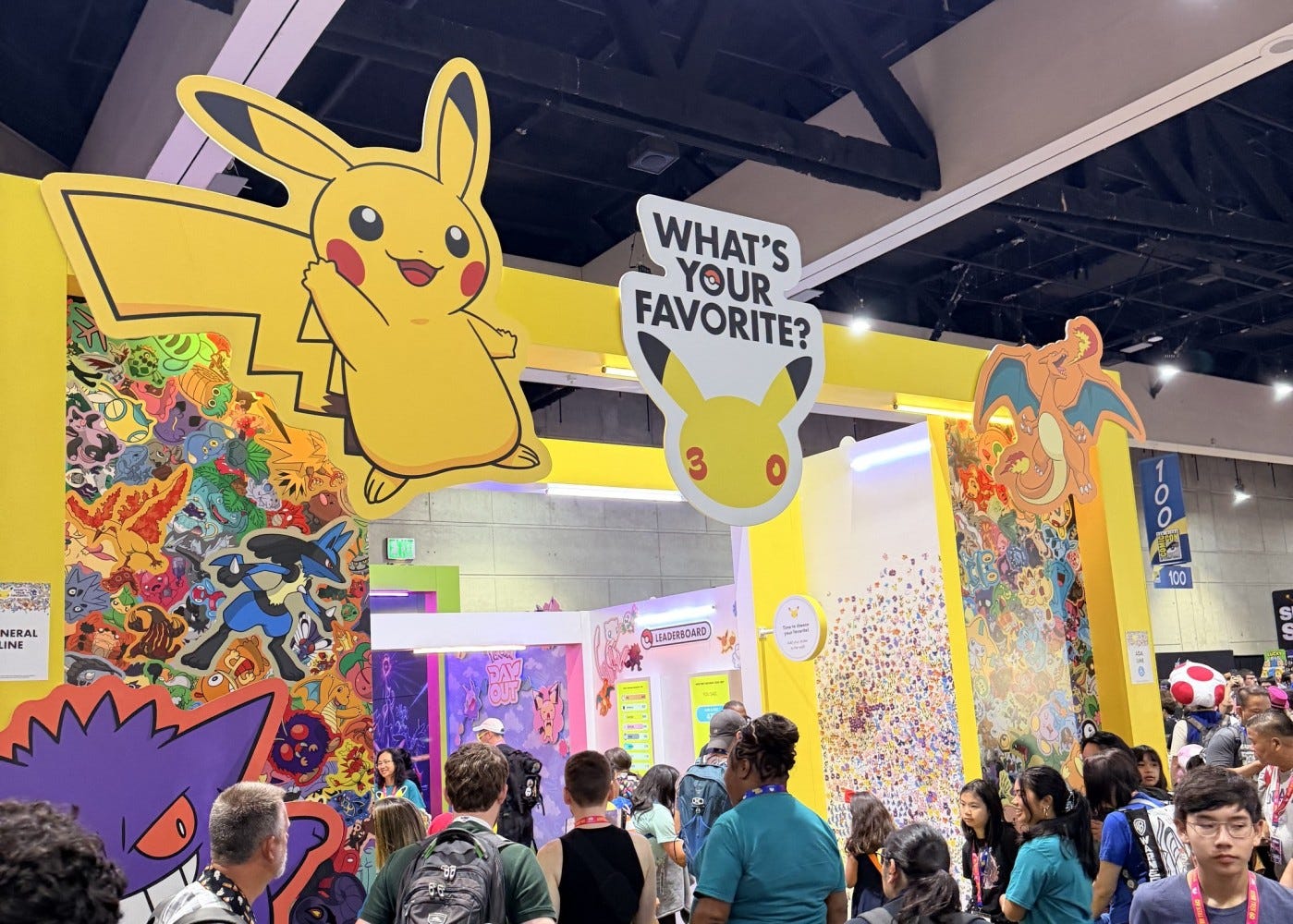
If gaming ever claims this floor properly, playable games are the obvious anchor... nothing else at a convention converts curiosity like picking up a controller. The fuller lesson is sitting in the anime aisle, though: fans want to express their fandom through stuff, and gaming has proven it can play that game before. @Blizzard ran this exact playbook in years past at SDCC to real success... the statues, the exclusives, the apparel, an identity you could wear out of the building... and plenty of others have pulled it off since.
Comic Con brands itself as comics and pop culture, and there is no version of pop culture in 2026 that doesn’t run through gaming... the culture already made that decision, even if the exhibit hall map hasn’t caught up. My wishcasting is simple. I want a publisher, a platform, or the Comic Con organizers themselves to look at the Pokémon line, study the Bandai Namco footprint, and connect the dots. California deserves its gaming moment back.
Comic Con Is Becoming A Merch Engine... Which Might Be A Return To Form
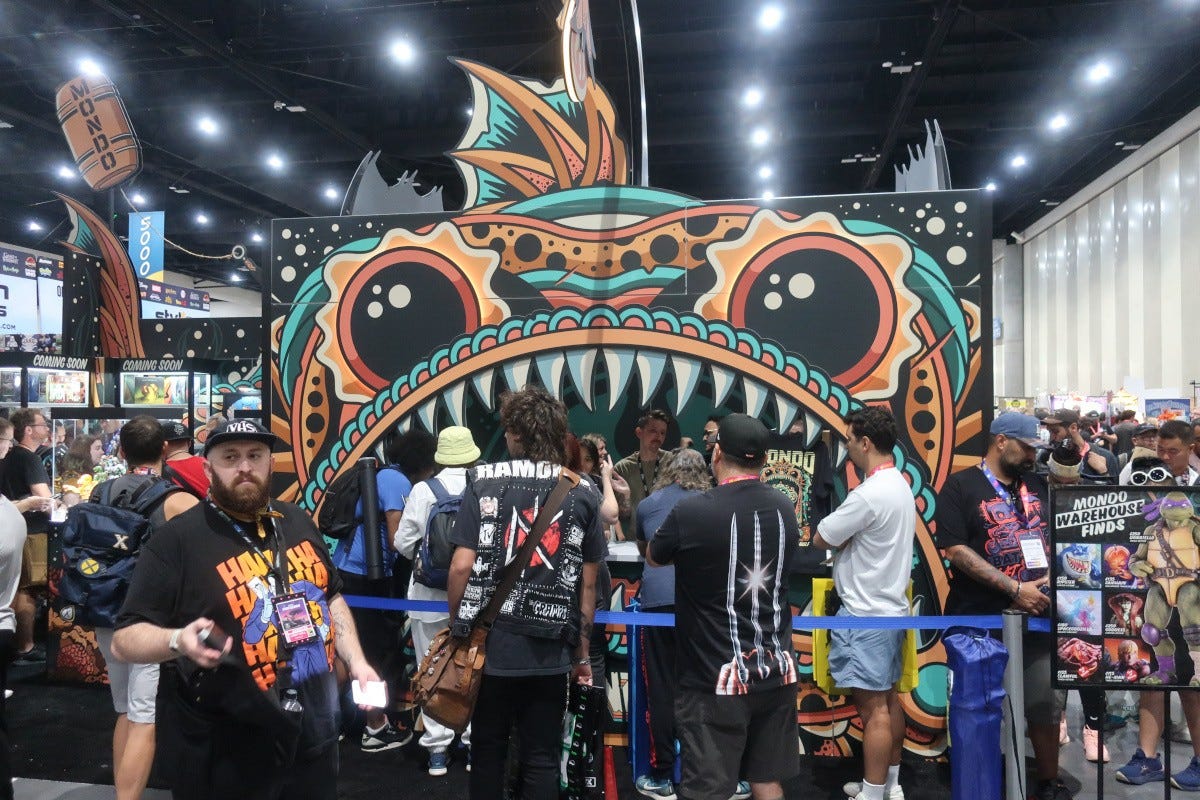
Ask anyone what they got out of Comic Con this year and the honest answer is stuff. Booth after booth has quietly converted into a store, and the anime takeover I described above is the leading edge of it... those companies aren’t renting floor space to market upcoming seasons, they’re running retail, and everyone else is following their lead. The economics force the issue from both directions. Comic Con itself has been open about brand dollars shrinking, sponsorship revenue coming in below the old highs, staffing and other amenitites (like outdoor WiFi) getting cut to match... and exhibiting in San Diego keeps getting more expensive for everyone at the same time. Selling merchandise is how the whole ecosystem closes the gap now, exhibitors and organizers alike.
Attendees changed right along with the exhibitors, and my Deadpool story is the proof. Camping out two days for a Hall H seat made sense when being in the room was the only way to have the experience... now the counterfeit wristband drama has people crying foul at the front of the line while I watch the panel’s biggest moment from a dinner table, sixty seconds after it happens, in better resolution. Being in the room still matters... touching grass and all that... needing to be in the room went away years ago, and once the panels stopped being scarce, the stuff became the point... the exclusives, the toys, the things you can only hold if you’re standing in San Diego. Everyone on that floor is building booths around that last bit of scarcity now.
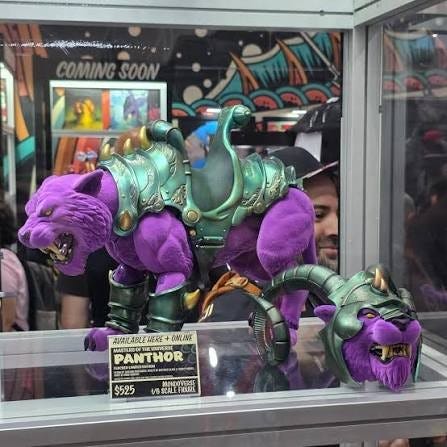
Every year the Vegas relocation rumor makes its rounds, and I’ll say it plainly... Vegas would kill Comic Con. This show survives its transitions precisely because of what San Diego lets it be, and a merch-first Comic Con doesn’t bother me the way it bothers some people. Kids want toys, mine got theirs, and a convention centered on buying comics and collectibles from the people who make them is arguably closer to the original vision / purpose of SDCC than the IP marketing machine the 2010s turned it into. Comic Con moves in eras... The studio marketing era just ended in front of me... and judging by the anime aisle and the registers ringing across that floor, the Anime x merch era is already here.
Which brings me home, literally and figuratively.
Before I left for San Diego, I knew this piece was going to be about Grand Theft Auto VI... walking that floor only confirmed it. I stood in a hall full of people screaming for Wolverine and Jean Grey, knowing the whole time what the data was going to say when I got back home. A black hole doesn’t only eat the games launching after it... it’s eating the ones launching before it too. I wanted a full month of post pre-order data before making that claim with numbers instead of vibes. The month is up... the data is in.
Let’s get into it.
The Fall Pie... Biggest In Five Years, Smallest In Five Years
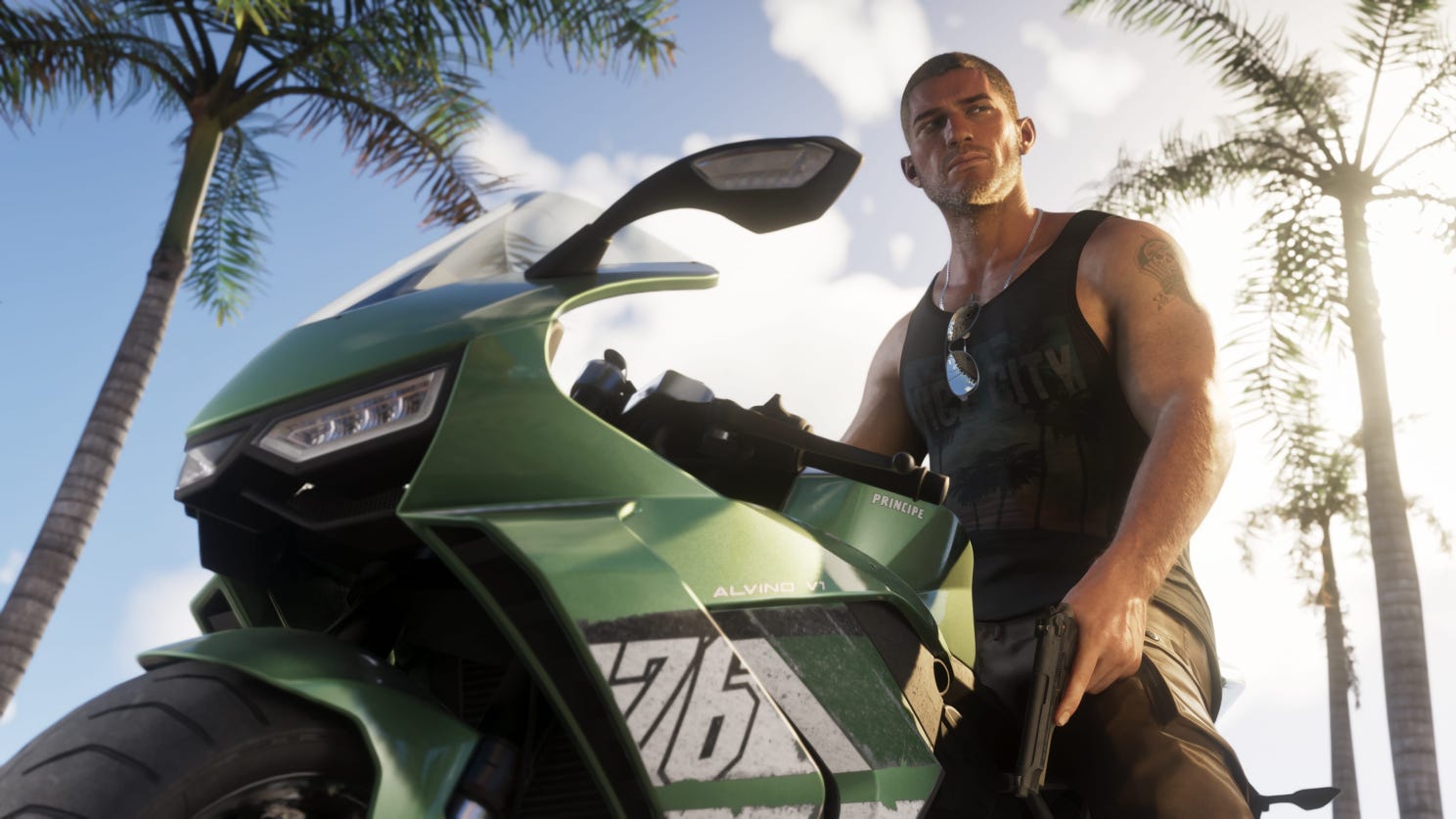
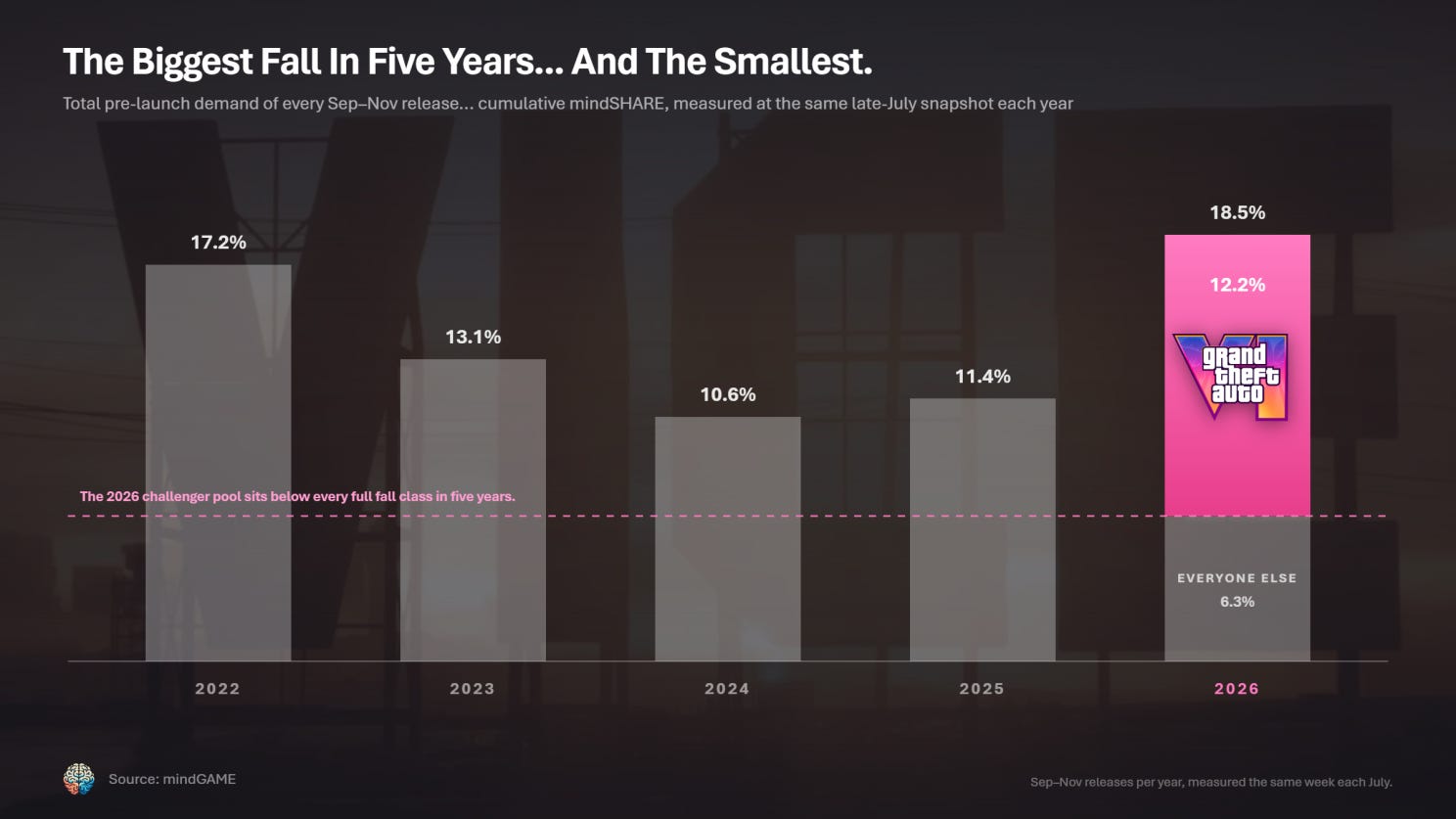
Start macro, because the strangest chart I’ve ever produced needs the setup. Every year I can measure the total pre-launch demand of the fall slate... take every game releasing September through November, add up their cumulative mindSHARE (our measure of demand accumulated over the 30 weeks before launch), and snapshot it at the same point in late July. Think of it as weighing the entire fall at the starting line. Five years of that exercise, same method, same date:
Fall 2022 held 17.2%. Fall 2023 came in at 13.1%. Fall 2024 hit 10.6%, and Fall 2025 rebounded to 11.4%... then there’s Fall 2026, sitting at 18.5%, the heaviest fall class in at least five years. Demand for fall games has never been measured higher in the mindGAME era.
Now remove one game.
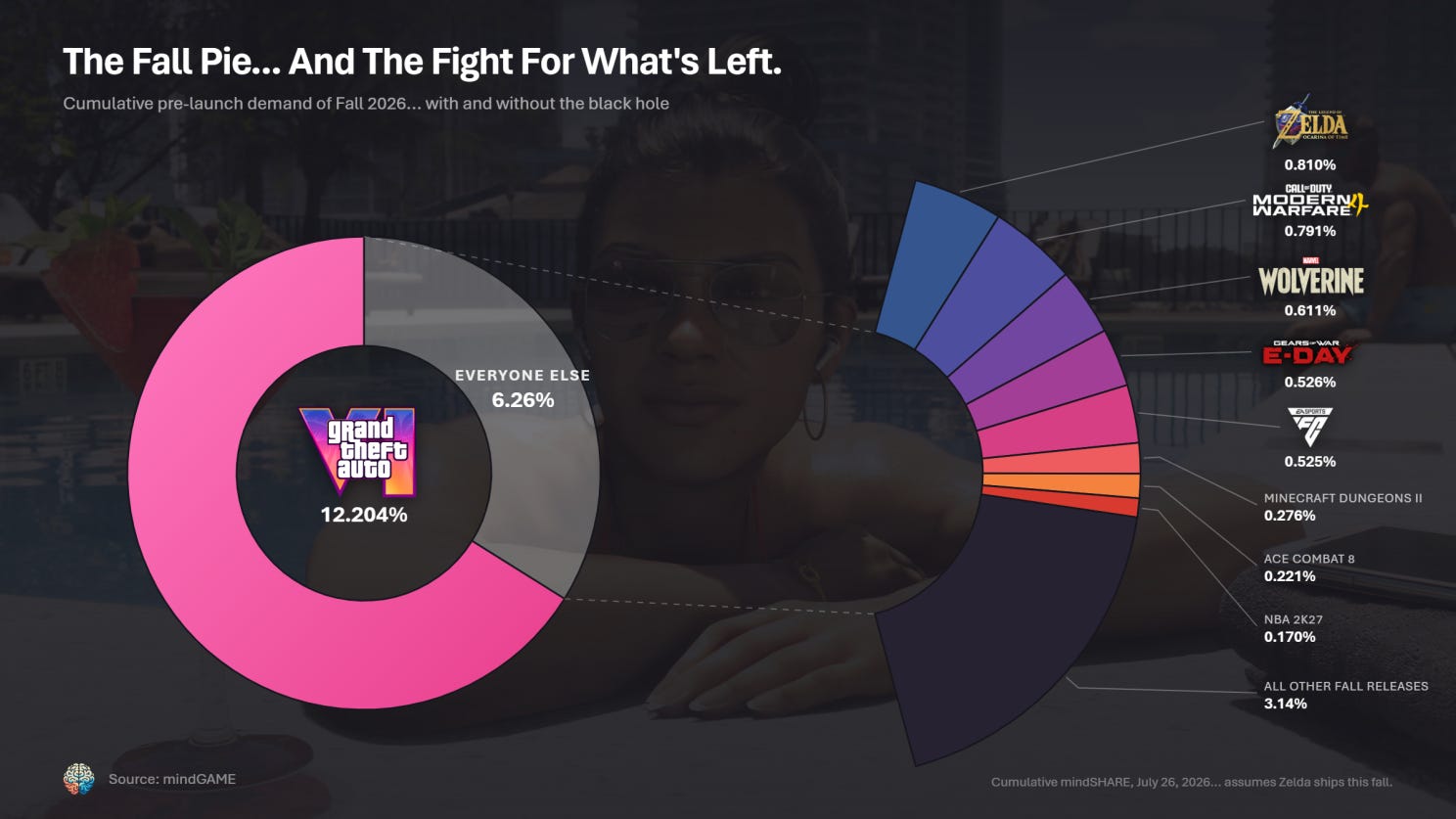
Without Grand Theft Auto VI, the fall of 2026 holds 6.26%. Roughly half of what any recent fall class carried at this exact point. Add back the Zelda: Ocarina of Time remake (undated, but almost certainly landing in the window... more on that later) and the challengers claw their way to about 7.1%. Either way, every publisher shipping a game in the next four months is fighting over the smallest pool of fall demand I’ve ever recorded, inside the biggest fall ever recorded. Both statements are true at the same time, and the distance between them is one game.
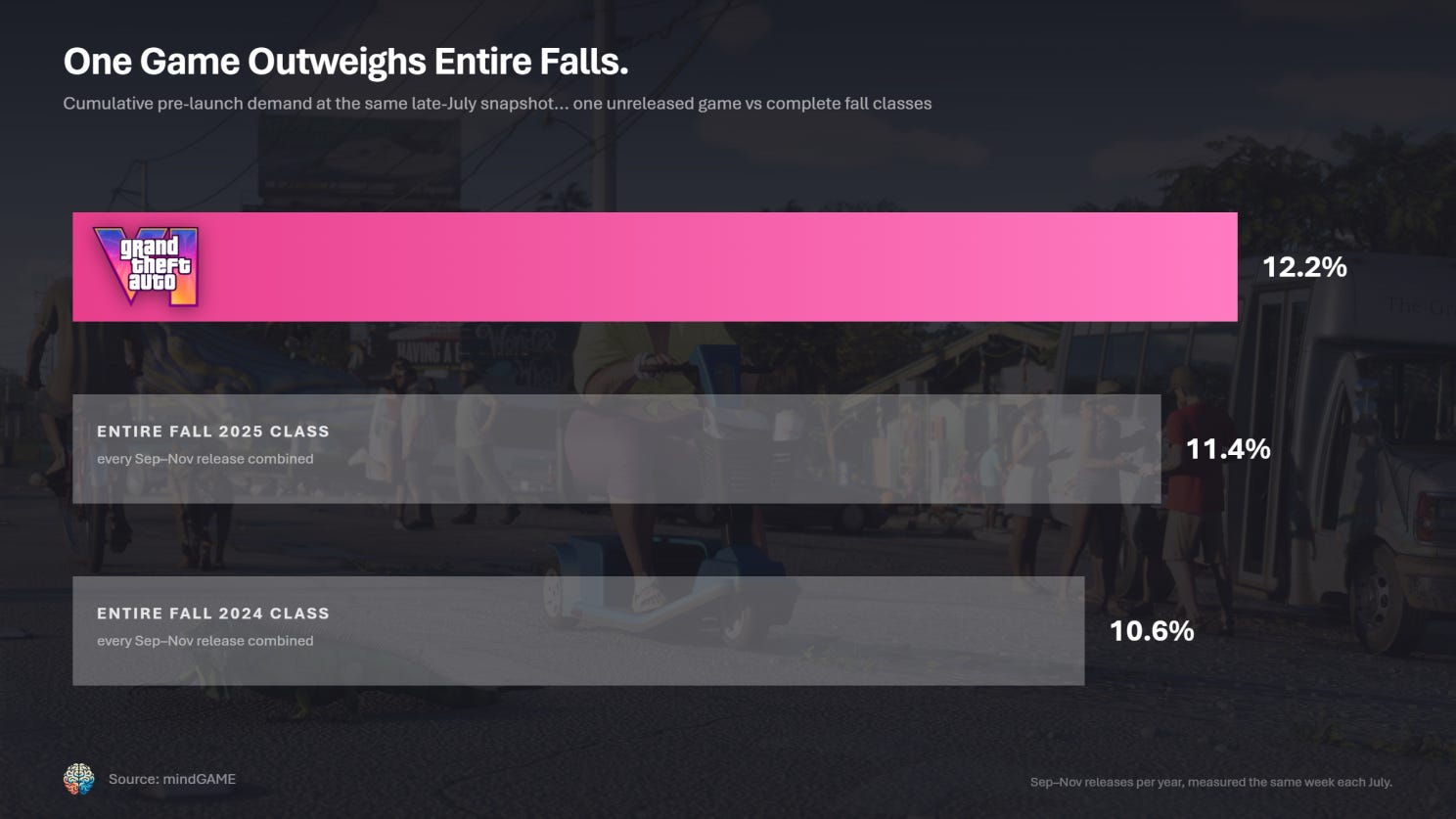
The comparison that stopped me cold: GTA VI’s cumulative demand currently sits at 12.2%... by itself. The entire fall class of 2024, every September, October, and November release combined, held 10.6% at this point in the calendar. All of fall 2025 held 11.4%. One unreleased game is carrying more accumulated demand than every game from an entire recent fall put together. I wrote a month ago that there is no counter-programming a black hole, and back then the argument leaned on GTA’s 7x lead over the next-closest game. The new framing is cleaner. GTA VI isn’t competing with this fall’s slate... it outweighs entire falls.
The release calendar tells the same story from the supply side. Our tracking shows 127 dated fall launches this year against the 242 to 349 that filled the books from 2022 through 2025. Some of that gap will close as stragglers announce dates (prior-year counts are retrospective, so treat the raw ratio gently), which is why I prefer the sturdier cut: games carrying meaningful pre-launch demand by late July. Twenty-two this year. Every fall since 2022 had between 30 and 36. However you slice it, fewer games are showing up to the fight, and Jason Schreier has spent all year documenting why... publishers fleeing the window, wide berths, some refusing to share a year with Rockstar Games, let alone a quarter. The retreat he reported in the spring is now visible in the raw count of games willing to exist this fall.
So the shape of the season is set. Less supply, less available demand, one game inhaling the difference... and I want to be careful with what that means, because “the fall is doomed” isn’t the takeaway. Games are still coming, plenty look genuinely great, and the companies shipping them aren’t stupid... they see the same gravity I do and they’re running the best plays available under the circumstances. Reveals are landing. Betas are loading. Cover athletes are being unveiled on schedule.
There will be winners this fall. What there won’t be is winners in the way we normally mean it, games that seize a quarter on their own momentum, because the oxygen those wins require is already spoken for. The winners of fall 2026 are getting decided... by the audiences GTA doesn’t own, by the marketing beats that still punch through, by default. The data on who’s punching through and who’s flatlining is where this gets interesting.
The Winners... Graded On A Curve
A quick word on how I’m grading before the report cards come out. Two tests run underneath everything in this section. The first is altitude... where does each game’s accumulated demand sit against its own franchise history at the exact same distance from launch? Past installments are the honest yardstick, because comparing anything to GTA is pointless and comparing a Call of Duty to a Silent Hill is worse. The second is the ramp... is the game accelerating into launch the way its predecessors did at the same point, or has the engine cut out? That one matters most this year, because my hypothesis coming into this analysis was that GTA’s pre-order gravity would flatten everyone’s growth curves.
The truth turned out more interesting. When a challenger buys a real moment (a reveal, a cover, a Hall H panel), the moment still works, at full franchise strength. Between the moments, though, everyone is floating on a lower water line... and a few games have lost their franchise ramp entirely. Punching through is possible this fall. Coasting is fatal.
The winners, in order of how I’d tell the story.
Marvel’s Wolverine... A New Franchise Launching At Spin-Off Altitude
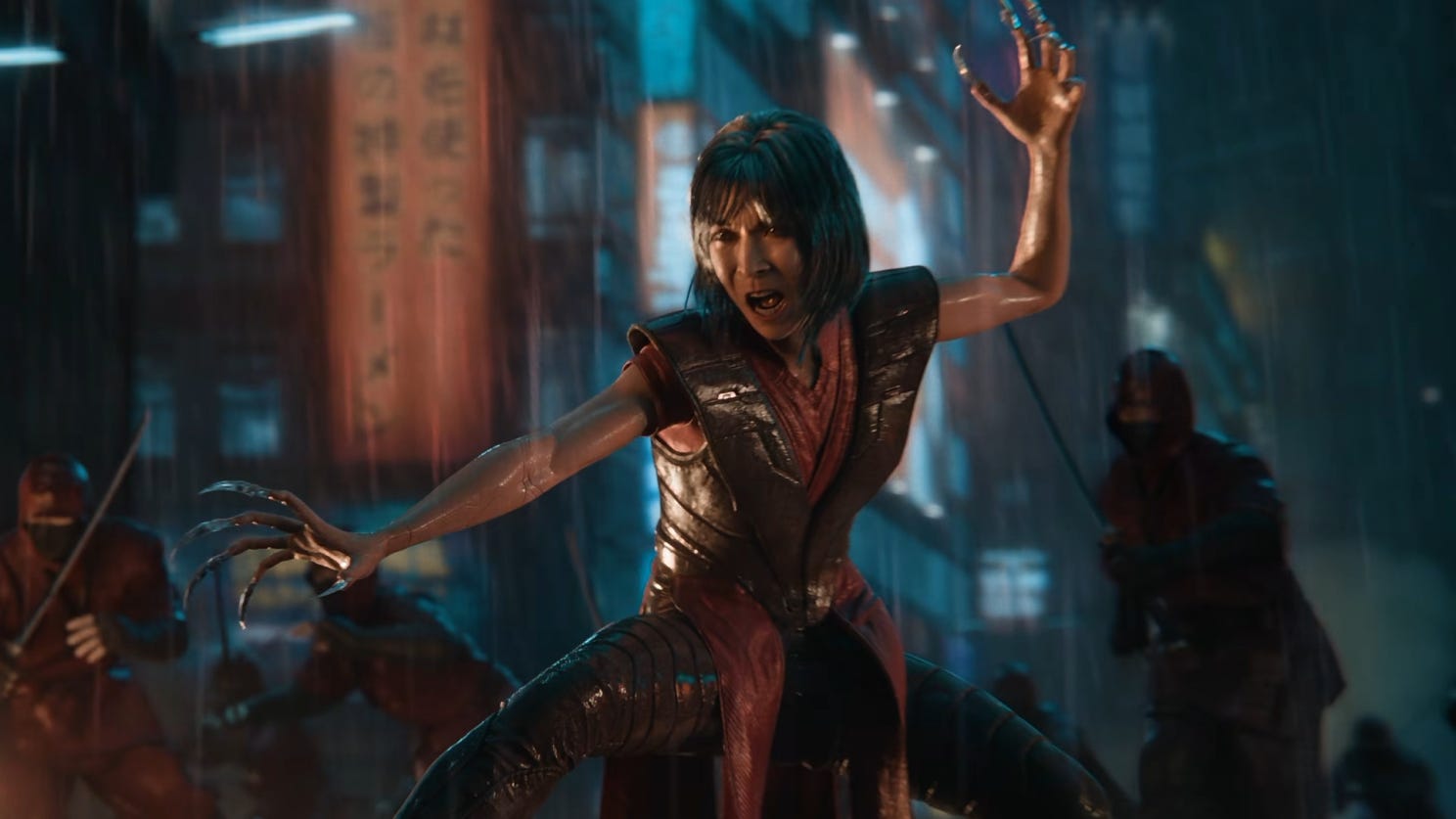
Start where I just came from, because I was in Hall H for the Deep Cuts panel and the room was electric... the new story trailer opens with Logan facing Jean Grey, Lady Deathstrike gets her showcase, the Hand pours in, and Insomniac stacked the stage with the creative leads and cast. They ran the full playbook: prequel comic, crossover suit in Tōkon, an actual moment engineered for the actual faithful. And it worked. Wolverine’s weekly demand growth jumped about 40% off the panel, the biggest organic bump any fall game landed that week. Punching through, confirmed.
Now the altitude check, and this is where the room and the data part ways. Eight weeks from launch, Wolverine has accumulated 0.611% cumulative mindSHARE. Spider-Man 2 stood at 2.115% at the same eight-week mark... Wolverine is running at 29% of its pace. Before anyone panics, the comp set runs deeper than one game. Miles Morales sat at 0.208% at this distance, and Guardians of the Galaxy (the closest thing to a non-Spidey Marvel single-player comp, from Square Enix) held 0.101%.
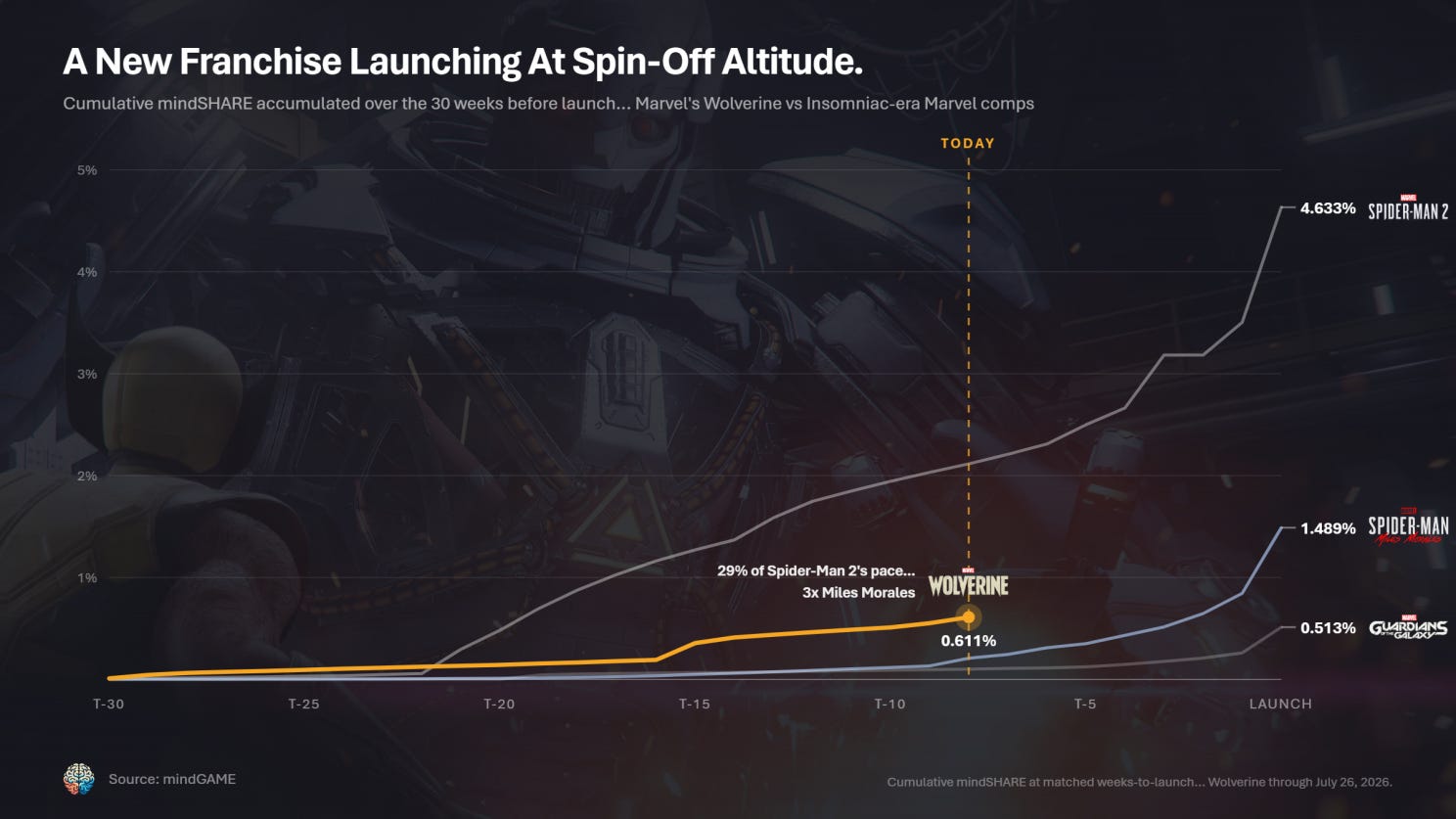
So Wolverine is tracking at triple the pace of Miles Morales and six times Guardians... while sitting at less than a third of Spider-Man 2. The shape of its curve is actually healthy. Its week-to-week trajectory mirrors Spider-Man 2’s at the same point almost exactly, just running at a fraction of the height. Nothing about this game’s demand is broken. It’s simply drawing the Wolverine audience instead of the Spider-Man audience, and there’s one obvious force out there deciding how much bigger than its base a game gets to grow this fall.
Wolverine isn’t a spin-off the way Miles Morales was a spin-off... it’s Insomniac launching the second pillar of its Marvel universe, a new franchise meant to stand on its own legs next to Spider-Man. That’s exactly why the altitude gap matters. A new pillar pacing at triple Miles Morales is a genuinely strong start for a franchise. A new pillar pacing at 29% of Spider-Man 2 says the second pillar is starting a lot shorter than the first... and whether that’s a problem depends entirely on what Sony needs this game to be.
EA Sports FC 27... The Best Punch Thrown From The Lowest Floor
The FC 27 story flipped in a single week. Nine weeks from launch, it holds 0.525% cumulative mindSHARE... the lowest of the entire FC era at this checkpoint. FC 26 stood at 0.783% at the same distance, FC 25 at 0.657%, and FC 24, the rebrand launch, towered at 1.151%. A World Cup summer, the single best tailwind football gaming can ever get, and the franchise walked into late July pacing dead last in its own history. That was the setup until July 23.
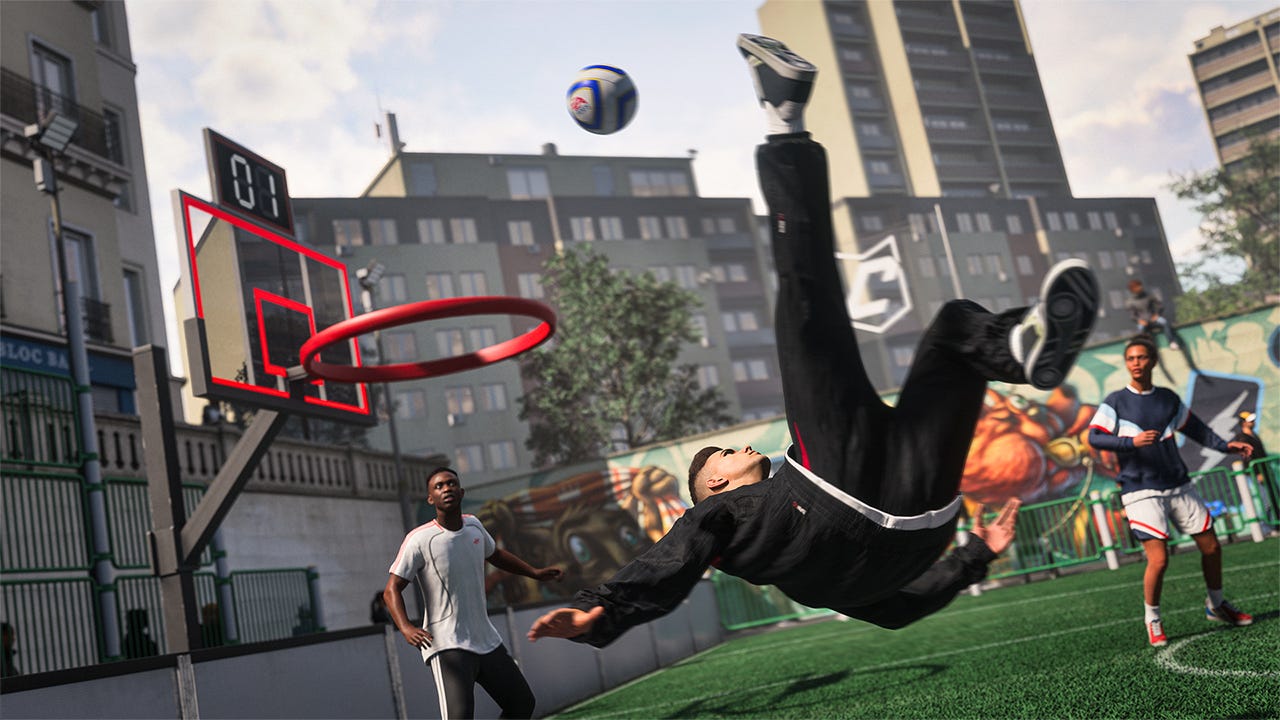
Then the reveal hit... Mbappé and Bellingham on the Ultimate Plus cover, The Grounds social mode as the new toy, September 25 locked... and FC 27’s weekly demand accumulation spiked roughly six-fold overnight. Here’s the number that matters more, though: measured as acceleration against its own franchise, the reveal delivered a 9x ramp. FC 26’s reveal managed 6x at the same point. FC 25’s did 7.4x. The best reveal-week acceleration of the modern FC era just happened... in the worst demand environment the franchise has ever launched into.
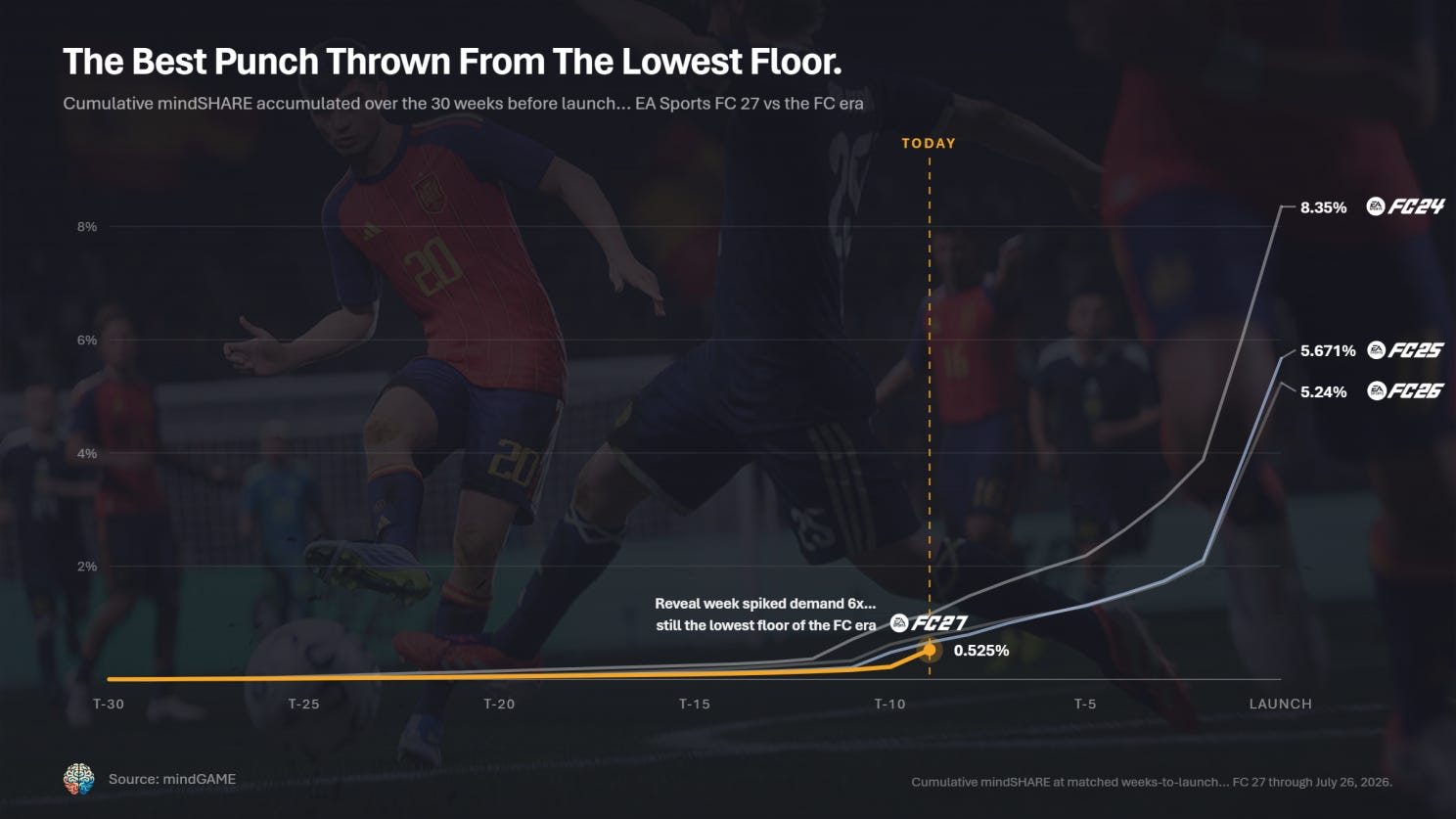
Electronic Arts (EA)‘s marketing machine is punching at full force, and the audience is responding on cue. What the punch hasn’t done is close the gap. Even after the spike, FC 27 still sits below where FC 26, FC 25, and FC 24 stood at this same distance... the reveal changed the slope, not the standings. The zone it landed in tells me plenty, though. A response this sharp means the audience didn’t leave, FC’s annual muscle memory is real, and most of those tens of millions will show up in the same two-week window they always do.
Recapturing the highs of the rebrand era? Very unlikely... FC 24’s 1.151% at this checkpoint might as well be a different sport. Matching last year? Possible, and honestly, that might be the whole win condition for this one. Hold serve in the year of the black hole and you’ve done your job.
Call of Duty: Modern Warfare 4... The Soft Middle, With One Shot Left
On paper, Call of Duty looks fine. Thirteen weeks from launch, Modern Warfare 4 holds 0.791% cumulative mindSHARE... ahead of Modern Warfare III at the same distance (0.687%), ahead of Black Ops 7 (0.428%), and comfortably clear of anything Vanguard or Cold War managed this far out. Look up instead of down and the view changes fast. Black Ops 6 stood at 2.416% at this checkpoint, Modern Warfare II at 2.769%, and Modern Warfare 2019 (still the modern high-water mark for this franchise) at 2.944%. Three to four times what MW4 is carrying right now. Middle of the pack in its own family history... above the entries everyone would rather forget, nowhere near the ones that defined the decade.
What actually worries me is underneath the standings. MW4’s weekly accumulation has been decelerating at 0.39x over the past six weeks... and at this same distance from launch, Modern Warfare III was accelerating at 2.93x. The biggest annual franchise in gaming has the most stalled engine of any game in this analysis. In a normal year, you coast through July and let the beta do its job. This is not the year to coast.
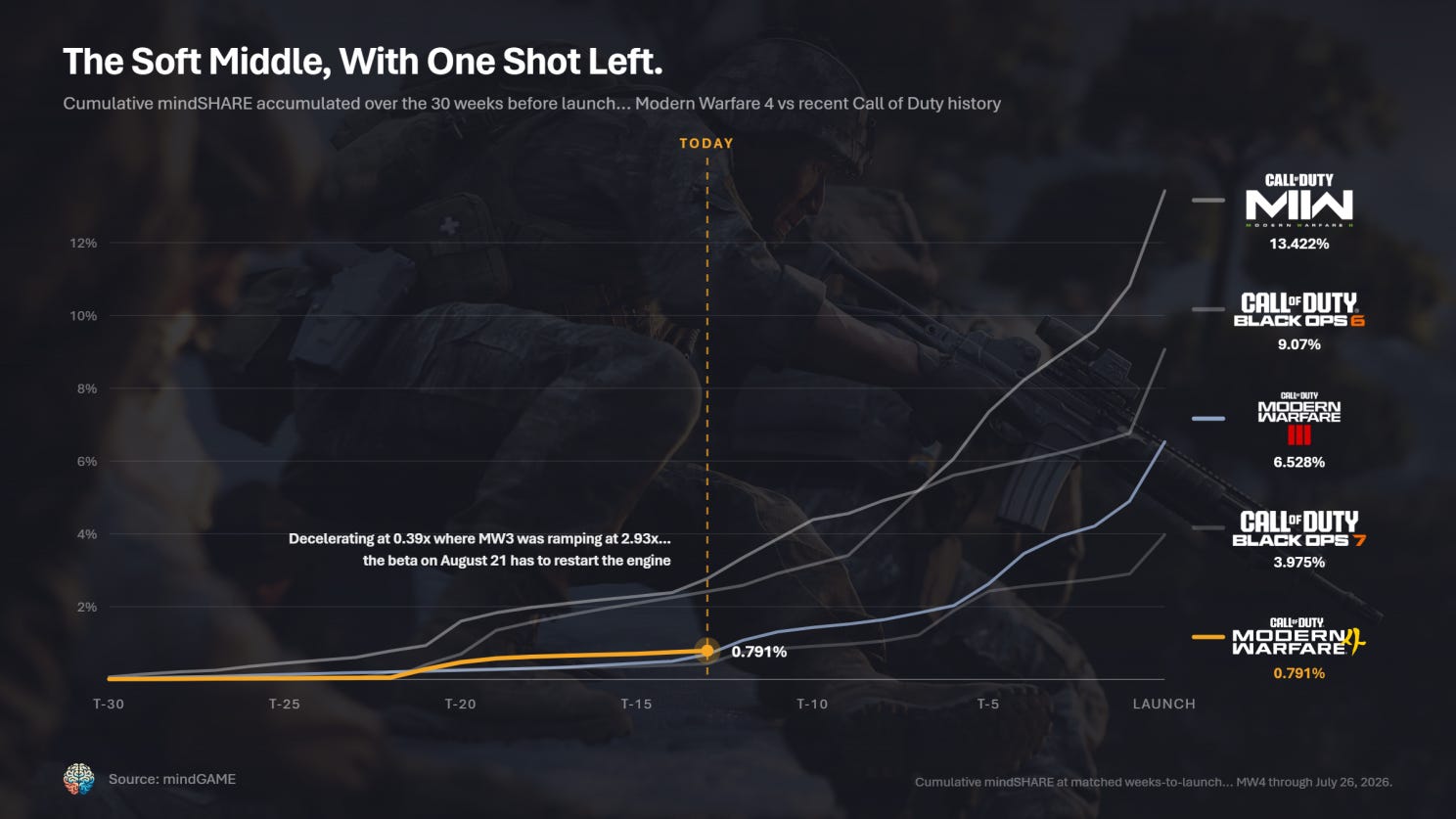
Activision seems to know it too, because August 21 is stacked like a rescue operation. Call of Duty: NEXT airs that day, and for the first time ever the beta starts immediately after the broadcast... Early Access through the 25th for pre-orders, Open Beta the following weekend for everyone (Switch 2 included, with Switch 2 pre-orders opening August 26), all funneling toward the October 23 launch. Even the pre-order mechanics are sweating... the serialized camo promotion literally engraves a number on your weapon for being one of the first 100,000 to finish a challenge (scarcity as a countdown clock, aimed straight at the undecided).
The beta has been Call of Duty’s biggest organic moment every year of the modern era, and this year it’s carrying more than hype duty... it has to restart a stalled engine. If it does, MW4 climbs toward the franchise’s decade highs and this section reads very differently in September. If it doesn’t... the soft middle of Call of Duty, three weeks in front of GTA VI, is a much colder place than Activision is used to wintering.
Gears Of War: E-Day... The Comeback Story With The Impossible Budget
E-Day turned in the strangest report card of the fall. Eleven weeks out, it holds 0.526% cumulative mindSHARE... the best pre-launch pace in modern Gears history, ahead of Gears 5 at the same distance (0.348%) and miles past Reloaded (0.183%). A franchise that’s been quiet since 2019, out-pacing its own biggest entry... in any other year, I’m writing this up as a comeback story.
Then I looked at the last month. E-Day’s weekly accumulation has been cut in half... 0.031 points a week, then 0.021, then 0.014, then 0.013... flat where Gears 5 was ramping at nearly 4x off its E3-era beats at the identical point. Best altitude in franchise history, engine dying on the climb.
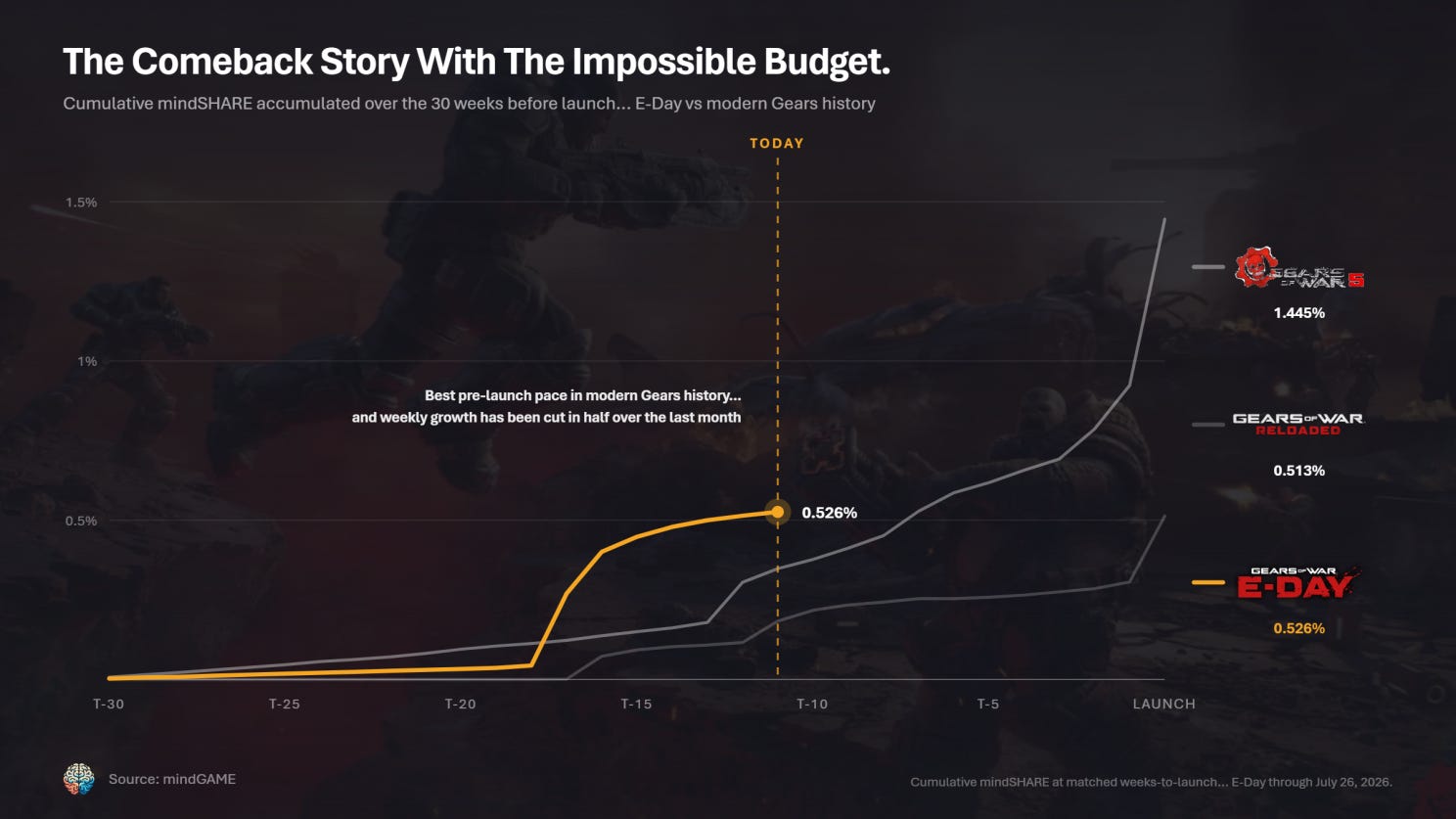
The counterpunch starts this week... multiplayer reveal July 30, beta August 6, launch October 6. Look at the calendar and you can see what Xbox is doing: they own the month of August for shooter betas, E-Day first, Call of Duty on the 21st. And the ordering is the tell. Everyone (Microsoft included) knows which beta wins that month... putting Gears first is damage control, giving it two clean weeks before the comparison machine spins up. Will it work? Maybe. There’s no version of this where people don’t compare Gears to Call of Duty eventually, but at least it gets its moment before the verdict comes in.
The real problem sits above all the scheduling: the reported budget on this game is north of $400 million, and there is no chance... none... it makes that kind of money back in sales. So what is it? A Game Pass engine, presumably, and maybe one of the last gasps of games greenlit before the Asha era began... a project approved under the old math, arriving under the new one, getting pushed as hard as the machine can push it. It might genuinely find its audience.
It has to find that audience fast, though, because the thing E-Day needs most is a clean window, and its window is exactly where an undated Zelda remake might land. Ocarina of Time comes through that October corridor and it crushes this game. My honest projection: E-Day lands as a solid B-tier fall release, and in most years, solid B-tier is fine. Is fine acceptable on a $400 million game? That’s an open question I don’t think even Microsoft can answer yet.
The Legend Of Zelda: Ocarina Of Time... Winning A Fall It Hasn’t Even Entered
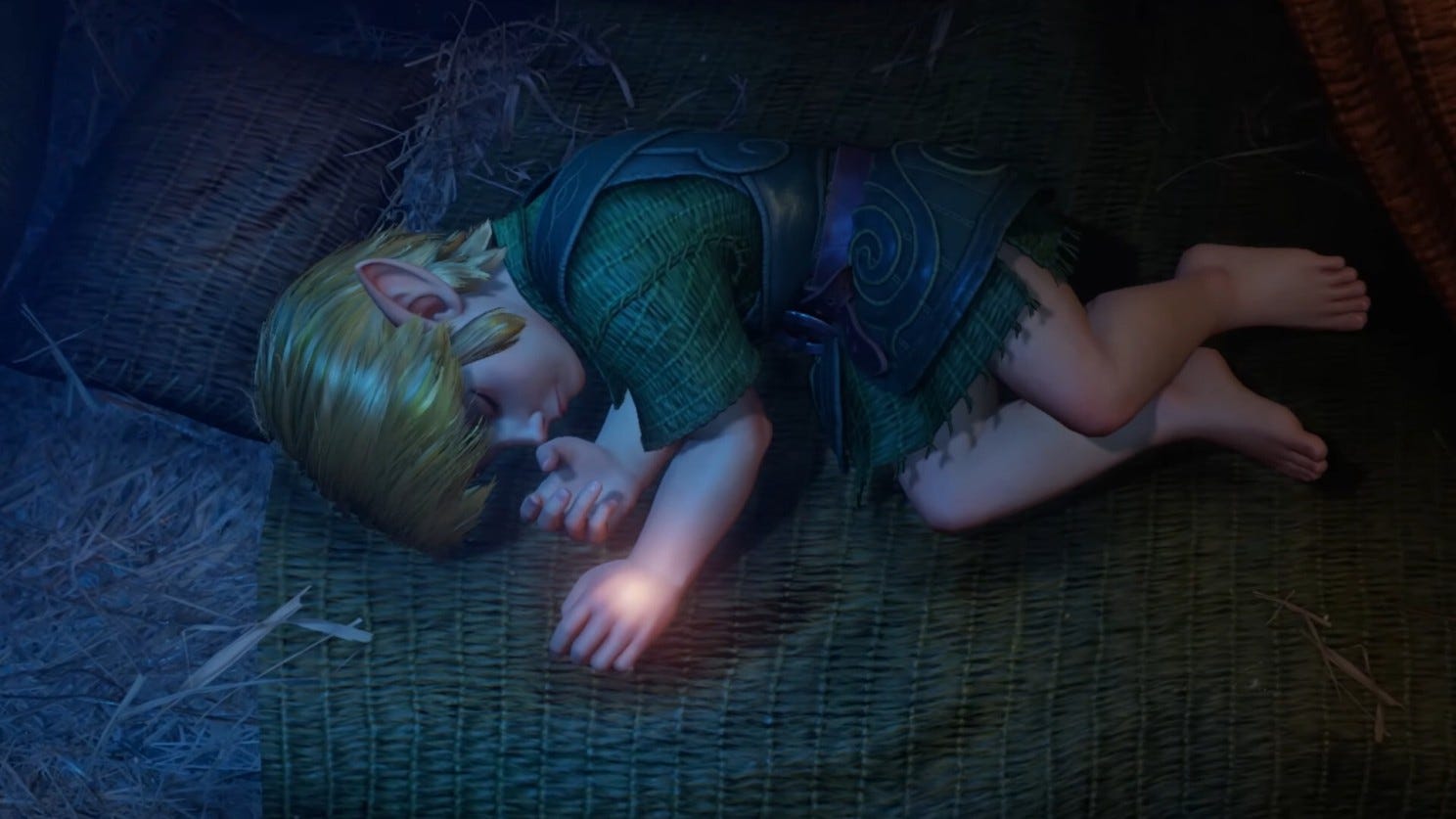
Nintendo, so help me, still refuses to announce a release date for this game. No window beyond “2026,” no Direct on the calendar, nothing since the June teaser... and none of it matters, because Ocarina of Time has quietly banked 0.810% cumulative mindSHARE anyway. An undated remake is currently the second-largest demand pool of the entire fall. Every other publisher in this piece is buying reveals, covers, and betas to move their number... Nintendo’s grew to second place on a 90-second teaser and silence.
The weekly tape is my favorite part of the story. Every game cools off after its reveal moment... Zelda did too, and then it found a floor around 0.04 points a week and just... held it. Four straight weeks, no news, no beats, no nothing, and the demand keeps arriving anyway. Line it up against the rest of the winners: E-Day’s weekly adds have decayed every week for a month, Call of Duty needed Fanatics Fest to tick back up, FC needed a cover reveal to move at all. Zelda’s do-nothing baseline is what other games get from a marketing beat. Growing demand without lifting a finger... very typical Nintendo, and in this fall, it’s a superpower.
My money is on October for the date, and the reasoning is Nintendo’s own calendar. October is where Nintendo ships its fall tentpoles... it’s the Pokémon slot, year after year, and with no mainline Pokémon on the 2026 slate, that slot is sitting open. Slide Ocarina into it and the comp gets serious. Tears of the Kingdom held 0.983% at the equivalent distance from launch, on its way to a 5.894% final... one of the biggest pre-launch accumulations we’ve ever tracked.
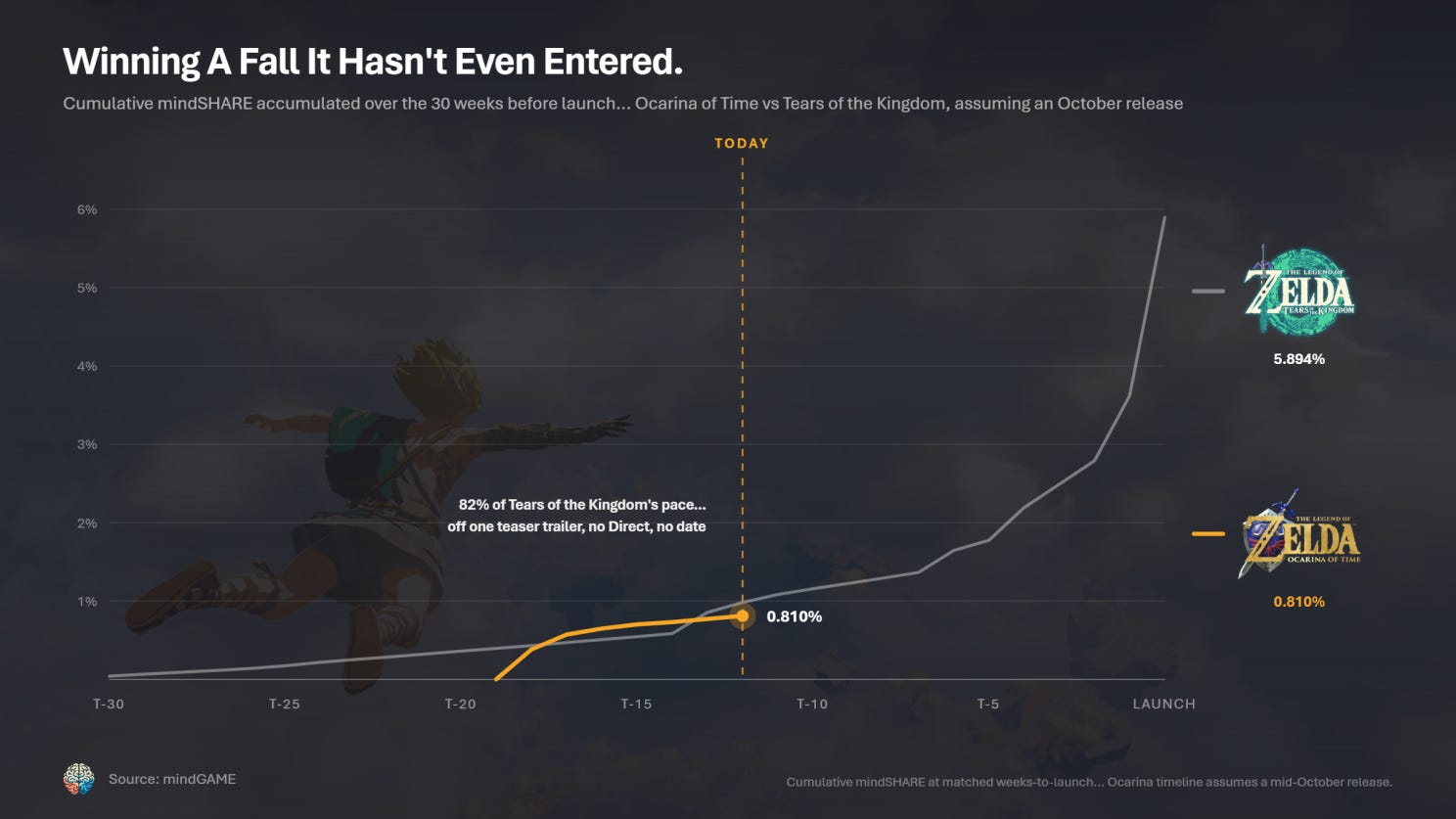
Ocarina is pacing at 82% of Tears of the Kingdom off a single teaser, no Direct, no date, for a remake of a 28-year-old game. And the catalysts are all still in the chamber... the date announcement, the inevitable Direct deep-dive, and lurking behind everything, the live-action Zelda movie arriving next year. The moment that marketing machine touches this franchise, I expect the demand line to blow past everything on this chart except the black hole itself.
Which brings me to the claim I need to walk back... carefully. A month ago I wrote there is no counter-programming a black hole, and I stand by it for every game trying to out-vibe GTA with a different flavor of the same audience. Counter-programming only works when the audiences genuinely don’t overlap, and there’s exactly one major release this fall that clears that bar.
Grand Theft Auto VI is not getting played by anyone under ten, at least not in households paying attention... which means every family in America needs something else this holiday, and (all apologies to Ubisoft’s Rayman) Ocarina of Time is that something. Switch 2 households, kids, families, and a nostalgia cohort for whom this is the most important game ever made. The wallet math dooming half this fall (one of your two annual purchases already spent on November 19) barely applies inside Nintendo’s ecosystem.
Everyone else is fighting the black hole for oxygen. Nintendo is playing on a different planet entirely, one GTA’s gravity barely reaches... and that’s how, outside of Grand Theft Auto VI, the Ocarina of Time remake becomes the clear winner of the fall.
And that’s the whole winners’ circle. Look at what it took to get in... a new franchise launching at spin-off altitude, a football game holding serve, a Call of Duty waiting on a defibrillator, a $400 million comeback praying for a clean window, and a dateless Nintendo remake lapping the field. Grade on the curve and every one of them passes. Every one of them is also fighting for scraps of a pie that’s half its normal size, and they’re the lucky ones. The pie only feeds so many.
The Real Losers... Caught In The Blast Radius
Let me define the term before I start naming names, because “loser” is doing specific work here. A loser this fall isn’t a bad game... several of the games below might end up on Game of the Year lists. A loser is a game the market has already stopped considering. The winners above all cleared the same bar: when they threw a punch, demand responded, and their franchise audiences are visibly assembling even if the numbers run below history.
The games below are failing that test... at least as of now. Their beats land on silence, their weekly demand is flatlining months from launch, and their pre-launch curves are running at fractions... not percentages, fractions... of what their own franchises accumulated in past runs. The blast radius isn’t about quality. It’s about arriving at the exact moment one game spent the industry’s entire budget of attention, with nothing in your audience or your calendar to shield you.
Three stories tell it best.
NBA 2K27... Grading Itself On The Curve
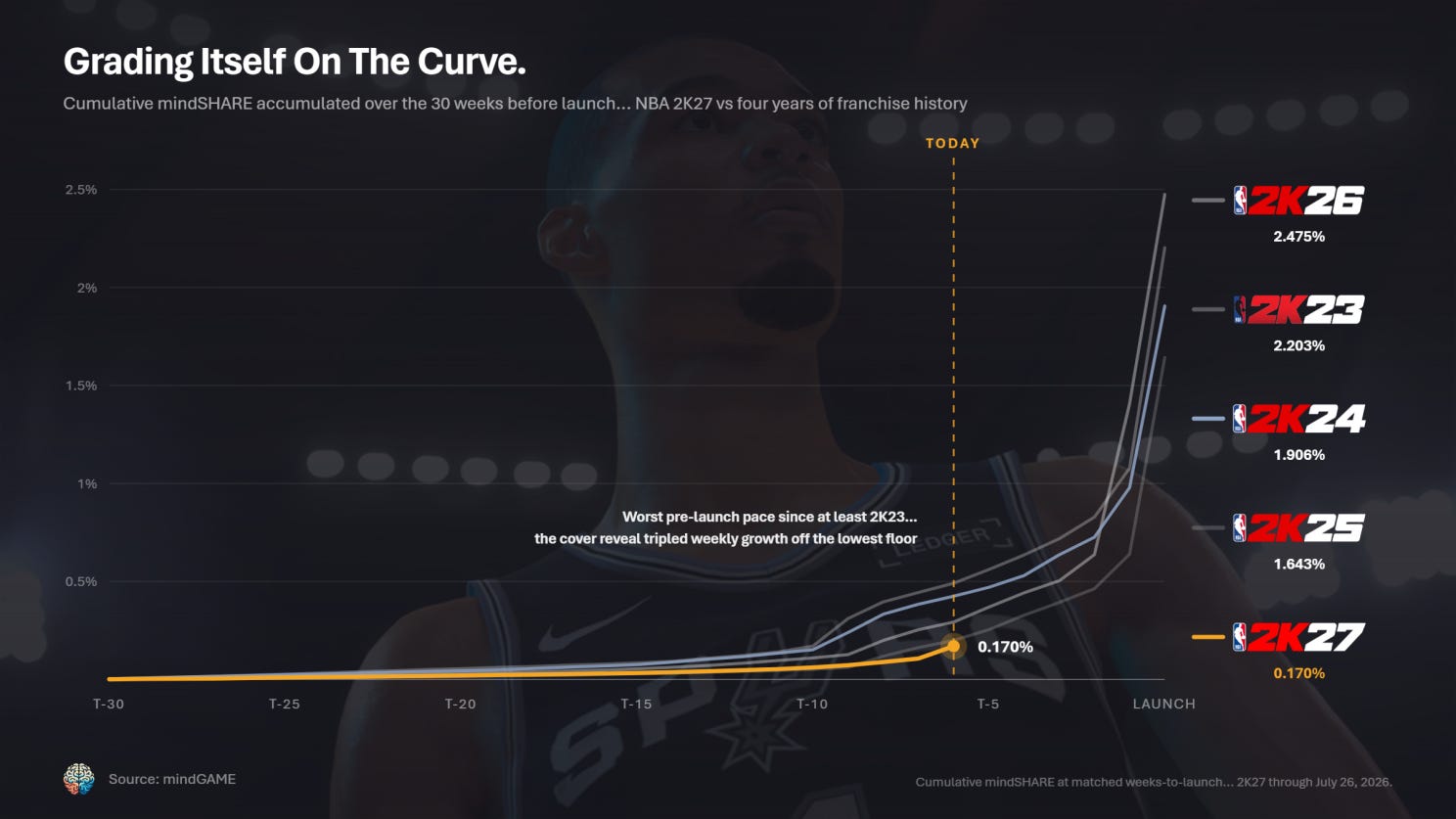
NBA 2K27 is running the worst pre-launch pace this franchise has posted in the years we’ve tracked it. Six weeks from its September 4 launch, it holds 0.170% cumulative mindSHARE... below 2K26 at the same distance (0.293%), below 2K24 (0.425%), below 2K23 (0.491%), and closest to 2K25 (0.199%), the entry nobody wants to be compared to. And 2K just fired its best bullet.
The cover reveal landed July 22... Wembanyama on Standard, Caitlin Clark making history on the Deluxe, Derrick Rose on the Ultra... a genuinely strong lineup that tripled the game’s weekly demand overnight. Franchise-normal acceleration, textbook execution. From the lowest floor in franchise history. Sound familiar? Same story as EA FC, one aisle over in the sports section... the beats work, the audience responds, the water line stays low.
Here’s what makes 2K27 different from every other game in this piece: its parent company built the black hole. Take-Two owns both ends of this story, which means somewhere in that building, executives are looking at the same curve I am and shrugging. Why panic? The annual audience shows up in September like it always does, there’s real room to close the gap against 2K25’s pace, and if a chunk of the basketball crowd is holding their wallet for November 19... the money lands in the same pocket either way. NBA 2K27 gets to grade itself on the curve. Every other publisher this fall is surviving GTA. Take-Two is being subsidized by it.
Silent Hill: Townfall And CONTROL Resonant... Holding The Ball At The Buzzer
Now the two that hurt to write about, and they belong together because they’re trapped on the same calendar page. Silent Hill: Townfall and CONTROL Resonant both launch September 24... the same week EA Sports FC drops its annual avalanche on the market, seven weeks before GTA VI. Two atmospheric single-player games sharing that launch day with each other. I’ve stared at this calendar for a month and I still can’t explain it.
Each one arrived at the same flatline by a different road. Resonant’s problem has a birthday: Summer Game Fest. Remedy showed up, spent real money... the promotion has been everywhere since, and I mean paid-everywhere... and the game never broke through. It’s still not breaking through. The demand line sits at 0.110%, one-fifth of what the original Control held at this same distance back in 2019, and where the original was accelerating at this point, Resonant is decelerating. Remedy is self-publishing the sequel to a game that sold over six million copies, calling it a “must-have day-one purchase,” promising the marketing will intensify... and every dollar so far has bought silence.
Townfall’s problem might be simpler: three Silent Hills in three years. SH2 Remake, then f, now this, and the well looks tapped... it holds 0.070% at six weeks out, one-ninth of SH2 Remake’s pace and one-sixth of f’s. This week the preview embargo lifted to genuinely glowing press... four-hour hands-on sessions, comparisons to f, real critical heat... and the demand line didn’t move. Konami spent two years rebuilding this franchise’s name, the rebuild worked, and the third trip to the well is coming up dry anyway.
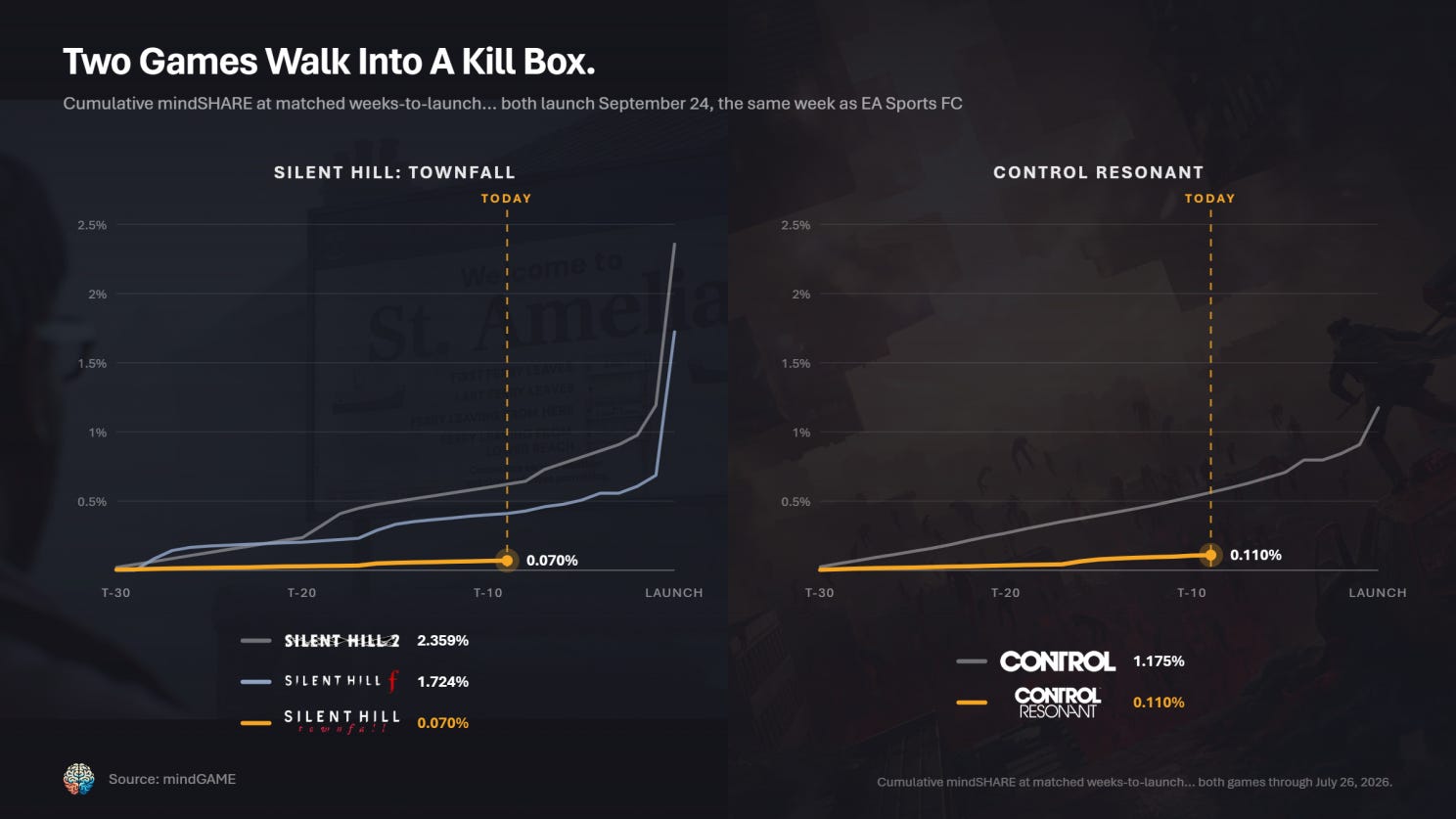
And there’s nowhere to go. Scan September for either of these games and every week is spoken for... scan October and it gets worse. Moving costs money, staying costs more, and so both studios are doing the only thing left: holding the ball as the clock runs out, hoping the shot falls on a day the entire market is watching football. Available attention is the problem this fall, and reviews can’t buy any.
Remedy already lived this lesson once... Alan Wake 2 racked up Game of the Year hardware and still needed fourteen months and two million units just to break even, and chasing a bigger cut of the next one is exactly why Remedy took the self-publishing route on Resonant. Critical acclaim converted slowly in a normal year. Now the same studio needs it to convert fast, on September 24, against football, seven weeks before the black hole... with Townfall needing the same miracle on the same day.
The realistic path for both is the long one: survive launch week, then lean on the Steam sale cycle and whatever word-of-mouth tail develops to claw the numbers back over a year. Nobody plans a launch around the discount algorithm. It’s just what the calendar left them.
Phantom Blade Zero... The Next Wukong Needed Wukong’s Calendar
Everyone wants to know if Phantom Blade Zero is the next Black Myth: Wukong, so I pulled the one comparison nobody runs: the competition. Wukong launched August 20, 2024, and look at what it launched against... nothing. The biggest game within three weeks of it was Space Marine 2 at 2.359% final pre-launch demand, and that came three weeks later. Launch week itself was Madden and a World of Warcraft expansion. Wukong walked into a late-August dead zone carrying 4.665% of accumulated demand, double anything near it, the undisputed main event of its own month... and then China turned it into a supernova. The clear runway wasn’t a footnote to that launch. It was a precondition.
Phantom Blade Zero gets the opposite calendar. It arrives October 29, six days behind Call of Duty: Modern Warfare 4 and three weeks in front of Grand Theft Auto VI... the undercard slot between the industry’s biggest annual release and the biggest release ever. And it’s carrying 0.096% into that gauntlet, a demand line sitting dead flat at four-thousandths of a point a week. Wukong at the same distance held 0.147% before growing 30x on the China surge, so the gap today is smaller than you’d think... the difference is Wukong had somewhere to grow into.
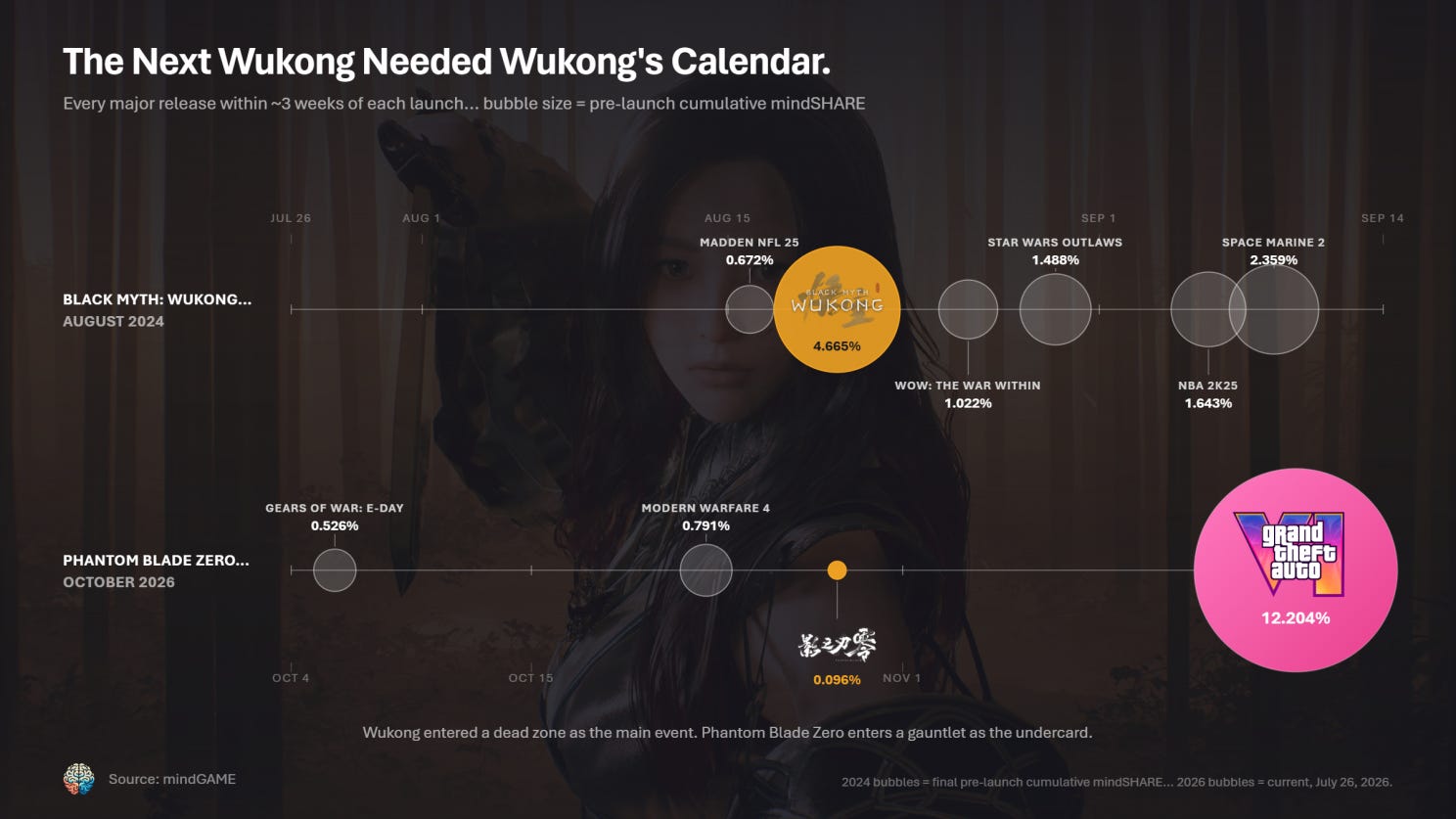
Could China rewrite the story anyway? Maybe. China is the wild card no model catches, and it’s the entire bull case here. The pattern makes me doubt it, though... every game handed the “next Wukong” label has fallen short of it, and the more I run these numbers, the more I land on the simplest answer: Wukong was a perfect storm of game, moment, and empty calendar. Phantom Blade Zero has, at best, one of the three.
That’s the blast radius... a 2K grading itself on a curve its parent company built, two September games holding the ball at the buzzer, and a would-be Wukong staring down a calendar Wukong never had to face. It would be easy to close the report card there and call the fall a two-tier season: the graded-on-a-curve winners up top, the flatlines underneath. The data kept surfacing a third tier, though... a handful of games nobody is talking about, quietly posting some of the healthiest demand curves of the entire fall.
The Sleepers... Flying Under The Black Hole
After three thousand words of gravity and blast radius, I owe you some hope... Not everything outside the winners’ circle is flatlining. While I ran this analysis, a handful of games kept surfacing in places they had no business being... mid-sized titles posting top-20 demand numbers, out-pacing games with far bigger budgets and far louder campaigns, growing steadily while the September pile-up fights for scraps.
No black hole panic, no desperate counter-moves... Just healthy curves, quietly compounding. These games share the winners’ secret without the winners’ name recognition: they found audiences the gravity doesn’t reach, and they’re proof the fall isn’t all doom... there’s a middle path through this season, and a couple of games are already walking it. Two stood out above the rest.
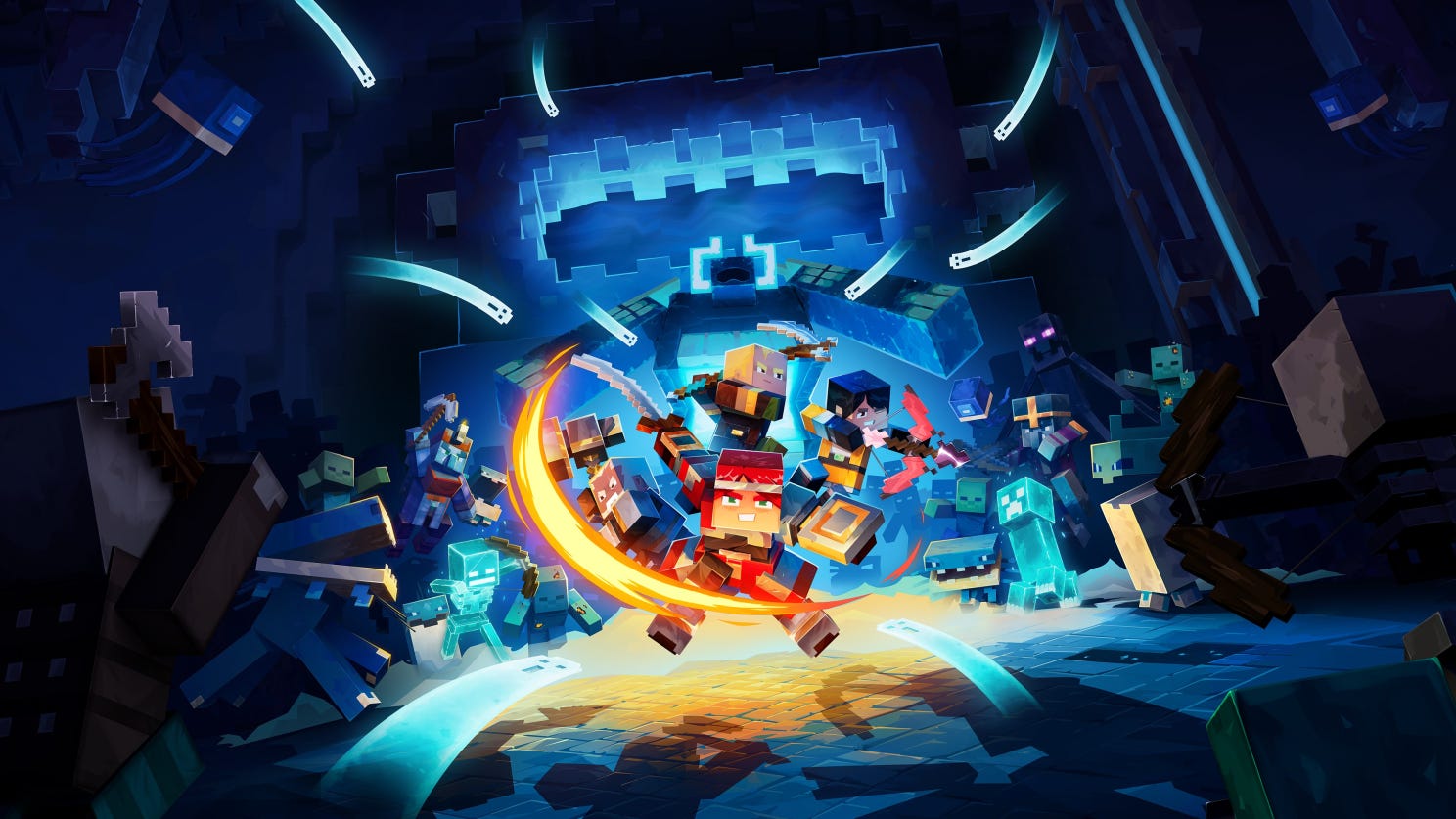
Minecraft Dungeons II... The Quiet Overachiever
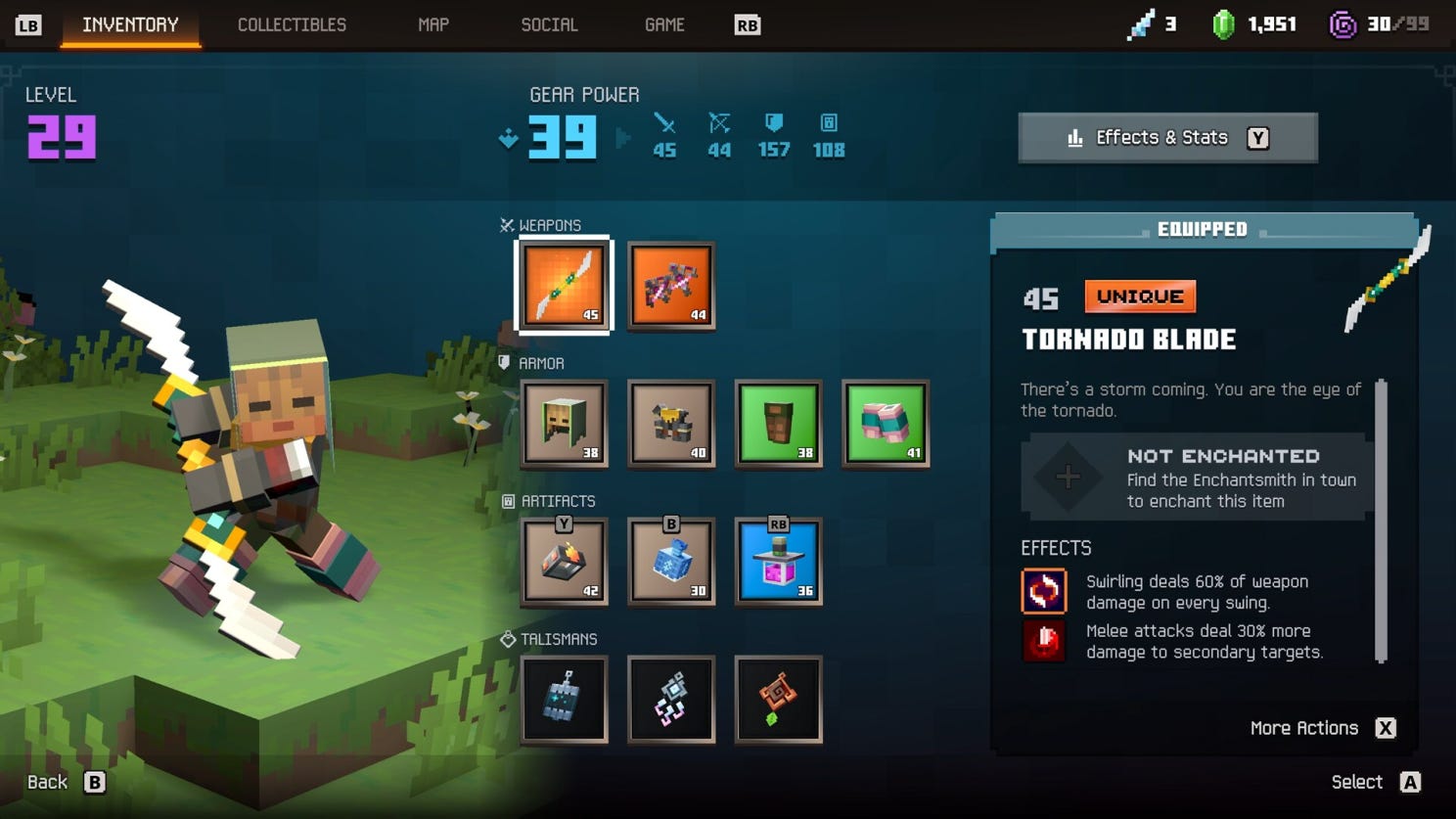
This sequel arrived quietly by design. The original Minecraft Dungeons launched in 2020 as Mojang’s family-friendly answer to the dungeon crawler... Diablo with blocks, four-player co-op, zero blood, and a difficulty curve a seven-year-old can climb. It found a massive audience on Game Pass and living-room couches without ever making industry noise, which is the most Minecraft-franchise outcome possible.
The sequel followed the same playbook: leaked as Project Spicewood, announced at Minecraft Live in March, dated at the June Xbox Games Showcase for September 29... every platform including both Switches, Game Pass day one, a new story built around the Deep Dark. No Hall H panel, no cover athletes, no urgency mechanics. A date and a trailer, nothing else.
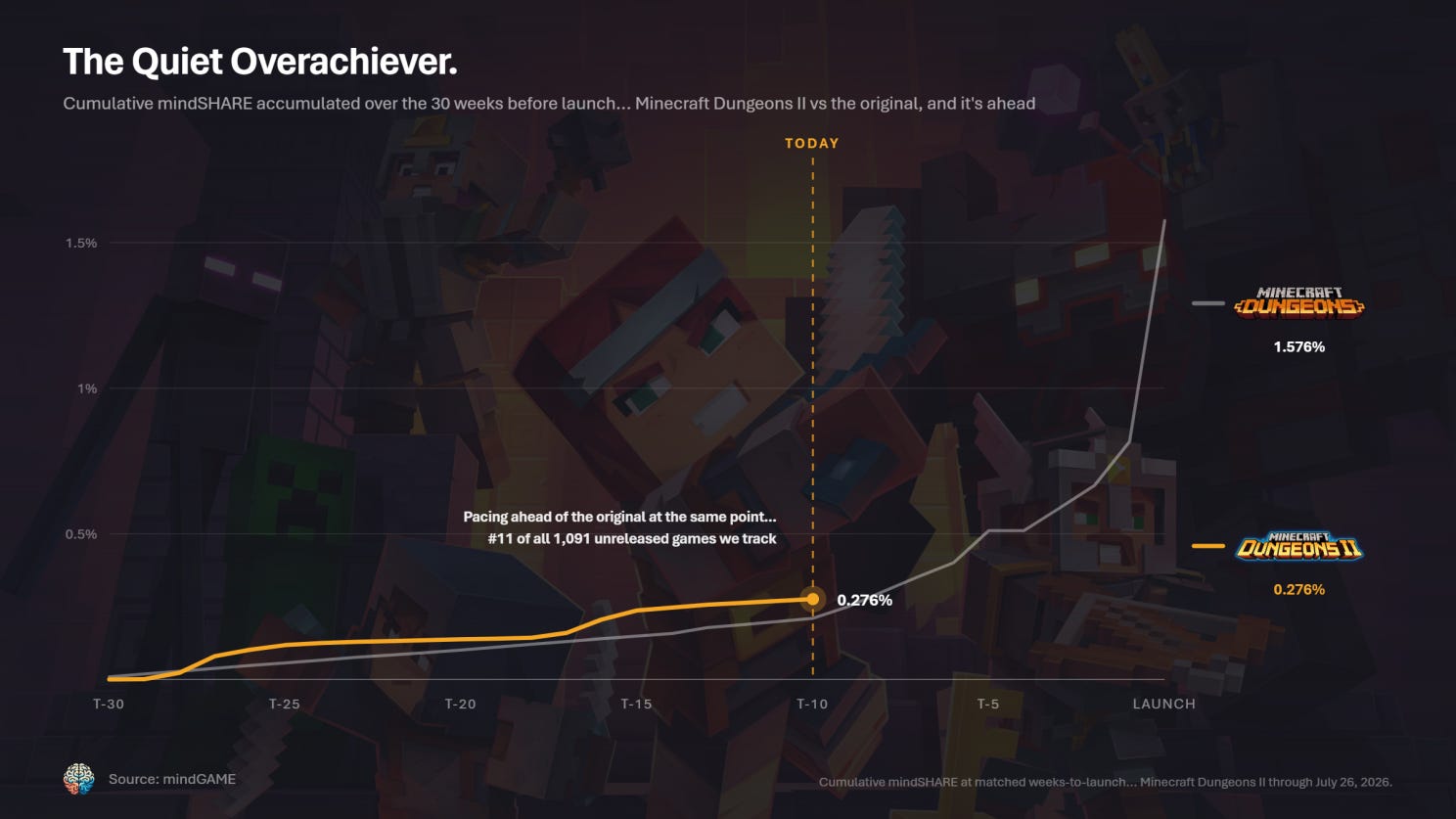
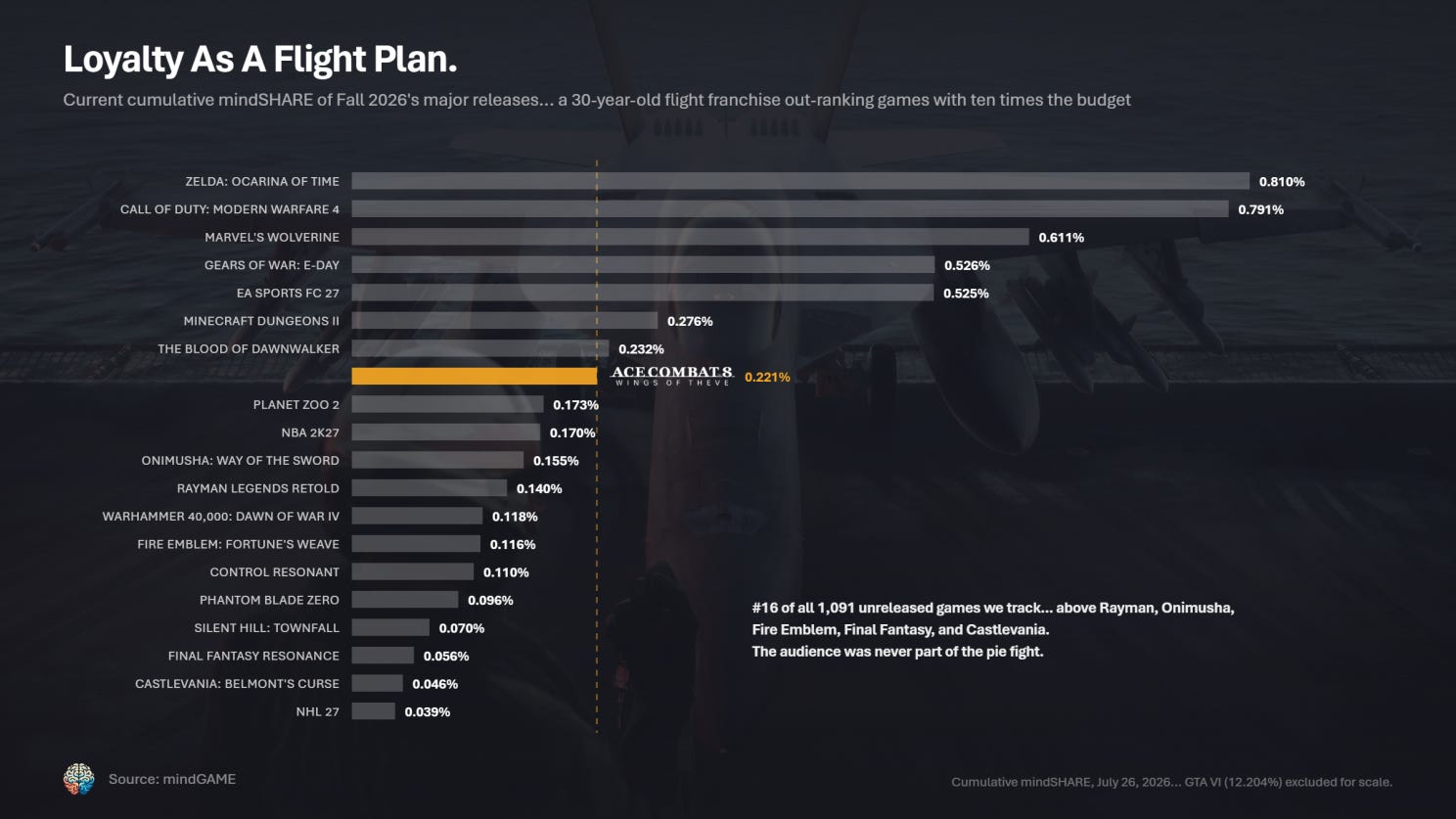
And the demand line responded anyway. Ten weeks out, Minecraft Dungeons II holds 0.276% cumulative mindSHARE... good for #11 among all 1,091 unreleased games we track. Ahead of Silent Hill. Ahead of CONTROL Resonant, ahead of Phantom Blade Zero, ahead of most of the September pile-up that’s spending real money to stay visible. The franchise comp makes it better: the original held 0.210% at this same distance in 2020, on its way to a 1.576% final, and the sequel is pacing ahead of it.
A sequel out-running its predecessor’s curve is rare in any year. This year it’s practically a cheat code, and the reason is the same physics that made Zelda the winner up above... the Minecraft audience is kids, families, and Switch households, the demographic slice GTA VI structurally cannot touch. The black hole pulls hardest on the 18-to-40 core gamer. Minecraft Dungeons II is fishing in the one pond that isn’t draining, and Microsoft gets to run this launch on the exact calendar week that’s murdering everyone else’s.
Ace Combat 8: Wings Of Theve... Loyalty As A Flight Plan
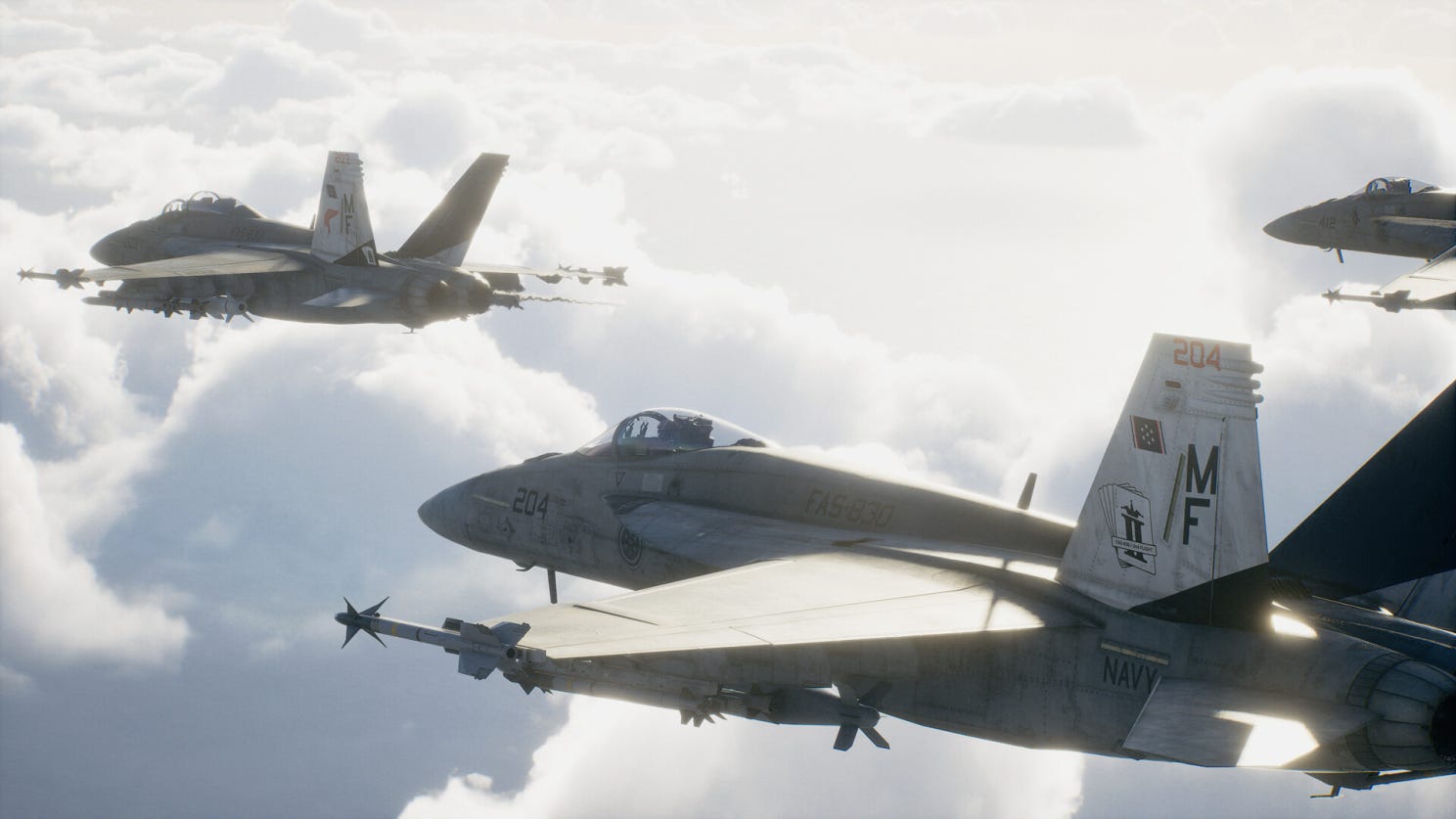
The other sleeper has been gone so long most of the market forgot to have expectations. Ace Combat 8 is the first mainline entry in seven years... Ace Combat 7 landed in January 2019 and became the franchise’s best-selling entry ever, quietly, the way this series does everything. The reveal came at last December’s Game Awards, the October 2 date locked at June’s State of Play (early access September 29 for the Deluxe crowd), and Bandai Namco is promising the most expansive multiplayer in franchise history on top of the Unreal Engine 5 campaign. Thirty years of Strangereal lore, a fanbase that treats each entry like a family reunion, and a marketing footprint you could miss by blinking.
Ten weeks out, it holds 0.221%... #16 among every unreleased game in the world. Ace Combat 7 shipped right at the edge of our tracking window, so there’s no full franchise curve to measure against this time... the current number carries the story on its own anyway. A flight-combat game from a niche franchise is out-accumulating games with ten times its marketing budget, and the mechanism is loyalty. Niche audiences behave differently in a gravity well. The Ace Combat player was never cross-shopping GTA, never weighing an October wallet against November 19, never part of the pie everyone else is fighting over. Their purchase was decided the day the trailer dropped at The Game Awards, and the demand line has been compounding steadily ever since.
Whose Season This Is... One Game, Decided Months Ago
So let’s land this thing. Grand Theft Auto VI is going to dominate the fall... that was never in question. A month of data settled everything underneath it. There’s a tier of clear winners doing the best anyone can do in these conditions, and the ones with the deepest pockets are spending their way to moments... covers, betas, Hall H panels... clawing back whatever attention money can still buy. The punches land... the math doesn’t move. Fewer games are coming out this fall than any year we’ve measured, less attention is available to the ones that showed up, and the whole season has gone top-heavy... one game holding more demand than entire falls of the past, a thin band of survivors below it, and very little room underneath that.
The sleepers are the part I’ll be watching closest, because they’re proof the door isn’t fully shut. Core communities still break through... Ace Combat’s faithful never left, Minecraft is bigger than any release calendar, and reaching kids turns out to be the one genuine counter-program against GTA VI that exists. Nintendo and Mojang figured out the same answer from different directions: the audience the black hole can’t touch is the one that isn’t allowed to play it.
Two things are true at once this fall. This season features genuinely exciting games backed by real audiences and smart teams... and none of it changes whose season this is. Everyone launching after November 19 knew what they signed up for... the data says the ones launching before it are getting shaped by it too, their demand, their calendars, their marketing spend, their entire fall dictated by a game that hasn’t come out yet. Earnings season lands next week, Take-Two Interactive and Nintendo both, and I’ll be listening for news on the two games that own this season from opposite ends of the age rating.
There’s never been a cleaner case study of what a black hole in gaming actually looks like. GTA VI is writing it in real time... and the fall is only the first chapter.