

An App, Inside An App, Plus An App On Another Platform... Netflix's Confusing Path To Play

Follow me here… or on LinkedIn
This is the last Patch Notes of July, and before you ask why... it’s Comic Con week. San Diego, my annual pilgrimage. Fun tidbit about me: I moved to California in 2008, and once I finished my MBA and started working, the streak began... I have gone to San Diego Comic Con every year since 2009, with exactly two exceptions: the year my son was born, and COVID. That’s it. Seventeen years of badges.
The relationship has evolved the way these things do. In the beginning I went purely for fun, back when procuring tickets was still something a normal person could do. Then it became my job, and my late twenties and thirties were the work-trip era... my wife and I doing the whole San Diego party circuit, me running the overnight Hall H gauntlet for panels I could have watched online ten minutes later.
Then my kids arrived, and the whole thing transformed into what it is now: family first, with some casual networking tucked into the early days before the weekend crush (Wednesday through Friday... if you’re around and want to grab a coffee and talk shop, hit me up). The rest of the con I experience through my kids’ eyes, which right now means hours in the overpriced secondary-market toy section, walking up and down the aisles while they inspect opened action figures and ask me to buy them a hundred-dollar loose Winter Soldier from Hasbro.
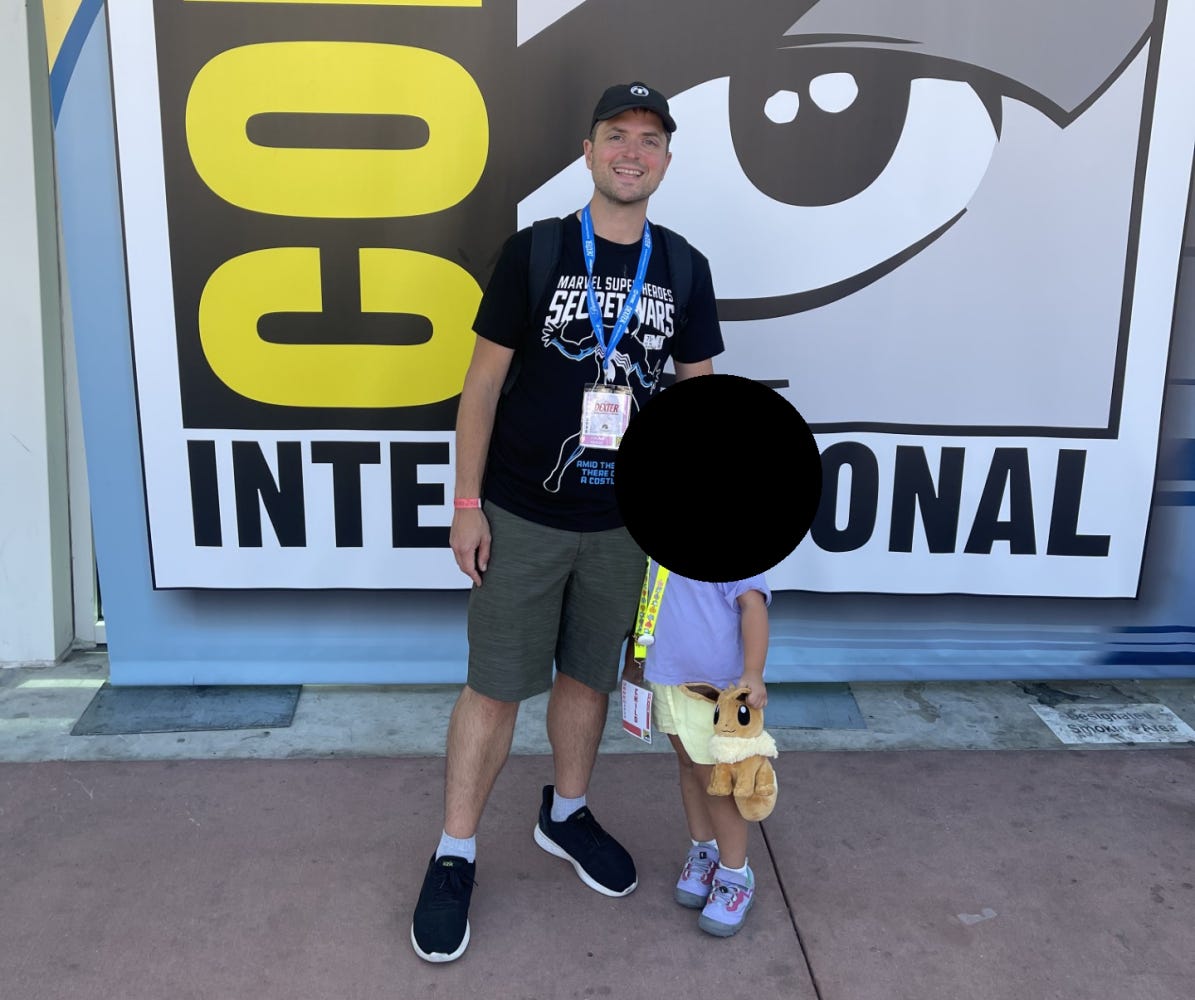
I love this event... I love the whole season around it. Seventeen years in and it still hasn’t gotten old.
To that end, I wanted to make this whole issue about comics and gaming... only to realize my two best angles were already spent. I covered Wolverine last month coming out of Summer Game Fest season, and my other big one, “where’s Batman,” I already wrote when LEGO Batman launched. My takes have been taken, by me.
Though seriously... where’s Batman? Still nowhere. It’s wild that The Batman Part II just got a teaser and won’t hit theaters until over five years after the original, and in the meantime there has been zero Batman for my kids. Everything is 18-plus fare, and that’s unfortunate. The character is a pillar of culture, the second most popular superhero on the planet behind Spider-Man... and consider how much Spider-Man content has shipped since the last real Batman content. There’s a bigger piece in that someday. For now the question just sits there. Where’s Batman?
The good news is that while one childhood icon sits on the shelf, another is in the middle of a full-blown renaissance... and it’s about to own this year’s con.
X-Men ‘97... The Best Superhero Show Since BTAS?
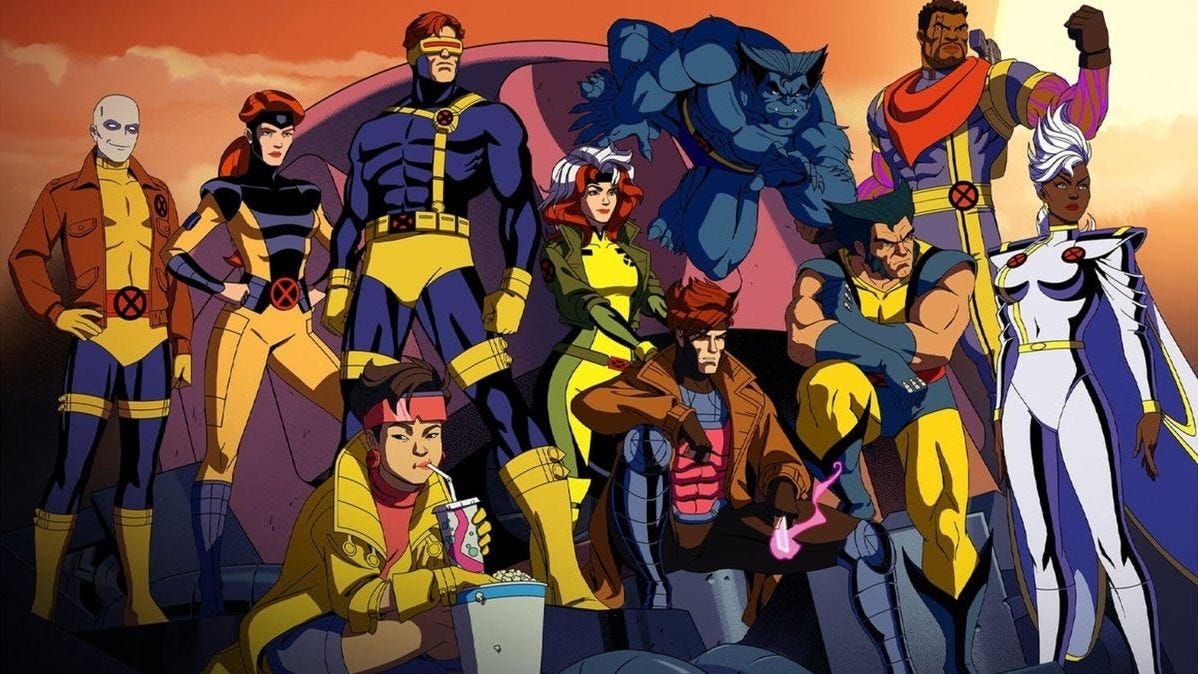
The thing I’m actually excited about this year is Marvel returning to Hall H. Will I be there in person? Probably not... I’m past the season of my life where I wait outside for fifteen hours to watch a trailer that hits the internet ten minutes later. But the energy Doomsday brings should take over the whole weekend in terms of vibes. And to be clear about why that movie has my attention: Robert Downey Jr. playing Doctor Doom? Absolutely not. Don’t care. I’m here for the X-Men.
X-Men ‘97... holy smokes, do I love this show. Season two just started, Apocalypse is the big bad, and it is outstanding. If you haven’t watched either season, and especially if you’re one of those people who “doesn’t do animated shows”... that sucks, man. You’re missing one of my favorite pieces of content this year, and probably the best version of the X-Men story ever told in any medium.
I hate to be overzealous here, but the comparison has to be made. Batman: The Animated Series is arguably the greatest animated show of all time, and inarguably the best superhero television universe ever built... BTAS led into Superman: The Animated Series, spun off Batman Beyond, then rolled into Justice League and Justice League Unlimited. A decade-plus of connected excellence that nothing has touched since.
The ‘90s X-Men cartoon was always my favorite as a kid, and it technically shares a universe with ‘90s Spider-Man... they had crossover episodes, which I fondly remember. Now X-Men ‘97 is building on all of it, and Marvel reportedly wants up to ten seasons, with the next two already in development. Ten feels ambitious given how fast they’re burning through comic material, but give me five or six, maybe bring back ‘90s Spider-Man along the way, and suddenly we’re having a real conversation about whether this universe belongs next to BTAS. I don’t think it’s there yet. That it’s even a legitimate question tells you how good the show is.
Here’s my bigger take, and I’m locking it in now. The X-Men are Marvel’s way out of whatever doldrums the MCU is in. We are living through peak ‘90s and early-2000s nostalgia, and nothing embodies that era like these characters. Fox’s movies were always more miss than hit... I want to see what Disney can actually do with them.
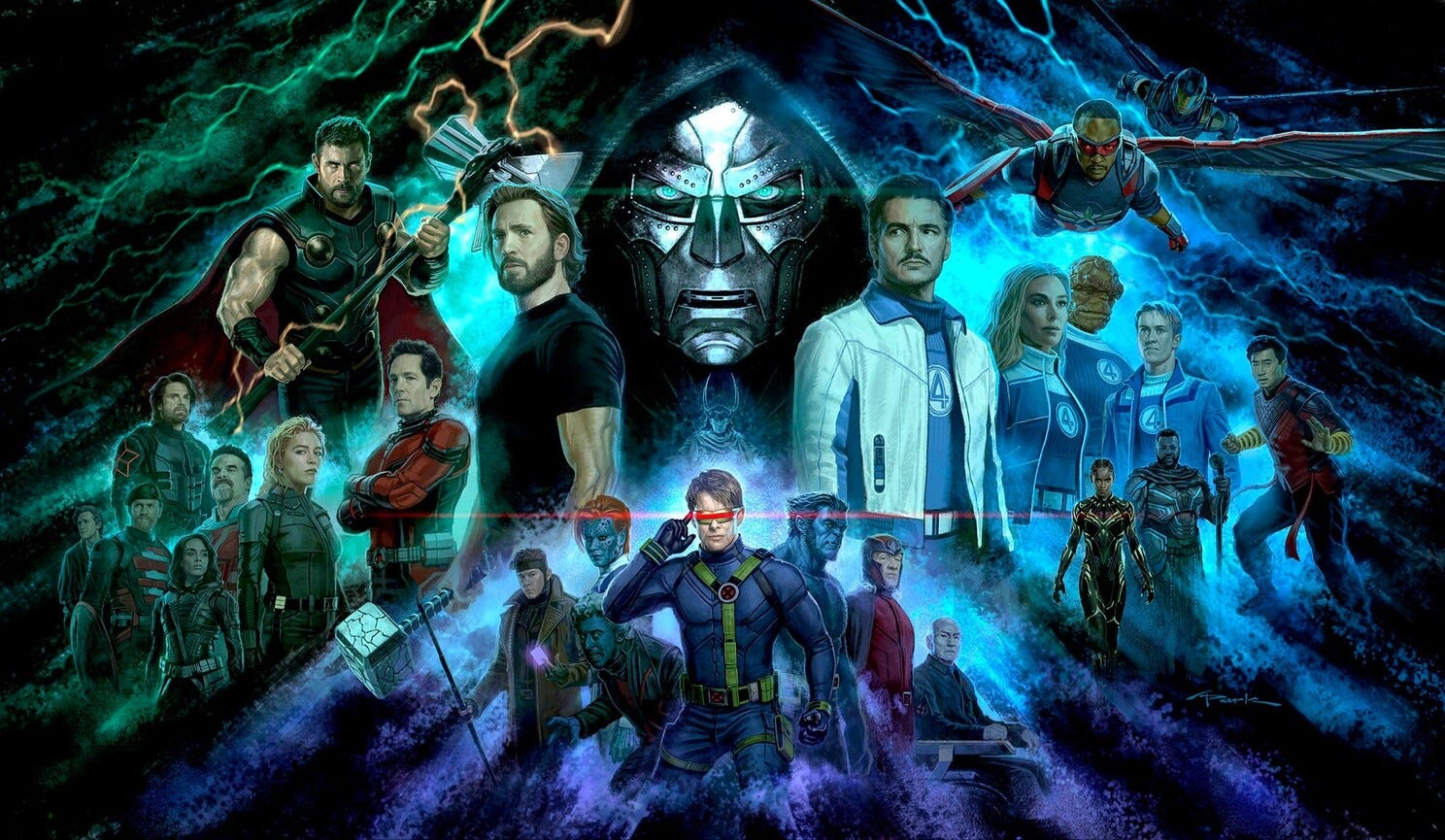
The hype train is already rolling: X-Men ‘97 now, the Wolverine game this fall, culminating in Doomsday, where I am guaranteeing the X-Men will be the highlight. Magneto, Xavier, Cyclops shooting laser beams into the sky while Sentinels descend? Hell yes. That’s exactly what I want. Is it a cash grab? Probably. Do I care? Not even a little.
I also hope the show is doing big numbers on the metrics side, because we’re about to spend a lot of this issue talking about streamers and what does or doesn’t capture attention... and Disney+ has a genuine attention machine here if they feed it.
But before we get to the streamer of it all, I have to start with Ubisoft. And it’s fitting, because one of my fondest Comic Con memories is the year of the Assassin’s Creed IV: Black Flag pirate ship... the full-sized vessel Ubisoft parked behind the harbor. I waited in the LEGO minifig line in the exhibit hall, tapping the iPad to see if I’d hit on figures now worth thousands of dollars (yes, I have a bunch). I went on the boat. Somehow I ended up at the party that night... a classic Comic Con horse trade, you get us into one party, we get you into this one. All of it stuck with me because the game itself earned the memories. Black Flag is easily my favorite Assassin’s Creed, the high watermark of the whole series in terms of pure fun... I’ve written about it before, and the naval combat alone earns the crown. So when the remake landed and Joost put out the best Ubisoft piece of this earnings season, I knew I had to touch on it before getting to the bigger story this week.
As a reminder, I’m off at the con next week, so this is it for two weeks. Thank you all for following, subscribing, commenting, and sending feedback... this newsletter keeps growing and it never stops being exciting. Oh, and I promise: no ads talk this week. No Xbox talk either. This is the week I abstain. At least I’ll try my darndest.
With that... let’s jump into it.
The Technology Trap... Ubisoft And The Cost Of Chasing
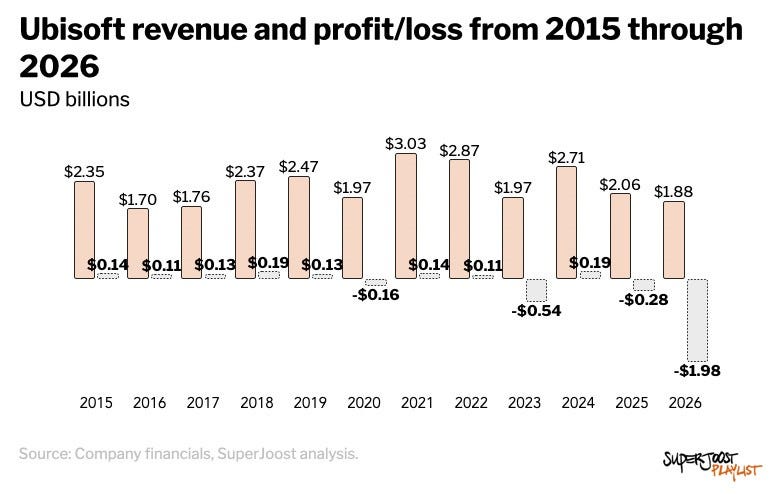
Joost van Dreunen published the best Ubisoft take you’ll read this earnings season, and I told him as much. His thesis, built off Ubisoft’s brutal 2025-26 annual report... a $1.98 billion loss, larger than any profit the company booked in the entire past decade... is that Ubisoft makes A-grade games and should be valued far higher than it is, but a decade of repeatedly unsuccessful ventures into novel technology has dragged the company down. VR and Eagle Flight. Front row at the Stadia keynote. The metaverse as “the industrial revolution of tomorrow.” Blockchain investments at the exact top of the crypto craze. Now AI, which Yves Guillemot calls “as big a revolution for our industry as the shift to 3D.” Joost van Dreunen names the pattern:
“Instead, it refers to the industry’s recurring conviction that the next platform, the next tool, the next acquisition of an engineering team is a strategy in itself, a way to buy the future without having to imagine it.” — Joost van Dreunen, SuperJoost Playlist, July 15, 2026
The foil in his piece is Strauss Zelnick, who spent the same decade saying no. No to VR. No to the metaverse, which he argued Take-Two already led through GTA Online and Red Dead Online. Deeply skeptical of blockchain real estate. And here we are... Take-Two is four months from launching what will likely be the biggest entertainment release of all time, while Ubisoft cancels six games, closes studios, hands Tencent partial ownership of its crown jewels to cover debt, and cuts 20% of its workforce from peak. One CEO chased every wave. One waited for his own.
I shared my initial thoughts on the piece and immediately got thoughtful pushback, including from folks who lived inside Ubisoft during those years... shout out to everyone who follows along and keeps me honest, the LinkedIn comment sections have been genuinely great this week. The counterargument is fair: the teams experimenting with Stadia and VR were never the teams shipping Assassin’s Creed, so there was no split focus, and the tech-forward reputation helped Ubisoft attract top talent for years. I respect that view, and there’s truth in it.
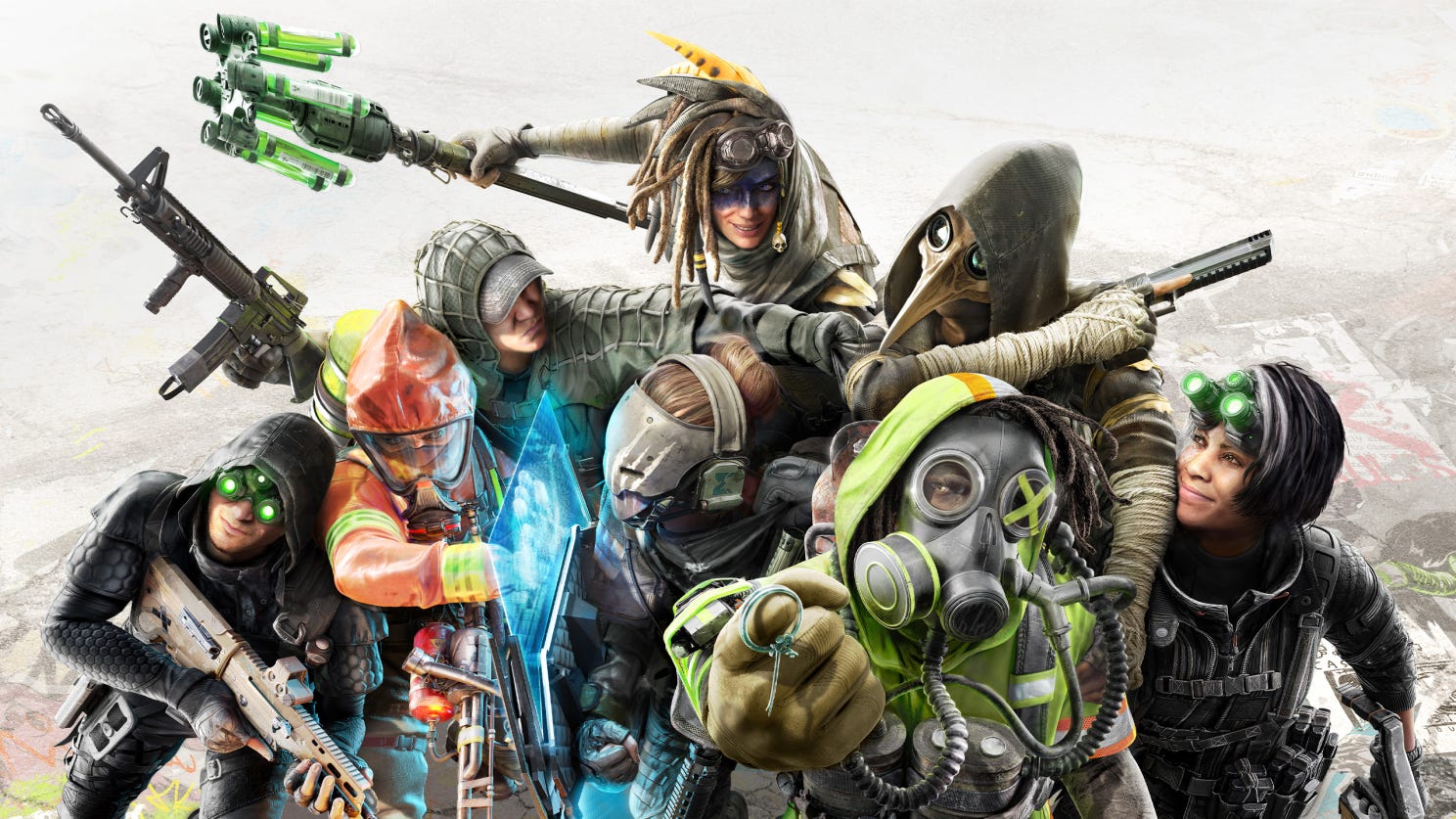
Where I hold my ground is that culture is set at the top. When your leader spends a decade publicly planting flags on the blockchain, the metaverse, and cloud... versus the other things he could be evangelizing... that focus trickles down through everything. And honestly, the technology chasing might not even be the most expensive habit. The misses that did the most damage were chasing live service. Ubisoft has exactly one genuine success in that genre, Rainbow Six Siege... a decade old and still their most durable attention asset in our tracking... and they have spent years trying to replicate it, failing every single time.
XDefiant spiked at launch and flatlined, dead. Hyper Scape came and went so fast I barely registered it existed. The Division and For Honor survive, but surviving is not Siege. And the worst example of the whole pattern: Skull and Bones, a decade in development, rebooted repeatedly, launched as a “quadruple-A” $70 live service game built from the bones of my beloved Black Flag... and in our data it never even spiked. Same instinct as the technology trap, different costume. Chasing what’s hot instead of executing what you’re great at.
Which is the perfect segue, because Ubisoft just released the thing they’re actually great at... a remake of the best game they ever made. So how did Assassin’s Creed Black Flag Resynced perform? Let me show you what we saw at mindGAME.
The View From mindGAME... A Franchise Finds Its Floor
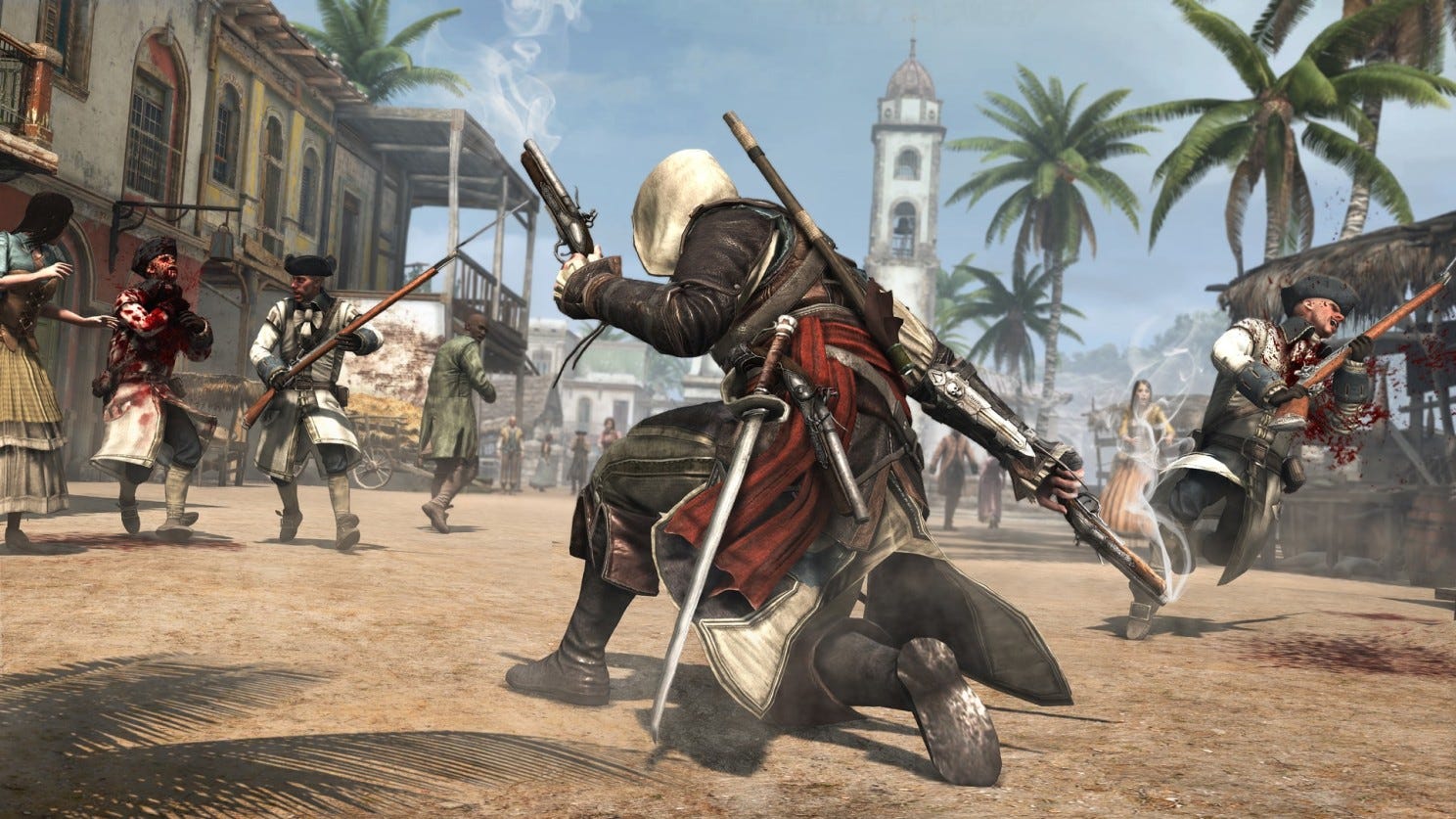
As I have state before... Black Flag Resynced is a remake of my favorite game in the series, arguably my favorite Ubisoft game ever made, and I haven’t played it yet. I will... probably before summer’s end, once the Comic Con dust settles. But seventeen-year-old me who logged hundreds of hours on the Jackdaw would be baffled that I didn’t clear my calendar for launch day. I feel zero urgency, and I don’t want to overextend one guy’s anecdote into a market thesis, but if a diehard Black Flag fan who writes a gaming newsletter isn’t racing to boot it up, I can’t imagine I’m alone.
First, credit where due. Resynced is marketed as a faithful remake... and spoiler, once you play it, the new modern-day framing quietly turns it into a quasi-sequel as well, picking up threads from Shadows and carrying the larger story forward. By most accounts Ubisoft executed it well. The reviews are solid, the naval combat still sings, 2 million copies moved on day one, and it posted the highest concurrent player count ever recorded for an Assassin’s Creed title on Steam. This is Ubisoft doing the thing Joost’s piece says they should have been doing all along: executing on what they’re great at.
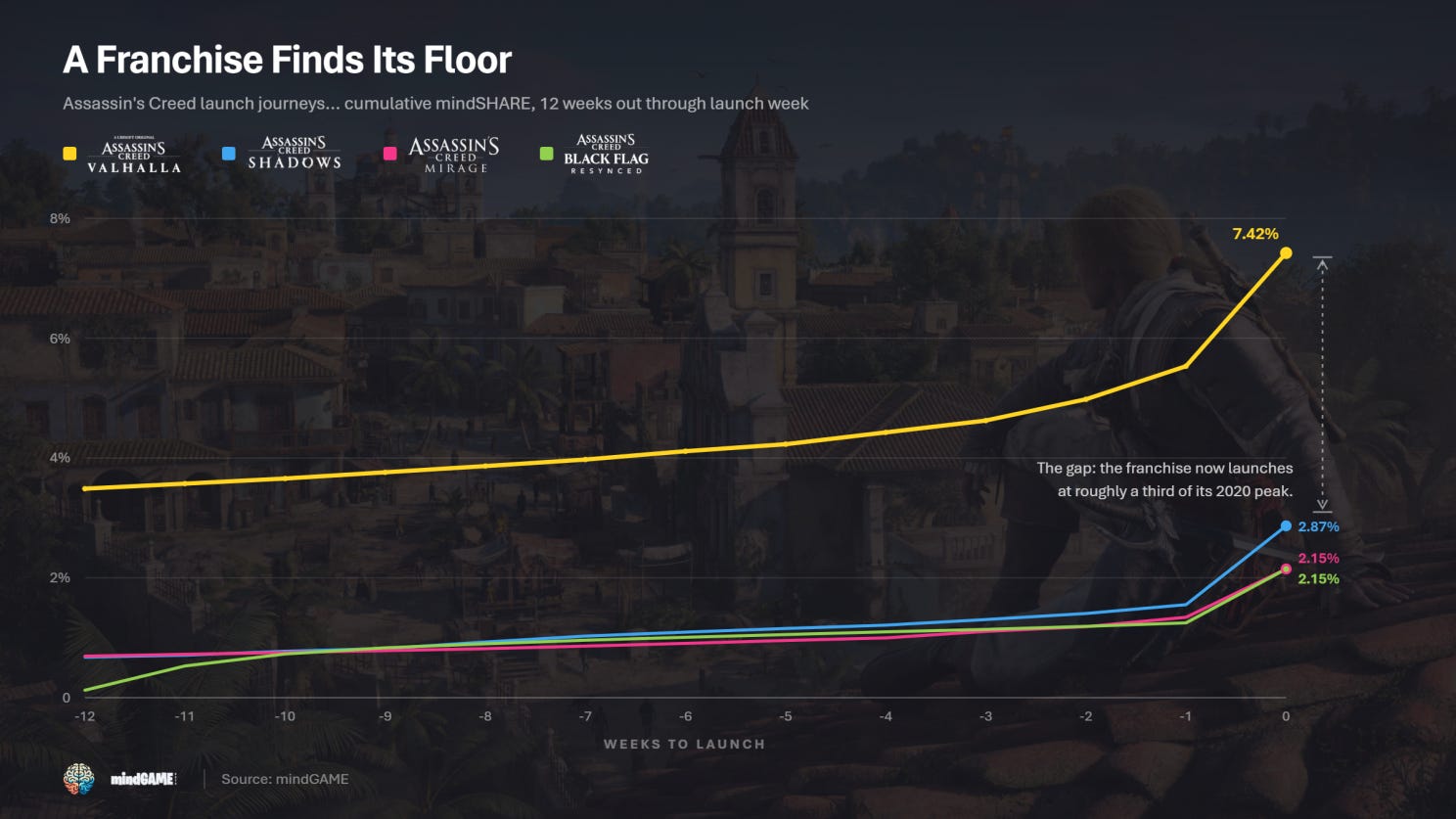
The launch data tells a bigger story than the launch, though. Valhalla is the high-water mark of this franchise, and everything since has been a descent. Shadows finished its launch week at 39% of Valhalla’s cumulative mindSHARE, and Resynced just landed at 29%... nearly identical to Mirage. Consider what that pairing means. A full flagship entry and a remake of the most beloved game in the series, two very different swings, arriving at the same altitude. The franchise has found its new baseline, roughly a third of what it commanded in 2020, and the last two releases confirm it from opposite directions. My missing sense of urgency, multiplied across millions of lapsed fans... that’s what a floor looks like.
Here’s the uncomfortable nuance: Resynced is probably a more profitable release than Shadows. A remake costs a fraction of building from scratch, and this one sold 2 million units into a fanbase that adores the source material. Smart business, genuinely. It’s just not the kind of business that employs 16,590 people. A floor keeps the lights on. It doesn’t fund a company that size.
Zoom Out... The Slow Leak
Widen the lens to all of Ubisoft and the franchise story becomes the company story. We’ve tracked their share of total gaming attention since the start of 2019, and it has declined every single year since. No exceptions, no recovery years, a 38% slide from where they started. Their biggest week in our entire history of tracking remains Valhalla’s launch in November 2020. Even Shadows at launch, their best moment in half a decade, couldn’t reclaim it.
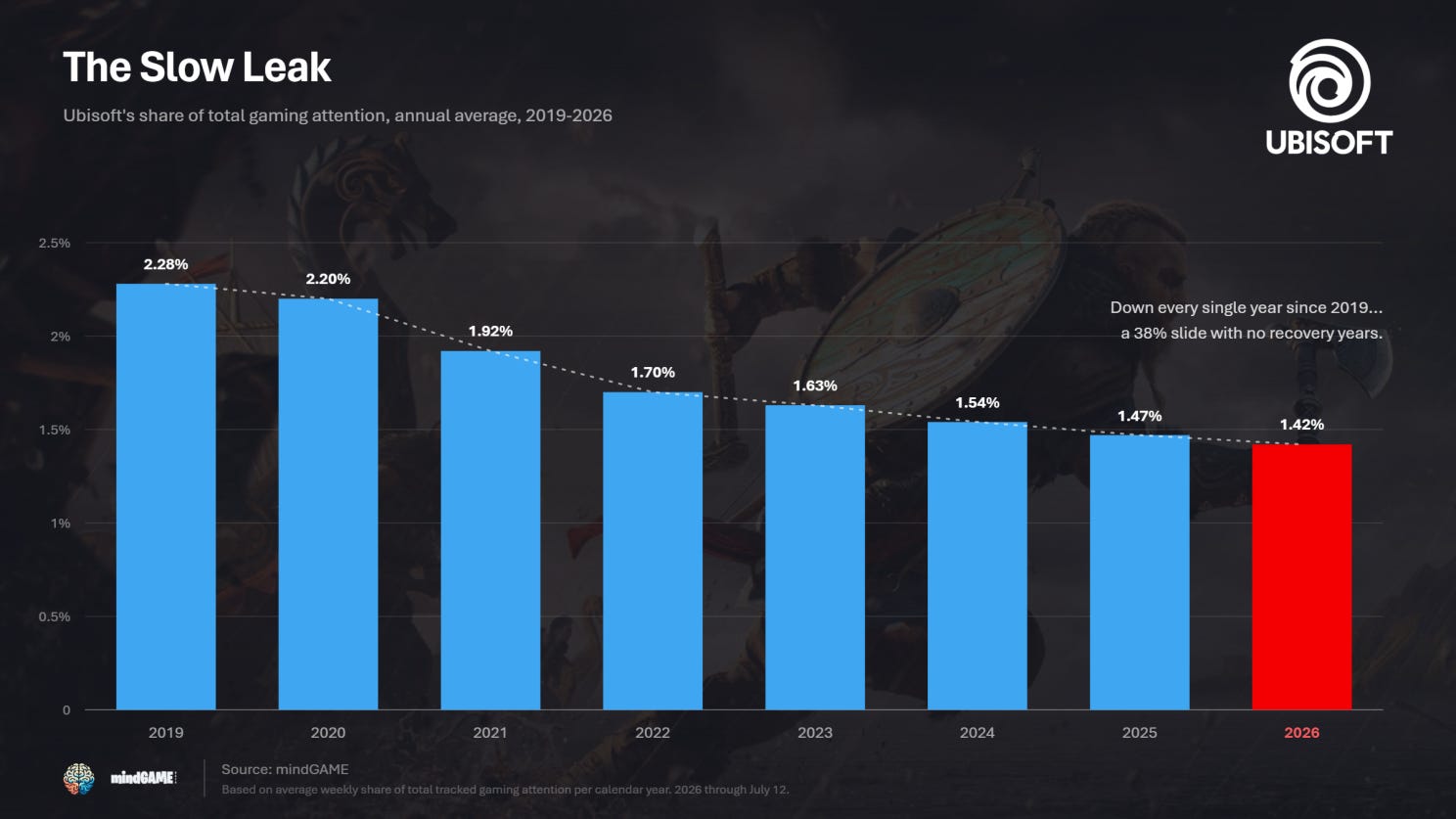
What actually happened inside that decline is the part worth spelling out. Old faithful kept the lights on... week after week, year after year, Rainbow Six Siege is the name doing the carrying, a decade-old game quietly propping up a publisher that used to generate this much attention from Odyssey, The Division 2, Watch Dogs, and Far Cry all at once. Around that one pillar, everything else came and went. XDefiant spiked and vanished. Skull and Bones never spiked at all. Star Wars Outlaws and Avatar arrived with massive licenses and faded fast. Far Cry went silent entirely... no new entry in five years and counting. The pipeline that once refreshed itself annually simply stopped producing games that hold anyone.
And this is where I’d extend Joost’s thesis rather than just echo it. The technology chasing is real, and leadership’s focus... or lack of it... trickles down, as I said above. But the deeper wound is what they chased within games: live service. Siege was their one genuine win in that model, and instead of treating it as lightning in a bottle, they treated it as a template, pouring years into replicating it while the single-player craft that built this company calcified into formula. The Assassin’s Creed games ballooned into hundred-hour sandboxes stuffed with checklist tasks, because bigger maps and longer engagement loops are what a live-service-brained org optimizes for.
Meanwhile the games people remember Ubisoft for... the tight, distinct, personality-rich single-player adventures... stopped coming. And before anyone frames 2 million day-one copies as a triumph, remember the original Black Flag sold 11 million back when Ubisoft still reported real numbers. Will Resynced get there? I’m dubious. The launch is really step one of a reset... make a great game people enjoy playing, earn back a little trust, repeat.
The reviews are solid and the feedback is genuinely positive... though they couldn’t help themselves, injecting a cash shop and weekly challenges into a faithful remake... live service brain dies hard. Still, there’s a template here if the economics work. Remake the classics, execute them well, rebuild brick by brick... an Assassin’s Creed II remake with Ezio practically writes itself. But a reset this slow requires runway, and runway requires more hits like this one, arriving on schedule, into a market that isn’t getting any friendlier. Which brings me to what comes next.
What Comes Next... A Thin Slate In A Cruel Fall
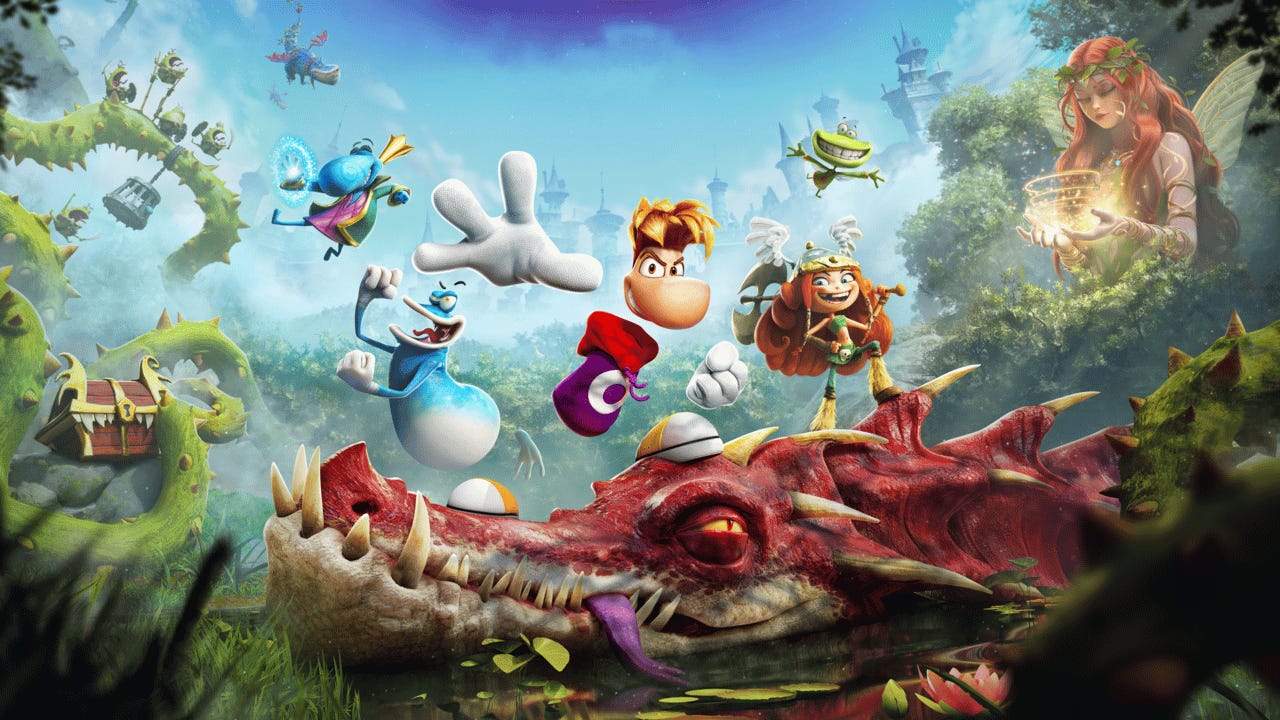
Look at Ubisoft’s calendar for the rest of this fiscal year and the runway problem gets real. Their only remaining release of consequence is Rayman Legends Retold, another remake, launching October 1... one month before Grand Theft Auto VI swallows the industry whole. In our tracking it currently ranks 11th in cumulative mindSHARE among the 116 fall releases with a meaningful audience, behind Call of Duty, Wolverine, Gears E-Day, and even Ace Combat 8, which shares its exact launch date. Its announce spike is already fading, and the hardest stretch of its launch journey hasn’t started. I wrote about the GTA VI blast radius two weeks ago... publishers with far stronger hands are fleeing this window, and Ubisoft is walking a mid-tier remake straight into it.
Even if Rayman lands, it doesn’t change the math. Guillemot has already told investors the coming year represents a low point in the company’s free cash flow trajectory, with a softer release slate and more restructuring costs ahead... the market heard that and sent shares down 16%. This is a 16,590-person organization, and a remake selling a couple million units here, another one doing fine there, stacked on top of one decade-old live service game, is nowhere near enough volume to feed it. Roughly 50 developers at Ubisoft Barcelona were cut days after shipping a hit, and two Canadian studios closed this year despite Quebec tax credits covering nearly a third of wages. Subsidies can’t manufacture revenue. I won’t guess at the timing, but more cuts are coming... the CEO has all but said so himself. That’s the challenge ahead: the wins are real, and the wins are too small for the company as currently built.
Joost closed his piece by noting how much of this earnings season will be about the tools and how little about the games, and he’s a hundred percent right. The unfortunate part is that Ubisoft now has to start from nearly peg one... the boring, patient business of shipping games people want to play, over and over, until trust returns. There is a case study for exactly this, and I’ve written about it before: Capcom. They were in a rut of their own not long ago (well... last decade but still), rebuilt through remakes, used the trust those remakes earned to take Resident Evil in a bold new direction, and today they’re the shining example of release cadence and execution in the industry. So there’s a path. I’m a hopeful person, and I wish them the best... but looking at the slate ahead, hope is doing a lot of the lifting.
Now, about that bigger story I promised. Ubisoft spent a decade paying for technology bets that never paid back. There’s another company making the inverse bet... that distribution can substitute for games... and it’s having a much louder month.
The Netflix Conversation... Everyone Smells Blood
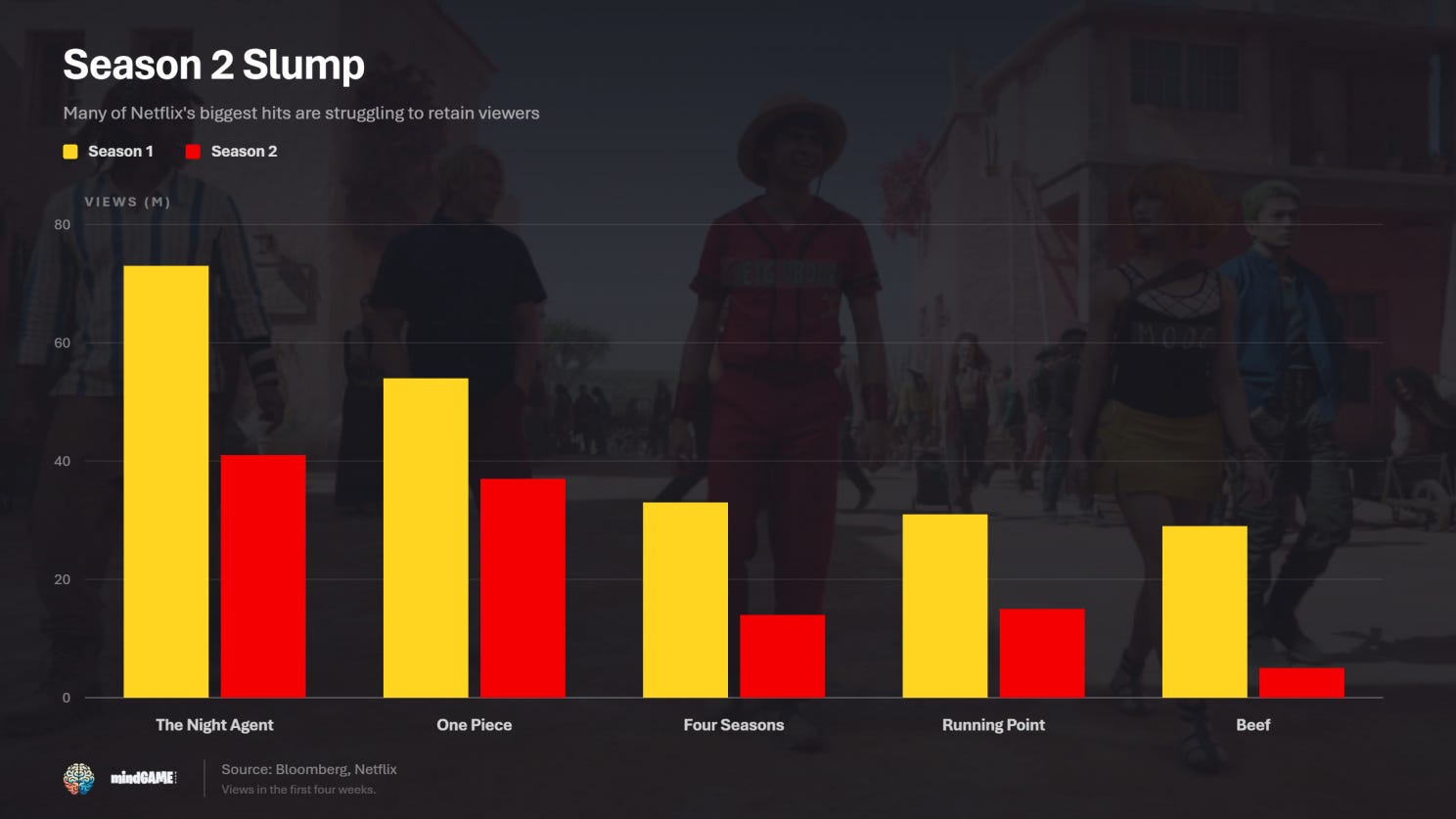
Netflix reports earnings Thursday (I write on Wednesday’s typically), and the two weeks leading into it have produced more skeptical coverage of the company than I can remember in years. The stock is down 40% over twelve months. The Warner Bros. pursuit came and went, leaving investors wondering whether the build-not-buy company had run out of things to build. And the sharpest reporting of the stretch came from Lucas Shaw at Bloomberg, who spent back-to-back Screentime newsletters on a problem Netflix would rather nobody quantified: their shows are bleeding viewers between seasons.
“One Piece, one of Netflix’s most-watched shows of 2023, lost more than 30% of its audience for the second season. Season two of Beef suffered a drop of more than 70%. The Night Agent shed 50% of its audience for the second season and another 35% for its third season.” — Lucas Shaw, Bloomberg Screentime, July 5, 2026
Netflix targets the second season of a show at the people who watched the first, which means the funnel narrows by design... the average show surrenders more than 30% of its audience after season one. String a few misses together, as they have this year, and suddenly the biggest viewing week in April or May belongs to a Kevin Hart roast. In his follow-up a week later, Shaw framed where this leaves the company:
“And yet, the data is clear. Netflix’s growth has slowed. This was inevitable for a company that now reaches 85% of US viewers, but it’s still a problem. The question for investors and for the entertainment industry isn’t whether growth is slowing but what Netflix is going to do about it.” — Lucas Shaw, Bloomberg Screentime, July 12, 2026
The Wall Street Journal added the internal color, reporting that the concern has moved from spreadsheet to conference room:
“But one metric was pointing in the wrong direction: Subscriber engagement was showing signs of decline, according to attendees. At the time, it was a small part of a conversation about the company’s goals, but it has since become a frequent topic of discussion at meetings, people familiar with the matter said.” — Jessica Toonkel and Ben Fritz, The Wall Street Journal, July 9, 2026
Nielsen pegged Netflix’s share of TV viewing at 7.8% in April, the lowest since May 2025. To be clear about what the crisis is and isn’t... Netflix is still the largest paid streamer on the planet, churn is still industry-best, and their misses would be hits at Peacock. The problem is growth. Total viewing hours grew under 2% last year, and as Eric Seufert put it in Mobile Dev Memo this week, that number is upstream of everything:
“Viewing time is an upstream factor for everything else: if users are finding less compelling content on Netflix over time, they’re more likely to churn, especially when faced with a surfeit of FAST options.” — Eric Benjamin Seufert, Mobile Dev Memo, July 14, 2026
Look at Netflix’s actual moves and you can see the company treating this with real urgency, because every announcement of the past year is a time-spent play. Live sports, where the World Baseball Classic broke records in Japan and delivered their biggest sign-up day ever in the country. Video podcasts, which over-index on daytime and mobile viewing... hours Netflix historically never owned.
YouTube creators like Ms. Rachel and the Sidemen, licensed at a fraction of original production costs. Clips, a TikTok-style vertical feed bolted into the mobile app. Short-form videos from BuzzFeed and Condé Nast arriving next month. TF1’s programming in France, with similar deals hunted across Europe and Latin America. And per the WSJ, executives are now discussing live channels and even bundling rivals like Peacock into the app... ideas Reed Hastings would have considered heresy in the focus-and-simplicity era. Seufert’s diagnosis ties the whole flurry together:
“Netflix’s real issue, as reflected in its recent product decisions, is that it lacks a sufficient volume of fresh, low-cost, high-frequency content inventory that demands little commitment from the user to sustain viewing-time growth across markets and viewing expectations (including on mobile). And those product decisions are helpful indicators of how Netflix plans to address it.” — Eric Benjamin Seufert, Mobile Dev Memo, July 14, 2026
Some of these bets will work. A few already show promise. But step back and the pattern is the thing: Netflix is placing chips on every square that might make the subscription stickier, because the core engine... scripted series that people return to season after season... is decelerating.
Gaming is one of those chips. It happens to be the oldest one on the table, placed back in 2021, five years and roughly two billion dollars ago. Which makes it the bet we can actually grade. So let’s grade it.
Five Years And Two Billion Dollars... Grading The Gaming Bet
Reed Hastings saw this coming before almost anyone. Back in 2017 he famously said Netflix was competing with sleep, and in the January 2019 shareholder letter the company went further: “We compete with, and lose to, Fortnite more than HBO.” Netflix understood the attention economy earlier than any of its media peers... games were eating their viewers’ hours, and the logical response was to get into games. In 2021 they did. Five years and roughly two billion dollars later, we can grade the response.
I wrote the first draft of this grade last October, when the tab read one billion and I called the effort a collection of experiments that had not produced a flagship. The tab has since doubled. The grade has not moved.
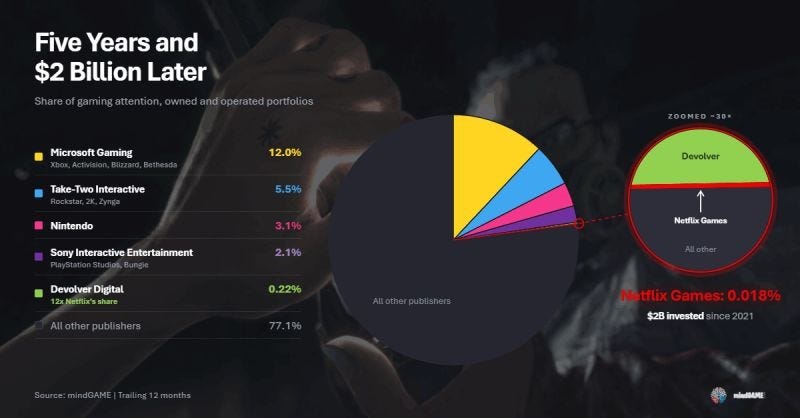
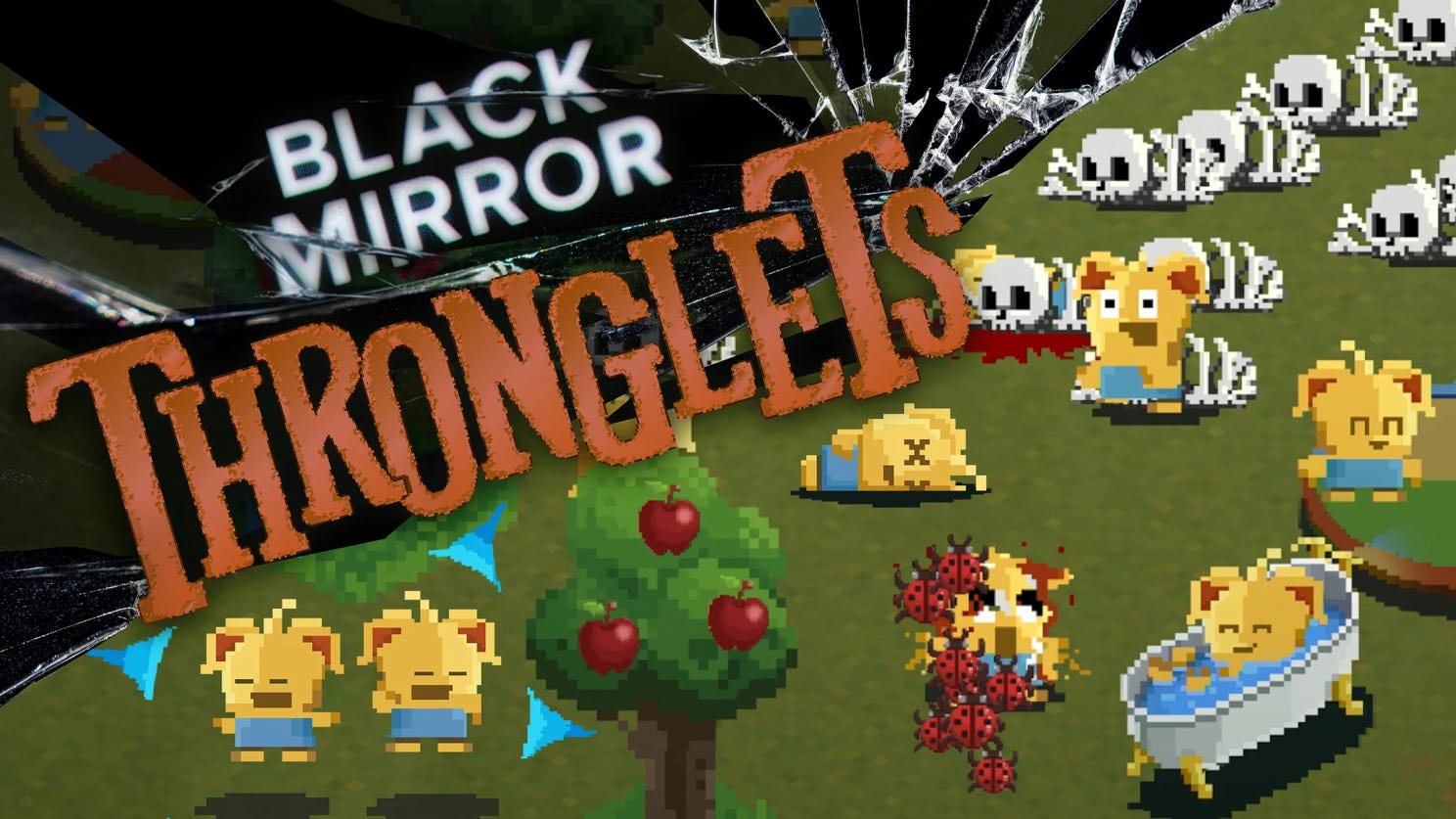
Start with the headline number. Netflix currently holds 0.018% of global gaming attention... their trailing twelve-month average across our tracking. Their all-time peak was 0.031%, a single week in April 2025 when Thronglets rode the Black Mirror season launch, and it decayed immediately. That footprint ranks them roughly 340th among the 3,700+ publishers we track, wedged between Skybound and Jagex... independent publishers operating on a rounding error of Netflix’s spend. Devolver Digital holds twelve times their share. Balatro, built by one developer, generated roughly the same cumulative attention as Netflix’s entire 24-title portfolio combined.
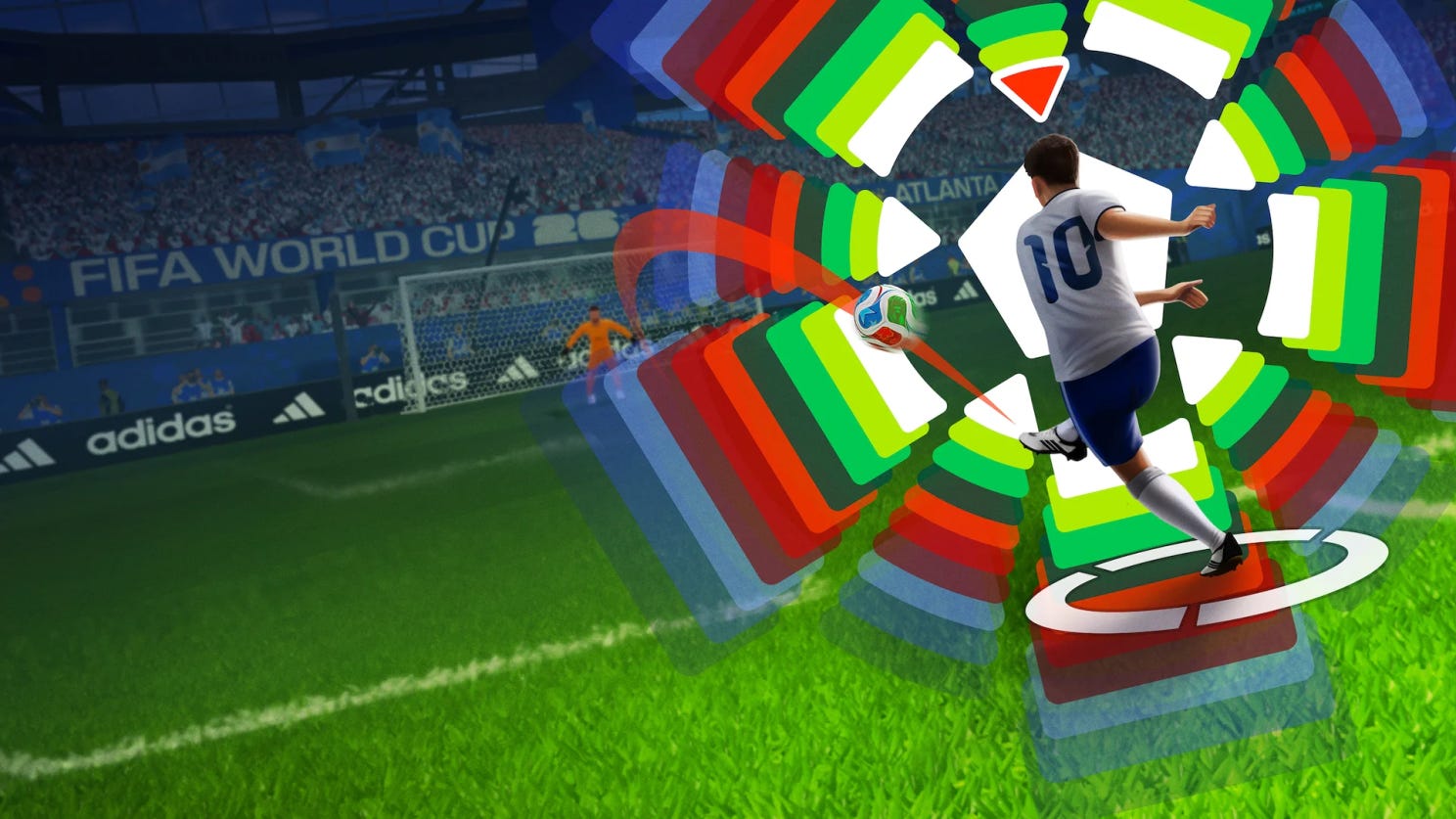
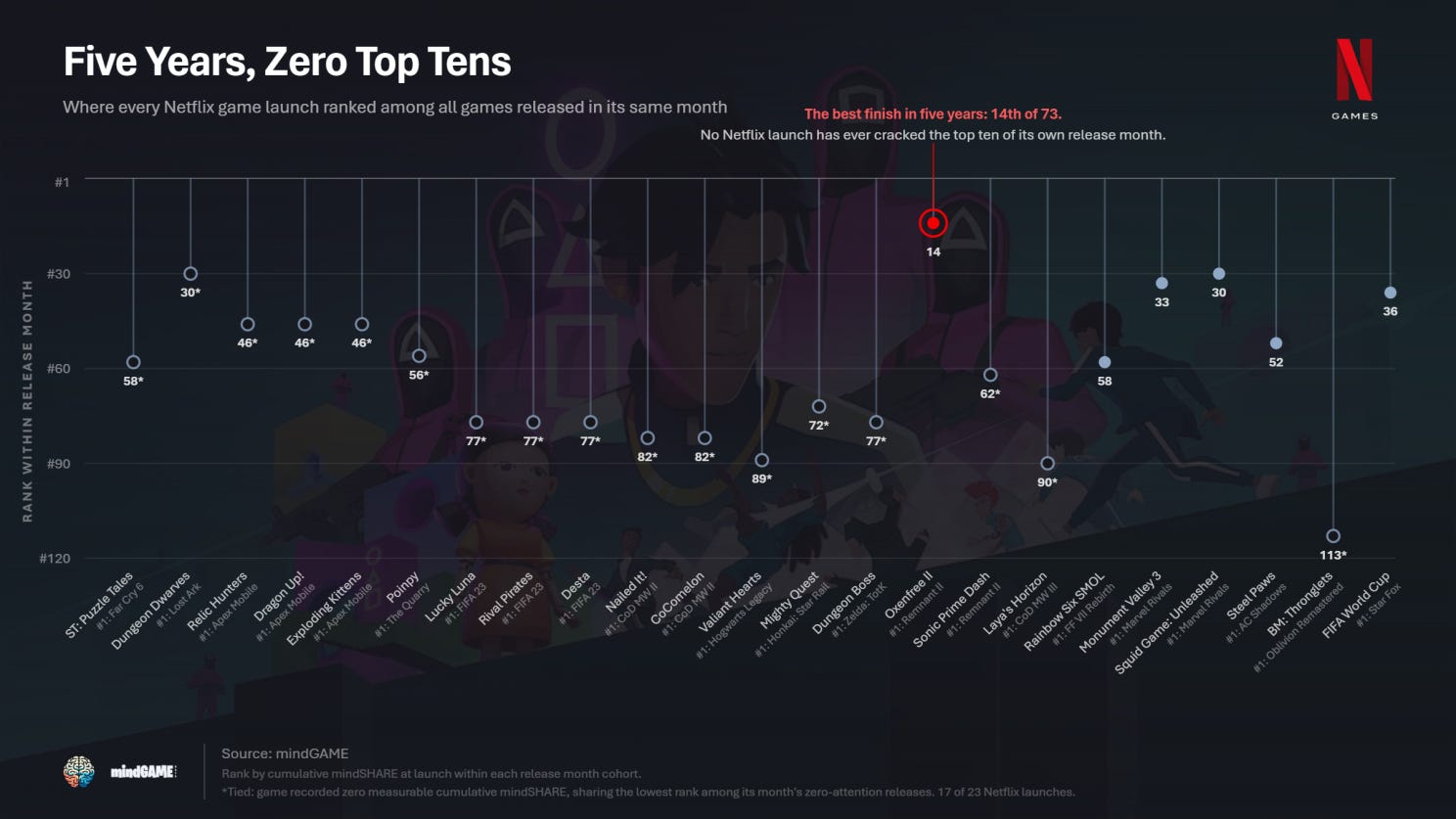
The launch-by-launch view is somehow worse. Since 2021, no Netflix game has ever ranked in the top ten of its own release month by cumulative mindSHARE. Their best finish in five years is Oxenfree II at 14th of 73 in July 2023... and that attention arguably belonged to the original Oxenfree’s indie equity, acquired with Night School, not to anything Netflix built. The FIFA World Cup game tells you everything about the ceiling: released this June to coincide with the most-watched World Cup in three decades, backed by the biggest sports license on earth and a subscriber base approaching a billion people, it finished 36th of 107 games in its own launch month.
Even Thronglets, the title behind Netflix’s best attention week ever, launched as a surprise drop with zero measurable pre-launch demand, tied at the bottom of its 125-game month. Seventeen of their twenty-three launches since 2021 share that distinction... no measurable cumulative attention at launch whatsoever.
Now, to be fair to Netflix, they’d tell you the old catalog is the wrong thing to grade. The mobile-first IP tie-in era is dead, they scrapped it a year ago, and the go-forward strategy has four pillars: narrative, party and puzzle, kids, and mainstream. Sean Krankel, fresh off Unhinged’s launch, made the case for the new direction in his interview with The Game Business this week:
“A lot of the time when people talk about the elusive non-gamer that we’re trying to bring into our industry, sometimes people extremely oversimplify, or lower the bar too low, on all the other aspects of what makes a story or experience interesting. Like, to get a non-gamer, it has to be a Fisher-Price baby toy. I don’t think we need to look at it that way.” — Sean Krankel, Head of Narrative Games, Netflix, The Game Business, July 14, 2026
Greg Peters made the executive version of the same case on April’s earnings call... a $150 billion market opportunity, early encouraging signals from kids’ games, a virtual controller app topping the iOS download charts, and a belief that gameplay improves member retention. But listen to how the co-CEO actually grades five years of work:
“So given all that, though, I think it’s worth noting that while we’ve been a couple of years in building this, we’re still really just scratching the surface today in terms of what we can ultimately do in this space.” — Greg Peters, Co-CEO, Netflix, Q1 2026 Earnings Call, April 16, 2026
Scratching the surface, five years and two billion dollars in. And the data says even that is generous... every measurable signal we track says the surface hasn’t been located. The ambition, for the record, I’m on board with. Krankel is right that the non-gamer audience is real and underserved, the casual market is booming, and there are companies out there proving it spectacularly right now... we’ll meet them in a minute. My skepticism isn’t about the category. It’s about whether this company, with this model, can ever reach it. Because the new strategy carries two structural problems the old one had too, and no amount of clever game design fixes either. The first one is sitting in your pocket.
Why It Won’t Work... The Funnel And The Phone
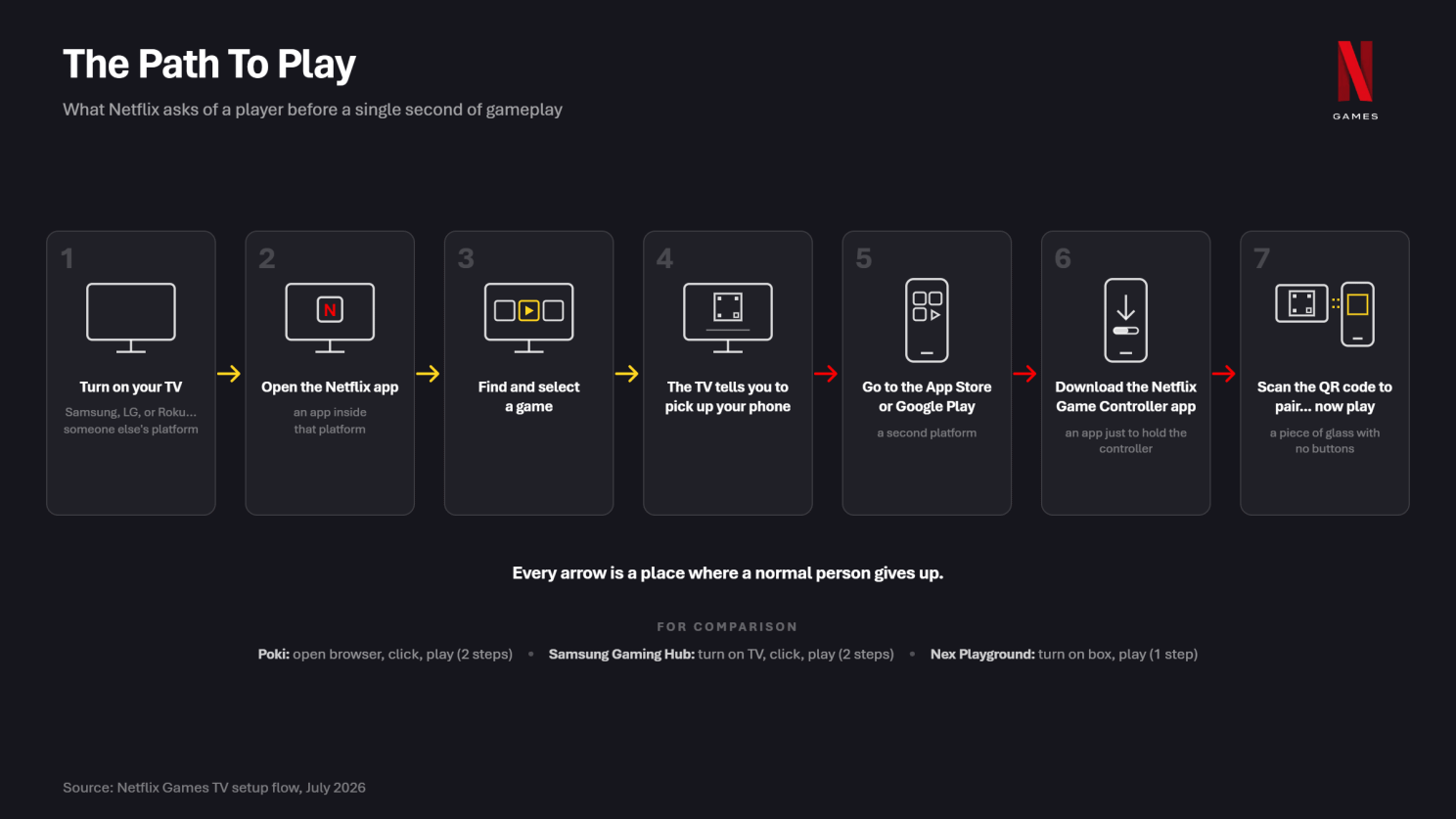
Let me walk you through what Netflix is actually asking a person to do, because I don’t think the people defending this model have mapped it.
You’re on your couch. You open Netflix on your TV... which is to say, an app running inside someone else’s platform, a Samsung or LG or Roku operating system. You browse to a game and select it. The TV now tells you to pick up your phone. You go to the App Store or Google Play... a different platform, owned by a different trillion-dollar company... search for the Netflix Game Controller app, download it, open it, and scan a QR code off your television. Now, finally, you’re holding a piece of glass with no buttons, pretending it’s a gamepad, playing a game inside an app inside a platform, controlled by a second app on a second platform.
That’s the funnel. Every arrow in that graphic is a place where a normal person gives up.
I thought the old model was crazy... open Netflix on your phone, get bounced out to the App Store, download the game as its own separate app, sign back in with your Netflix account. A double funnel, discovery living outside the app entirely. The new TV model is not much better, and in one way it’s worse: mobile UA is already one of the hardest, most expensive problems in gaming, entire companies exist just to claw people through a single app install... and Netflix’s strategy requires an app install just to hold the controller. The game isn’t even on the other side of that download. A steering wheel is.
And here’s the pushback I keep getting, from people I genuinely respect: controllers are the barrier. Console TAM has been stuck at 200-300 million people for twenty years precisely because gamepads intimidate normal humans, a kid will happily play Bluey with a phone, and Netflix isn’t chasing the Resident Evil buyer anyway. I take the point, and the console-ceiling part is true... until someone adopts a free, ad-supported model, but as I promised at the top, I’m staying out of the ads conversation this week. But follow the logic one more step. If the phone is the frictionless input everyone already owns and already understands... the phone already has games on it.
Millions of them, free, one tap away, on the phone’s native platform, designed for that glass. If I’ve got the phone in my hand anyway, why am I using it as a degraded remote for a TV game three layers away? Mobile UA is already one of the most brutal problems in gaming, and Netflix’s model handicaps itself further with a download and a QR code before anyone plays a single second. The phone-as-controller doesn’t remove the barrier. It relocates the competition to the most contested attention surface on earth.
There’s a history lesson hiding in all of this, and Ben Thompson told it last week on TBPN while explaining a different company’s disaster. Microsoft built the Xbox because it believed the game console was the path to owning the living room:
“And it failed for a kind of an obvious reason in retrospect, which is first and foremost, people buy consoles to play games, not to have a portal to the internet in their living room. And so you’re selling a multi-hundred dollar console to people who want to play games, but people who don’t want to play games aren’t going to randomly start buying consoles. What actually ended up taking that over was things like the Fire Stick... you had the Chromecast, you had Roku TV.” — Ben Thompson, Stratechery, on TBPN, July 2026
Read that again and flip it. Microsoft tried to reach the living room through gaming and learned the living room belonged to TV. Netflix owns the living room through TV and believes that position is the path into gaming. It’s the same category error running in the opposite direction. People associate playing games with the surfaces built for playing games... a console, a PC, the phone’s own home screen. Netflix is the largest paid streaming platform on the planet, with industry-best engagement, and none of that transfers, because an app inside someone else’s operating system is not where anyone’s brain files “video games.” Twenty years of Xbox regret proves the door between the living room and gaming is locked from one side. Five years of Netflix data suggests it’s locked from both.
None of which means the audience Netflix wants doesn’t exist. It absolutely does... casual players, families, non-gamers curious enough to try something easy. The market is real, it’s growing, and it’s being won right now, this year, by companies who understood something Netflix hasn’t: you don’t reach these people through an app. You reach them by being the platform. Let me introduce you to a few of them.
The Casual Market Is Winning... Just Not At Netflix
Since my LinkedIn post, the most common misread of my argument is that I’m down on casual gaming. The opposite is true. This market is the most exciting expansion story in the industry, and three companies are proving it right now. Notice what they have in common.
Nex Playground... The Box Grandma Buys
A camera-based family console for under $300... no controllers, the camera tracks up to four players, the games are Bluey and Sesame Street and Peppa Pig, and everything runs on a subscription. The origin story is wonderfully unlikely. Founder David Lee spent eight years at Apple building web apps before leaving in 2017 to chase a niche idea: a basketball training app that used the phone’s camera to track shots. During the pandemic, the motion games inside that app went viral with families stuck indoors, and Lee noticed something in the data... retention tripled on an iPad and jumped 10x when people connected to a TV. The living room was pulling his product toward it. Unable to find a hardware partner beyond an early Sky collaboration in the UK, he built the box himself.
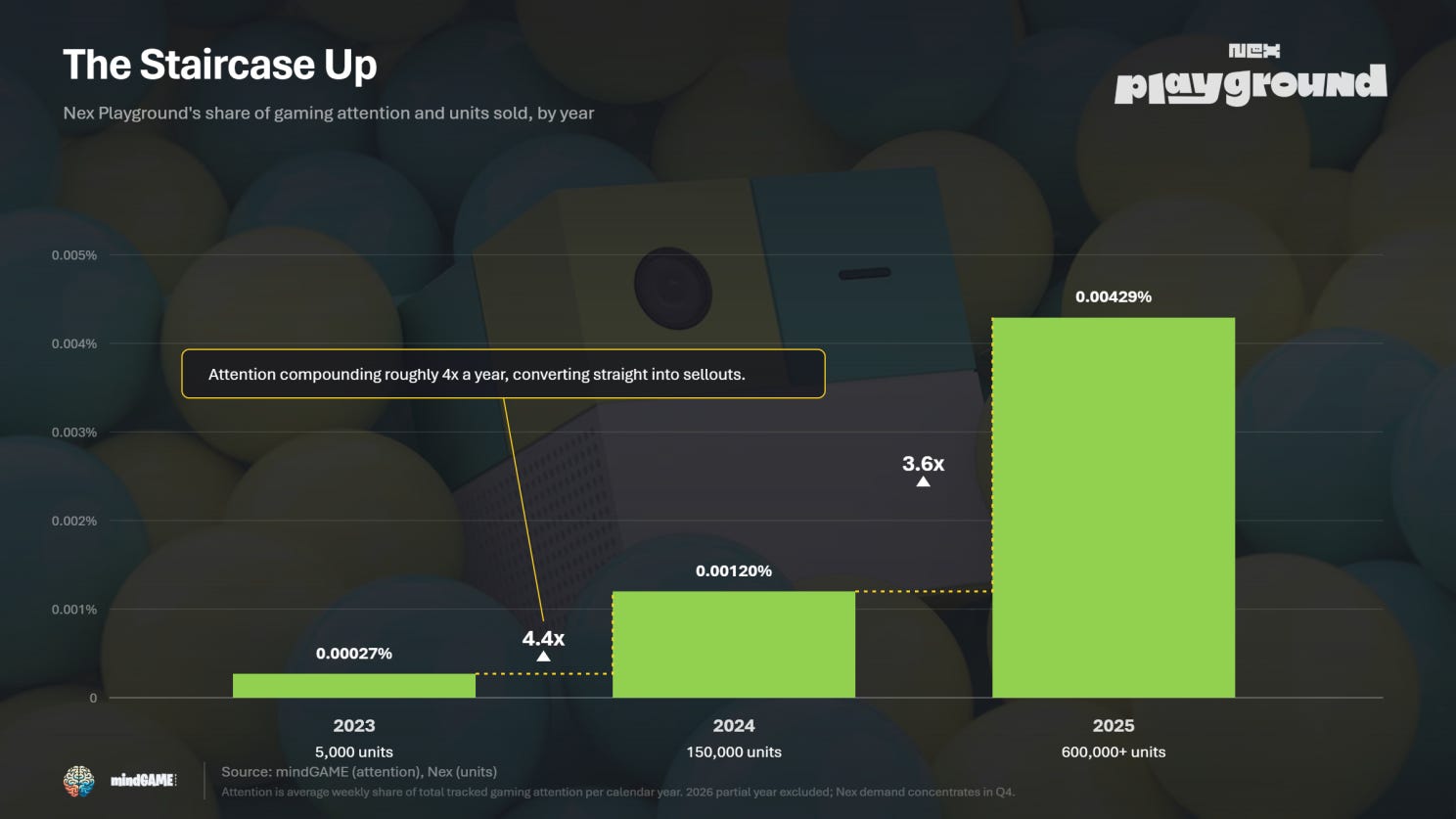
The trajectory since tells you the demand is real. Nex sold 5,000 units in 2023, direct off their own website. Retail buyers took the samples home, played with their own kids, and every chain wanted in... 150,000 units across a thousand stores in 2024, then over 600,000 in 2025 across 5,000 stores, selling out at Sam’s Club, Best Buy, Walmart, and Target... and per Circana, outselling Xbox in the US in November of last year. The console launched in the UK last month with Ed Sheeran and Dua Lipa music licenses and a Bluey mini-game built for that market, Europe next, Asia in 2027... and they’ve navigated this year’s RAM shortage with a US price bump while securing supply, which tells you they’re managing growth, not chasing it. When Christopher Dring asked Lee about his ambition late last year, the answer was simple:
“It would be great if there would be a playground in every living room... we want to kind of create something so worthwhile that would earn our place to be in every living room.” — David Lee, CEO, Nex, The Game Business, December 2025
This is the Wii spot, the one Nintendo vacated fifteen years ago... grandma buys the kid a box for Christmas, the family plays together, everyone understands what it’s for. That last part is the entire advantage, and it’s worth more than any spec sheet. A dedicated device sits under the TV and your brain says that’s the thing we play games on. The customer knows exactly what they bought and why. Netflix, meanwhile, asks a family to remember that somewhere inside their movie app, behind a QR code and a second download, games technically exist. One of these is how normal people adopt gaming. The other is a scavenger hunt.
Our data shows the dedication paying off. Nex’s attention compounded roughly 4x in each of its first two full years, its rank has climbed every year since launch, including this one, and the demand converts straight into those sellouts. A growth curve that steepens on its own is the healthiest pattern we track. Netflix has spent two billion dollars and six quarters producing a flat line.
Samsung Gaming Hub... The TV Is The Platform
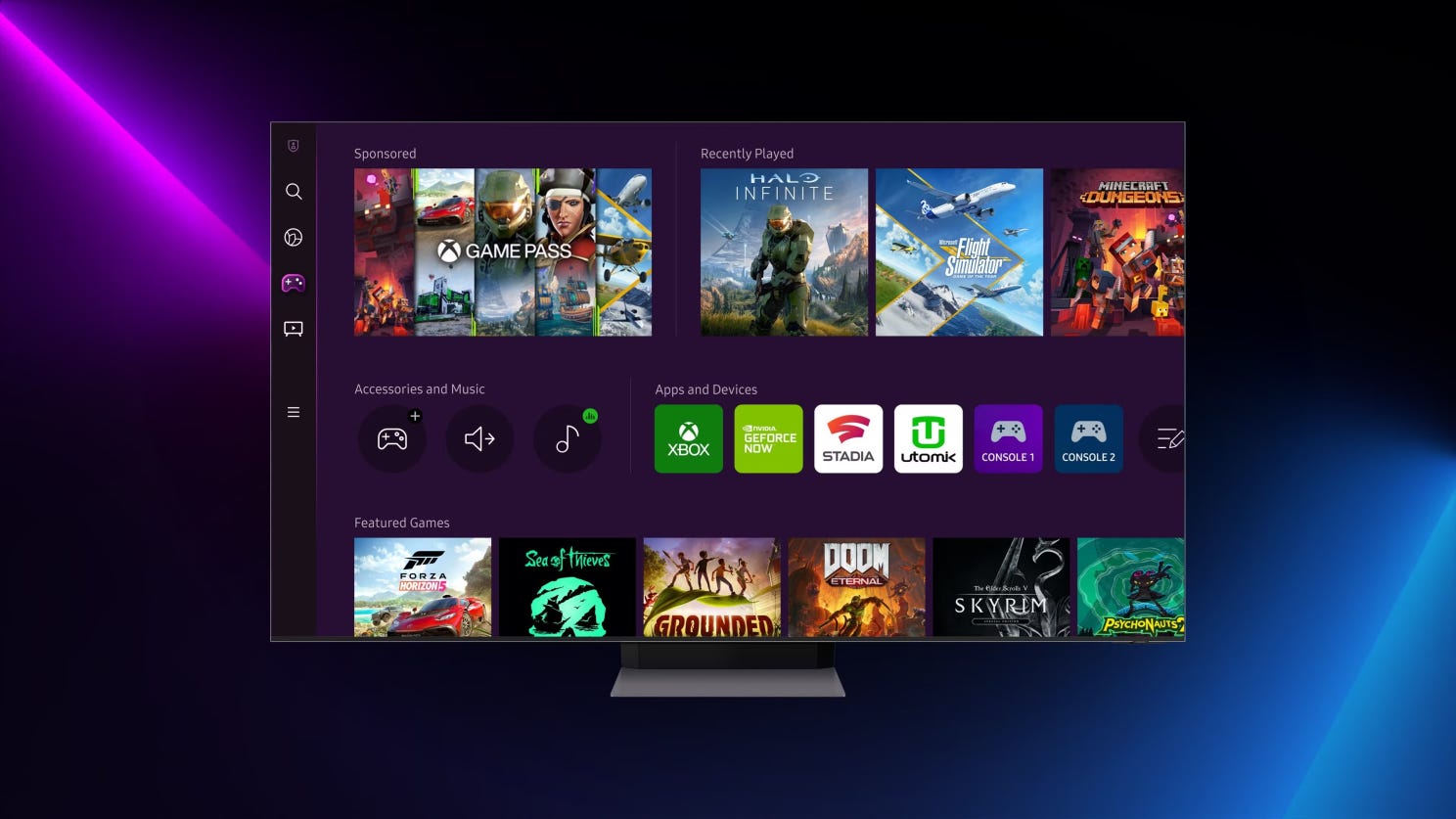
The platform-level version of the same idea. Samsung built gaming directly into the television’s operating system... turn on the TV and games sit next to shows in the same interface, no console, no downloads, over 4,000 titles via cloud. Unique users have nearly doubled in two years, and casual and party game players grew 200% globally between June 2025 and June 2026, per numbers Samsung shared with GamesBeat this week. The growth isn’t hiding in one friendly region either... North America alone grew more than 90%, Brazil is going gangbusters in Samsung’s own words, and Play.Works, a casual games partner on the platform, saw an elevenfold increase in global monthly actives over the same stretch.
We don’t track the Gaming Hub as a standalone entity at mindGAME, so I can’t grade it with our data. What I can do is point at how Samsung’s VP of product development describes the landscape:
“Netflix is now offering games on their service, and Amazon is offering games to their subscribers, which is great, because we have a lot of users on our TVs that are subscribing to Netflix or Amazon, or both.” — Avner Ronen, VP of Product Development, Samsung, GamesBeat, July 15, 2026
Read that from Samsung’s chair. Netflix’s gaming ambitions are, to Samsung, a content amenity running inside their operating system... one more reason to buy the television. Even when Netflix’s games work, the value accrues upward to the company that owns the shelf. Rent space on somebody’s shelf and you work for the landlord.
Before anyone says Samsung is just running the Netflix play one level up... that one level is everything. I own a Samsung TV. When I turn it on, the Gaming Hub sits right there on the home screen, a click away, before I’ve entered anybody’s app. No layer to open first, no account handoff, no funnel. Position at the OS level means Samsung controls the first screen you see and can surface games based on how you actually use the device... notice someone firing up a console every night and put games in front of them. Netflix can’t do any of that from inside its rented rectangle. The psychology stacks on top: a television has been a thing people play games on since the Atari days. An app inside that television never has been.
Worth noting on inputs: Ronen is pragmatic about phones as controllers... for some games it’s the only viable mechanism and that’s fine, though Samsung encourages connecting real controllers and hopes people grow into other modes over time. For Samsung, the phone is one option among several on hardware they own. For Netflix, it’s the load-bearing wall.
Poki... The Ninth Biggest Thing Nobody’s Heard Of
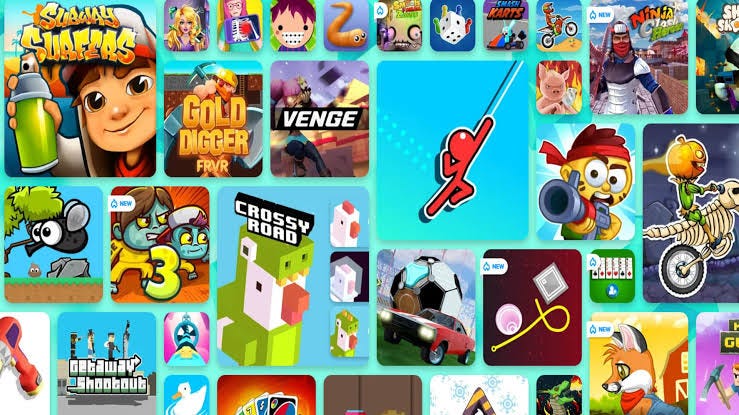
My favorite of the three, and I’ll confess up front this company deserves its own Patch Notes... consider today the appetizer, because I’d love to sit down with the founders someday and hear the full story. Poki is a curated web gaming platform, and yes, it’s fair to call it a throwback to the King.com era... before Candy Crush, King was a browser games portal, and I came up in this business when the web was covered in destinations like it, flash games between classes, Miniclip and Addicting Games and all the rest. Poki rebuilt that idea for 2026. No install, no login, no account. Click and play.
The story underneath the nostalgia is what makes them special. Co-founders Bas Moeys and Michiel van Amerongen had each been building web gaming projects since the early 2000s... they joined forces and launched Poki properly out of Amsterdam in 2014, betting on HTML5 and the open web at the exact moment the entire industry stampeded toward app stores. They offered developers a revenue-share model that was unheard of at the time, curated instead of open-uploading, and released roughly one new game per day. When Flash died and browsers got fast, Poki was standing in pole position... a bootstrapped company of about 65 people, no outside capital ever, that quietly became the market leader in web gaming. COO Stein Janssen put the founding conviction simply:
“I think we figured the easier you make it to access play, the more people can enjoy it. So the vision has always been let the world play... in a time where most people were looking at app ecosystems, we really betted on web.” — Stein Janssen, COO, Poki, Player Driven, July 2026
My podcast partner in crime Greg Posner had Janssen on a couple weeks back, and Greg framed the scale better than I could:
“You’re running one of the biggest gaming platforms nobody’s talking about. You went from 10 million players to 100 million players in six years. That’s about 1 billion game plays a month.” — Greg Posner, Player Driven, July 2026
A hundred million monthly players across 190 countries, market leader in over 100 of them, 650 developers, four to five games per session, 37% coming back multiple times a day... and 62% going on to download or buy a game they discovered there. The top of the industry’s funnel, hiding in a browser tab. This is the ecosystem none of my gaming clients realize exists until I show them the chart.
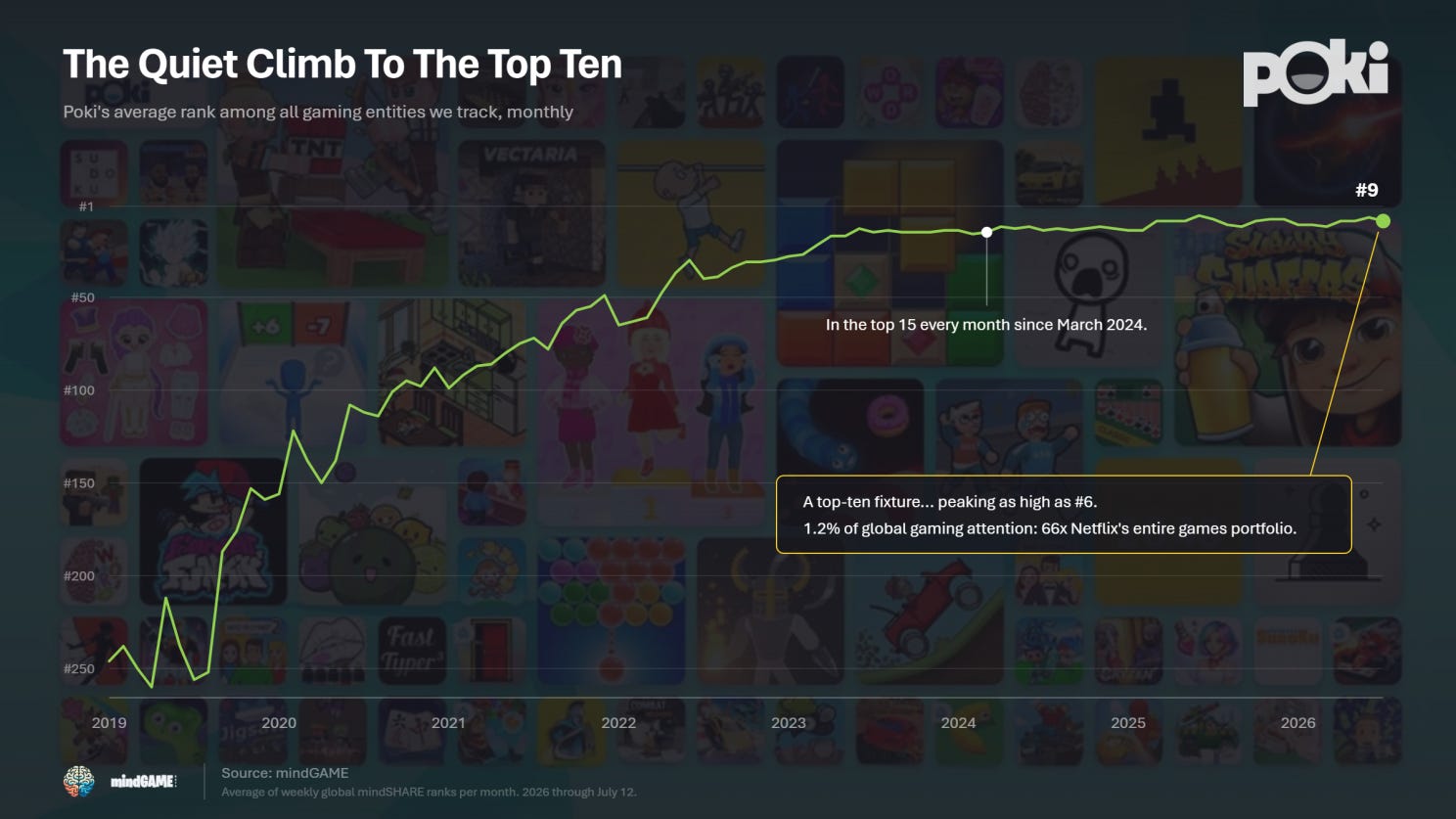
Here’s the chart. In our tracking, Poki is, give or take, the ninth largest gaming entity in the world by attention... averaging rank #9 over the past year, having peaked as high as #6, up from an average rank of 218 in 2019, climbing every single year since. They currently hold 1.2% of global gaming attention, which is 66 times Netflix’s entire games portfolio. Their whole business is the removal of friction... the shortest possible distance between a person and play, nothing between the click and the game. Every layer Netflix adds, Poki deletes, and the gap between 1.2% and 0.018% is what that difference buys.
Look at what these three share. A dedicated box. An operating system. An open browser. Different surfaces, same principle: each one owns the place where the games live, or is the object your brain associates with play. Nobody downloads a controller... nobody gets bounced to a second store. The casual market isn’t waiting to be invented... it’s booming, right now, on every surface except the one inside somebody else’s app. So no, I’m not bearish on casual. My bear case is funnels.
Press Start... Or Press Buy
So where does that leave Netflix? Give them their due first. As I’ve written about before, they have the transmedia flywheel figured out in one direction... Arcane, Castlevania, The Witcher, Devil May Cry, game IP into television, over and over. The other direction is where two billion dollars went to die, and this week made the why legible. Netflix has an engagement problem, the market knows it, and the company is placing bets on every square of the table... live sports, podcasts, creators, short-form, live channels. Gaming is one chip among many. Just not a cheap one, and after five years, nobody can point to the engagement it bought.
The pushback this week sharpened my position, so let me restate it. I’m not down on casual games... I’m down on this customer journey. The UX Netflix designed, an app inside a platform reaching for a controller app on a second platform, is the product of a company that never asked how normal people actually adopt play. Better ecosystems exist, purpose-built, and they’re winning the exact market Netflix wants... we just met three of them. None of this means Netflix can’t succeed at gaming. It means succeeding requires giving people a reason to show up and a model that drives continual engagement, the same thing console makers have understood forever. If the controller experience is awkward, solve it with an actual controller.
And the reason to show up has always been sitting in their own history. Their single biggest gaming moment was licensing Grand Theft Auto: The Trilogy, which spiked downloads like nothing they built ever has... one of the biggest IPs on earth did what two billion dollars of original development couldn’t. People want to play IP they recognize, which is why my honest advice remains what it’s been all along: buy, don’t build. When Netflix bid for Warner Bros. Discovery, the piece that genuinely excited me was WB Games... an organization structurally, historically great at building games on top of IP. Hogwarts Legacy was the best-selling game of its year. Bolt that machine onto Netflix’s library of universes and the synergy writes itself. The deal died, but the logic didn’t. I wrote last October that if Microsoft’s AI bills ever crowd out patience for gaming and the portfolio gets sold piecemeal, Netflix is a plausible home for a studio like Bethesda... proprietary IP that fits their transmedia machine like a glove. We shall see.
One note on timing: I’m writing this before Thursday’s earnings call, so by the time it hits your inbox, Netflix may have already said something that ages a paragraph or two. That’s the game. What I’ll be listening for is a number... any number. This company invented the weekly Top 10 because when they have engagement wins, they publish them. Gaming has produced five years of “encouraging signals” and “scratching the surface.” The day a real figure shows up is the day the strategy has something to say for itself.
As for me, I’ll be in San Diego, where Netflix will undoubtedly have a presence... Brad Bird’s Ray Gunn gets a Hall H panel, and even the Clash of Clans panel is touting its upcoming Netflix series. The IP machine hums along, the culture keeps compounding, my kids will hunt action figures while Doomsday eats the weekend. Netflix owns a real piece of what this con celebrates. The audience was never the problem... the path to them was.
See you in two weeks.