

Three Games, Eight Days... And A Release Window That Didn't Have To Happen This Way

Spring break is over, and I’m back.
I’ll be honest, I didn’t unplug as cleanly as I planned. I shared a few things out there, couldn’t fully resist. But I did get something I hadn’t managed in a while... time to actually sit down and finish a game. That game was Pokopia.
For anyone who’s been following my writing on this game, I’ve talked a lot about the mindSHARE data, the retention curve, the week-three hold. What I haven’t talked about is actually finishing it. Over spring break, I did. And I mean finishing it in the way the game asks you to: working through all four story areas, Withered Wasteland, Bleak Beach, Rocky Ridges, and Sparkling Skylands, rebuilding the Pokémon Center in each one, and raising every area’s Environment Level to 5 to unlock the ending.
What I did not expect was the story.
I won’t spoil it here, but the mystery of what happened to Kanto, the villainous organization thread running underneath all of it, and where it leads... I got more out of that story than I have out of any mainline Pokémon game in a very long time. Maybe ever. It’s quietly one of the best things anyone has done with this IP in years. My current game of the year, and it isn’t particularly close.
Next on the docket is Crimson Desert. A game that more than a few people I like and respect have already called their game of the year (or decade?). My takes are incoming.
Another thing I did while I was out was jump on a quick pod with Greg over at Player Driven. My position on Epic had apparently been gaining enough traction that people felt the need to hear it out loud, and I was happy to oblige. We covered Fortnite, Tim Sweeney, and the case against Disney buying Epic... which brings me to something I’ve been wanting to say since about day three of spring break.
A note to anyone at Disney Corporate who has somehow found their way to a gaming newsletter....
I’ve written before about why a Disney acquisition of Epic Games would be a mistake, and I stand by it. The counterpoint I keep getting is Unreal Engine. The pitch goes: Disney gets access to one of the most powerful development platforms on the planet, plugs it into their CGI pipeline, and suddenly the price tag makes sense. Forget the fact that I’d put the over/under on what Epic costs north of $50 billion, probably well north. Forget the fact that the Fox acquisition ran somewhere in the $70 billion range and hasn’t come close to delivering the returns that Marvel, Pixar, and Star Wars did at a fraction of that price. Set all of that aside.
My core argument is simpler. Disney is not a technology company. And Aulani just proved it for me in three acts.
Act one: you engage with the resort through the Aulani app. Fine. Makes sense. It’s their property, it’s a navigation tool, no complaints there.
Act two: you want to access photos taken by Disney’s own photographers on-site. For that, you need the Disneyland app. Not the Aulani app. The Disneyland app. I am standing at a resort in Hawaii downloading an app for a theme park in Anaheim to see photos that Disney’s own people took of my family. Two apps now.
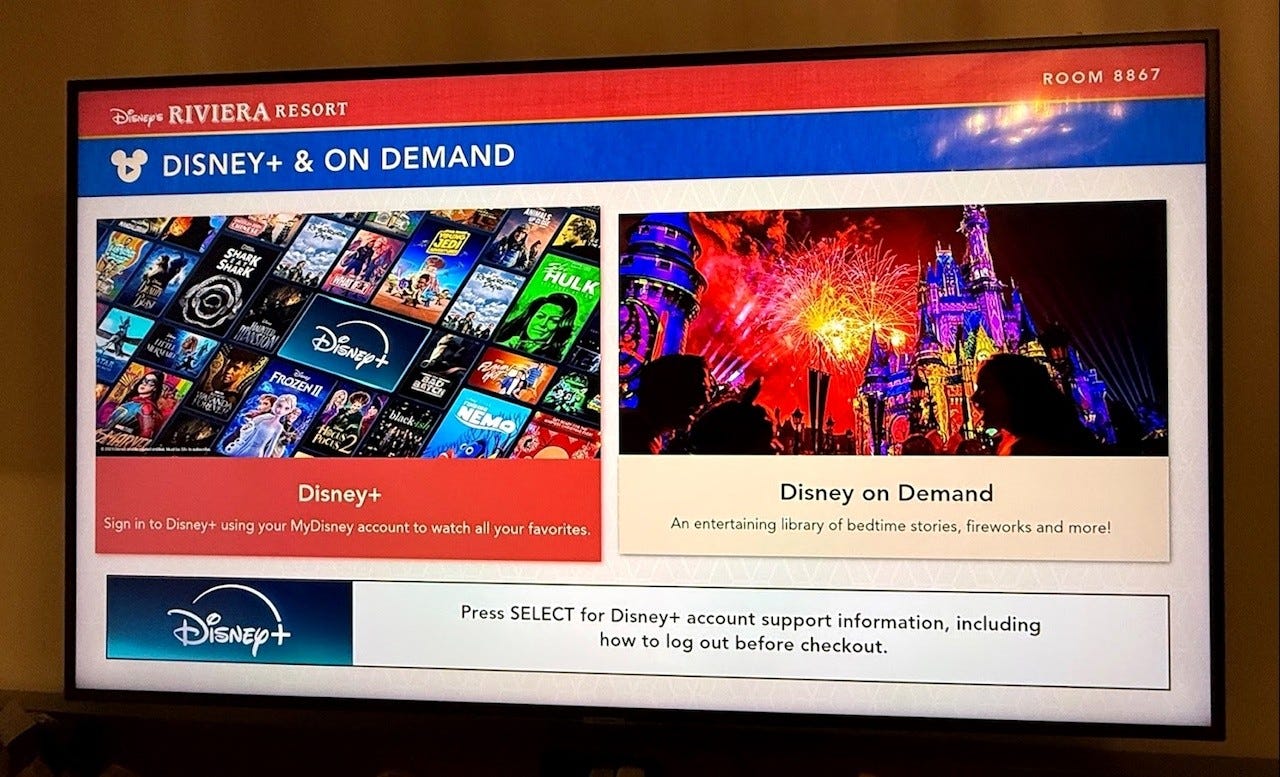
Act three: I get back to the room and QR code my TV like I’m at a Marriott Courtyard. Sign in manually. Authenticate Disney Plus from scratch. The TV has no idea who I am.
What I want, and what a technology company would have built, is one app. A Disney super app. It knows I’m a guest. It holds my reservation. It carries my Disney Plus login. It stores my photos. It talks to the TV in my room before I’ve put my bag down. My kids are watching Bluey before I’ve touched a remote. That’s the product. Disney doesn’t have that. They have somewhere north of a dozen apps across their park properties and entertainment brands, none of which talk to each other the way they should.
Owning Unreal Engine doesn’t solve that. It becomes valuable only if you can operationalize it, and the Aulani app situation tells you everything you need to know about Disney’s current ability to do that. They are an entertainment and experiences company. World class at both. That’s the lane. Stay in it.
Speaking of entertainment companies who understand their lane...
The Super Mario Galaxy Movie landed. And it hit.
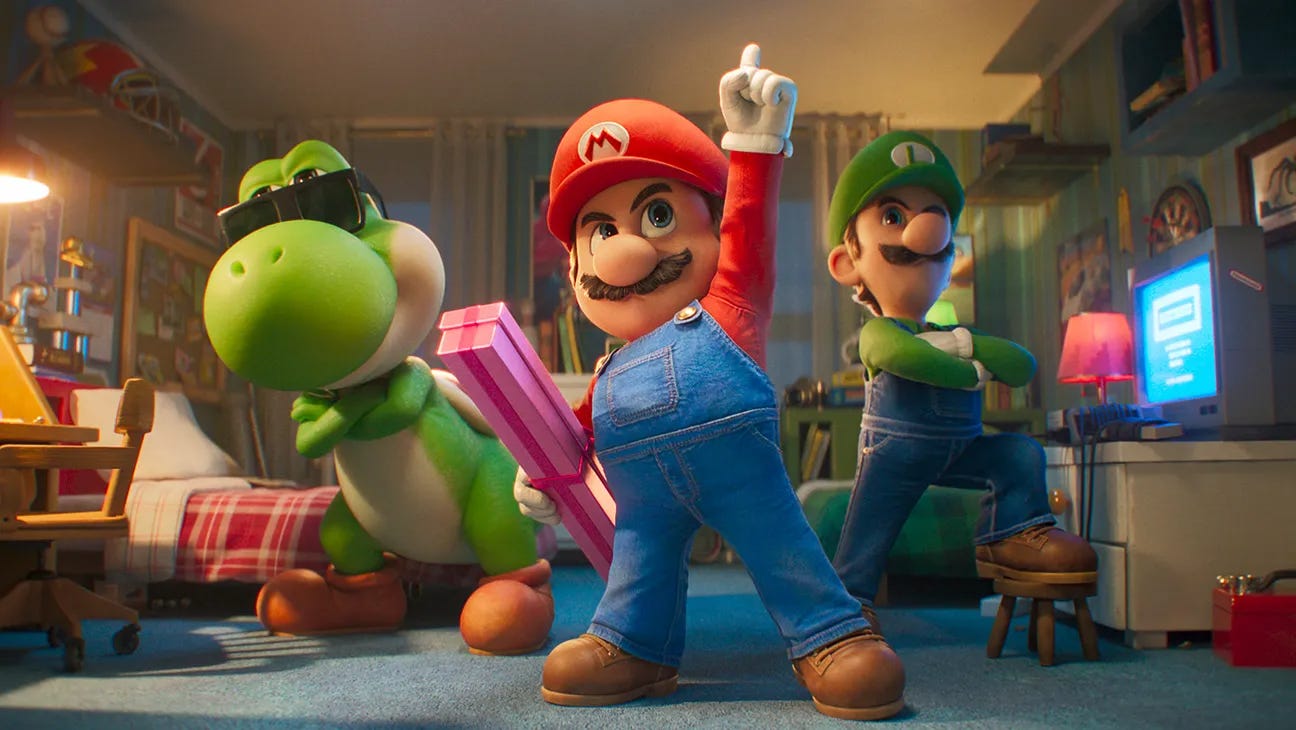
$372.6 million globally in its opening weekend. $190 million domestic in five days. Biggest debut of 2026 by a wide margin, essentially matching the first film’s $375 million global opening, which went on to $1.3 billion worldwide.
My rating: 8 out of 10. Marginally better than the first one. Bowser Jr. was the best part by a mile, the paintbrush, the Sunshine callbacks, the emotional arc with his dad... that’s the film working at its best. Yoshi, on the other hand, was a genuine disappointment. One of the most beloved characters in the franchise, reduced to comic relief with zero plot attachment. The real litmus test for kids movies in our house is bathroom breaks. Zero from either kid, start to finish. Standing ovation.
Bigger picture, Nintendo is clearly running a full cinematic universe build now, and it’s moving fast. Fox McCloud is already in this film. The Zelda live-action film directed by Wes Ball releases May 2027, distributed by Sony. A Donkey Kong animated film is reportedly in development at Universal. Rumored projects for Luigi’s Mansion, Metroid, Pikmin. Nintendo published an official movie release calendar in their investor presentation with four confirmed slots. That is not a company dabbling in Hollywood. That is a company running a transmedia IP strategy with the same intentionality they bring to hardware launches. Nobody in gaming is doing this at scale... nobody is close.
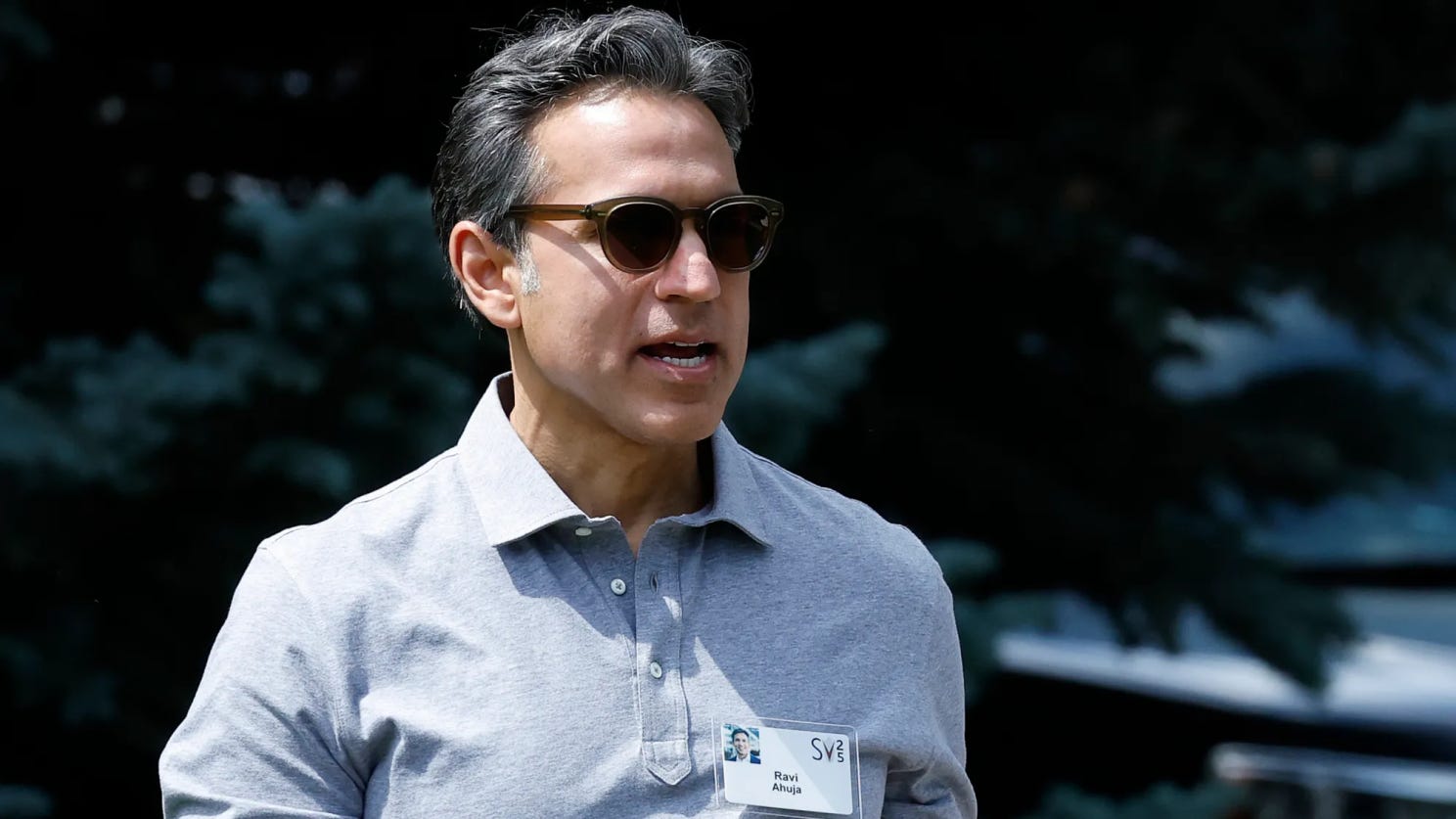
The one company I’d put in the same sentence, playing a different game in a different lane, is Sony Interactive. This week, Sony Pictures Entertainment announced layoffs across its film, TV, and corporate divisions. CEO Ravi Ahuja framed it directly in his note to staff:
“Our connectivity to the broader Sony Group ecosystem centers us for accelerated growth in anime and game IP adaptations.” — Ravi Ahuja, CEO Sony Pictures Entertainment, Hollywood Reporter, April 7, 2026
Sony is explicitly doubling down on PlayStation IP as a growth vector. God of War is in production on Prime Video right now, two-season order already in hand. The Last of Us already set the blueprint for what this looks like when it works. Nintendo is the family lane. Sony is building the adult lane. Kratos is not Mario. There’s room for both, and it’ll be worth watching how this pivot plays out in practice over the next few years.
I said last week I was done writing about Pokopia... Now.. the last several paragraphs suggest otherwise (sorry). But it won’t be the center of this week’s piece, more on that later. Right now, May is coming fast, and it deserves its own conversation.
Three games. One month. Let’s get into it.
Forza Horizon 6: The Clear Winner Of Q2 2026
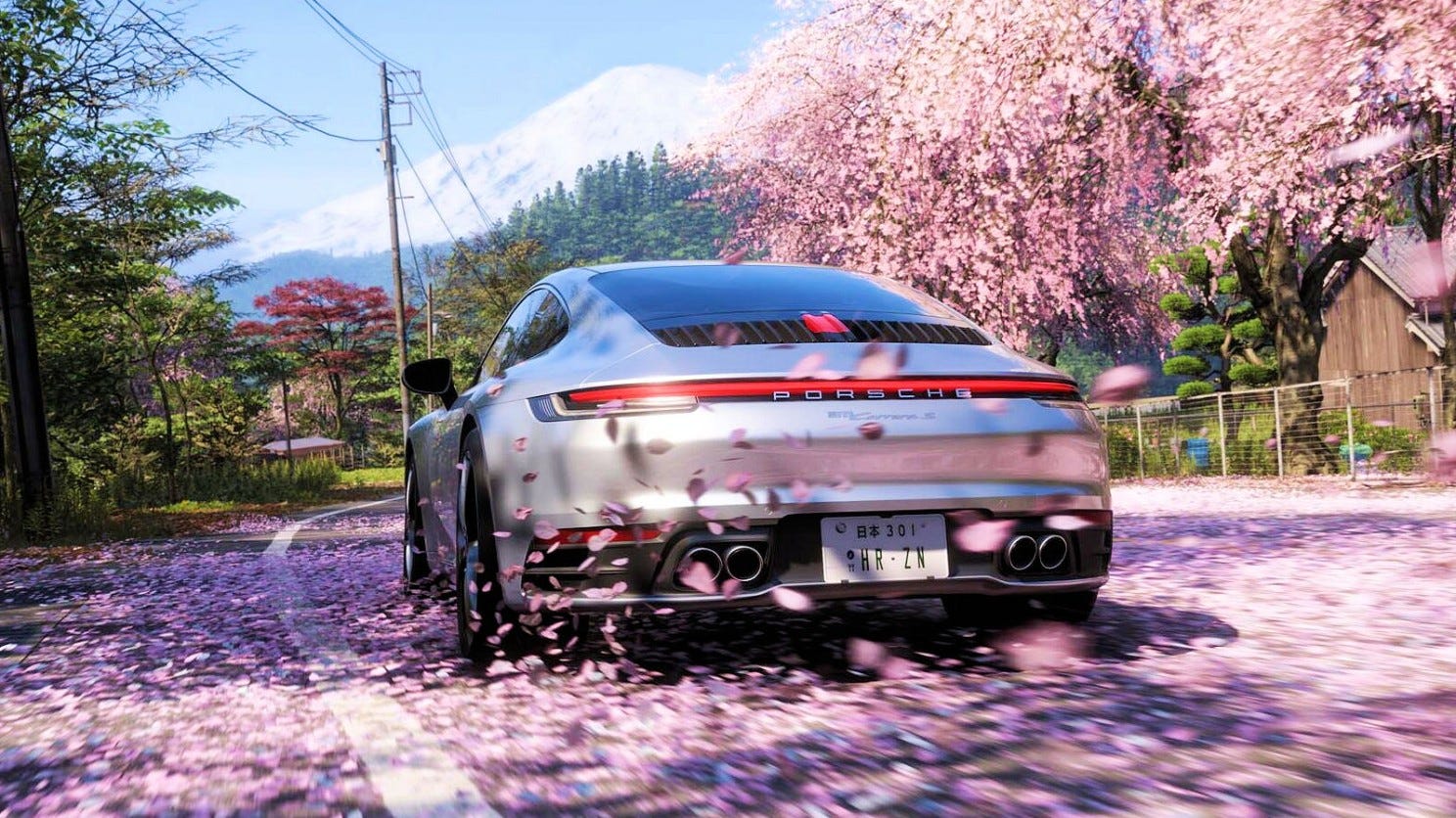
Let’s start with the obvious one.
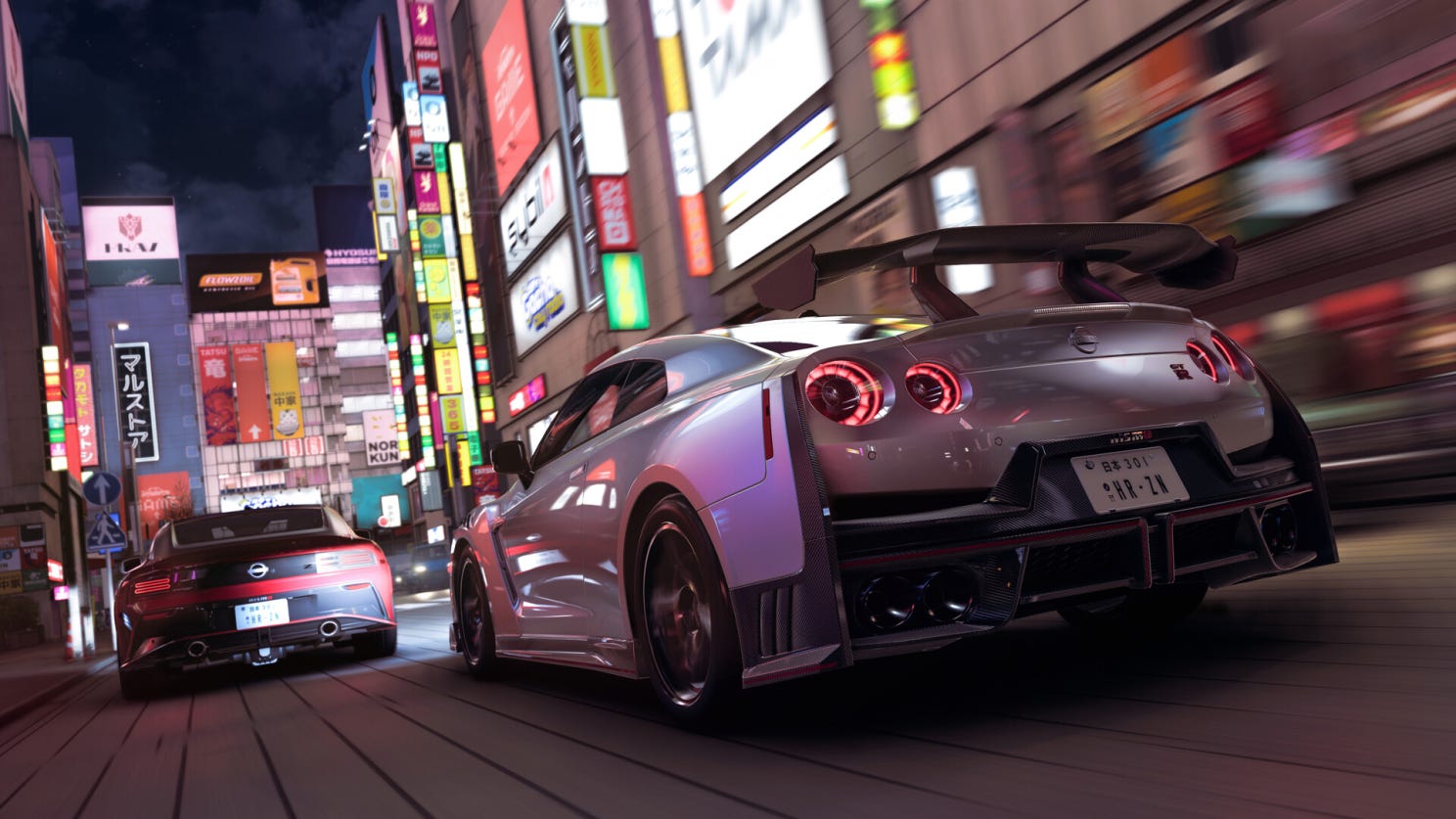
Forza Horizon 6 is the biggest game of this quarter. Not a prediction, a statement of fact. The data has been telling this story for months, and at seven weeks from launch nothing in the pipeline is within striking distance. It’s also, quietly, the most important franchise Microsoft still owns that people genuinely care about. More on that in a moment.
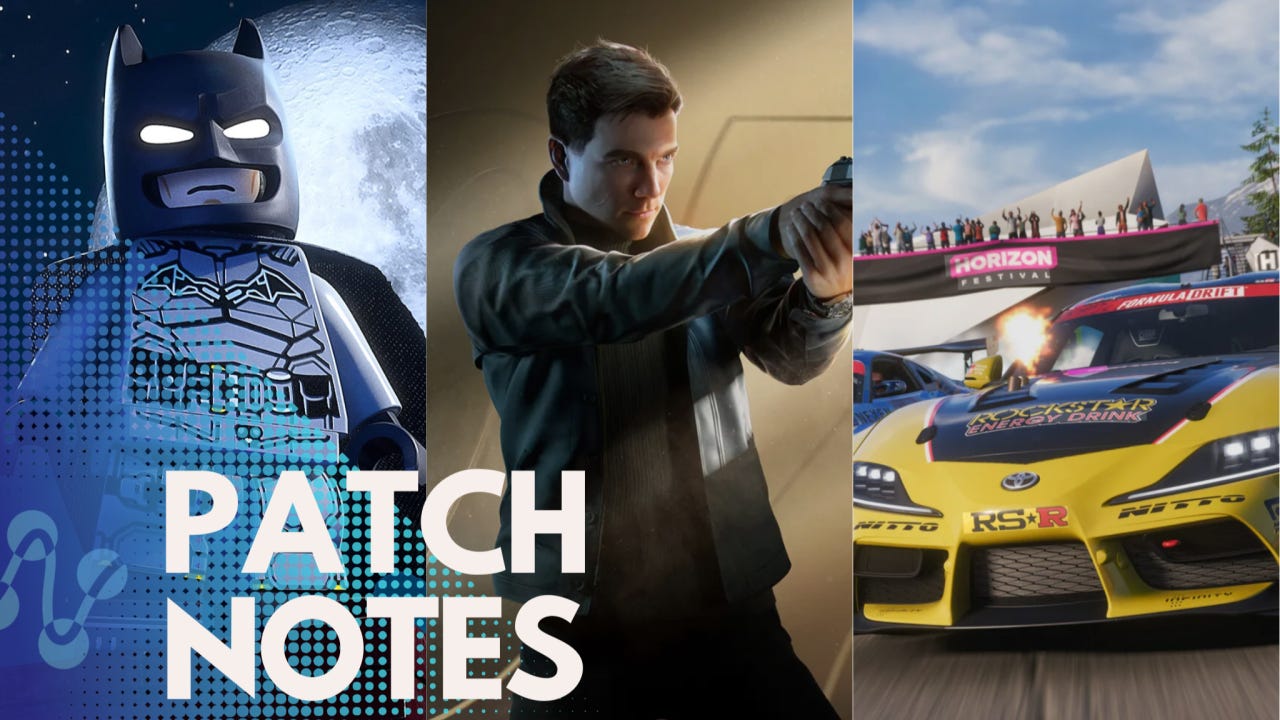
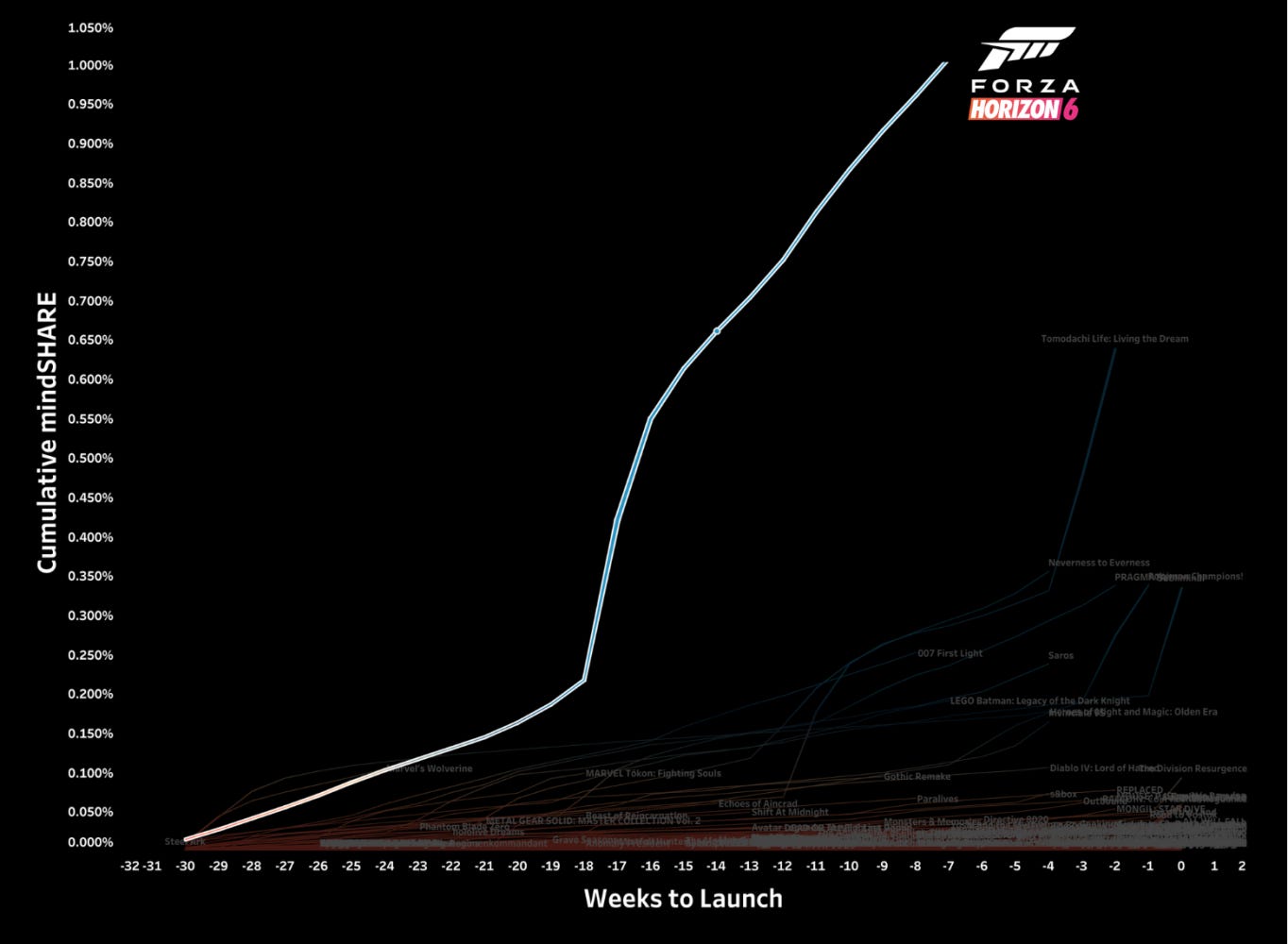
Here’s where it sits right now. Cumulative mindSHARE of 1.008%, generating over 300,000 search queries every week, ranking inside the top 500 across both Google Search and YouTube. And then there’s TikTok, where Forza Horizon 6 has accumulated around 400 million lifetime views across roughly 20,000 videos. That video count is the number I keep coming back to. Views are passive. Twenty thousand creators actively choosing to make content around an unreleased game is a signal of a different kind. For context, 007 First Light has around 70 million views across roughly 3,000 videos. LEGO Batman has around 20 million views across around 600. Forza isn’t just winning May. It’s been winning the quarter for a while.
The game itself is Playground Games’ most ambitious Horizon entry, and they’ve been candid about why. Japan was the most requested setting in franchise history, and the team held off until they felt the technology could do it justice. Art director Don Arceta described the goal as being “authentic and respectful” to Japan’s culture, not just its scenery. Design director Torben Ellert framed the ambition plainly:
“Japan is such an exciting, interesting, intriguing location that many people have wanted from the franchise for a long time, that we’ve wanted to do for a long time.” — Torben Ellert, Design Director, Playground Games, Xbox Wire, January 2026
The map reflects that ambition. 550 plus cars, the largest open world in franchise history, with Tokyo alone being five times larger than any previous Horizon city. Multiple distinct districts, from neon-lit downtown streets to suburbs, docklands, and the Japanese Alps. Seasonal weather cycles. A progression system that starts you not as a racing superstar but as a tourist with a dream of earning a spot at the Horizon Festival. That last part is a deliberate design shift, and Playground has been direct about what drove it.
They openly acknowledged that Forza Horizon 5’s Mexico map didn’t fully resonate with fans. The open desert stretches worked against the feeling of discovery and movement between spaces that makes Horizon tick. FH6 was designed as a direct response. Denser. More vertical. More varied. The team articulated their core design philosophy around this:
“Ultimately, freedom is a core design pillar for us. We’ve really tried to not force you to go and do a specific thing, but instead, tempt you into going and doing them.” — Torben Ellert, Design Director, Playground Games, Xbox Wire, January 2026
The COVID Comp

The comp everyone wants to make is Forza Horizon 5. And yes, FH6 is currently tracking about 15% below FH5 at the same point pre-launch. In our data, looking at all racing launches over the past seven years, FH5 was the largest racing launch of the past decade, going on to surpass 40 million players globally across Game Pass and full sales combined. So a 15% gap sounds concerning until you remember what FH5 actually was.
Forza Horizon 5 was a COVID-era game. It launched in November 2021 into a world where people were largely stuck at home, entertainment options were structurally suppressed, and the competition for player attention was artificially muted in ways that inflated numbers across the industry. That rising tide lifted a lot of boats, and FH5 was one of the biggest beneficiaries. Grading FH6 against that baseline without accounting for that context is intellectually dishonest.
Being within 15% of FH5 in a market that is exponentially more competitive, where new games launch every week and player attention is pulled in more directions than ever, is not a warning sign. It’s a win. Microsoft should take that number and feel good about it.
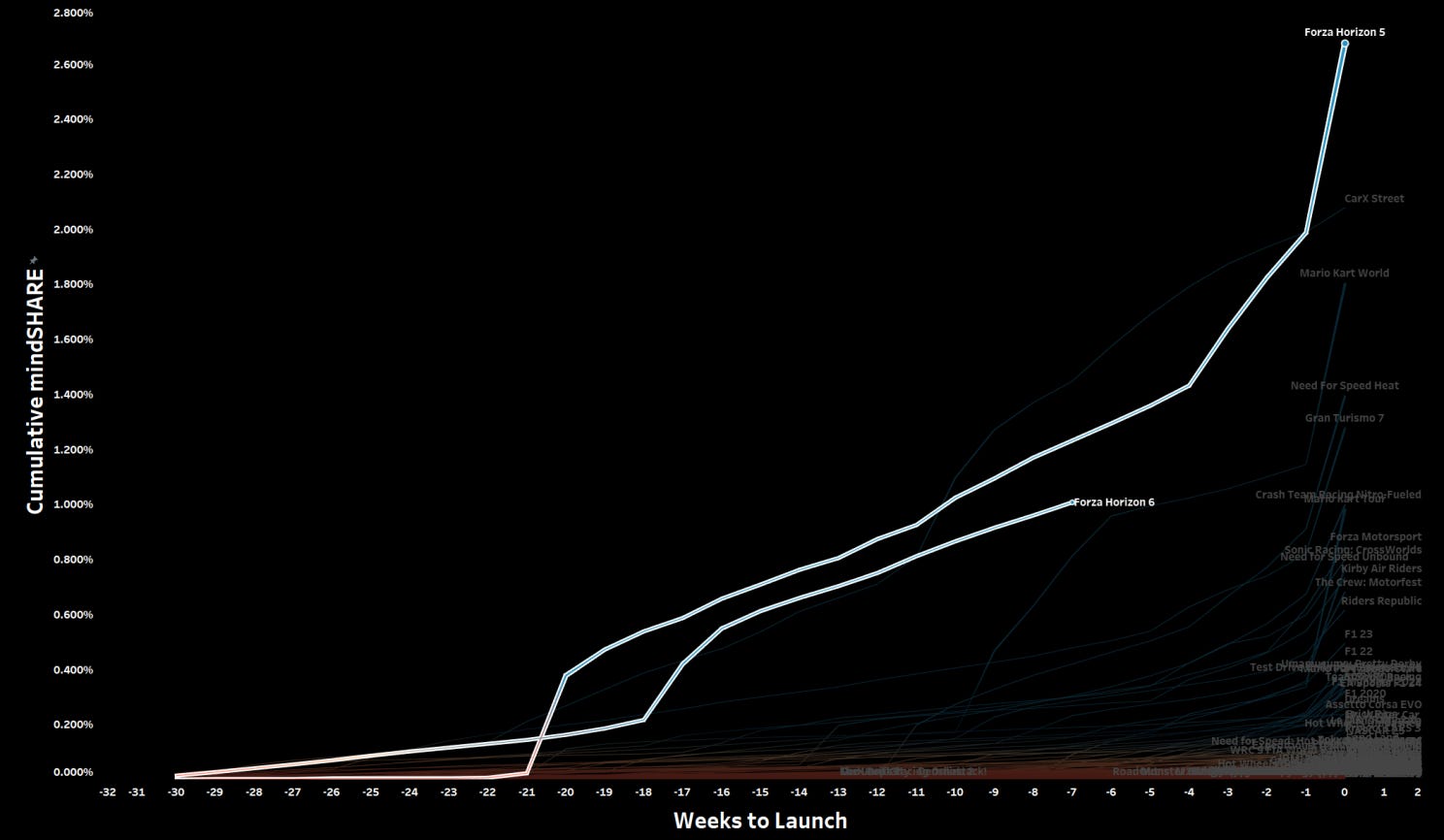
The genre picture reinforces the same story. CarX Street has built genuine momentum as a cross-platform mobile and PC title with 50 million plus lifetime downloads and strong traction in drift-focused communities. Gran Turismo, Need for Speed, and F1 all continue to show steady engagement. The racing genre is broader than it’s ever been. And yet no single competitor is consolidating attention at anywhere near Forza’s level in this cycle. The field has spread out. Forza has stayed on top. The gap between first and second is still significant.
The one honest caveat is that even Forza isn’t fully immune from the attention tax of a crowded window, something I’ll dig into more later. That 15% decline is partly COVID inflation. It’s also partly a noisier market taking a small bite out of even the biggest release of the quarter. Nobody escapes entirely clean. But relative to everything else launching in May, Forza Horizon 6 is operating in a different tier entirely.
Xbox Needs This One
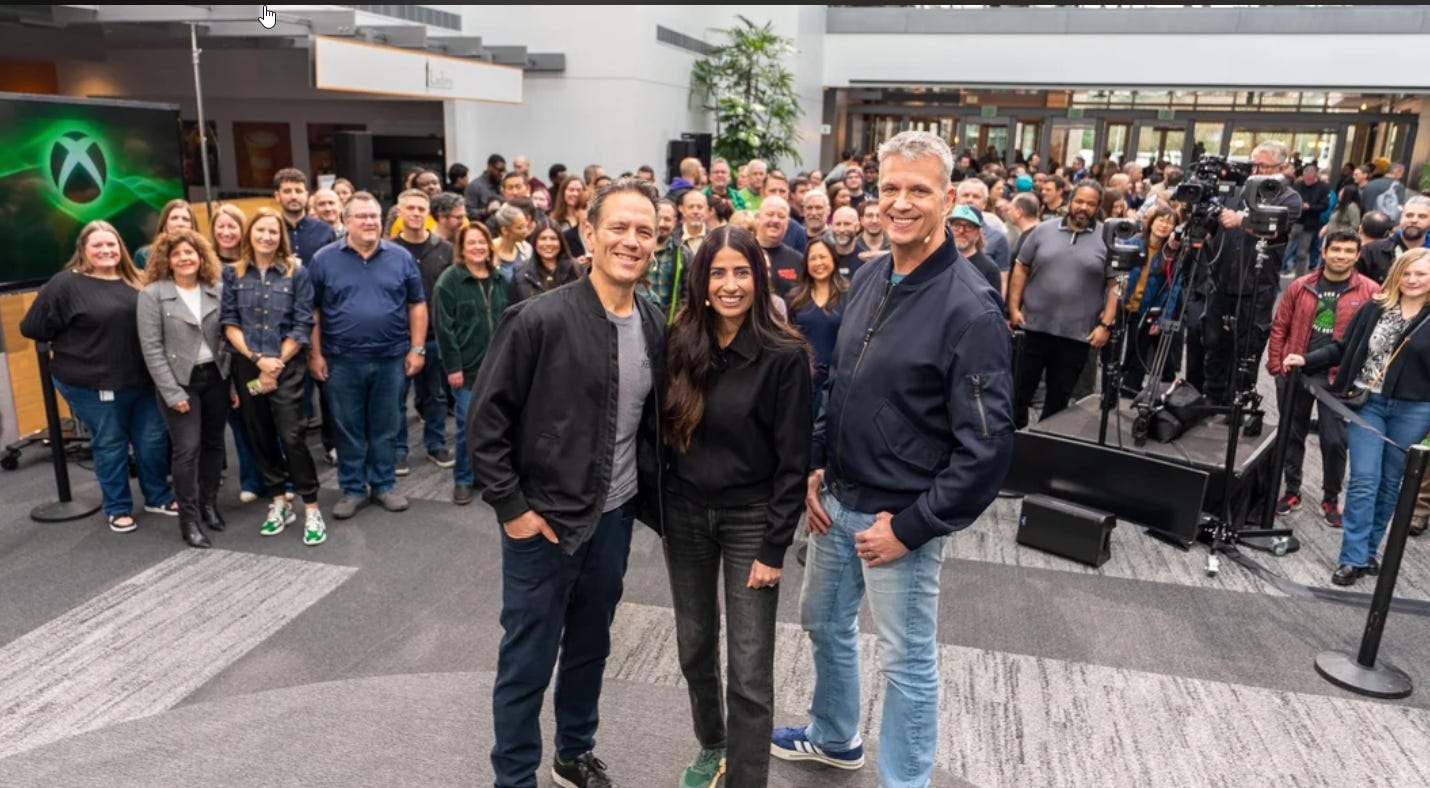
Which brings me back to that opening point. Forza Horizon 6 isn’t just the biggest game of the quarter. It’s the first major release under Xbox’s new leadership era, and the stakes are higher than a launch week number.
I wrote about this at length in February. The short version: Xbox is no longer really a console business or a Game Pass subscription business in the traditional sense. It’s pivoting toward a publishing model, distributing games across every platform including PlayStation, betting that great games can sustain a division that no longer depends on hardware install base. That’s a significant strategic bet, and it only works if the games are actually great.
Think about what Xbox Game Studios Publishing actually owns right now that has genuine cultural momentum. Not Activision Blizzard, not Bethesda, not Minecraft, those are acquisitions with their own orbits. The core old-school Xbox franchises. Halo is in remake mode. Gears of War is six years between mainline entries. Fable has been MIA for so long it became a running joke before finally returning this year. And then there’s Forza. Consistent. Well-received. Beloved. A franchise that has quietly become Xbox’s most important owned IP, which is a remarkable thing to say about a racing game in 2026, but here we are.
New CEO Asha Sharma took over from Phil Spencer and her message to the organization was direct:
“We must have great games beloved by players before we do anything.” — Asha Sharma, CEO Microsoft Gaming, The Verge, April 2026
Forza Horizon 6 is exactly what that sentence is pointing at. It’s already a bestselling series on PlayStation. It’s the franchise that has maintained quality and audience growth through every organizational upheaval Microsoft’s gaming division has gone through. And it’s arriving right now, as the first big statement of this new era, in a window it will win convincingly.
May 19. Japan awaits. Xbox’s best franchise is ready. This one is locked.
LEGO Batman: Legacy of the Dark Knight
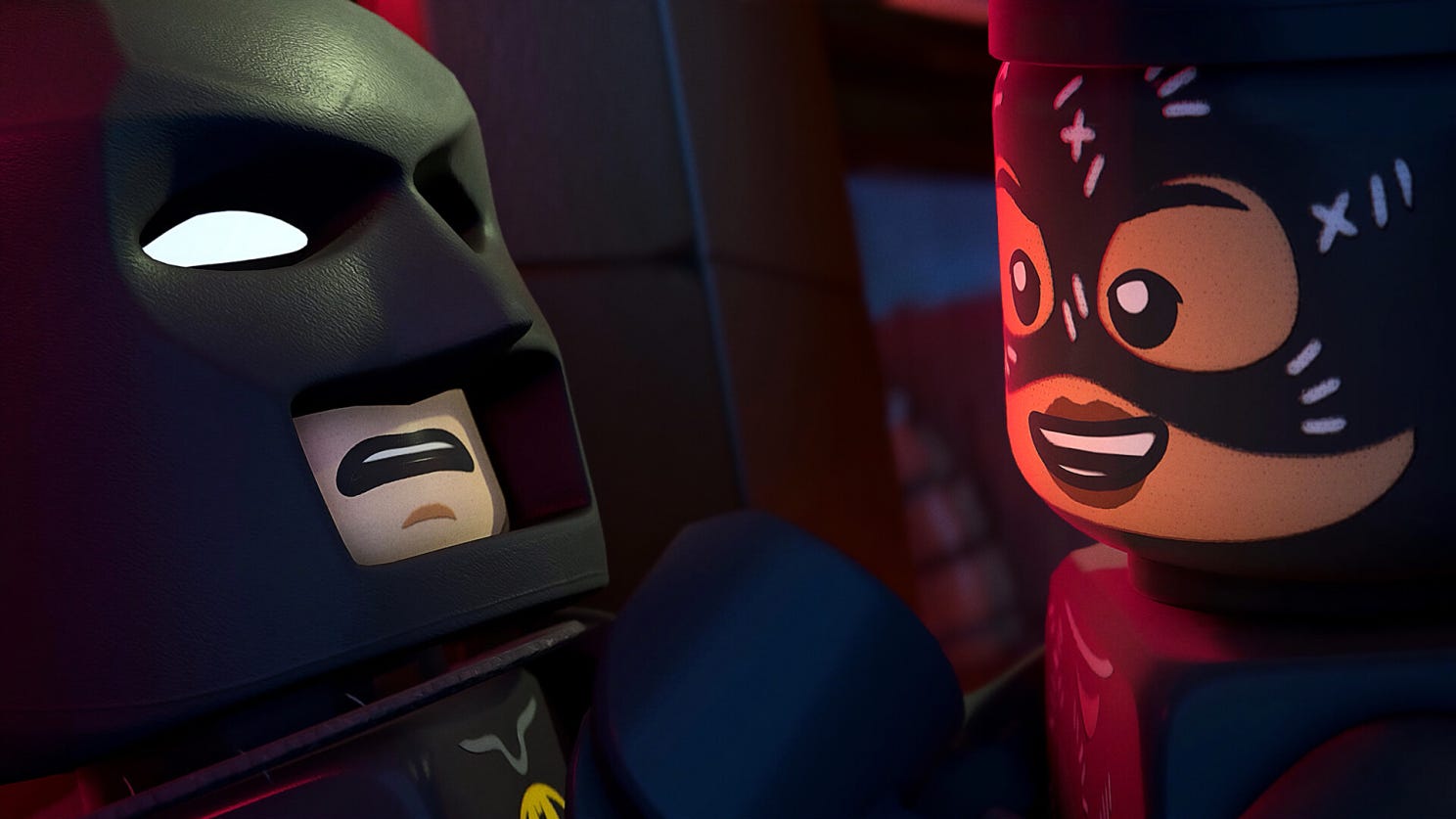
Let me start with full disclosure. I am not an objective observer on this one.
My son and I have spent a lot of time this year in LEGO Star Wars: The Skywalker Saga together, hunting Kyber Bricks across the open world, unlocking secret characters and vehicles. He’s taken it further on his own, running a three-level loop on repeat. The Darth Maul duel... the General Grievous battle... the Count Dooku battle. Boss fights, cycling endlessly, because TT Games built them well enough that a kid wants to live inside them. That’s the magic of what this studio does. It turns a game into a habit, and a habit into something a father and son come back to together.
So when I tell you I want LEGO Batman: Legacy of the Dark Knight to succeed, I mean it in the most personal way possible. And when I tell you I’m worried about it, that’s coming from exactly the same place.
The game itself looks genuinely great. TT Games Ltd ‘ most ambitious Batman entry, fourth in the series, open world Gotham, combat built from the ground up with clear Arkham DNA. Jonathan Smith, strategic director at TT Games, was candid about the inspiration at Gamescom:
“When we think about embodying Batman as a video game character today, of course we’re inspired by the generational defining work that our friends and colleagues at Rocksteady Studios executed so brilliantly in the Arkham series.” — Jonathan Smith, Strategic Director, TT Games, GamesRadar, August 2025
But Smith was equally clear this isn’t an Arkham reskin. It’s TT doing what TT does, taking a foundation and bending it toward something more accessible, more playful, more distinctly LEGO:
“We also wanted to bring our own LEGO approach to that foundation, to deepen what we can do with the gadgets.” — Jonathan Smith, Strategic Director, TT Games, GamesRadar, August 2025
Seven playable characters, Batman, Robin, Nightwing, Batgirl, Jim Gordon, Catwoman, and Talia al Ghul, each with distinct gadgets, abilities, and progression trees. A rogues gallery spanning the Joker, the Penguin, Bane, Poison Ivy, Two-Face, Mr. Freeze, and more. One hundred suits to collect across 86 years of Batman in film, TV, comics, and games. Heath Ledger’s Joker. Michelle Pfeiffer’s Catwoman. The Tumbler. The Animated Series Batmobile. DC Comics president Jim Lee called it “a love letter to the world of Batman,” and based on everything previewed, that framing is accurate.
Launching May 22 with early access starting on May 19, which means the effective window between Forza’s launch and LEGO Batman’s start date for paying customers is zero days.
Good Game. Wrong Month.
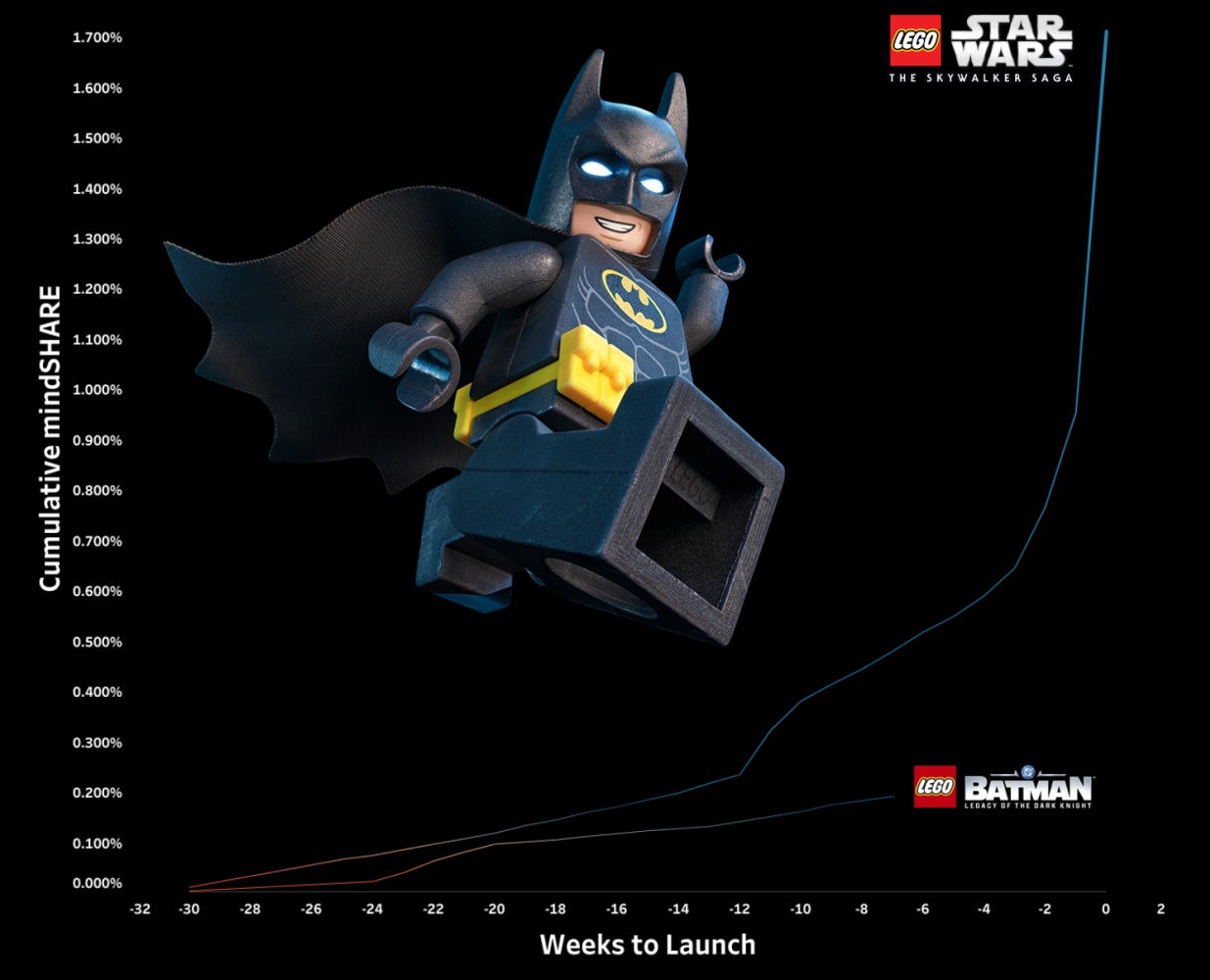
The data is telling a different story than it was in January, not because my read back then was wrong, but because the market changed around it.
At -21 weeks, LEGO Batman and LEGO Star Wars: The Skywalker Saga were genuinely neck and neck. The Gamescom reveal had landed well, the Arkham-inspired preview coverage was strong, the trajectory looked healthy. That read was accurate for January. Then Forza Horizon 6 locked in May 19. Then 007 First Light moved from March all the way to May 27. Suddenly LEGO Batman wasn’t launching into a relatively open window... it was launching into the noisiest week of the quarter, and the attention curve since January reflects exactly that. The flatline isn’t a product problem. It’s a market problem, compounded by a go-to-market problem I’ll get to in a moment.
At seven weeks from launch: LEGO Star Wars Skywalker Saga sat at 0.479% cumulative mindSHARE at the same point. LEGO Batman today is at 0.191%, running at roughly 40% of the Skywalker Saga pace. Weekly search volume around 50,000. Inside the top 1,000 on both Google Search and YouTube. Around 20 million lifetime TikTok views.
That TikTok number is where I want to spend a moment, because it tells a story that goes beyond the data. Twenty million views for a game launching in seven weeks. Forza has 400 million. First Light has 70 million. TikTok skews younger than any other major platform, and LEGO Batman’s core audience is kids and families. That is exactly where you need to be building momentum right now... and they aren’t. The material is sitting right there. Easter eggs across 86 years of Batman. Arkham-style combat that would clip incredibly well. A physical LEGO toy line tied directly to the game. None of it is being leveraged at anywhere near the level it needs to be.
And that is not a TT Games problem. TT Games is a world class studio. It is a Warner Bros. Games problem, and the story behind it goes back further than most people bother to trace.
Three Owners. One Line In An Investor Call.
The 21st century has been a particularly frenetic time for this company. AT&T acquired Time Warner for $85.4 billion in 2018, folding it into WarnerMedia... then threw in the towel three years later, spinning the whole thing off with tens of billions in debt attached. Discovery CEO David Zaslav stepped in and merged with WarnerMedia in 2022 to create Warner Bros. Discovery. The culture clash was immediate. HBO branding got stripped, then restored. A completed Batgirl film was scrapped as a tax writeoff. Hundreds of layoffs followed, then hundreds more. And now, as of February 2026, Paramount Skydance has confirmed a deal to acquire all of Warner Bros. Discovery for $110 billion, expected to close Q3 2026.
As the Hollywood Reporter put it in a piece tracking the company’s ownership history:
“The 21st century has been an especially frenetic time for the company, with two — and soon to be three — mergers and subsequent breakups as the studio changed hands.” — Hollywood Reporter, June 2025
Bloomberg’s Jason Bailey framed the broader pattern plainly:
“Media giants attempt to be every kind of entertainment company at once and then struggle to do much of it particularly well. Ultimately, the audience is left with the short end of the stick.” — Jason Bailey, Bloomberg Opinion, June 2025
Gaming is not the audience Bloomberg had in mind. But the analysis fits perfectly.
And what does perpetual ownership uncertainty actually do to a gaming organization? Bloomberg’s Jason Schreier documented it in detail in a February 2025 piece on the state of Warner Bros. Games. The division had just taken $300 million in losses across a single year. Zaslav himself told investors the gaming business was “substantially underperforming its potential.” Former WB Games Montreal head Martin Carrier captured what the constant organizational churn actually felt like from inside:
“There was a lot going on politically within the organization. The focus on games was perhaps lost a little bit.” — Martin Carrier, Former Head of WB Games Montreal, Bloomberg, February 2025
Lost a little bit. That’s a diplomatic way of describing a decade of trend-chasing, leadership turnover, canceled projects, and studios left in limbo waiting months for basic answers from executives who, by multiple accounts, weren’t particularly engaged with games as a product category in the first place.
The irony is almost too much. In February 2023, fresh off Hogwarts Legacy selling 12 million units in two weeks, Zaslav stood in front of investors and declared games “core” to the company’s strategy:
“As the only studio scaled in gaming, we see it as a meaningful differentiator and a substantial opportunity.” — David Zaslav, CEO Warner Bros. Discovery, Deadline, February 2023
Two years later the division had taken $300 million in losses, its head had stepped down, and Warner Bros. had canceled the Wonder Woman game outright, closing three studios alongside it: Monolith Productions, the team behind the beloved Middle-earth: Shadow of Mordor series, Player First Games, and WB San Diego. The Wonder Woman game alone had cost over $100 million, been rebooted once, and switched directors before being quietly killed. Warner Bros. confirmed the closures in a statement that was almost painful to read:
“After careful consideration, we are closing three of our development studios... The development of Monolith’s Wonder Woman videogame will not move forward. Our hope was to give players and fans the highest quality experience possible for the iconic character, and unfortunately this is no longer possible within our strategic priorities.” — Warner Bros. Games statement, IGN, February 2025
Strategic priorities. From “meaningful differentiator and substantial opportunity” to three studio closures and a canceled flagship game in 24 months. That’s not a gaming strategy. That’s a company that never really had one.
The exceptions prove the rule. Hogwarts Legacy launched February 10, 2023, squarely Q1, into a relatively quiet window, tied to one of the largest IP in the world. The WB Discovery merger had barely closed a year earlier, and that game was already built. Discovery walked in and collected the check on work that was already done. LEGO Star Wars: The Skywalker Saga had COVID tailwinds, same as everything that launched in that window. Neither outcome reflects a functioning gaming strategy from the current ownership group. They were windfalls inherited from a previous era.
When The Ecosystem Actually Fired Together
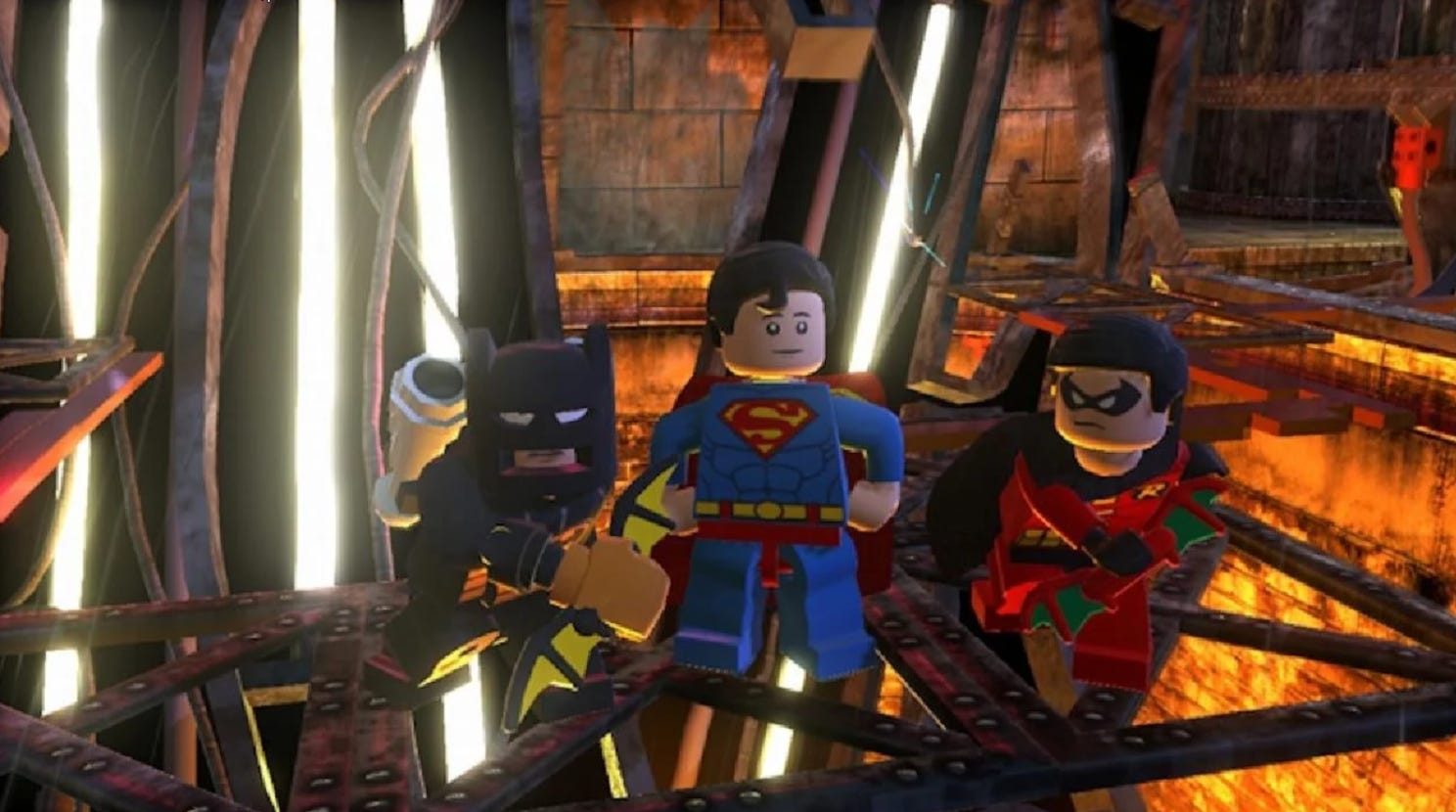
What that previous era actually looked like is worth remembering. The late 2000s and early 2010s under Time Warner was a genuinely special moment for Batman as a franchise across every medium. The Arkham series was redefining what an adult superhero game could be. The Nolan films were doing the same thing in cinema. Running alongside all of it was a steady, consistent flow of LEGO Batman sets that tapped into a younger audience and kept Batman culturally omnipresent across age groups simultaneously. It wasn’t one specific product line driving it... it was the whole ecosystem firing together. Games for older fans, films for older fans, LEGO sets pulling in kids and families, all under the same Batman banner, all at the same time. That kind of synergy doesn’t happen by accident. It happens when an ownership group understands the value of what it has and actually coordinates around it. That was the Time Warner era of Batman. And it showed.
Fast forward to 2025. James Gunn’s Superman released in July to solid reviews and real commercial success. No LEGO Superman tie-in of any consequence, no major game, no synchronized push across the toy and gaming ecosystem that Warner Bros. theoretically controls. The Harry Potter LEGO line is still going strong, but LEGO DC has quietly drifted into occasional one-off releases. There has never been a coherent Superman game strategy, not because the character is impossible to build a game around, but because there has never been an ownership group willing to align the pieces. The best DC superhero game ever made is honestly a LEGO one, and that probably tells you everything you need to know about how seriously anyone has taken this portfolio over the last decade.
My honest take, and this is one I’ve made in writing before: I would love nothing more than for the the LEGO Group to acquire TT Games outright from whoever ends up holding WB Games after Paramount closes. Structurally it makes complete sense. TT is the engine behind over 200 million units of LEGO-branded games globally. That is not a vendor relationship. That is a core strategic asset that LEGO probably shouldn’t be licensing out to a media conglomerate with unclear gaming ambitions, a shrinking LEGO DC toy line, and a new ownership group on the way.
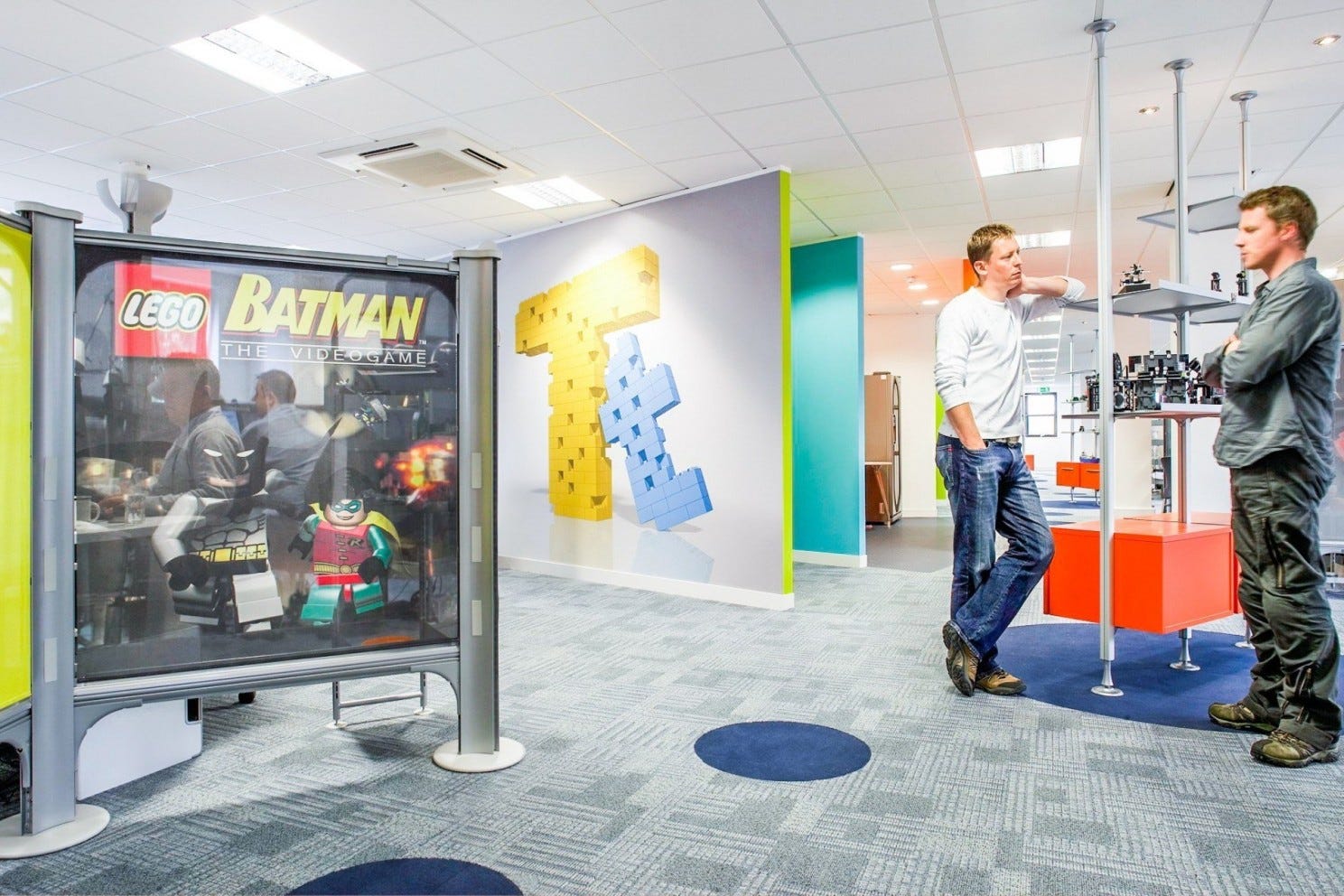
Save TT. Give them an owner who actually understands what they’re building.
Until that happens, LEGO Batman: Legacy of the Dark Knight launches May 22. Three days after Forza. Eight days before First Light. In a window it didn’t need to be in, with a TikTok presence that reflects the broader marketing failure of the organization above it, competing for attention it’s going to have real trouble capturing against games operating in completely different tiers.
This game is going to do fine. TT Games is going to deliver, my son is already asking when we’re playing it together, and the audience for this kind of co-op family experience is real. But there’s a meaningful difference between fine and massive success, and this game had a path to the latter. A cleaner launch window. A TikTok strategy that actually reached the kids it’s trying to sell to. A gaming division with a coherent identity instead of one being passed along to its third corporate owner in a decade. Threading those needles was always going to be hard under these conditions. And that’s the part that frustrates me most, because the product deserves better than the circumstances around it.
The adult money is there. The nostalgia is real. The generational flywheel between parents who grew up on LEGO Batman games and their kids who want to play the new one is sitting right there, largely untapped. As I’ve written about in depth, the brands that figured out how to follow their audience from childhood into adulthood are the ones winning right now. LEGO the toy company understands this. Warner Bros. Games, under whoever happens to be managing it this year, apparently does not.
007 First Light
Six to eight months ago I wrote that this game couldn’t miss. I was bullish in print, on the pod, in conversations with people in the industry. The data backed it up, the IP made sense, and IO Interactive felt like the perfect studio to bring Bond back to games after a 14-year absence.
My position today is more measured. Not bearish. Measured. And the data is why.
Let me set the stage first, starting with the studio itself. IO Interactive is a Danish developer based in Copenhagen, founded in 1998, and best known for one thing: Hitman. That franchise is their DNA, their legacy, and for a long stretch of their history, their lifeline. Eidos acquired IO in 2004, Square Enix absorbed Eidos in 2009, and IO spent nearly a decade operating under Square Enix’s ownership. When Hitman 2016’s episodic release model produced what Abrak himself called “historically low sales,” Square Enix lost faith and cut funding in May 2017. IO performed a management buyout the following month, walked out the door independent for the first time in their history, and kept the Hitman IP with them.
What followed was one of the better comeback stories in recent gaming. Warner Bros. Interactive Entertainment published Hitman 2 in 2018, and then IO took the publishing reins themselves for Hitman 3 in 2021, their first fully self-published title. Between those two games and the World of Assassination platform, Hitman surpassed 80 million players globally by late 2025. From the outside, everything looked like it was working. Then they made a move that didn’t.
In 2024, IO announced IOI Partners, a publishing venture for external studios. Their first published title was MindsEye, the debut game from Build a Rocket Boy, led by former Rockstar North president Leslie Benzies. When MindsEye launched in June 2025, it was a disaster. Metacritic scores of 37 on PC and 28 on PS5, the lowest rated game of 2025. Social media was flooded with bug videos. PlayStation started issuing refunds. IO and Build a Rocket Boy have since formally ended their partnership. When asked if IO would publish external games again, Abrak’s answer was telling:
“IO Interactive will publish our own games internally. IOI Partners? That remains to be seen.” — Hakan Abrak, CEO, IO Interactive, VGC, September 2025
All of which makes 007 First Light the most consequential game IO Interactive has ever made. This is their first major swing at iconic IP that isn’t Hitman. Their publishing reputation took a hit with MindsEye. A lot is riding on Bond delivering.
The good news is the creative foundation looks right. 007 First Light began life in November 2020 as Project 007, announced with a short teaser and Abrak calling it “the most ambitious game in the history of our studio.” What most people didn’t know then, and still don’t fully appreciate, is how the deal actually came together. Delphi Interactive, a small LA-based firm founded in 2020 by CEO Casper Daugaard, originated the concept, secured the MGM/Danjaq license, and brought IO in as the developer and publisher. Daugaard described the thinking:
“We loved what Rocksteady did with Batman: Arkham and what Insomniac did with Spider-Man, and we couldn’t understand why no one had done something similar for James Bond. So we went back to first principles and decided to build it ourselves, with the right partners.” — Casper Daugaard, CEO, Delphi Interactive, GamesIndustry.biz, February 2026
That framing matters. This game wasn’t greenlit by a major publisher running a franchise strategy. It was conceived by a small firm asking the same question every Bond fan has been asking for years, then finding the right studio to answer it.
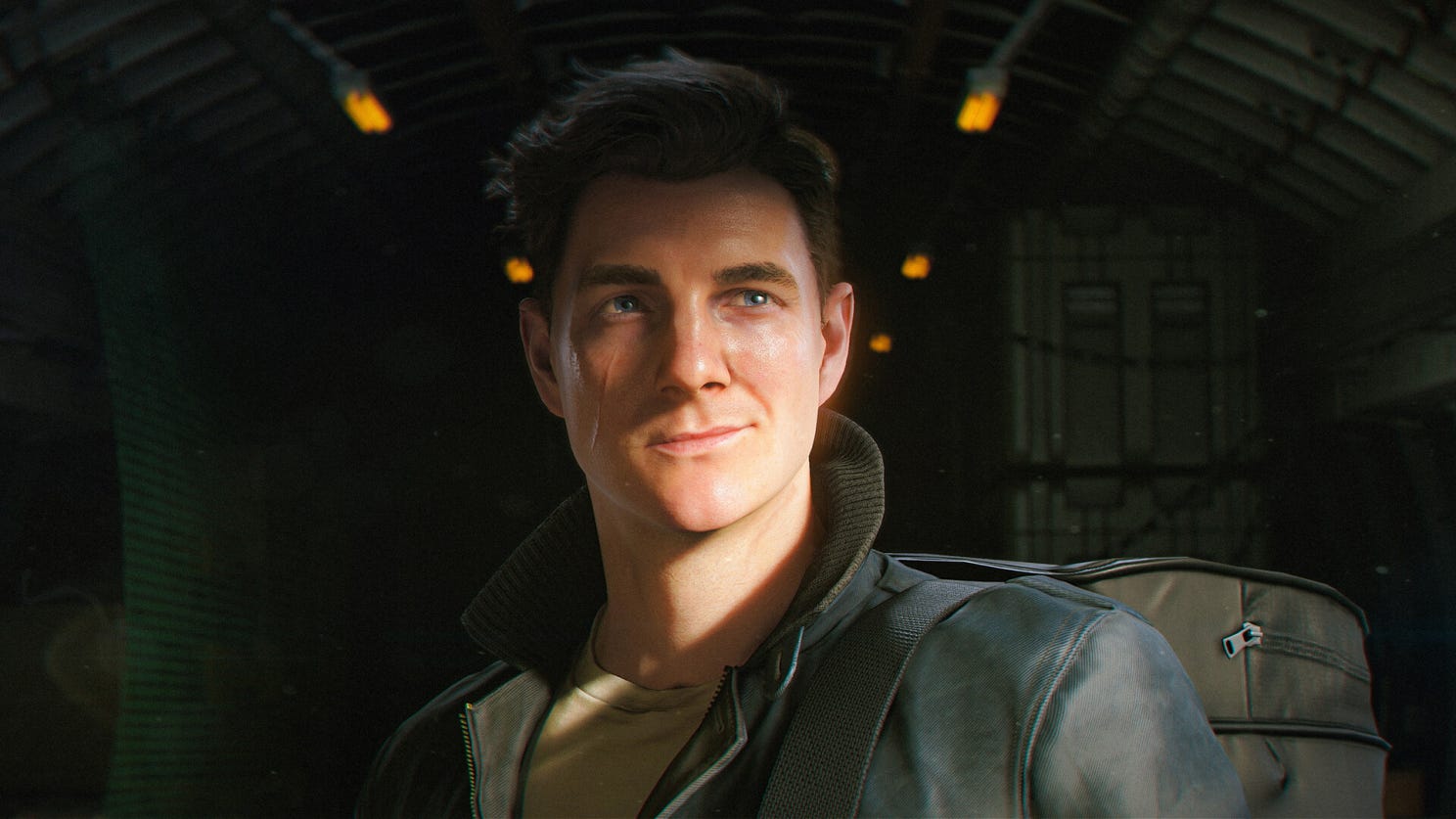
The game itself is IO’s Bond origin story, following a 26-year-old James Bond, played by Patrick Gibson, as a hotheaded MI6 recruit working to earn his 00 status. Narrative and cinematic director Martin Emborg spent years drilling into what makes Bond who he is across every medium, not just the films. The result is a Bond who is recognizable but raw:
“Wits, in this case, he’s a hungry mind. He’s whip-smart, but he doesn’t have that kind of experience. Yet, in terms of guts, you can definitely say, as a young man, he skews more reckless, whereas with a more seasoned 007, it’s a calculated risk. Yes, he will jump out of an airplane, but this guy does it just because that seems like the next best thing to do to catch the bad guys.” — Martin Emborg, Narrative and Cinematic Director, IO Interactive, Game Informer, January 2026
And Abrak on the creative freedom that made the whole thing possible:
“It’s very important for us to have part of ourselves in the story and in the characters that we create, yet still being very respectful to the source material, to the IP. I don’t think we would have necessarily had the same energy and the same vision and the same results if we were to do a gamification of a movie. That freedom of creativity was very important to us.” — Hakan Abrak, CEO, IO Interactive, Game Informer, January 2026
Built on IO’s Glacier engine but a meaningfully different game than Hitman. Freeflow combat inspired by the Batman Arkham series. Cinematic setpieces inspired by Uncharted. Drivable vehicles, a first for IO. Quick-time event sequences woven into the action to give it that big-budget cinematic feel. Stealth is still an option but you’re playing a spy, not an assassin.
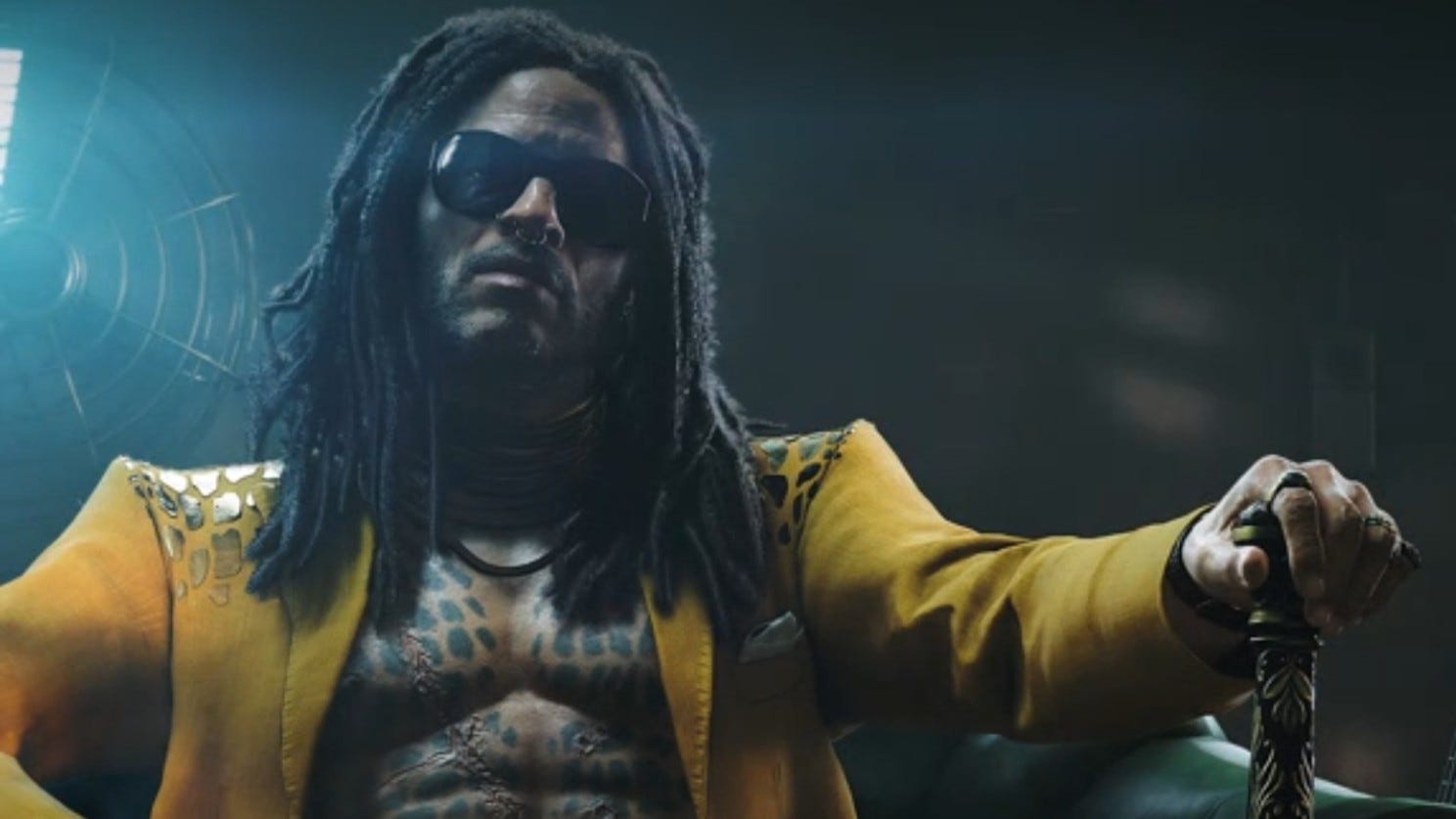
And that last point is why I was so personally bullish on this game from the jump. When I saw the first trailer, what I saw wasn’t just a Bond game. What I saw was Uncharted. Sony’s Uncharted. That cinematic, action-packed, single player blockbuster format where you’re running from explosions, jumping across rooftops, trading witty lines, and doing QTEs through gorgeous set pieces. A game that isn’t asking you to grind or build a base or live in it for 500 hours. Just a great single player action adventure, start to finish, roll credits, feel good about it. That format hasn’t had a major representative in years. The market has been starving for it and didn’t know how to say so. Bond with IO’s stealth DNA layered underneath felt like the perfect answer to a question nobody was asking out loud but everyone was feeling.
That’s still the pitch. That’s still the upside. And the window is what complicated it.
The Forza Shadow
IO’s statement when they moved the date was measured and professional:
“007 First Light is our most ambitious project to date, and the team has been fully focused on delivering an unforgettable James Bond experience... The game is progressing well and is fully playable from beginning to end, so these additional two months will allow us to further polish and refine the experience, ensuring we deliver the strongest possible version at launch.” — Hakan Abrak, CEO, IO Interactive, December 2025
The reasoning is legitimate. Nobody is questioning whether IO needed the time. The problem is where the time landed them.
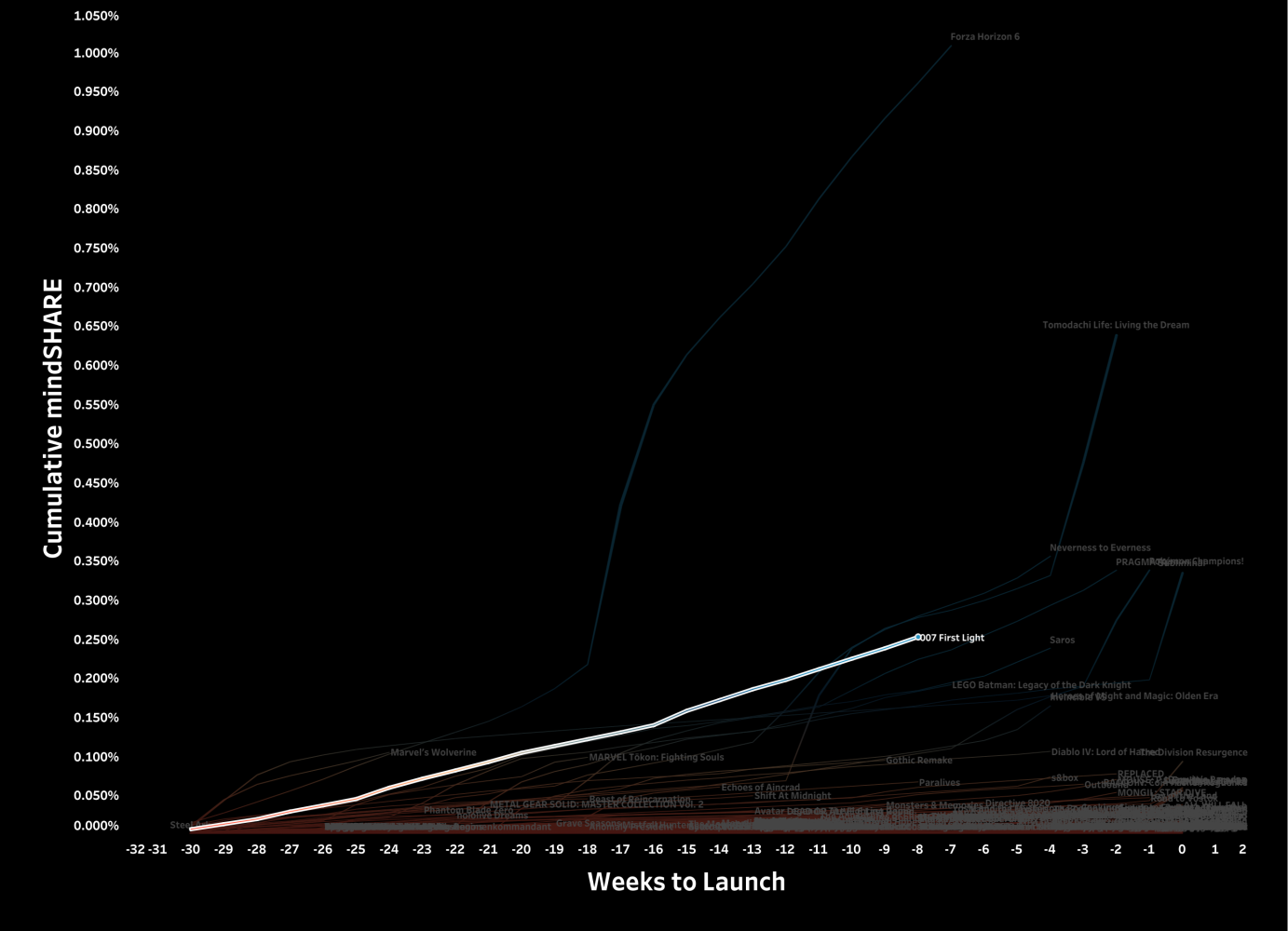
Here’s where the numbers are. Cumulative mindSHARE of 0.252% at eight weeks from launch. About 100,000 weekly search queries. Ranking inside the top 750 across Google Search and YouTube. Roughly 70 million lifetime TikTok views across roughly 3,000 videos. For more context on where this game was tracking earlier in the year and why I was so bullish on it coming out of January.
The numbers are tracking fine. The issue isn’t the absolute score, it’s the context around it. May 27 was originally GTA VI’s launch date. When GTA moved, a flood of games backed into that date, Bond included. Had First Light held March 27, the competitive landscape looks completely different. Pokémon Champions, Mega Man Star Force Legacy Collection, Life is Strange Reunion, Pragmata. Games First Light would have comfortably outpaced. A cleaner window, a pole position similar to what Tomodachi Life has in April right now, and a cumulative mindSHARE curve building from a much stronger starting moment.
Instead, Bond is launching nine days after Forza. The Forza halo effect, that two-week window where a massive game owns all the conversation, runs almost exactly until First Light’s launch date. Bond arrives just as Forza is hitting peak saturation. That’s not a death sentence but it is an anchor.
The ideal release date for this game was June 3rd. First week of June. Give Forza its two weeks, let the halo fade, then step into a month with nothing of consequence competing for attention. Gothic Remake from THQ Nordic launches June 5th and has essentially no North American audience. Bond would have owned June outright. Instead it’s launching into May’s noise and hoping to carry momentum into June on the back of word of mouth alone.
Bond Needs A Jedi Survivor Moment
And word of mouth carries you further when the road ahead is clear. That’s the upside case, and it’s worth taking seriously.
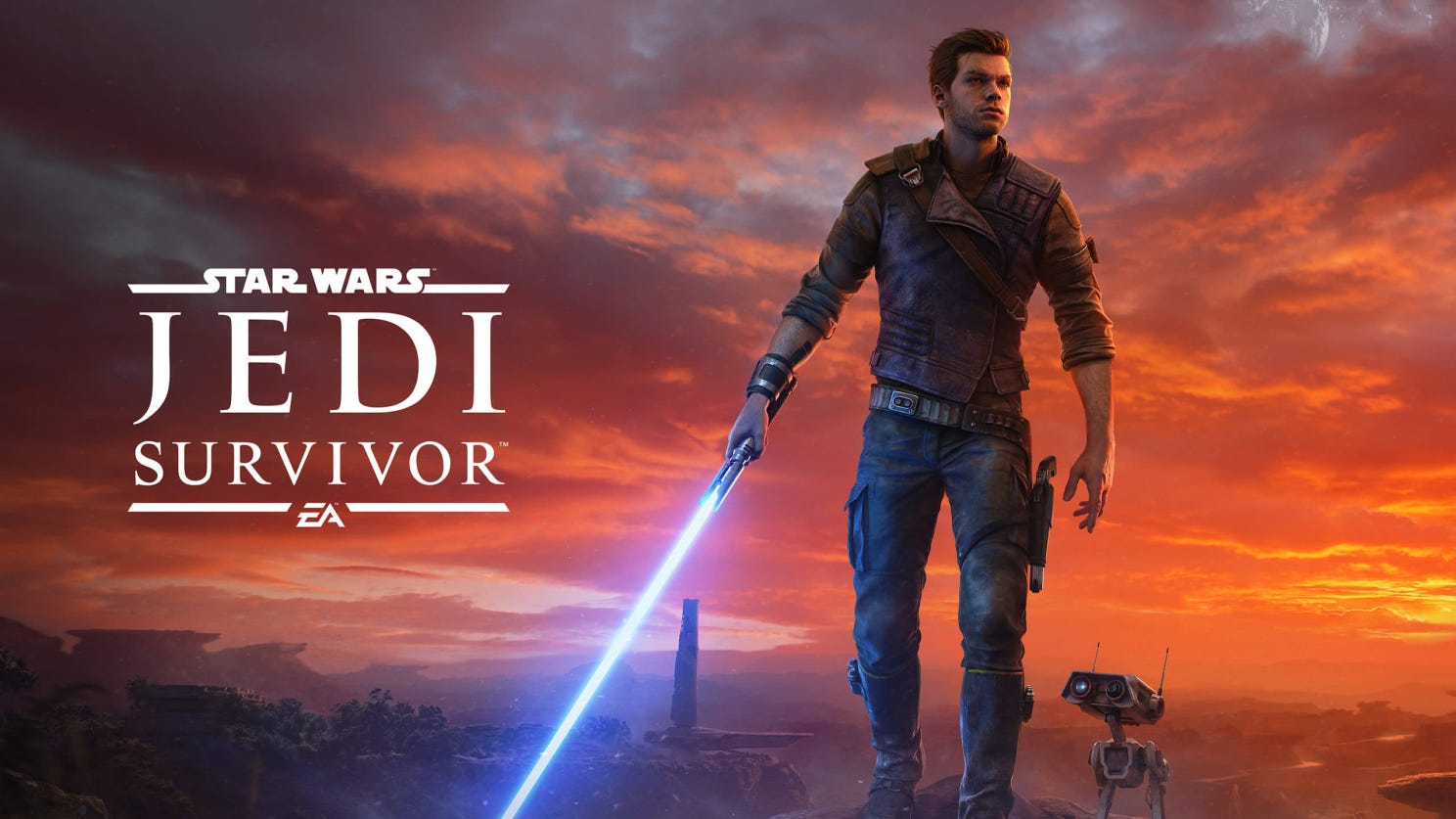
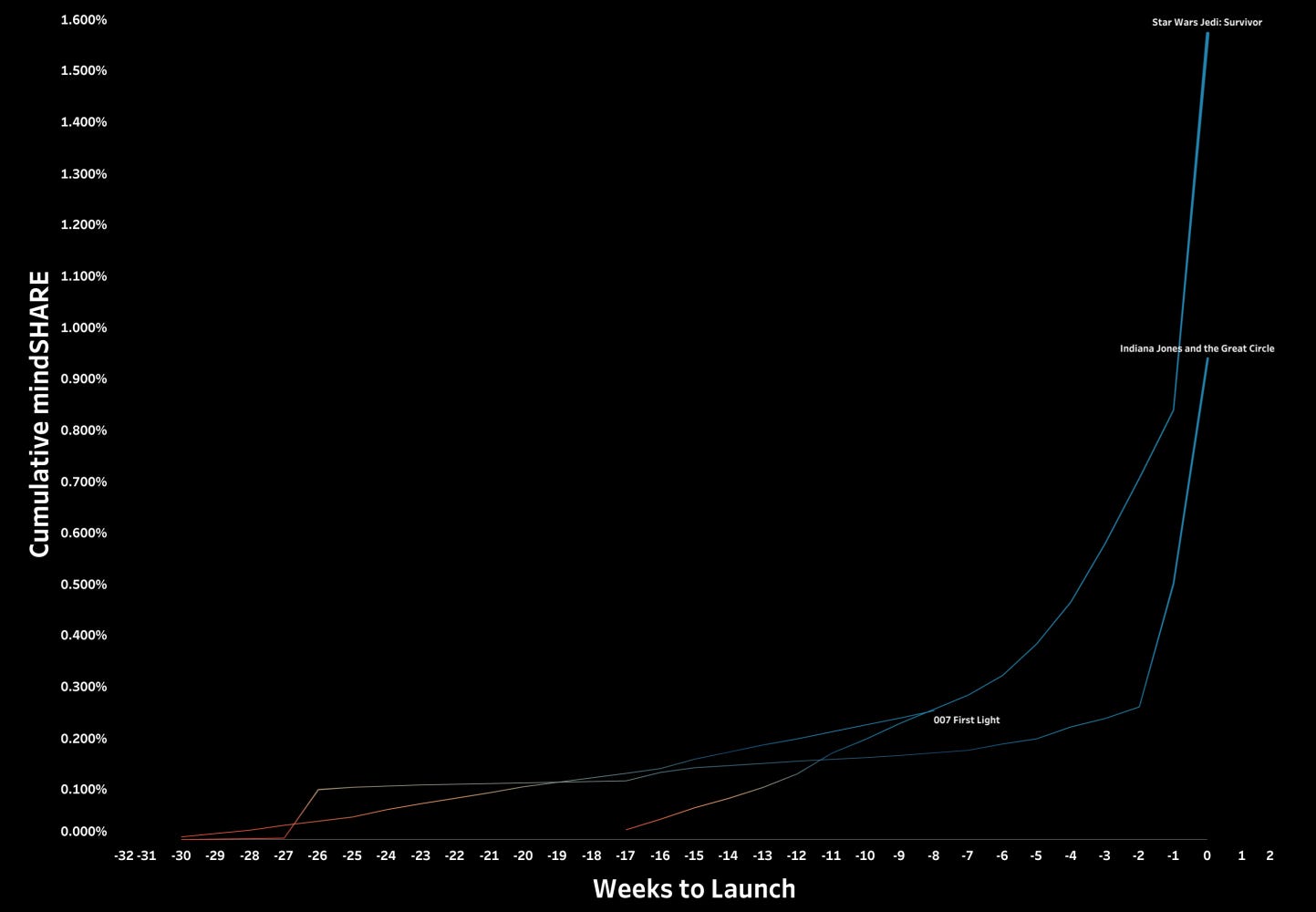
The comp I keep coming back to is Star Wars Jedi: Survivor, and not just because of the numbers. At the same point pre-launch, Jedi Survivor was sitting at 0.255% cumulative mindSHARE, essentially identical to where First Light is right now. EA then put the marketing machine into full gear in those final eight weeks, and Jedi Survivor ramped to 1.571% cumulative mindSHARE at launch, ranking as the second best performing action adventure launch in our post-COVID data set.
But the more interesting parallel is the IP itself. Star Wars is, by any reasonable definition, a boomer IP. Indiana Jones is a boomer IP. Both franchises carry enormous cultural weight with audiences who grew up with them, and both have struggled at various points to convert that nostalgia into gaming momentum. Indiana Jones and the Great Circle was at 0.170% cumulative mindSHARE at the same pre-launch point as First Light, and despite strong critical reception it was commercially hampered by Game Pass, nobody needed to buy it. First Light is tracking above that, and it’s a full premium release with no Game Pass crutch pulling the commercial legs out from under it.
Bond belongs in that same generational conversation, but with one structural advantage neither Star Wars nor Indiana Jones has. Bond reinvents itself. Every generation gets their own Bond. Every era gets a new tone, a new actor, a new version of the fantasy. Connery’s Bond is not Craig’s Bond is not Gibson’s Bond. The IP doesn’t age the same way because it was never tied to one person or one interpretation. That’s the key. Star Wars is always Luke and Han and Leia underneath it all. Indiana Jones is always Harrison Ford. Bond can genuinely be something new for a new audience, and IO Interactive, with the freedom Delphi gave them to build their own Bond from scratch, has the best possible shot at pulling that off.
IO needs to pour gas on the marketing fire between now and May 27 in a serious way. A new gameplay moment. Creator access. Something that generates earned attention the way EA’s final push did for Jedi Survivor. The paid push alone, into a window owned by Forza, isn’t going to be enough.
But if the game is genuinely great... if it delivers the Uncharted-with-a-Bond-license experience that the first trailer promised... First Light could ride into June as the single player game that popped off, owning a month with no real competition. That’s still the ceiling. It’s a good ceiling. And unlike a lot of what’s launching this spring, the foundation to reach it is actually there.
First Light will do fine. Bond will be back. It just would have been a bigger moment in June than it’s going to be in May. And that’s entirely a function of the window, not the game.
The Calendar Is Broken
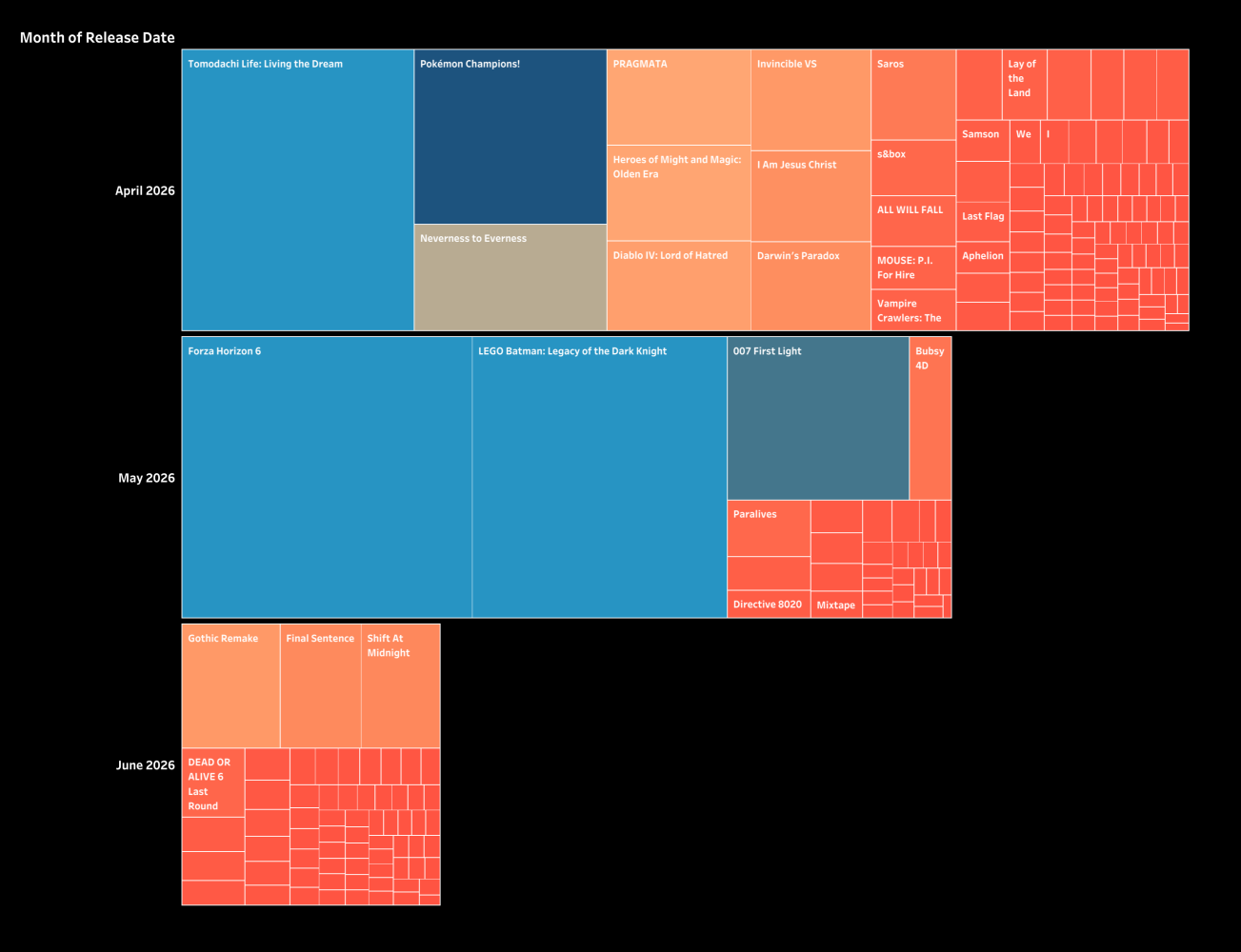
Three games. Little over one week. May 19 to May 27.
Forza Horizon 6. LEGO Batman: Legacy of the Dark Knight. 007 First Light. Three of the most anticipated releases of Q2 2026, all launching within eight days of each other, all competing for the same player hours, the same wallet share, the same cultural conversation. And none of them had to be here.
This is the part that frustrates me most, not because any one of these games is bad, but because the industry keeps doing this to itself over and over again, and the data makes the cost visible in a way that should be impossible to ignore.
Let’s look at what the numbers are actually telling us.
Forza Horizon 6 is the clear winner of the month. Cumulative mindSHARE of 1.008% at seven weeks out, 400 million TikTok views, 20,000 creators making content around an unreleased game. It is operating in a completely different tier from everything else launching in this window. And yet even Forza isn’t fully immune. Tracking 15% below FH5 at the same point. Some of that is COVID inflation on FH5’s numbers. Some of it is a noisier market taking a small bite out of even the biggest release of the quarter. Nobody escapes the attention tax entirely.
LEGO Batman is running at 40% of the Skywalker Saga’s cumulative mindSHARE pace at the same point pre-launch. In January it was neck and neck with Skywalker Saga. Then Forza locked in May 19. Then Bond moved from March to May 27. The market shifted around it and the curve flatlined. A game that was humming quietly became a game launching into the noisiest week of Q2 with a TikTok presence that reflects everything wrong with how Warner Bros. Games has been managed for the better part of a decade.
Bond is sitting at 0.252% cumulative mindSHARE at eight weeks out, neck and neck with where Jedi Survivor was at the same point before EA poured gas on the marketing fire. The upside is real. The window is the problem. May 27 was GTA VI’s original launch date. GTA moved. A flood of games backed into that window and didn’t get out. Bond is launching nine days after Forza, right as the halo effect is peaking, fighting for whatever attention is left after the biggest racing game of the decade has absorbed the room.
The ideal scenario for all three of these games looked like this. Forza owns May. Bond owns early June. LEGO Batman in late April or early May, well clear of both, with room to build its family audience before Forza arrives and takes all the oxygen. Three separate moments, three separate cultural conversations, three separate opportunities to generate real word of mouth before the next thing arrives.
Instead we got eight days.
June is sitting there essentially empty. Gothic Remake from THQ Nordic is the biggest announced title of the month, a game with virtually no North American audience. There is nothing of consequence filling that calendar. First Light in June owns the month. LEGO Batman in late April or early May finds its audience without Forza eating up every oxygen molecule in the room. Neither of them is there.
The gaming industry has a 12 month calendar. It consistently treats a handful of windows as if they’re the whole year. Part of this is structural, developers delay games, release dates move, GTA VI casts a gravitational pull that reshapes the entire first half of the calendar when it moves. Part of it is habit, the industry has been trained to think Q4 and certain spring windows are the only moments that matter, and everything else is a dead zone.
But the data doesn’t support that. Pokopia launched March 5th and became one of the biggest games of the year. Resident Evil Requiem owned February. Every month has room for a game to own it if you’re willing to show up without three competitors in the same week.
Attention is zero sum. Player time is zero sum. Every hour someone spends in Forza Horizon 6 in that first two-week window is an hour they’re not spending in First Light or LEGO Batman. The industry knows this. It keeps doing it anyway.
The three games we just walked through are genuinely good products made by genuinely talented studios. All three of them deserved better than this calendar. One of them will win May convincingly. The other two will do fine. All three could have done more.
Use the calendar. All twelve months of it.
Nintendo Is Playing Two Games At Once (And Winning Both)
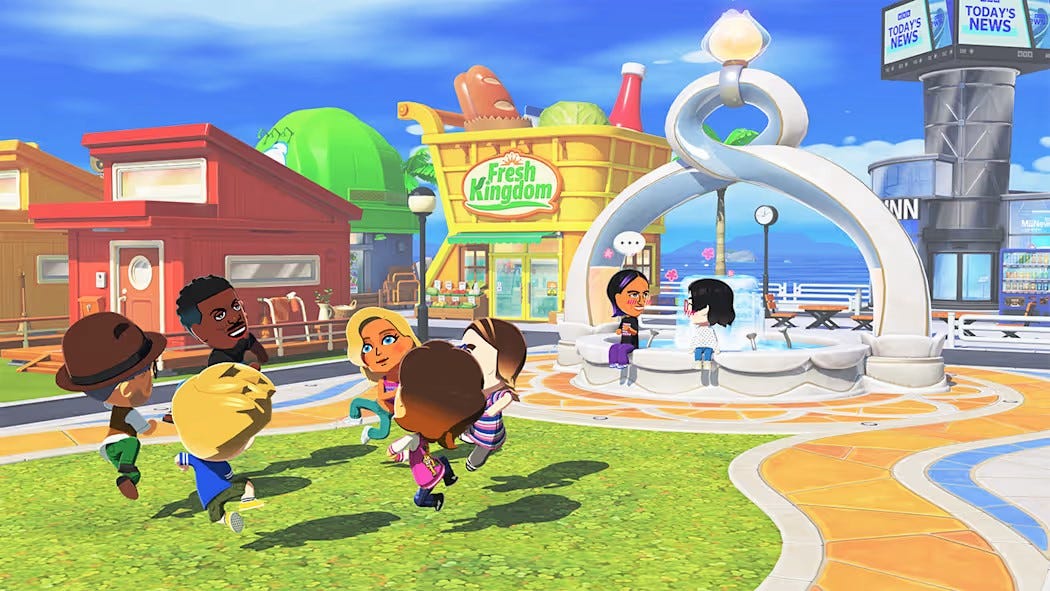
I promised I was done writing about Pokopia. The intro of this very piece suggests otherwise. But this section isn’t really about Pokopia. It’s about what Nintendo just did without announcing it as a strategy.
Let me set it up.
Pokopia launched March 5th as a Switch 2 exclusive. Premium title. System seller. My game of the year right now, and the retention data five weeks in is telling a story worth pausing on.
Week four saw a 34% decline. Week five held at just 17% down. For context, Pokémon Legends: Z-A saw a 37% drop at the same week-four point. Mario Kart World dropped 29% in week four. Donkey Kong Bananza dropped 22%. Pokopia is holding significantly stronger than all of them. It currently sits as a top 14 search game worldwide, top 75 on YouTube, top 40 on Twitch. Five weeks post-launch. That’s not a game burning through its launch audience and fading. That’s a game finding new players continuously, generating word of mouth, becoming genuinely sticky. The long tail is real, and the signal is strong.
Then Tomodachi Life: Living the Dream launches April 16th on Switch 1.
And that’s the move.
The Accidental Two-Platform Strategy
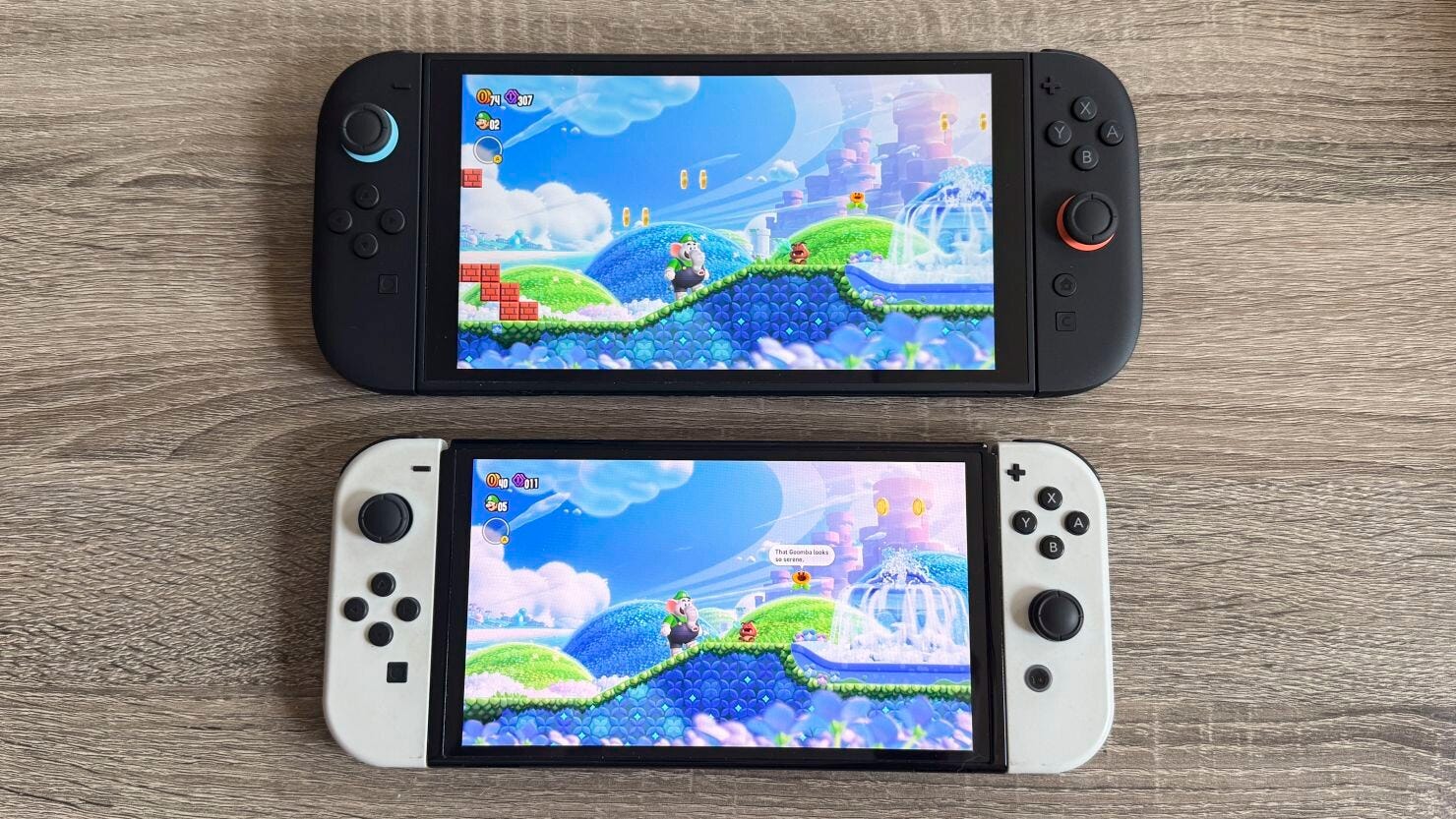
For anyone who hasn’t followed the series: Tomodachi Life is Nintendo‘s quirky life simulation franchise, built around creating Mii characters and watching their lives unfold on a tropical island in increasingly absurd and charming ways. Relationships form, rivalries erupt, dreams get acted out in bizarre little theatrical sequences. It’s Nintendo doing Nintendo things, low stakes, high personality, completely its own thing. The original launched on 3DS in 2013 in Japan, 2014 internationally, developed by Nintendo SPD. This is the first new entry in thirteen years, and Nintendo gave it its own dedicated Direct in January to show off everything that’s changed, including same-sex relationships, expanded island customization, and a Mii creation system that goes significantly deeper than anything before it.
The reception has been warm. Tomodachi Life currently sits at 0.637% cumulative mindSHARE with eight days to go. To put that in context, that puts it on par with Donkey Kong Bananza at the same point pre-launch, below Mario Kart World and Pokémon Z-A, but well ahead of titles like Metroid Prime 4, Kirby Air Riders, Xenoblade, and Hyrule Warriors at comparable windows. One of the advantages Tomodachi has is addressable market, though it’s worth noting several of those titles also launched on Switch 1. It launches exclusively on Switch 1, backwards compatible with Switch 2, targeting over 150 million units in the wild. With that install base behind it, don’t be surprised if it pushes past some of those comps entirely by the time launch week numbers are in.
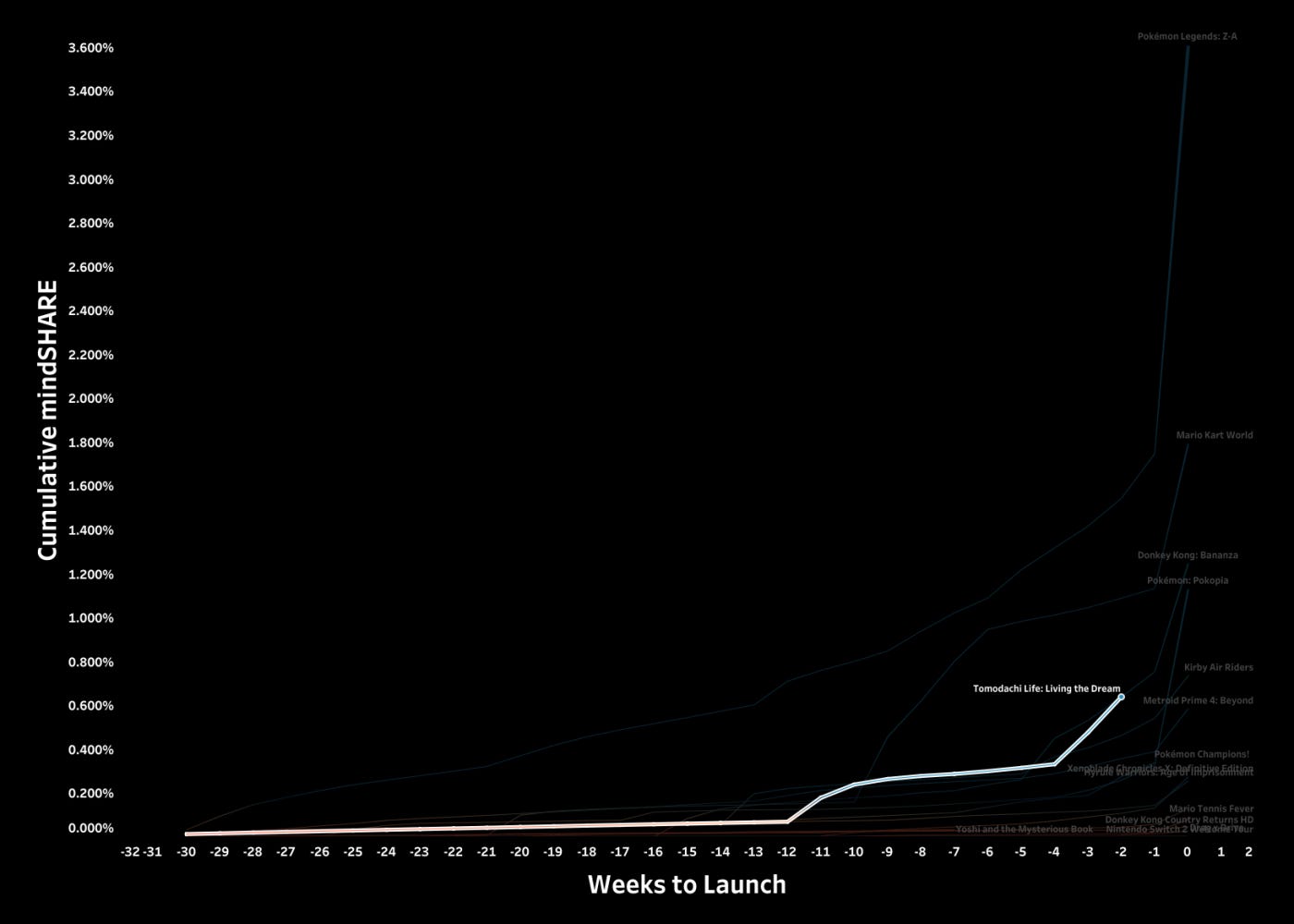
It will be the biggest game of April by a wide margin, comfortably outpacing Pragmata, Saros, and everything else on the spring calendar.
Here’s what makes this interesting. Nintendo is running two games in parallel targeting two completely different install bases. Pokopia drives new Switch 2 hardware installs, pulling in players who haven’t made the jump yet and giving them a reason to. Tomodachi Life monetizes the existing Switch 1 base that hasn’t upgraded, meeting them where they are with a game that doesn’t require new hardware to enjoy. One game for people who already made the jump. One game for the people who haven’t.
To be fair, Nintendo isn’t alone in supporting a previous generation after a new console launches. Sony did it with PS4 well into the PS5 cycle. Microsoft has leaned into cross-gen even more deliberately. Running parallel support isn’t unique. What’s amusing here is that both games happen to be cozy, adjacent in audience, targeting a similar demographic across two different pieces of hardware simultaneously. That’s less genius and more a happy accident of timing, two games that were already in development landing in a way that happens to serve a dual-platform strategy Nintendo probably didn’t plan explicitly.
But the more interesting question isn’t whether this was intentional. It’s whether it becomes intentional going forward.

As DRAM costs rise and hardware margins tighten, there’s a real case to be made that abandoning 150 million Switch 1 players the moment Switch 2 launches doesn’t make financial sense. Those players are still buying software. They’re still engaged. They just haven’t upgraded yet, whether by choice or by cost. In a world where the Switch 2 carries a premium price point and component costs continue to climb, it might actually serve Nintendo to deliberately extend Switch 1 software support longer than originally planned. Give the base that’s still there something to play. Let the upgrade happen on its own timeline.
That’s an open question, not a definitive call. But Tomodachi Life landing the way it has, generating real pre-launch momentum on aging hardware, suggests the appetite is there if Nintendo wants to serve it.
For now, the April picture is clear. Tomodachi Life is going to own the month. A thirteen-year-gap sequel to a beloved franchise, landing in a quiet window with no real competition, on a platform with an install base that dwarfs most consoles in history. Nintendo running a cozy game alongside a cozy game, accidentally threading a dual-platform needle, and probably not losing any sleep over how it happened.
That’s the Nintendo flywheel. It doesn’t always look intentional. It just tends to work.