Welcome To Highguard... Paid Attention Isn’t A Community

Two quick personal notes, then we are going to talk about why shooters are such a brutal place to launch anything new right now.
We are basically at the two-year birthday of mindGAME Data.
We launched in February 2024, and it has been a nonstop exercise in proving value, tightening methodology, and building something that helps teams make decisions in a market that does not slow down. I will not name-drop our earliest customers here, but some of you read this, you know who you are, thank you.
Also, shout out to the team, and especially Brian Rogers, the creator and founder of mindGAME Data. None of this exists without him.
And then, somehow I hit 10,000 followers on LinkedIn.
That is equal parts exciting, humbling, and slightly embarrassing to type, and it does not happen without Patch Notes. If you read this each week, forward it, reply to it, or even just steal a chart for an internal deck, you are the reason the conversation around our data has gotten louder. Thank you.
One last note for anyone in the industry circuit, I will be at D.I.C.E. Summit in Las Vegas, February 10–12. If you are there and want to grab coffee, talk attention economics, talk launch strategy, or just trade notes on what is actually working right now, hit me up. My calendar is getting a little full-ish, but I will make room for smart conversations.

And if you want something more casual, Greg Posner and I will be at this Player Driven event during DICE,
Player Driven, An Exclusive Event @ DICE
When: Feb 10 @ 4PM PST
Where: Aria Sky Suites, Las Vegas
Link: http://playerdriven.io/events/dice25
Now, the real reason I am writing this week,
Highguard launched from Wildlight Entertainment, and if you follow me on LinkedIn you have probably seen me being, let’s call it, feisty about it.
To be clear, this is not about dunking on the people who made the game. It is about being honest about the math of modern launches, especially in shooters, where you can often tell early whether something is going to find oxygen, and whether it has any chance of sustaining.
And Highguard is a clean case study because it sits right at the intersection of three things the industry keeps getting wrong,
the shooter category is increasingly a small number of forever-games that do not give up attention easily,
you cannot growth-hack a community, even with a huge spotlight moment and a creator-heavy launch push,
the loudest conversation is rarely the most important one, the signal is what players do once the game is playable.
This is also why I can sound blunt about games like Highguard.
It is not me trying to offend anyone. I know a lot of the team poured their love and effort into this game. Geoff Keighley’s love for this game is basically a meme at this point. At the end of the day, though, math is going to math. When your pre-launch signals show little to no measurable demand, and the plan is to try to manufacture that demand at the last second with a spotlight moment, the outcome is usually not a mystery. We called that shot at mindGAME Data, and it was not a hard one to call.
But, it is also not all Highguard’s fault.
Even a great shooter is launching into a category that is uniquely hostile to new entrants, a power-law market held together by a handful of forever-games with enormous gravity.
That macro reality is the first hurdle, so let’s start there.
The Shooter Market Is Calcified
A shooter launch doesn’t happen in an open field, it happens inside a power law. In business terms, a power law is a winner-takes-most market where a few leaders capture a wildly outsized share, and everyone else fights over what’s left.
You see this pattern everywhere. Streaming music is a clean example, a relatively small number of artists rack up a huge share of total plays, and millions of others split the remainder. The shape of the curve is the point, the top is heavy, and the long tail is long.
In shooters, the “thing” being concentrated is attention and engagement, which is exactly what we measure in mindGAME Data. A handful of forever-games do not just lead the category, they warp it. They own player habits, they anchor creator coverage, and they pull the conversation toward them by default.
That leads directly to the second layer of why this category is so hard to enter. Even if you build something fun, you still have to overcome switching costs that compound on top of each other.
The Sunk Cost Of Three
When players say they are “sticking with” a shooter, they are usually protecting three different sunk costs at the same time.
Time: players have put in hundreds or thousands of hours, they are good at the game, and switching means becoming bad again, at least for a while.
Money: even “free-to-play” adds up once you factor in years of battle passes, cosmetics, DLC, and other purchases.
Friends: the hardest one to break, you are not just asking one person to move, you are asking an entire squad to move together.
When those forces stack, markets tend to move slowly. That is what I mean when I say shooters are “calcified”, not that nothing new can ever happen, but that breaking through requires an unusually large, unusually fast wave of demand.
So, enough theory. Let’s look at the shape of the market in the actual data.
Same Winners, Different Year
2020 Snapshot
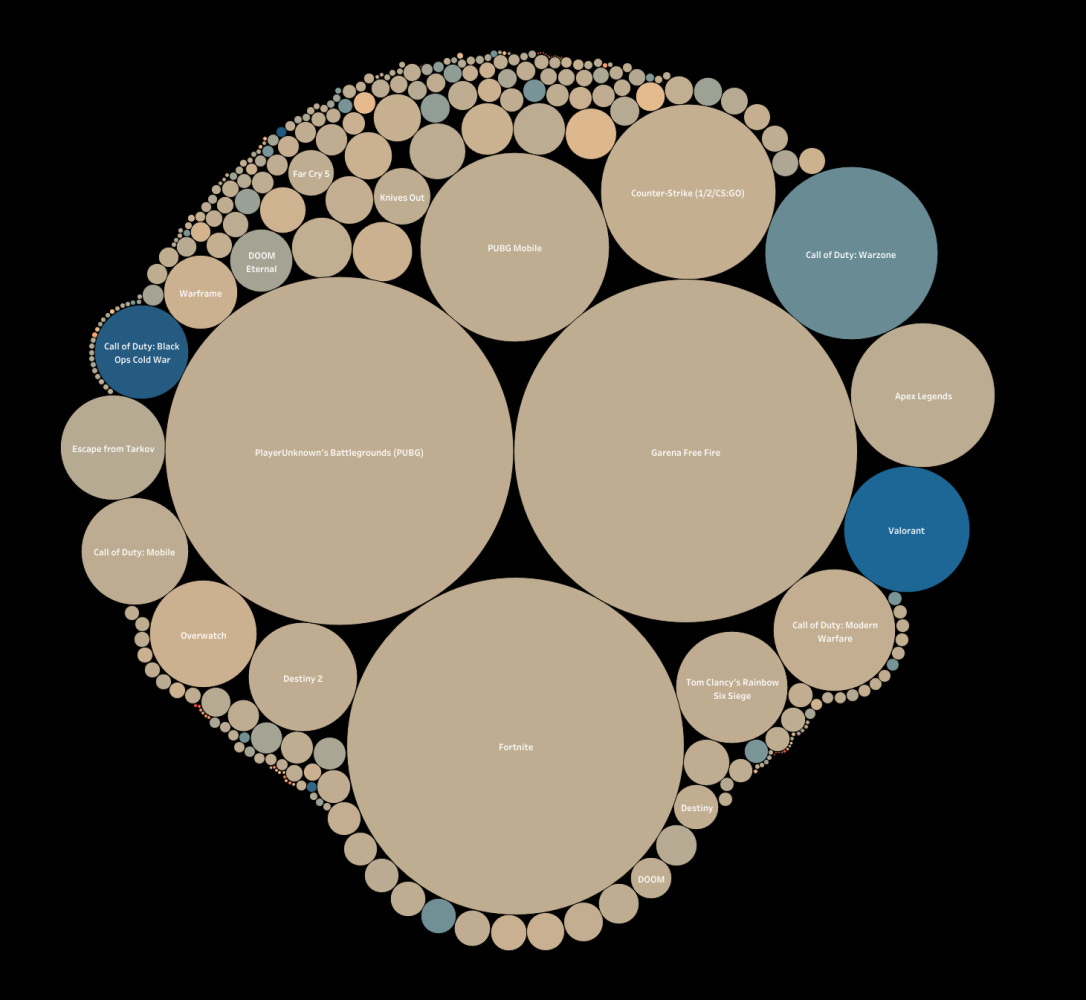
Ranked by share of shooter mindSHARE in our data,
PUBG (franchise): 22.9%
Garena Free Fire: 17.2%
Fortnite: 16.6%
Call of Duty (franchise): 9.541%
Counter-Strike (CS*:GO*): 4.49%
Apex Legends: 3.051%
VALORANT: 2.326%
Rainbow Six Siege: 1.835%
Destiny 2: 1.74%
Overwatch: 1.691%
Escape from Tarkov: 1.615%
Those eleven titles alone accounted for ~82.989% of the shooter category in 2020.
The long tail, hundreds of other shooter titles, fought over the remaining ~17.011%.
2025 Snapshot
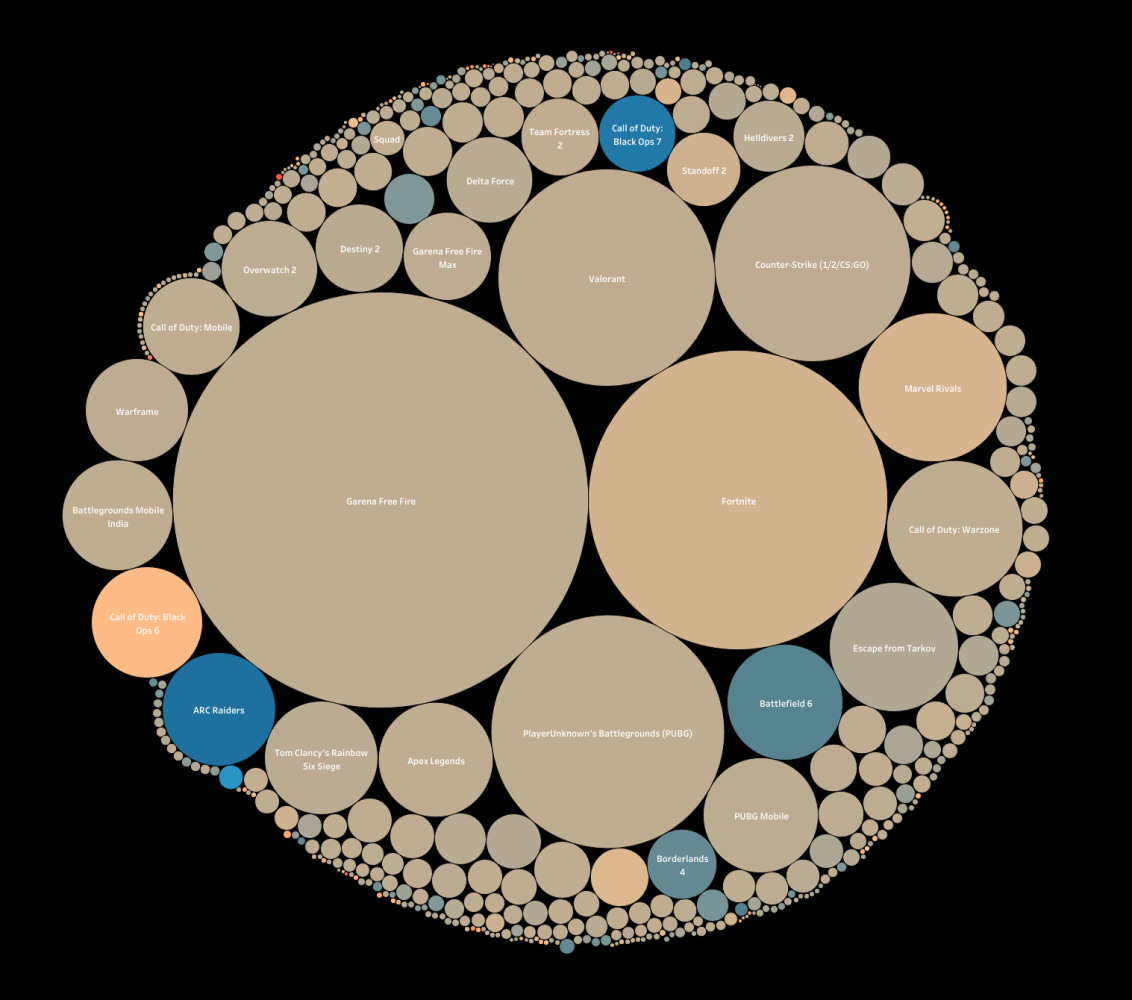
Now fast forward to 2025. Same exercise, ranked by share of shooter mindSHARE,
Garena Free Fire (franchise): 23.289%
Fortnite: 11.554%
PUBG (franchise): 10.313%
VALORANT: 6.0%
Call of Duty (franchise): 5.981%
Counter-Strike: 4.972%
Marvel Rivals: 2.857%
Escape from Tarkov: 2.148%
Battlefield 6: 1.731%
Apex Legends: 1.697%
Rainbow Six Siege: 1.664%
Arc Raiders: 1.657%
Overwatch 2: 1.196%
Destiny 2: 1.014%
That list adds up to ~76.073% of the shooter category in 2025.
The names shuffled a bit, but the shape of the market did not.
If you squint at the “what actually changed” list between 2020 and 2025, it is surprisingly short. Discounting Overwatch vs Overwatch 2 as the same franchise evolving over time, the notable new entrants in the top cluster are basically three games, Battlefield 6, Arc Raiders, and Marvel Rivals. Everything else is the same cohort trading places on the totem pole.
And two of those new entrants are already a good reminder of how hard “staying power” is.
Battlefield 6 cleared the bar immediately, Electronic Arts (EA) called it the biggest launch in franchise history, and Circana data shows it finished 2025 as the #1 best-selling game in the U.S. But whether Battlefield 6 stays in this band next year depends on whether it can actually build and operate a live-service engine, which is always the harder part.
Embark Studios Arc Raiders is the opposite signal right now. If the trend holds, it looks like it will definitely still be here, more like this year’s version of NetEase Games‘Marvel Rivals, a game that came out swinging and then held meaningful attention into the next year.
Either way, the safer bet remains the forever-games that have been here for years, Free Fire, Fortnite, PUBG, Call of Duty, and Counter-Strike will be in the mix in some form or fashion.
That is the power law effect in practice. The market can add a new winner occasionally, but the center of gravity rarely moves.
Now, if you want a second, very public signal that reinforces the same story, look at what happens when shooters hit Steam, where the conversion from “conversation” to “play” is visible in real time.
Steam, The Reality Check
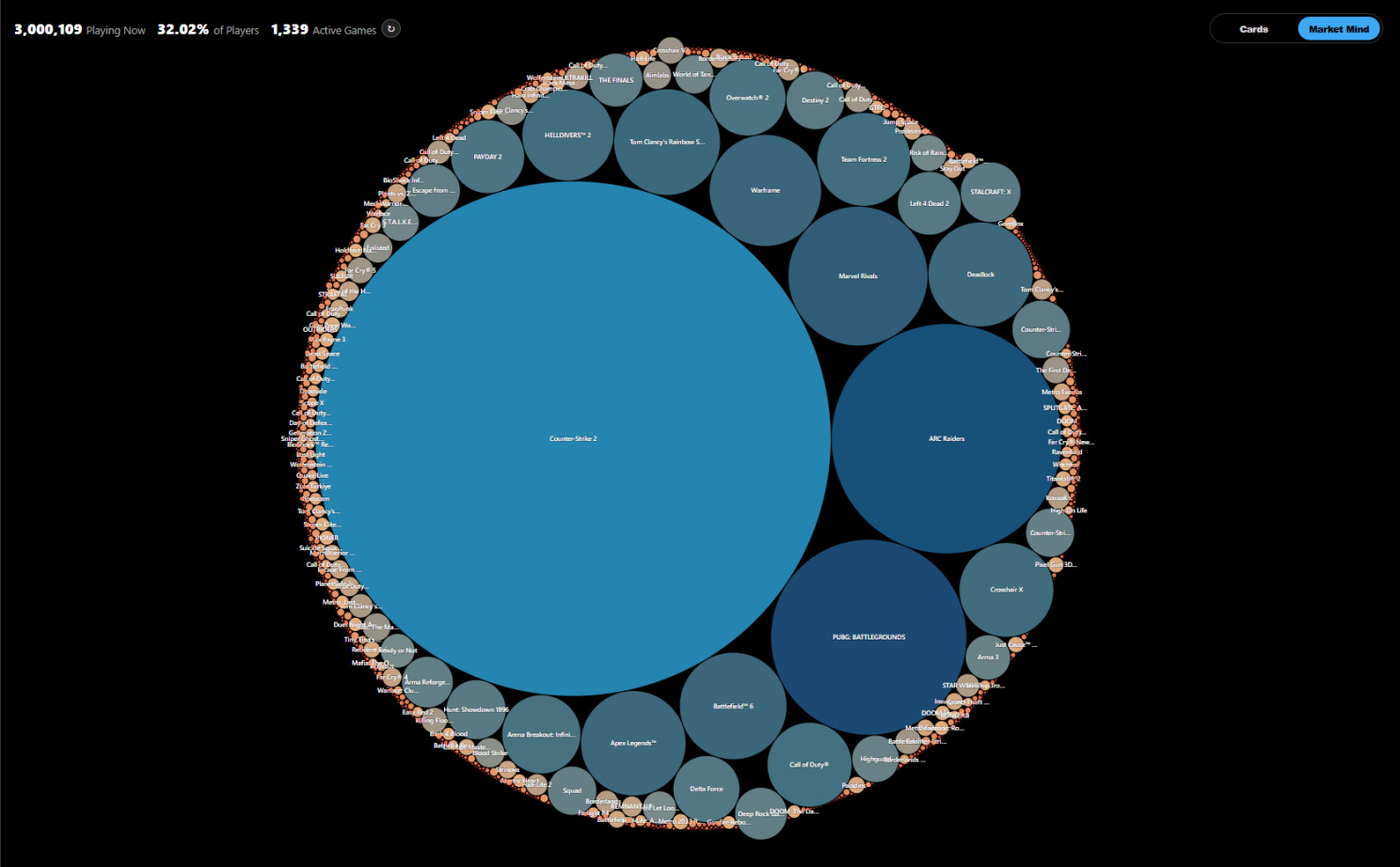
Steam is not the shooter market, it is a very visible slice of it. It misses console, it misses launcher-only giants like VALORANT, and it misses mobile behemoths like Free Fire, but it is still one of the cleanest public ways to see what players do when a shooter is actually playable.
That is why, inside mindGAME Data, Steam is one of our six core signals. It is not perfect coverage, but it is hard, consistent, and hard to hand-wave away.
The Post-Launch Cliff
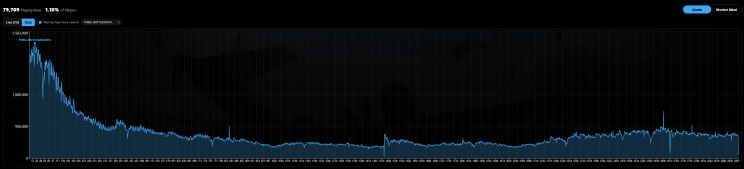
When a shooter truly breaks through on Steam, the curve has a familiar shape. It hits an enormous peak, it bleeds from that peak (because every shooter does), and then it either stabilizes into a healthy floor or it keeps sliding until the floor falls out.
Here are the peak Steam CCU anchors we have been using,
PUBG: ~3.2M peak (Steam peak in 2018)
Battlefield 6: ~747K peak
Marvel Rivals: ~644K peak
Apex Legends: ~624K peak
Arc Raiders: ~481K peak
The part that matters is what happens after the peak, because that is where the business lives.
Arc Raiders is the clean “sticky” example right now. It broke out of the gate and, in our reads, it has held remarkably well, still sustaining north of ~400K concurrent players on Steam at peak times. It is decaying a bit, because everything decays, but not in a drastic way.
PUBG is the extreme version of the same story. It peaked at an all-time insane level, then a year later it had dropped into the ~800K–850K band, and over the years it has lived in a range closer to ~850K down to ~600K. That is a massive drop from peak, and still one of the most successful shooter outcomes in PC history.
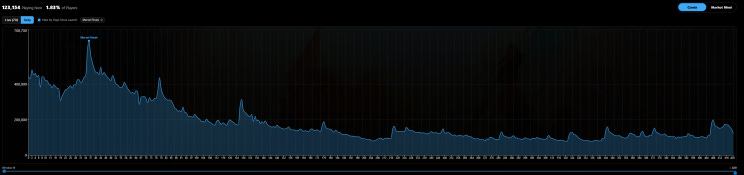
Marvel Rivals is the more common live-service pattern. It peaked big, then settled into a daily peak band of roughly ~150K–200K. That is a meaningful decline, and still a very real floor for a free-to-play shooter.
Battlefield 6 shows why business models matter. It peaked huge at launch, and now it is hovering closer to ~60K daily concurrent players. That is a sharp drop, but it is also a premium title that monetized the top of the funnel up front, it is not purely reliant on the long tail in the same way a free-to-play shooter is.
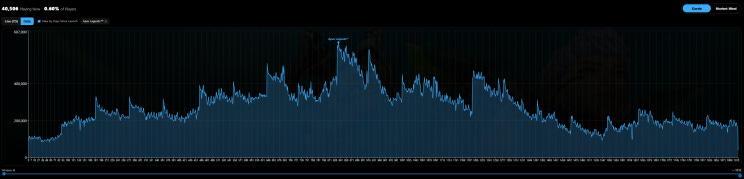
Apex Legends is the weird one in the best way. Its Steam peak happened further from launch than most games, and its floor has historically lived in the hundreds of thousands more consistently than the typical “big spike, big bleed” story. Even now it sits in the ~150K–200K daily band.
Put those curves together and the takeaway is simple. The breakthrough bar is high because the post-launch slope is inevitable, and you need a peak big enough that, after the bleed, you still have a floor that can support matchmaking health, creator energy, and a real live-service business.
When The Floor Falls Out
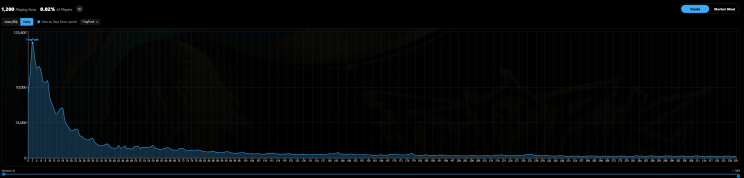
When a shooter does not get high enough on the way up, the stabilization point lands in the danger zone. Matchmaking suffers, creators move on, and even a good game can end up feeling empty.
FragPunk is a clean recent example. It launched with real heat and peaked around ~114K concurrent players on Steam, then fell sharply and now hovers closer to ~2K.
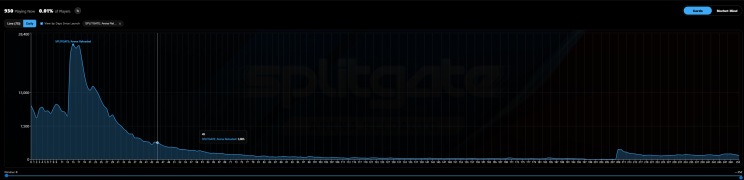
Splitgate 2 (rebranded as Splitgate: Arena Reloaded) is the cautionary tale we were vocal about back in May / June. We warned them (via LinkedIn content) not to go head to head with the Switch 2 launch, and not to get buried in the noise around Summer Game Fest. And what happened? It peaked around ~25K at launch, then fell off a cliff and ended up living in the hundreds.
Concord is the extreme failure case. It peaked around ~700 concurrent players on Steam, then was delisted shortly thereafter.
It is also worth saying out loud that this is not a Steam-only phenomenon.
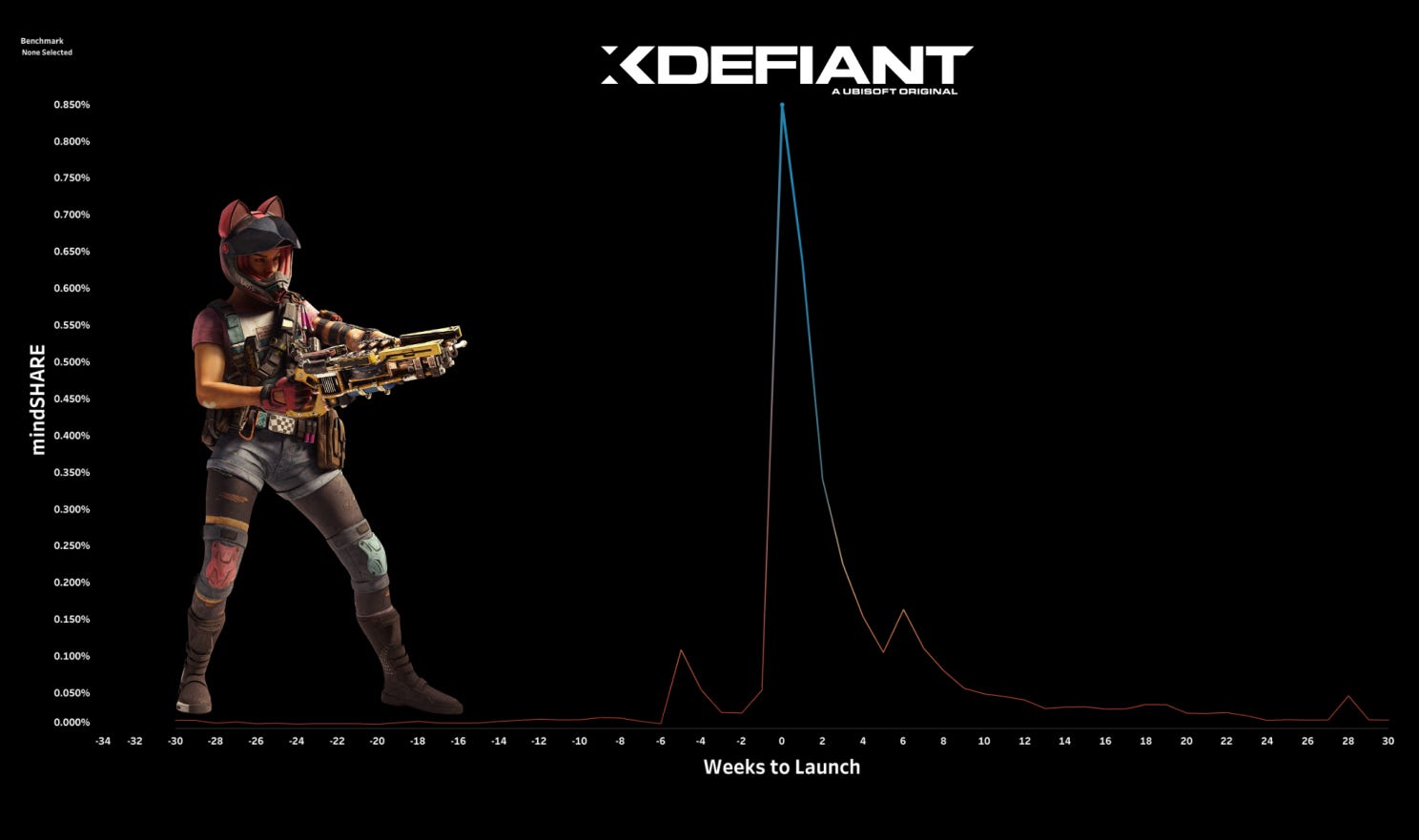
Ubisoft‘s XDefiant did not launch on Steam. It launched on PS5, Xbox Series X|S, and PC via Ubisoft Connect (and later became available on Epic as well). In our data, it opened around ~0.849% weekly mindSHARE, then fell to ~0.048% within ten weeks. Ubisoft later announced it would discontinue development and sunset the servers on June 3, 2025.
Look... shooter launches are hard, regardless of quality, because the category’s gravity is real. Power laws concentrate attention into a few forever-games, and switching costs keep players locked in. Even if your product is fun, you are fighting habits, not a blank slate.
That is why the early curve matters so much. You need enough demand at launch to absorb the inevitable drop and still land on a healthy floor that can support a vibrant community. With that context, Highguard becomes a useful case study. What was the go-to-market plan, what did it do well, what did it miss, and were there any real demand signals before launch that suggested it could survive the curve?
Highguard As A Case Study
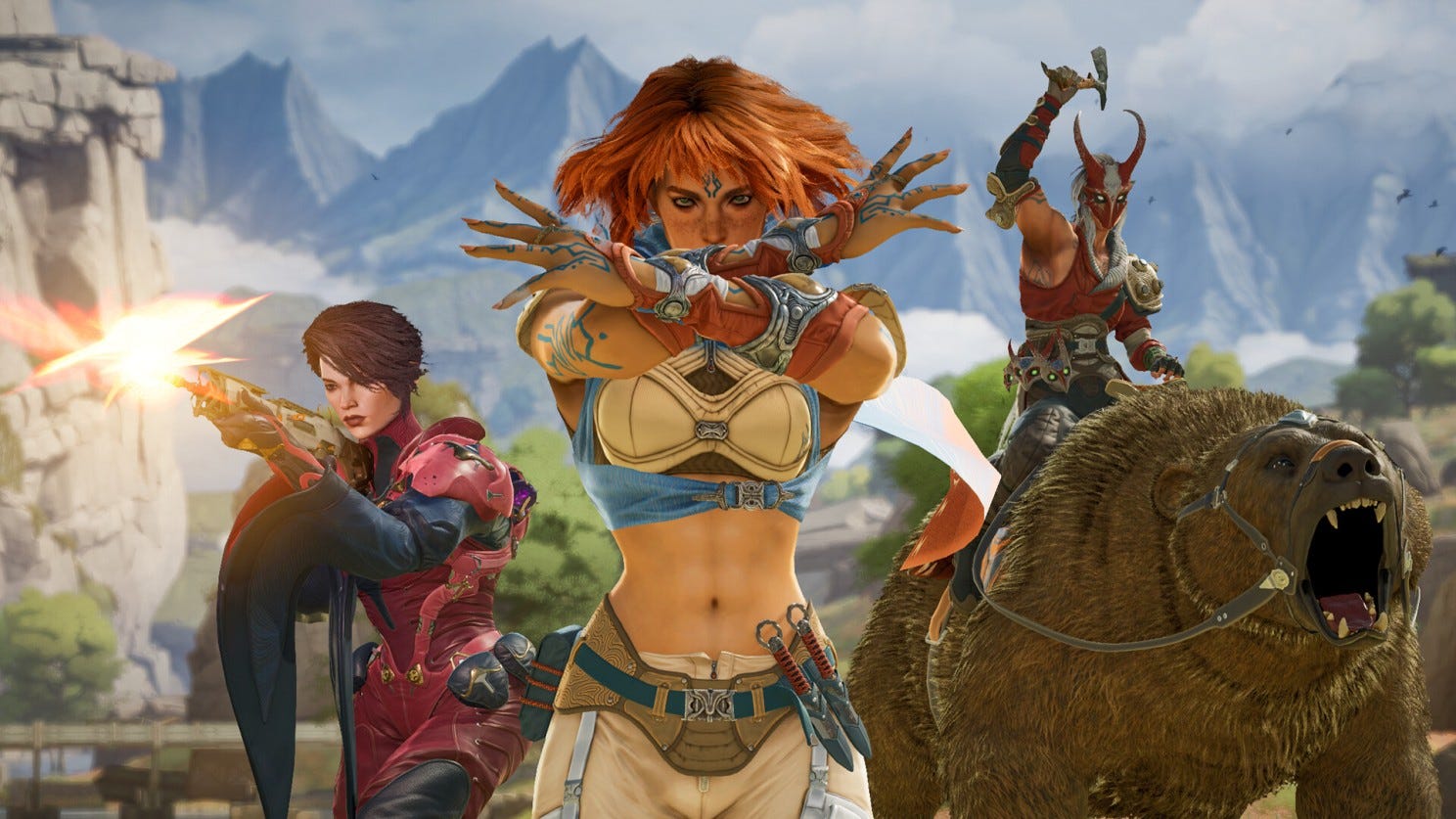
The Reveal, The Plan, The Missing Demand
For most people, Highguard did not exist until it suddenly did.
The game’s first real consumer reveal was the final slot at The Game Awards 2025, which is historically where audiences expect something unmistakable. Instead, Highguard landed with the opposite first impression, “samey,” “benign,” “what is this,” and a wave of instant comparisons to other failed live-service shooters.
The initial reaction was blunt.
From The Game Business ( Christopher Dring):
“Disgruntled gamers were calling it the ‘next Concord’, and even the media joined in.”
And from PC Gamer’s write-up of the same period:
“the internet responded… with a resounding ‘meh’.”
That reaction matters because, according to Wildlight, The Game Awards was not the original plan.
In The Game Business, CEO and co-founder Dusty Welch says the studio’s intent from day one was an Apex-style surprise drop.
“That was always our plan when forming this studio… we wanted to do that surprise drop again.”
The twist is the Geoff Keighley piece. Welch says Keighley came in, played the game, and pushed for the “one last thing” spotlight, specifically because it was an indie shooter from a new studio.
From The Game Business:
“Geoff came in and played the game… and he was blown away.”
So Wildlight revealed the trailer, and then, per Welch, they went right back to their original go-to-market approach, go quiet, stay focused, and let the first hands-on moment do the talking.
Welch describes returning to that plan immediately after The Game Awards.
“we went back to our game plan, which is, ‘let’s stay focused, let’s stay quiet for the next six weeks’. And nothing speaks better to players than hands on the sticks.”
They also say they did not ignore the reaction entirely. Welch describes reading the feedback and reworking how they talked about the game.
From The Game Business:
“We… retooled… mostly messaging and positioning.”
And you can see the Apex scar tissue in how they talk about post-launch preparedness.
Welch frames Apex’s launch as a success that the team mishandled operationally, treating launch as an endpoint, then going dark for months while content caught up. With Highguard, they claim they are entering launch with far more runway.
From The Game Business:
“We were dark for about nine months… This is not the case with Highguard.”
“We already have a year’s worth of content… [and] a full roadmap.”
All of that is the stated strategy, and it is coherent on paper. The catch, and the reason this became interesting for us to cover, is that the pre-launch demand signals were not there.
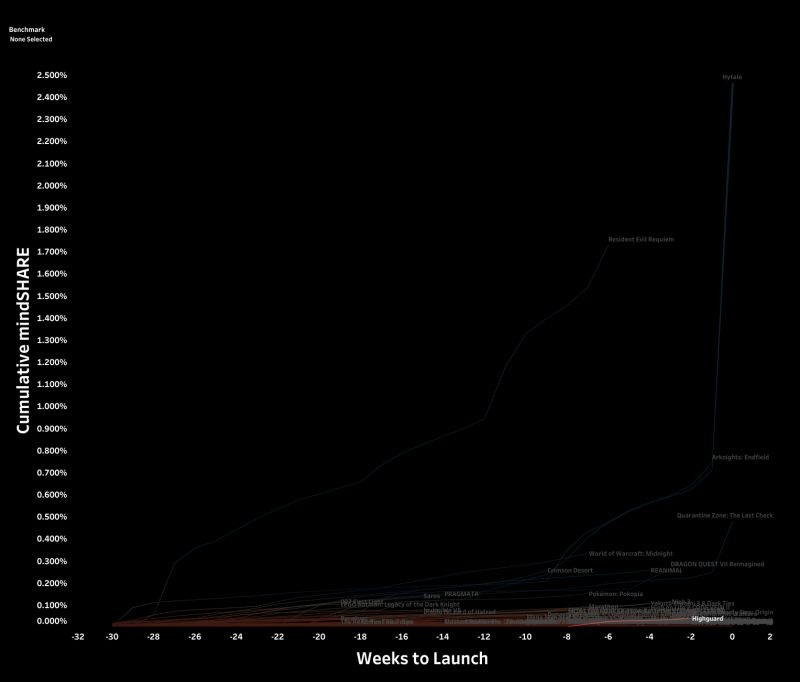
In mindGAME Data, in the week before launch, Highguard was sitting outside the top #600+ in Search, it was effectively absent on YouTube, and it had no meaningful audience on Twitch, which is insane for a shooter. On TikTok it was not generating tens of thousands of views, it was barely generating hundreds.
This is the opposite of momentum. If anything, it looked like the team was not even trying to recirculate the trailer through creator ecosystems, which matters because creators are the oxygen of shooters.
This is also where a useful parallel shows up.
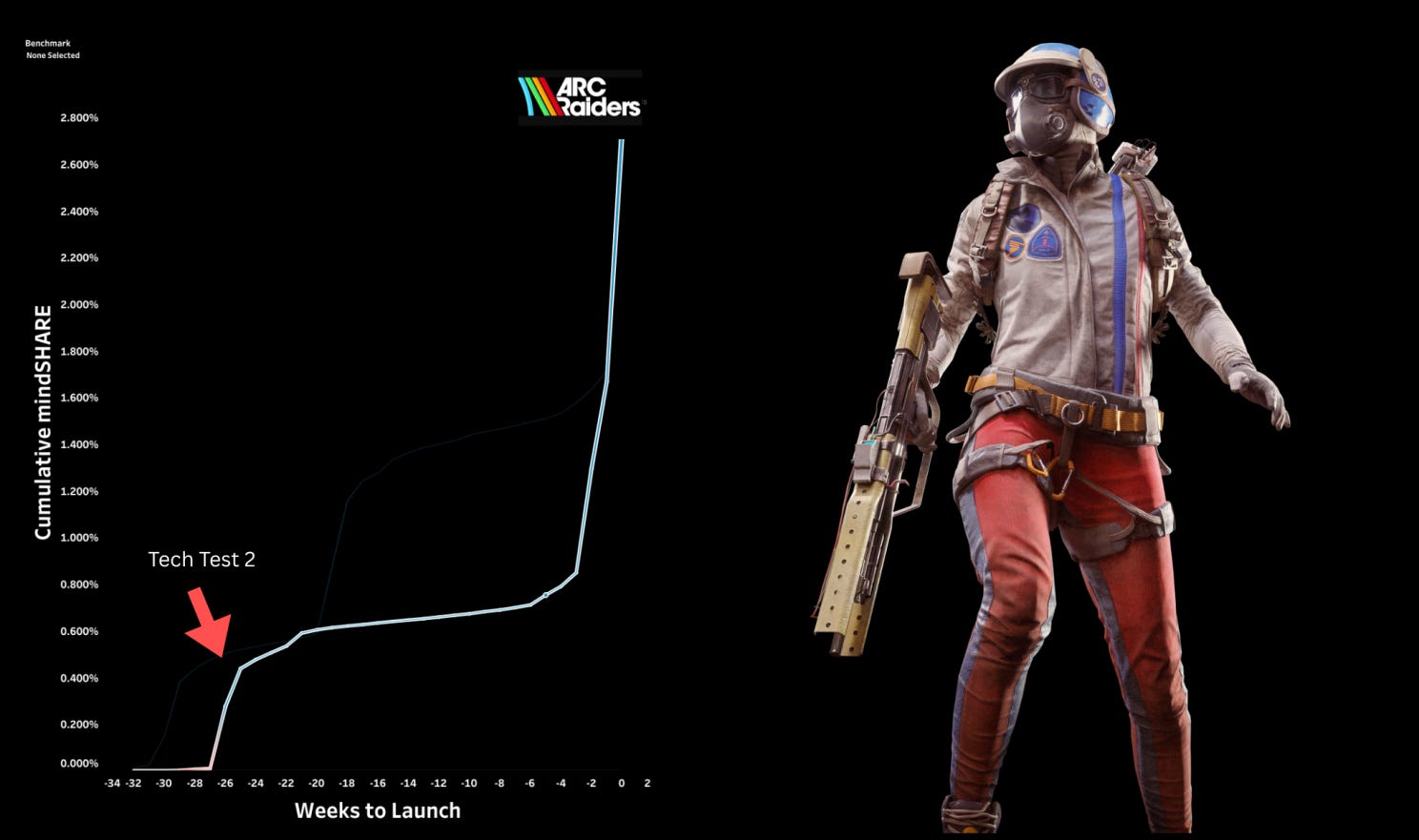
Arc Raiders is another game that went quiet for an abnormally long period of time. But the key, key, key difference is that Arc Raiders had already earned its silence. Embark put the game in players’ hands with Tech Test 2 (Apr 30–May 4, 2025), generated a massive spike of attention, then went dark, then came back with another open beta moment (Server Slam, Oct 17–19, 2025) right before launch. That is what “hands on sticks” looks like when it is used as a compounding strategy, not a last-minute hail mary.
So the setup is simple,
a last-slot reveal that landed poorly
a deliberate silence window
a bet that launch-day play would flip perception
and a pre-launch demand profile that suggested there wasn’t much organic pull to begin with
With that context, we can talk about the real bet Wildlight made, the launch-day activation, and whether paid attention turned into a durable floor.
Launch Day, The Big Bet
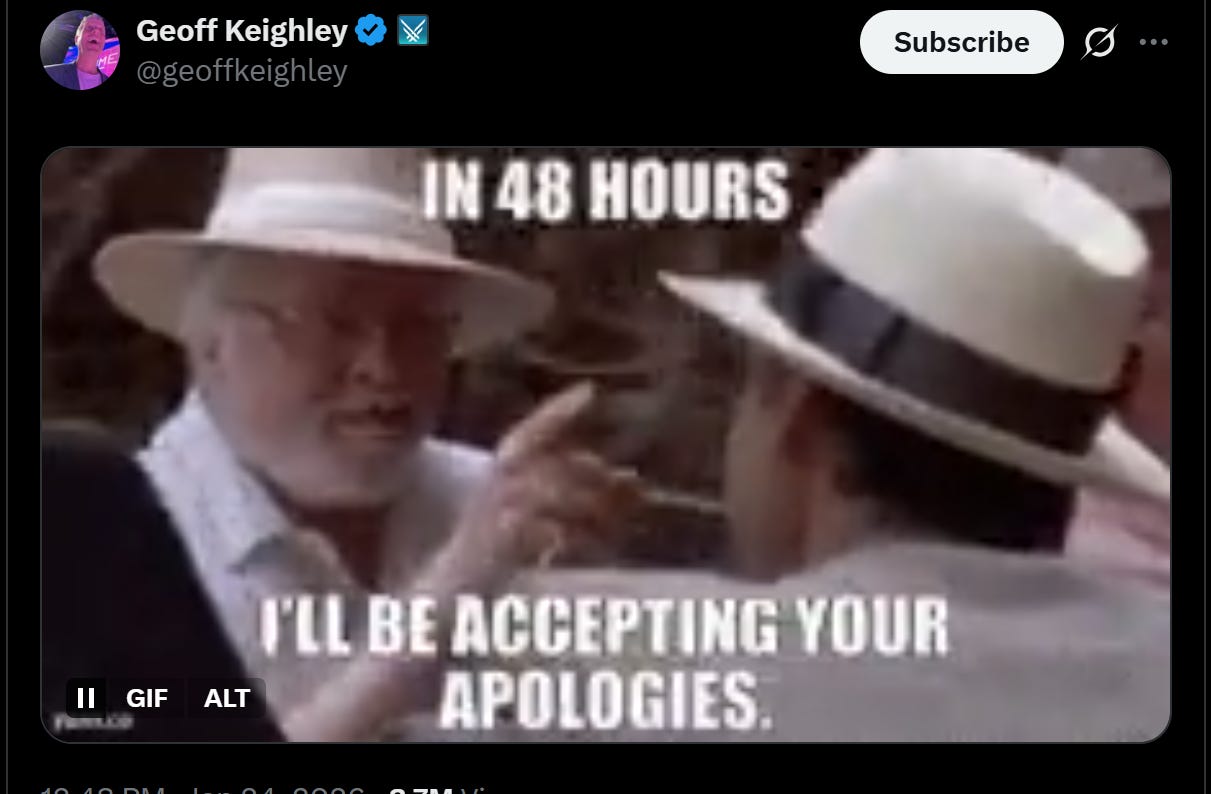
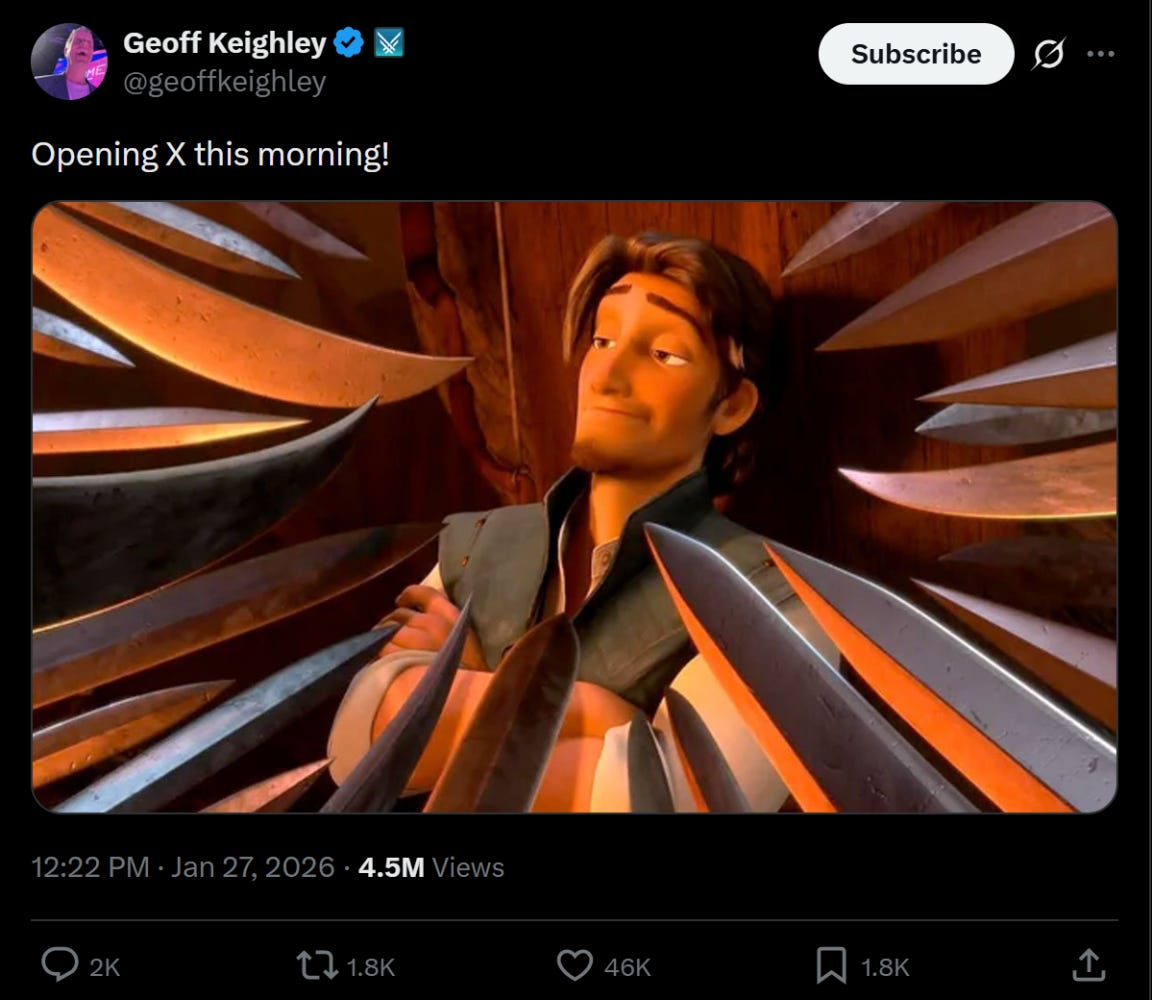
Before anyone booted the game, there was already a marketing story, Geoff Keighley clearly did the most he could to get attention on Highguard. People on the internet accused him of being “on the take.” I doubt it. He does not need that. The simpler explanation is usually the right one, he liked the game, he wanted it to win, and he tried to will it into existence with sheer volume.
That build-up culminated in the now-immortal tweet, “In 48 hours, I will be accepting your apologies.”
Here is the problem, though. By the time we got to launch day, Highguard was already on an F trajectory in our pre-launch signals. Outside the #600+ in Search, effectively absent on YouTube, no Twitch footprint to speak of, and barely generating hundreds of views on TikTok. That is not what momentum looks like for a shooter.
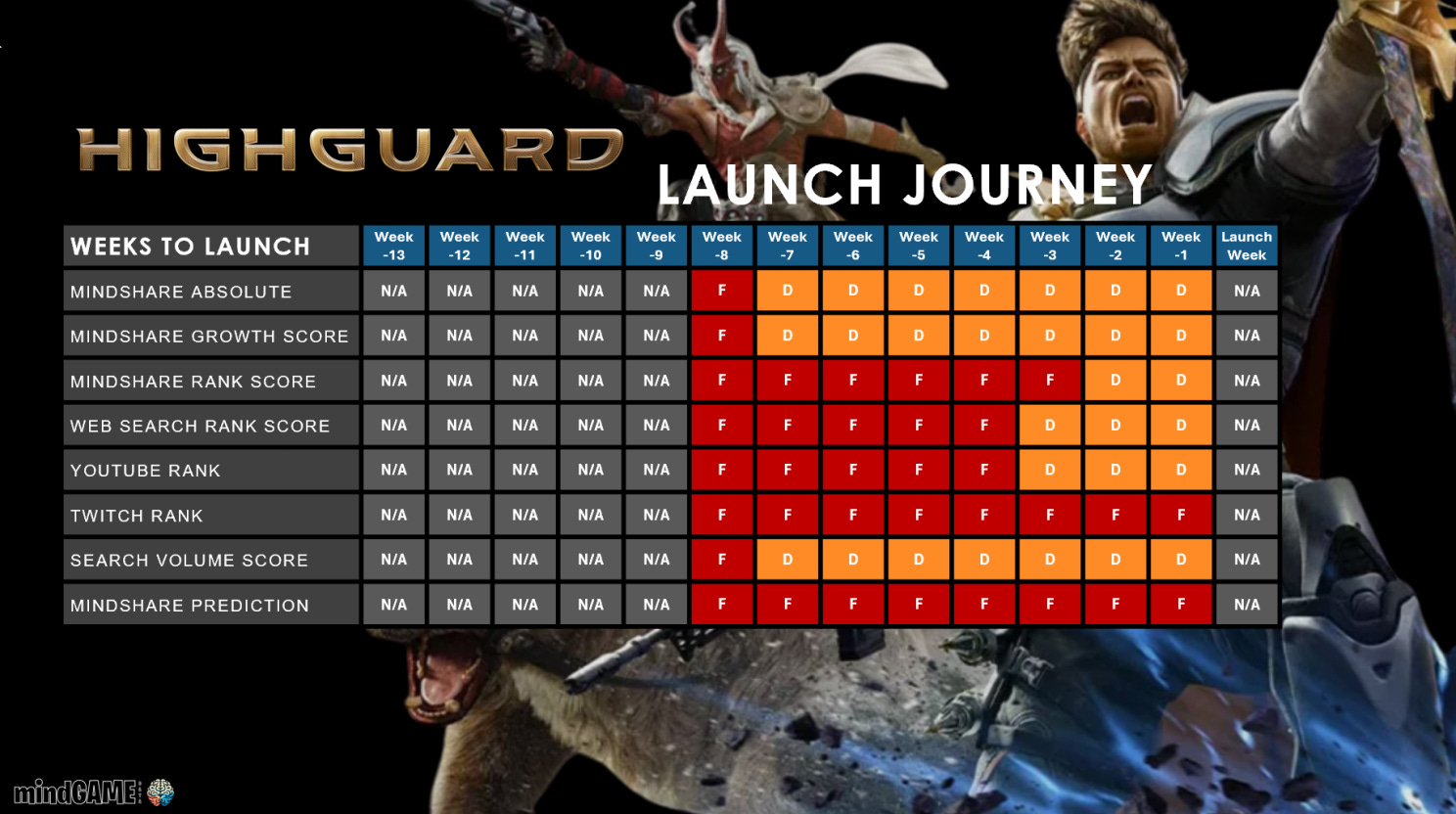
So the launch-day strategy was basically forced. If you do not have organic pull, you have to buy distribution.
They went out of their way to “own Twitch” on day one. In mindGAME Data, Highguard hit roughly ~380K peak concurrent viewers on Twitch, and the launch push generated 2.5M+ hours watched. If you are launching a shooter, that instinct is directionally correct. Twitch is still the fastest awareness channel for this category.
The issue is what happened when the paid window ended.
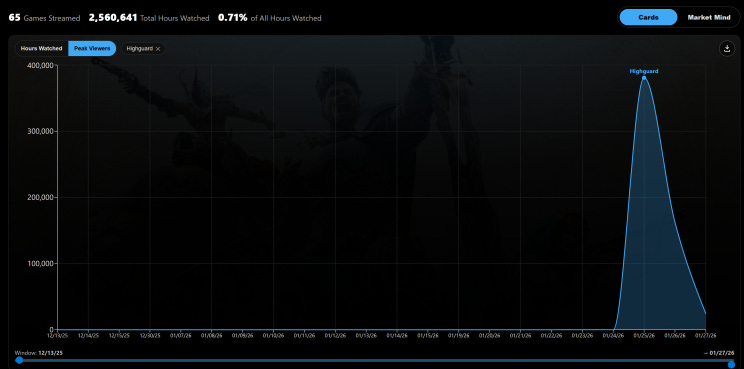
The viewership profile fell off a cliff. From that ~380K peak, it dropped to roughly ~162K the next day, and then down to roughly ~24K shortly after. That is what paid attention looks like in the data, a spike you can purchase, followed by a collapse the moment the spend turns off.
You Can’t Growth Hack A Community
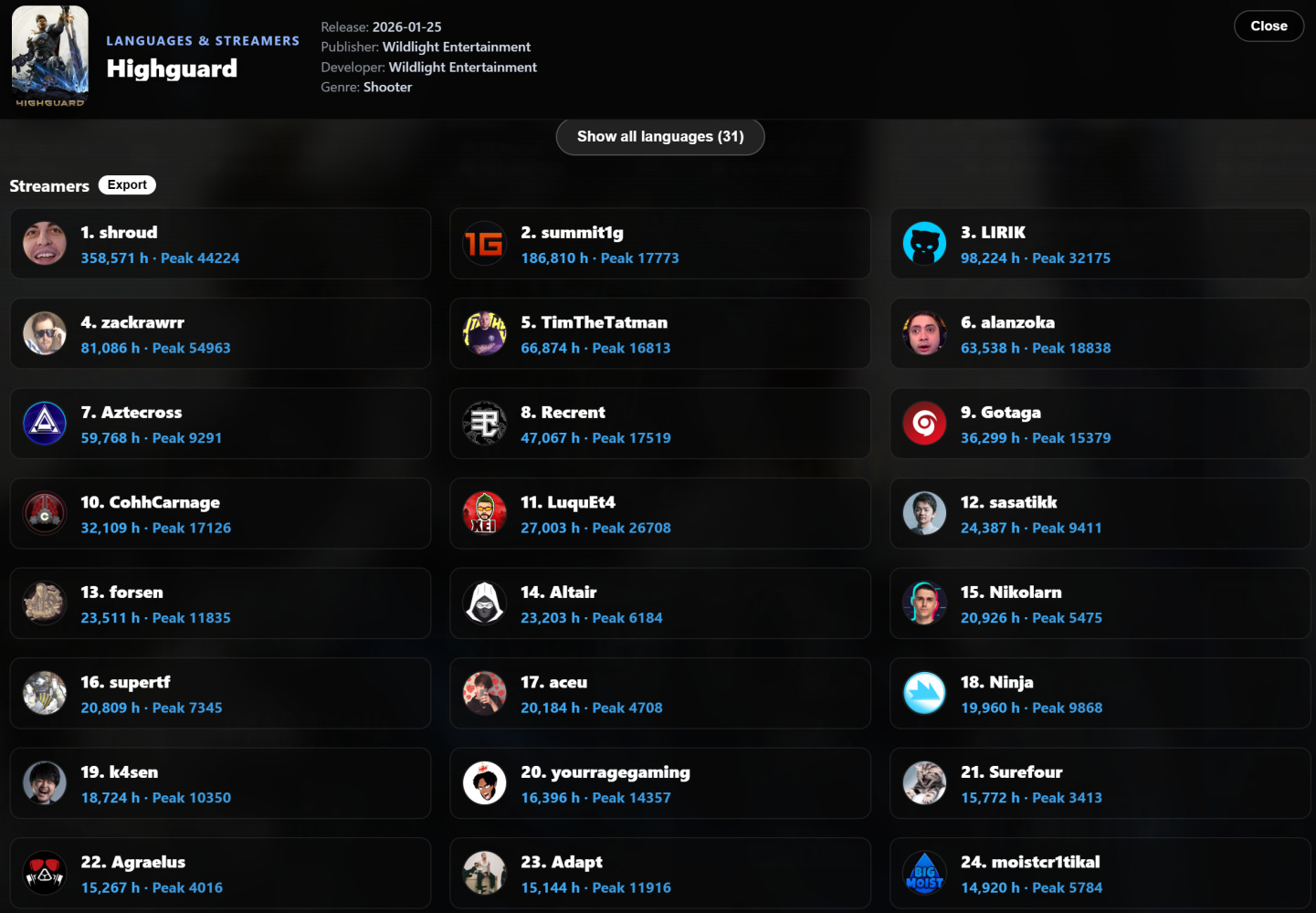
If the Twitch spike is real demand, you expect creator behavior to shift from “sponsored moment” to “I’m still playing this,” and you expect the platform mix to start compounding. Instead, the top channels looked like a textbook paid activation.
Wildlight leaned on Loaded (a agency that represents various Twitch streamers), which makes sense as a tactical move, but it also makes the shape of the spike easier to interpret. Here are a few of the biggest launch-day channels and what they delivered,
shroud: 358,571 hours watched, Peak 44,224
summit1g: 186,810 hours watched, Peak 17,773
LIRIK: 98,224 hours watched, Peak 32,175
Aztecross: 59,768 hours watched, Peak 9,291
CohhCarnage: 32,109 hours watched, Peak 17,126
This is not a moral judgment, this is how the business works. The critique is structural. The best creator activations do not just rent attention, they convert creators into believers. The proof is not “did a huge streamer play it on day one,” the proof is “do they keep playing when they do not have to.”
The viewership collapse suggests the day-one moment was mostly rented.
This is also where the “Apex playbook” comparison gets misunderstood.
What people remember is “surprise drop + creators,” but what actually happened with Apex Legends in 2019 was closer to “black out Twitch.” EA didn’t just pay a handful of creators and hope for the best, it was a coordinated, multi-million-dollar activation designed to make the game feel unavoidable for a day.
A year later, VALORANT used a similar creator-heavy approach, and it worked for the same reason, it was scaled, coordinated, and expensive.
Now fast forward to 2026. We’re seven years removed, creators have more leverage, sponsorship economics have inflated, and the cost to “black out” Twitch the way EA did back then would almost certainly be even higher today.
Wildlight doesn’t have EA’s pockets, and the market is far more crowded now. Trying to brute-force the same move without the same budget… adjusted for the modern market… and without any pre-launch momentum, is exactly how you end up with a spike that disappears.
TikTok, The Missing Echo
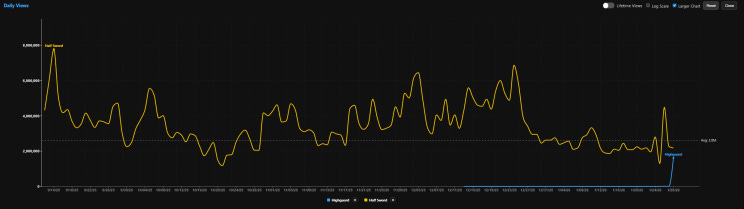
If Twitch was the bought megaphone, TikTok is where you normally see the organic echo if the market is actually catching. Here the numbers were brutal. In our live TikTok feed, Highguard’s peak video views, pre launch, were roughly ~15K, which is not “small for a shooter,” it is basically noise.
For context, other indie titles can generate more organic motion in a random day than Highguard did around launch. Dinoblade averages 60K+ views per day, and Half Sword can spike into the millions daily.
If you are going to buy eyes on Twitch in 2026, you want those moments to be clipped, recirculated, and amplified elsewhere. TikTok is the fastest sanity check for whether that is happening. Here, it wasn’t.
Views To CCU
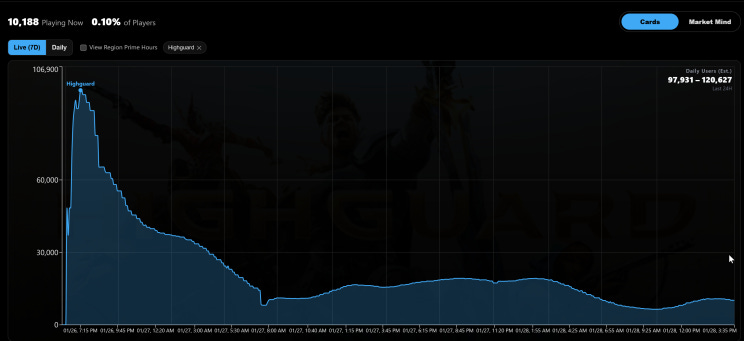
The cleanest conversion signal is always, did watching turn into playing.
Highguard peaked just under ~100K concurrent players on Steam, and then within days it was living in the ~10K–11K band.
Even more telling, it did not show a strong daily prime-time pattern by region. Most shooters have a clear APAC, EU, or NA peak. Highguard was oddly flat, which is consistent with a launch where a paid awareness moment did not translate into a durable player base.
This is the Steam version of the same story as Twitch. A spike happened. Then the floor never formed.
And because this is free-to-play, that matters. You are explicitly betting that the back end of the curve will be large enough to monetize over time, seasons, cosmetics, and everything else. If the floor stabilizes too low, you are not just losing players, you are losing the business model.
Now that we’ve covered the hard data, the next part of the story is what happened when Highguard hit the culture layer, and how that reaction lined up (or didn’t) with the behavioral signals.
The Internet’s Reaction
By the time Highguard was playable, the conversation had already split into two different realities, and they were not talking to each other.
One reality was the press narrative, the “stop dunking on this, it’s actually fun” rehab tour. The other reality was the creator and player narrative, which was much closer to the behavioral signals, “the idea is interesting, but the feel and performance are rough, and rough is fatal in a competitive shooter.”
That disconnect is the point of this section. It is not just “people being mean online.” It is a reminder that the tastemakers have shifted, and the clip economy can outweigh traditional coverage by an order of magnitude.
The Press... “It Slaps”
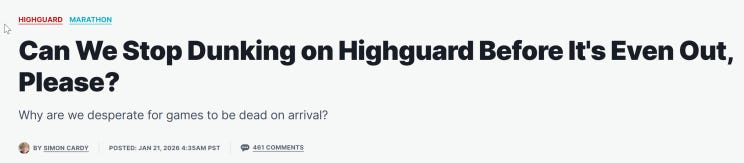
The press coverage around Highguard did not start at launch. Weeks before the game was even playable, IGN ran a piece essentially asking everyone to stop declaring it dead from a single trailer, and arguing that we should at least play games before we decide they are good or bad.
That instinct, on its own, is reasonable. The problem is what the coverage implicitly turns Highguard into, an event. A game that “matters,” simply because it is being treated like something the industry should rally around.
And here is the irony, that same IGN piece also laid out the exact signals you would normally associate with a game that does not have organic pull. At the time, the official YouTube channel had one teaser and roughly 1,610 subscribers, and the official X account had around 7,000 followers and had been silent since the reveal. IGN even called out that the marketing could fairly be accused of being sub-par.
Our data read pre-launch was that this was not an event.
In our signals, there was no heat behind this game. No meaningful pull. No “normie” gravity. And that is what made the press posture feel so disconnected, you had a steady stream of stories treating Highguard like something the industry should rally around, while the rest of the ecosystem was largely indifferent.
That mismatch is the point. A game can rack up plenty of coverage inside the press bubble and still have no organic pull anywhere else, and in shooters... especially those of the F2P variety.. that gap is deadly because the launch curve has nothing to land on.
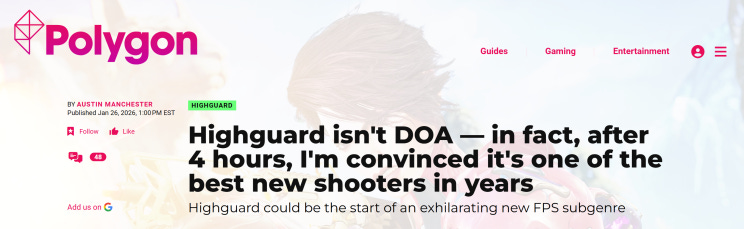
Once the game was in hands, the press tone stayed consistent. Polygon’s hands-on says it bluntly,
“Highguard freakin’ slaps.”
IGN’s “Review So Far” is similarly optimistic, calling out polished gunplay and a “trailblazing” mode, while still admitting it is hard to know if it will have staying power beyond the novelty.
ScreenRant goes even further, framing Highguard as one of the biggest surprises of 2026, and leaning hard into the “raid shooter” idea as a new subgenre.
Then, after launch, the same “discourse” framing escalated. IGN followed with a piece built around the idea that it had become trendy to hate on new games, and highlighted prominent developers coming to Highguard’s defense. Swen Vincke’s point, in particular, was that criticism can be honest without being personally hurtful, and he even floated a Metacritic-style scoring system for reviewers, based on how others evaluate their criticism.
All of that is empathetic, and I agree with the human part of it. But it also risks missing what players were actually reacting to. Even IGN’s own launch coverage lists concrete complaints, map size and emptiness for a 3v3 shooter, too much downtime in the gathering phase, lack of content, performance issues, and a “mostly negative” Steam review profile.
This is why I keep coming back to the gatekeeper shift. The press can still add context, but it does not set the default story anymore. The default story gets written by creator clips, community sentiment, and the aggregation layer that turns a moment into a narrative.
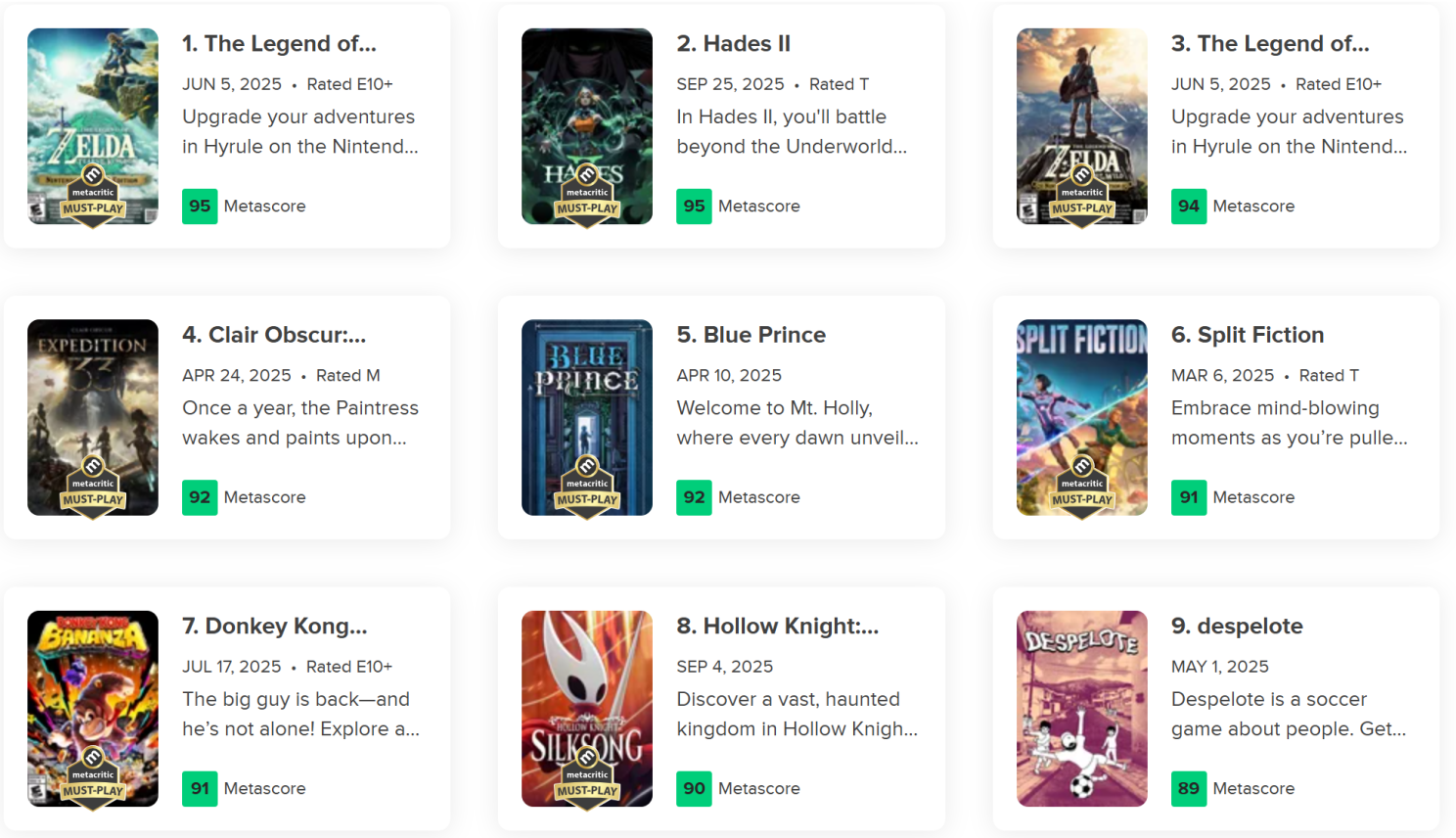
It also changes how I think about Metacritic, at least at the margins. Metacritic still has value, but in practice it often tells you as much about the machine behind a launch as it does about player outcomes. Review coverage is not evenly distributed across the tens of thousands of games that ship. It clusters around the games that have PR relationships, marketing budgets, and distribution to get review codes, previews, and attention in front of editors.
That does not mean anyone is being “paid off.” It means attention is scarce, and the games with a machine behind them are the ones that get covered, scored, and then aggregated into a Metacritic narrative.
I may do a full Metacritic breakdown later, but for now the point is simpler. Press coverage is not the same thing as demand, and demand is what determines whether a shooter gets a second session, or whether everyone quietly goes back to what they already play.
And that brings us to the layer that actually moves the needle fastest in 2026, the creator and clip economy.
Creators, Clips, And The Story That Sticks
This is where the market actually decides what is real.
It is also worth being honest about how the creator economy works. Creators are businesses. If Shroud, LIRIK, summit1g, or anyone else takes a sponsorship to play a game, that is not some scandal, that is the job. They are selling attention the same way a publisher buys ads.
In fact, in 2026, spending money here is directionally smart, because creators are the modern tastemakers for games, especially F2P shooters, but the real tell is what happens when the sponsored window ends. Do they keep playing anyway, on their own time, because the game is compelling, because the audience is engaged, because they personally want another session. Or do they move on immediately.
That dynamic is not moral, it is market-driven. For any creator, their audience is one click away from the next thing, so they follow what viewers want. If a creator spends too much time on a game viewers don’t want to watch, the viewership drops, the chat goes quiet, and the audience migrates to whoever is playing the thing they actually care about. You can feel it in the broader industry too, the “variety streamer” era has narrowed for a lot of creators, because attention concentrates, and the market pulls them toward whatever is hot.
Then you add the clip economy on top of the creator economy.
Creators generate hours of VOD and livestream content, but most people are not watching eight hours of Shroud. They consume it via osmosis. The 20-second clip. The one quote that feels true. The one moment that gets reposted across X, YouTube Shorts, TikTok, Reels, Medal and clipping accounts.
That is why the hierarchy matters,
creators generate the raw signal
communities decide whether it is worth time
aggregators like Jake Lucky (and outlets like Dexerto) turn it into the version that travels
A single aggregator post can rack up over a million views and become the default story for the game, while the original stream and the original article are both footnotes.
Shroud’s reaction is a clean example of how fast that story gets written.
“The vision is there, the FPS is not… the game’s gameplay is really good, it’s just poor performances… is a little rough.”
He also flagged a retention landmine that shows up in every input-split shooter discourse, perceived controller advantage.
“The first thought is controller is gunna decimate this game, we’re not gunna stand a chance on MnK…”
This is not “internet hate.” This is the market doing what it does, turning real player friction into a narrative that spreads faster than any trailer. And in a shooter market where the default move is “go back to what you already play,” that kind of clip does more than hurt sentiment. It reduces second chances.
At that point, you get the perfect capstone from another creator, videogamedunkey.
Because his punchline is not just a joke about Highguard, it’s a joke about the entire gap we’ve been describing, the press posture of “this slaps,” versus the player posture of “this feels rough,” and the way the reviewer ecosystem tends to grade everything on a curve.
The bit lands because it says out loud what a lot of the internet already suspects,
“This game is literally the worst piece of sh*t I’ve ever played in my life.” videogamedunkey: What would you give it out of 10? “9... 9.5”
That line got clipped because it’s clean, it’s cruel, and it compresses a whole debate into five seconds.
What We Should Learn From This
If you strip away the noise, I think the lesson for Highguard (and honestly, for any new shooter in 2026) is pretty simple.
Stop trying to cosplay 2019.
The Apex Legends surprise drop era was a specific moment in time, and it was backed by a scale of budget and coordination that most teams simply do not have. Trying to “buy Twitch and go dark” without pre-launch momentum is how you end up with a spike that disappears.
What works now, over and over in our data, is inviting players in early and letting the community help you shape the game.
If Highguard had framed this launch as an open playtest, an alpha, a beta, early access, whatever label you want, two things change immediately.
First, you get permission to be unfinished. Performance issues, balance complaints, input-feel debates, all the friction that becomes fatal when you call something “launch,” become expected when you call something “test.” Players still complain, but the tone shifts from “this sucks, I’m out” to “this could be great if you fix X.”
Second, you get the thing Highguard never had pre-launch, an invitation into community. A test is an excuse to join a Discord, to submit feedback, to clip moments, to feel like you have some ownership in where the game goes.
That’s how you start building an on-ramp into the castles that dominate a power-law shooter market. You’re not defending a moat, you’re trying to penetrate the gravity of the forever-games by chipping away at the three switching costs that keep players where they already are.
Time: they get better, learn maps, build muscle memory.
Money: they invest over time, battle passes, cosmetics, DLC.
Friends: a squad forms, and leaving means leaving your people.
Even then, it’s a risky bet. As we showed up top, this market barely moves year to year, and switching behavior is brutally hard. But if you’re going to try, this is the playbook that actually gives you a shot, repeated access points, real feedback loops, and a community that feels like it’s building the game with you.
This is the playbook that works. Look at Battlefield 6, Marvel Rivals, and Arc Raiders.
Each put the product in players’ hands early, let the market feel the “glimmer,” then used feedback loops to compound momentum into launch. None were perfect in their test windows, but the community bought into the journey.
If I had to boil it down to one sentence for teams trying to ship a shooter right now,
Don’t ask players to believe in your launch, ask them to help you build it.
I still see a possibility for Highguard to survive in the market, and that is that, somehow, the developers keep the game going for a few more months, commit to their roadmap, and hope that, if the game is fun, it slowly builds community.
There's been games that started off dead and then somehow revived, not to the levels of Marvel Rivals, but decent enough to be a game worth keeping up. All it takes is a few viral clips online for people to say "hey, this actually looks fun".
Although to be fair, I have seen some gameplay and it does not look particularly fun or special to me.